Monthly Archives: December 2009

Note to Obama

Obama is having his jobs summit today; in fact it may already be over.  In the spirit of wondering how to create more jobs, I noticed that Krugman has a solution:

Meanwhile, the federal government could provide jobs by … providing jobs. It’s time for at least a small-scale version of the New Deal’s Works Progress Administration, one that would offer relatively low-paying (but much better than nothing) public-service employment. There would be accusations that the government was creating make-work jobs, but the W.P.A. left many solid achievements in its wake. And the key point is that direct public employment can create a lot of jobs at relatively low cost. In a proposal to be released today, the Economic Policy Institute, a progressive think tank, argues that spending $40 billion a year for three years on public-service employment would create a million jobs, which sounds about right.

That got me to thinking.  There are currently about 15.7 million unemployed people in America.  Almost all are receiving some form of unemployment benefits.  How about instead of spending $40 billion a year for 3 years like Krugman says, we just make these people do the work he is suggesting and call ’em jobs?  Why would we create a program to offer “relatively low-paying” jobs for people to work when we already have a program that offers “relatively low-paying” jobs where people have to do–NOTHING!?

Krugman.  Sheesh.

Hat tip:  Forbes

California: Part III

Water water everywhere.  And not a drop to drink.

Sounds like California is thirsty:

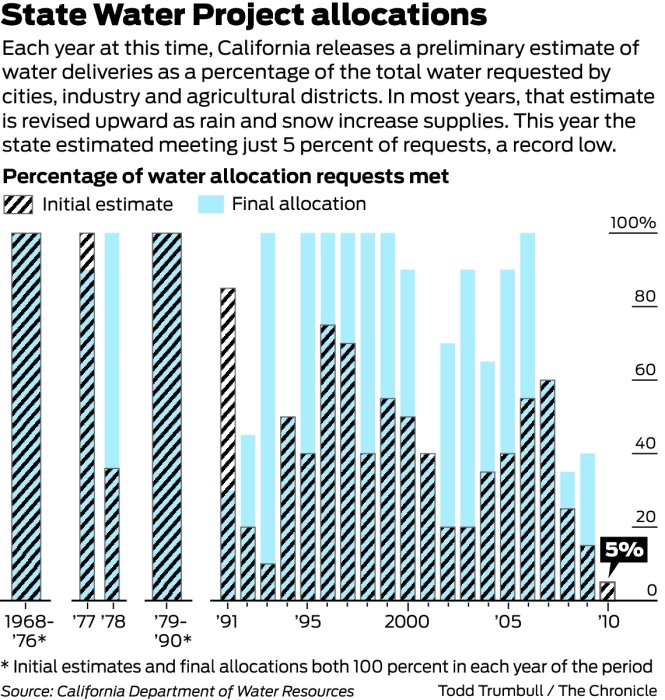
Operators of the sprawling state system that supplies water to 25 million Californians from Butte County to San Diego issued their lowest-ever estimate on the amount of water they will be able to deliver.

Officials predicted Tuesday they will be able to offer only 5 percent of the total volume of water requested by California cities and farms next year. That’s the smallest water allocation the agency has released since its creation in 1967.

Government in Action

That’s quite a gap.  Now, to be fair, you can see in the chart above that there are years in which the water allocations eventually meet 100% of the need, but more than often, they don’t.

Makes you wonder why this is, right?  I mean California should have plenty of water to supply their need.  Why are they so short so often?  What could possible cause a shortage in a specific commodity?

Well, I just finished a fantastic book:  Basic Economics by Thomas Sowell.  And it just so happens that Mr. Sowell does indeed talk about shortages and what causes them.  One word:  Regulation.  For example, have you ever noticed that it always seems the grocery store is out of Coke when you go to buy some?  Or that gas stations always seem to be empty when you need to fill up?  I know I know.  Every time you go to buy a pair of sunglasses, there are none available?  Huh?  Never happens?  Wanna know why?  Because no one is regulating the price of these products.  They are selling at a price the market can bare.  And so supply is nearly always available.

Now, if I told you that Wal-Mart was going to be selling Coke 6-paks for a dime starting at 6pm tomorrow night, what do you think the scene would be?  Packed initially and then finally, they would run out.  They would run out when under normal circumstances, they would have a predictable supply for anybody to come and buy as much as they need/want.  And why doesn’t someone come in and buy all of the supply of Coke now?  Because the marginal cost of Coke dictates that we won’t waste or hoard it.

So, again, what cause a shortage?  Regulation; specifically the imposition of a reduced price when supply remains fixed.  So, why do you think that California State Water Project has problems meeting 100% of need?  Because they are regulations in place that reduce the cost of water for significant portions of the population:

In 2002, the average price paid for irrigation water from the CVP (Central Valley Project-An agricultural district) was less than 2 percent of what residents of Los Angeles pay for drinking water, and less than 3 percent of what residents of San Francisco pay.

What does this mean?  It means that farmers can grow crops in regions where those crops wouldn’t normally grow because it’s too dry.  But because they are getting water at less than the market rate, these farming practices are continued and water is going where it wouldn’t otherwise go.

The lesson is simple, if you want there to be a 6-pak of Coke at the local Wal-Mart, you better hope that it’s expensive enough to be there.

OJT: On the Job Training

Barack Obama.

You know it’s bad when the far left begins to give you economic advice:

Liberal Democratic lawmakers, including the Congressional Black Caucus, are unhappy with the Obama administration’s pace of efforts tackling the unemployment rate, which is a whopping 10.2 percent and expected to rise.

The CBC, in particular, say Obama officials have not done enough to address the severe economic problems in the black community. Rep. Maxine Waters, D-Calif, reportedly issued a warning Wednesday that the 43 members of the caucus are planning to vote with the GOP to derail a number of Democratic bills if it isn’t addressed.

However bad it is for Obama this, at least, is encouraging:

Labor support is more in favor of funding labor projects, in terms of public works, putting more money into the states and cities but the White House is concerned about the deficit.

Finally.

Barely Legal

I was thinking about this last night as I was posting on the “Night is Day” thing:

All eight initiatives were the result of a series of private meetings in the past month between the four new members and the new board chairman, Ron Margiotta. Those meetings also included members of private groups that Margiotta declined to identify. Members of the new majority defended their private meetings, saying they didn’t violate state mandates because they had yet to be sworn in.

Look, I get it.  The old Board did things, and in ways, that some people didn’t like.  Because of that, the election process removed them from their seats and gave new people with new voices the ability to shape things.  That’s ho it’s supposed to work.  I’m very happy that it did work.

But these shenanigans are really really over the top:

Malone said they met before Tuesday because heading into the meeting unprepared would have sent their supporters a bad message.

“It’s not illegal,” Malone said. “We needed to be prepared. I had nightmares about walking into the meeting not being prepared.”

It’ll be fun to continue to watch this.  Fun to see if anything really changes.

Where Red is Blue and Blue is Red

I have been following the WCPSS drama for nearly three years now.  Besides the pure raw emotion poured into this debate, the shocking role reversal has been astounding.  Now, you would be hard pressed to find anything more local than a school board; perhaps a Home Owners Association or maybe a PTA board, but really, for all intents and purposes, the local school board is as close to the people as government is going to get.  And with that in mind, the folks involved, on both sides, really do try and give the appearance that they are not affiliated with any major political party.

But they are; they all are.

The support and the money breaks too neatly down party lines for it to be ignored.

All of which gives me a moment’s pause.  You see, when it really comes down to it, we have conservatives acting like liberals and liberals acting like conservatives.   And I say that from a conservative view-point.  See, normally, we on the right are acting from a standpoint of Liberty and freedom.  But here, the Republicans are acting like they can ignore such things.  For example, given two quotes, tell me which is the conservative and which is the liberal:

Politician One:  “We have to do something and move forward,” Politician One said. “Parents have a right to decide if they want a year-round school.”

Politician Two:  “If we’re talking about doing away with year-round schools, we’ll have to raise taxes,”

See what I mean?  You can’t tell.  You can’t tell because you know what the answer SHOULD be, but because I have been ranting you feel suspicious.  In this topsy tervyy world that is WCPSS, you have conservatives claiming they have a “Right” to select the location of their public education and you have a liberal resisting a tax increase.  Amazing.

California: Part II

A lot of talk going on about projections and what ifs.  So much so, that for many of us, we begin to lose sight of  “what is” within the forest of  theoretical science.  Sometimes, really, a picture is simply worth a thousand words.  Or maybe, a picture is not having to read a thousand words.

Who get's it? Who doesn't.

Why, you may ask, is the unemployment rate so much higher in California than in Texas?

What’s the worst state to do business in? According to readers of Chief Executive magazine, it’s California. In the same poll, Texas won first place as the best state in which to put your headquarters. As reported in The Economist, the two largest states in the nation have very different philosophies and very different success rates.

The article goes on to mention why Texas is doing a better job:

  1. Texans on average believe in laissez-faire markets with an emphasis on individual responsibility.  Since the ’80s, California’s policy-makers have favored central planning solutions and a reliance on a government social safety net.
  2. Californians have largely treated environmentalism as a “religious sacrament” rather than as one component among many in maximizing people’s quality of life.
  3. California has placed “ethnic diversity” above “assimilation,” while Texas has done the opposite.
  4. Texas has focused on streamlining the regulatory and litigation burden on its residents.  Meanwhile, California’s government has attempted to use regulation and litigation to transfer wealth from its creators to various special-interest constituencies.

The whole article is an awesome read as a “how to guide” for planners.  It would be great if Barack Obama would read it.

Hat Tip Mark Perry and Rick Perry

Powerful Hurricane Set to Hit North Carolina

Do you remember the hurricane that made landfall onto North Carolina beaches this past July?  Uh, no?  Maybe August then?  September-October-November?  Yeah, me either.  Wanna know why the mainstream media didn’t report any of those storms hammering the Carolina coast?  Cause we had the quietest Hurricane season in 10 years.

SAVANNAH, Ga. — The Atlantic hurricane season ended Monday with barely a whimper: Not a single hurricane came ashore in the United States.

Since June, when the season began, just nine named storms developed. Only three of them became hurricanes, and those stayed out at sea or weakened before passing over land.

Two tropical storms made landfall in the U.S., causing little more than rain and some beach erosion.

It would seem that with a vanishing hockey stick, record cold and dampening of the powerful tropical storm season that we should finally be able to make some progress in combating the Climate Alarmists.

Prolly not, see, CO2 changes climate of which can appear all kinds of different symptoms.  Including cooling and lessening of storms.

Politics: Always the Same

The new members of the Wake County school board were sworn in last night.  Immediately changes began to take place.  And yet for all the change that was occurring, sadly, it all remained very much the same.

Before a packed, mostly hostile audience, the new group made ad hoc additions of major items to the agenda. That drew heated public comment from those opposed to the newcomers’ actions, a shocked reaction from members who now make up the board minority and a walkout by a group representing Wake teachers.

I feel like I’ve been punched in the mouth,” said Keith Sutton, a member representing East Raleigh.
Nothing to See Here; Move on

This time, instead of the families supporting neighborhood schools feeling left out, it’s the families supporting the diversity policy that are feeling left out.  Nothing, really, has changed; only that the other team has the ball and is driving.

One of the complaints against the old board was the fact that they often wouldn’t reach out to the public on policy issues:

The board quickly took up the district’s diversity policy, which uses busing to ensure balanced populations at each school. Once based on race, those calculations have relied on the poverty of students’ families since 2000.

However, no copies of the proposal on changing the diversity policy were given to members of the public before they were voted on. Instead, an overhead projector showed a copy with the phrase “creating and maintaining a diverse student body” with a line through it. The move to change the policy was sent to committee.

Apparently the information was not only withheld from the public, but from some of the board members as well:

“I like to study the things that I am going to vote on, but this is an unusual evening,” said member Anne McLaurin, a member of the board’s new minority. “I find this an interesting proposal, but I don’t feel prepared to vote on it without further information.”

Said ousted chair Kevin Hill about the last-minute resolutions: “To me this is a process that is very new to the school board, where essentially half the members are not privy to information prior to the meeting.”

And the battle between board and public is still very much of a “We vs. They” kind of thing; complete with threats:

“Please be quiet or we’re going to ask you to leave,” Margiotta told the audience. “Don’t make an arena out of us.”

When Margiotta’s remarks drew laughs, he threatened to ask security to make the crowd leave.

Look, there are a LOT of things that a school board can impact and I really am hopeful that this new board can make improvements.  Obviously, when it comes to strategies I am in favor of anything that encourages strong fiscal restraint.  I support any attempt to weaken organized teacher unions or representation organizations.  I like merit based pay for teachers.  But to be honest, the overwhelming issue that faces this board has been the combination of the Diversity Policy and the Year Round schooling; both of which I am in favor of.

Clearly something new occurred at last night’s meeting.  But just as clearly, nothing changed.

Don't Be a Turkey: Czar

Really.  All ya’ll.  Just get out of the way and let people make decisions that reflect their best interests.  If you do that, wonderful wonderful things will happen.  All by themselves!

Like in previous years, you probably didn’t call your local supermarket ahead of time and order your Thanksgiving turkey this year. Why not? Because you automatically assumed that a turkey would be there when you showed up, and it probably was there when you showed up “unannounced” at the grocery store to select your bird.

The reason your Thanksgiving turkey was waiting for you without an advance order? Because of “spontaneous order,” “self-interest,” and the “invisible hand” of the free market – “the mysterious power that leads innumerable people, each working for his own gain, to promote ends that benefit many.” And even if your turkey appeared in your local grocery stores only because of the “selfishness” or “corporate greed” of thousands of turkey farmers, truckers, and supermarket owners who are complete strangers to you and your family, it’s still part of the miracle of the marketplace where “individually selfish decisions lead to collectively efficient outcomes.”

The entire process of raising turkeys for slaughter is timed so that a huge demand is met with a huge supply, but not TOO much of a supply.  And nobody, not even ONE body, is in charge of making it so.

The Law of Supply and Demand is Proven Again!

If we ever had any doubt, there is a new real world example of the law of supply and demand:

Raleigh, N.C. — Home sales in the Triangle area shot up 44 percent in October from a year ago, but the good news was offset by a 12 percent decline in sale prices.

As prices decrease, demand increases.  Very soon, if left to its natural devices, the housing market will be dangerously close to equilibrium.

Oh, yeah.  About that pesky decline in sale prices?  Yeah, 2000+ families have now found buying a home affordable.

New and existing property sales hit 2,009 in October, up from 1,397 a year ago, according to the North Carolina Association of Realtors.

Go capitalism!