Category Archives: Economics

California Budget Cuts: Inevitable

California Is Broke

It’s not even really a question at this point anymore.  California doesn’t have any money and is losing more every year.  In fact, the situation is getting worse and not getting any better, it’s not even slowing down:

California’s budget deficit will swell to nearly $7 billion greater than expected due to weak tax revenues and slow progress in cutting spending, Governor Jerry Brown said on Saturday.

Brown said the shortfall for the state’s 2012-2013 fiscal year now stands at $16 billion, up from a previous estimate of $9.2 billion made in January.

“We are now facing a $16 billion shortfall, not the $9 billion we thought in January,” Brown announced in a video posted on YouTube. “This means we will have to go much further and make cuts far greater than I asked for at the beginning of the year.”

There’s little reason to believe that this trend isn’t going to continue.  Individuals from California earning incomes in the top 1% are delivering less and less tax revenue:

In 2007, the top 1% of California earners paid about half of the state’s income taxes. Now it’s around 37%

Is this because salaries are dropping for the very rich or is it because they are leaving the state?  It’s hard to say.

Revenue Or Spending

Whatever the reason, the top 1% are no longer the cash cow they used to be.  Going from 50% to only 37% is going to massively impact balance sheet.  But is that the only cause for California’s current condition?  Not at all.  Committed spending on public pensions is also to blame:

(Reuters) – A radical plan to slash public employee pension benefits gets voted on by the residents of Silicon Valley’s San Jose on Tuesday – a decision that could set an important precedent for many other cities, not only in California but across the nation.

The nation’s 10th-largest city is also one of the wealthiest, but over the past several years it has cut its municipal workforce by a quarter, laying off cops and firefighters, shuttering libraries and letting street repairs fall by the wayside.

The problem? Mayor Chuck Reed says it’s simple: Retiree benefit costs eat up more than a quarter of the city budget – and are growing at a double-digit rate.

So, the mayor has identified a problem specific to San Jose.  Is this systemic across California?

Public finance woes are nothing new in California. The state budget deficit stands at an estimated $15.7 billion for next year, requiring further cuts in state services and, if Governor Jerry Brown has his way, higher income and sales taxes. Local governments and school districts have struggled for years to make ends meet.

The pension problem, though, may be the mother of all budget issues – for California, for its cities and counties, and for other states and municipalities across the nation. The main California state retirement systems have a total shortfall in pension-plan funding of close to half a trillion dollars, a Stanford University study estimated. The bill is not due at once, but payments on it grow steadily and can eventually squeeze out even basic services. Public officials like Reed, and academics who have studied the issue, say the day of reckoning is nigh.

Yes.  California has created a condition that is set to consume public budgets very soon.  In efforts to pander to the unions and the public employees, the state and her cities have engaged in reckless commitments that is has no hope of meeting.  There is only one solution in sight:

The solution he is pushing at the ballot box, after city council approval, would slash benefits for workers, increase employee contributions – and almost certainly prompt a precedent-setting legal challenge from the public employee unions.

“The best metaphor is cancer,” said Reed, a Democrat known as more of a technocrat than a firebrand, who is now cast as public enemy No. 1 by public employee unions. “It started a long time ago, it goes for a long time, and then it becomes life-threatening.”

Of course that’s the solution.  California is already taxing her people so much that the freakin’ Buffalo is puking*  I don’t know how much of a leftist/statist individual Governor Brown is out there in California, but if he’s at ALL interested in fixing his state he should gaze east and look and see what a government can do as exemplified in Wisconsin.


* This is an old reference to someone who is so cheap in the days when the buffalo adorned the nickel.

Minimum Wage And Rent

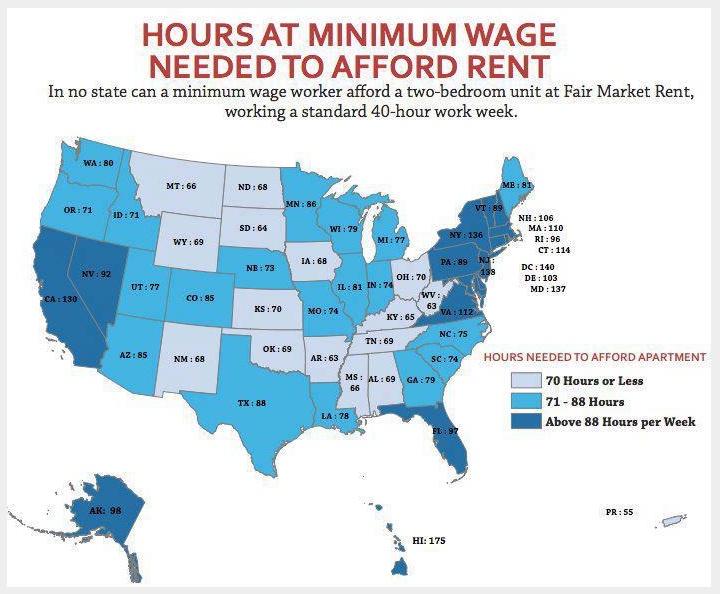
The image above is making its way around the internet and for me, Facebook.  The idea, of course is to make the point that someone making minimum wage isn’t able to afford even rent, much less eat.  However, the chart fails to examine some deeper truths about minimum wage:

  1. Very few Americans work at minimum wage.  And the vast majority of them that do live in homes with other wage earners making significantly more.  Examples include teenagers and spouses of primary bread winners.
  2. Minimum wage earners should not be in the market for 2 bedroom units without a roommate.  For many years I bunked up with a friend.  At times even two.  In fact, there were times I slept on the couch or floor of a buddy until I could make ends meet.
  3. Minimum wage earners almost always make more than the minimum wage very quickly.
  4. By raising the minimum wage, the marginal employee will make the REAL minimum wage – $0.00

To be sure, we all want an environment where anyone who wants work can find work.  But we have to agree that we live in a world where people bring different levels of value to the table.  Further, that these people travel a graduation of value.  We start out with no work experience and are compensated poorly.  As we grow in experience and knowledge, our productivity rises and our compensation likewise increases.  By changing this, the only thing that will occur is less employment.

Free Market: Airplane Style

How many times have I been flying and need to get off that plane to make my gate?  Plenty.  And how many times did I muse, “I’d pay $50 to be that first guy off?”

Again, plenty.

And, as is the case with me, I began to imagine a world where the seats in a plane could be offered on the open market.

Continue reading

We Spend More On Healthcare Than…..Bug or Feature?

The arguments have been going on as long as we’ve had modern healthcare.  On one side we have those that claim the United States spends more on healthcare, with worse results, than any other industrial nation on earth.  Therefore our system is broken.

The other side claims that the ability to spend more on healthcare may be an indicator than our system is the BEST in the world.

To be sure, no one wants to have to spend $550.00 a month on medication when we could craft a system that delivered the life saving pills at a tenth of the price.  Spending money for money’s sake is silly.  But our levels of expenditure are elevated because the medical care system is, quite simply and without debate, the best in the world.

Just ask Mr. and Mrs. Baker.

Continue reading

Austerity In The EU: Myth?

All we hear from the left is that austerity programs in Europe are causing the continued problems over there.  I posted on Monday that the austerity” the left is bemoaning doesn’t exist:

It would seem that with the exception of Greece, there is no European austerity “problem.”  Europe seems to be growing their government just fine and just as they’ve always done.

The problems experienced in Europe right now are not the result of reduction in spending.

Loyal reader Scott called shenanigans:

You have to look at 2011 and especially2012, you’re only going through January 2010, that’s before talk of austerity budgets really took hold. Hollande was talking about real aspects of the EU pact and Sarkozy’s plans — none of that is captured in data that go through January 2010.

So, in order to dig deeper, I’ve gone and found data for the entire EU, in Euros though 2011.

And the new data doesn’t change the point I made earlier in the week.

Continue reading

European Austerity: A Myth?

France will have a new President.

Yesterday in France, the Socialist Francois Hollande defeated the sitting French President:

…Hollande defeated centre-right incumbent Nicolas Sarkozy on Sunday…

It seems that the President-elect ran on a platform of austerity-rejection:

Hollande has promised more government spending and higher taxes — including a 75-percent income tax on the rich — and wants to re-negotiate a European treaty on trimming budgets to avoid more debt crises of the kind facing Greece.

I’ve always believed the left when they claim that Europe is undergoing a time of “fiscal austerity.”  Then I bumped in Coyote, who questioned it:

It is almost impossible to spot this mythical austerity beast in action in these European countries.  Sure, they talk about austerity, and deficit reduction, and spending increases, but if such talk were reality we would have a balanced budget in this country.  If one looks at actual government spending in European nations, its impossible to find a substantial decline.  Perhaps they are talking about tax increases, which I would oppose and have been occurring, but I doubt the Left is complaining about tax increases.

Seriously, I would post the chart showing the spending declines but I can’t because I keep following links and have yet to find one.  I keep seeing quotes about “commitment” to austerity, but no actual evidence of such.

So, I thought I would look.

Continue reading

Capitalist Pigs

If you listen even just a little, you can pick up on one of the main complaints against the medical care delivery system here i the United States.  That the whole system is doomed to fail because we allow greedy asshole pigs to profit off the medical needs of our citizens.  For some reason, the fact that this doesn’t apply to food or clothes is a point that’s missed by those that scream we must nationalize health care.

The fact is this, when exposed to market forces, blueberries and shoes become less expensive and come with higher and higher degrees of quality.

I stopped by my local “Grocery Barron” outlet and was amazed to see this new advertisement.

The grocery store market is offering drugs that “cures” high blood pressure.  The cost?  $3.99 a month.  By the way, hypertension is the single #1 killer in the United States.  Number one.  Cured, blammo, for the crazy cost of 4 bucks.

After that is the program for diabetes medication.  The cost?

Nothing.

That’s right; free.  Diabetes medication carries no cost to the consumer.  The greedy bastards are offering life saving medication for free in the hopes that you’ll just come in a shop.

But wait, there’s more!

For the low low price of NOTHING you can now get antibiotics as well.

Blink.  Blink.

All of this will be delivered to you in less than 15 minutes while you shop in  conditioned warehouse for berries from Chili, chocolate from Switzerland, wine from France and sushi fresh from the sea.

Bastards!

The Evils Of Oil Speculation

The price of oil, and perhaps more accurately, gas, has been steadily rising during  the last several months.  All kinds of people have all kinds of reasons for this but one of the common themes has been the impact that oil speculators have on the market.  Many on the left are calling for legislation that would limit the ability of people to speculate on oil:

Experts have been clear: Wall Street speculators are artificially driving up the price at the pump and causing pain to millions of American consumers.

Now others have a different view of the impact that oil speculators play:

But economists and traders cautioned that pushing smaller investors out of markets would only hand greater influence to the largest hedge funds and Wall Street banks. Ultimately, there may not be enough traders left to do business with oil producers and consumers looking to hedge their needs.

“Reduced liquidity often means greater volatility,” said broker Jay Levine at Enerjay LLC in Maine.

So let’s compare.  Let’s take a look at an example of a commodity that prevents speculation and compare it to oil.

Continue reading

Tax Revenues Year Over Year

Did you know that there are two ways to increase revenues generated from taxation?

If you’re liberal, we’ll forgive you for not knowing very much about things like economics:

You can either increase the rate at which you tax the population or you can increase the amount of money the population has.

One of those things results in bringing in more money to the federal government.  The other results in being labelled a class warrior.

I just posted that the federal government is set to receive a 6.51% raise.  And with the updated numbers I can understand that the government is upset with its raise.  After all, since 1941, the average increase in revenues to the federal government is a healthy 9.54%.  Even going back to a much more recent 20 year history we are seeing a 4.14% increase, and that’s including the negative 16.60% turkey we saw in 2009.

The fact is this, if you wanna increase revenue, then focus on increasing revenue.  Grow the economy, embrace business and celebrate capitalism.  On the other hand, if you wanna use the tax code to redistribute wealth in the name of raising revenue, be honest about that.

Taxes: The Left Wins – I Lose

I have been waging a continuous war on taxes and increasing them.  I personally think that the best way to cause our elected officials to reduce the size of government is to reduce the amount of money we give ’em.  Those on the left feel that the best way to balance the budget is to INCREASE taxes.  Now,  unless they are pure Marxists who simply will not accept any other form of economic structure than that of transferring money from the wealthy to the poor, what my friends are saying is that we need to increase taxes to increase REVENUE.

The more money IN, the better off the budget/deficit will be.

Sadly, for the second year in a row and for the last 24 out of 30 years, the left has succeeded in growing revenue.  In 2011 the United States Federal government will have taken in $2.3035 trillion.  This represents a 6.51% increase year over year 2010.

If I’m lucky I can achieve my goal of shrinking government in 2012 but it doesn’t look good.  The Tax Policy Center is calling for a 2012 tax receipt increase of  $165.1 billion in 2012.  And it only looks to get worse year over year after that.

Sigh.