Category Archives: Economics

The Mandate And The Cost Of Insurance

Let’s set aside the debate on whether or not the mandate represents a penalty or a tax.  In many ways, it doesn’t matter; the bill was made law, the law was challenged and the law remains the law.

A question occurred to me as I was watering failing to save my flowers Saturday:

Given that individuals are offered the choice of purchasing health insurance or paying a penalty, and that penalty is paid to the federal government of the United States, what will this do to health insurance premiums?

The answer is, of course, “Insurance premiums will go up.”

Individuals will make a value based decision on whether or not to purchase insurance or pay the penalty/tax.  The problem comes into play when you consider that the organization making the determination, and receiving the money, of how much that penalty/tax will be is NOT the same organization that is required to insure people who decide not to purchase insurance.

In short, the insurance company has to cover uninsured individuals while the government keeps the penalty/tax.  What this means to the insurance companies is that they have to cover uninsured people for free.  And since coverage of medical costs isn’t really free, they will have to raise the rates of everyone to cover those costs.  As those costs rise, more and more Americans will conduct value propositions and conclude that purchasing insurance isn’t worth it.

And costs will rise.

And costs will rise.

And costs will rise.

Equality: Perfectly Providing Equal Opportunity

What if we could, with perfection, create a nation that provided equal opportunity?

Whatever that may mean to you, suppose it’s true.  Every kid has the same chance to get to a good school and graduate from it.  College?  Available to all.  While not important to this conversation, we could say that college could be free.  There would be no need to worry about poor families being unable to send their bright children to the hallowed halls of higher eduction.

Poverty create hurdles due to inability to buy books, electricity or heat?  Gone.  We’ll adjust for it.

Any problem you might have that produces unequal opportunities has been answered.  To your individual liking.

Everyone has the same chance.

Question:

What characteristic or quality would determine who succeeds?

We Are All Investors

A recent post over at Poison Your Mind got my attention.  In it, nickgb ponders the assertion that we are all investors.

…I had a much different outrageous pull-quote to emphasize:

Romney’s opponents seem to be aghast that he has made money for investors (aren’t we all investors?), though they studiously ignore other greed-less facts: He never took a dime in salary for heading the Olympics in Salt Lake City nor as governor of Massachusetts, to mention a couple.

Those latter sentences are pretty stupid, because obviously Romney received gains from both of those ventures (both in reputation and financially). But aren’t we all investors? Who says that? Who still gets credit as a journalist after saying something like that?

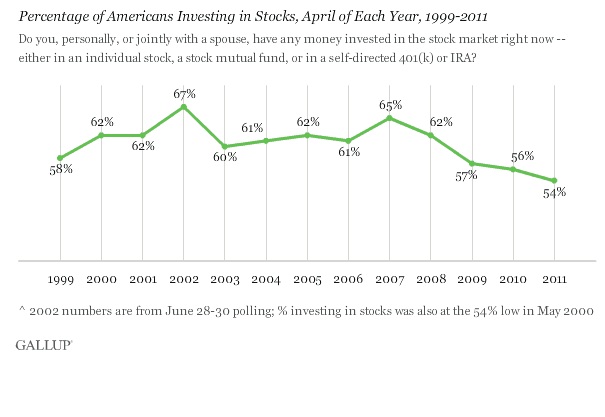
So, I thought I’d take the bait and look into  how many of us are investors:

Not many.  At all.

In fact, the rate is depressingly low.  And even if we excuse the low number due to the economy the highest we’ve been is 67% back in 2002.

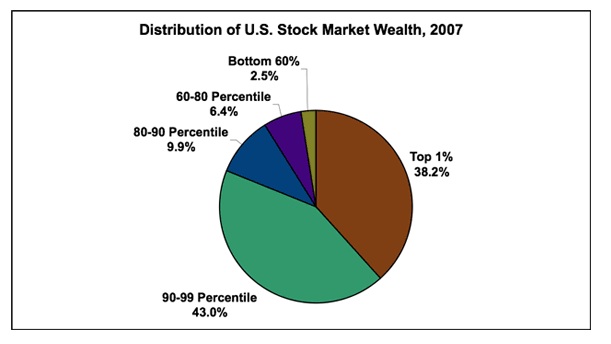
Before I could post this data, however, reflectionephemeral beat me to the punch.  The data he posted is below:

A revealing bit of data to be sure.  One more in the collection of charts that show the distribution of wealth is skewed.  However true that may be, the chart directly above doesn’t speak to investment participation.

At first I was struck by nickgb’s critique of the article, surely no one expects the reader to think that literally ALL of us are investors, but then when I saw the graph by reflectionephemeral, I was more struck by the thought process that would cause one of us to show data that explains the unequal distribution of wealth as the unequal distribution of risk.

Is it possible that as we all discuss this thing we call politic that we have failed to establish basic assumptions, have failed to agree upon a basic set of accepted bedrock givens?

I have full faith that the fellas over at PYM have the best interest of “folks” at heart.  I like to think that I do too.  Why is it that the two of us would take so different paths in responding to nickgb?


Employment: SES Impact – The Bell Curve

I’ve been posting data that comes from the book “The Bell Curve” in a rather chapter by chapter format.  I started with Poverty and then moved to Education.  This post deals with Employment.

I should mention that the data discussed comes from a study the authors use throughout their book.  They have decided to use this data because of the size, scope and amount of relevant data points gathered.  That study is The National Longitudinal Survey of Youth [NLSY].

From the book:

The NLSY is a very large [12,686 persons], nationally representative sample of American youths aged 14-22 in 1979, when the study began, and have been followed ever since.

In the beginning chapters of the book, the authors use the NLSY extensively.  However, the work that they have done and the results being shown in these early chapters are the result of including only non-Latino whites in the analysis.  I’ll explain the authors reasoning in following posts – or you can go ahead and read it for yourself 😉

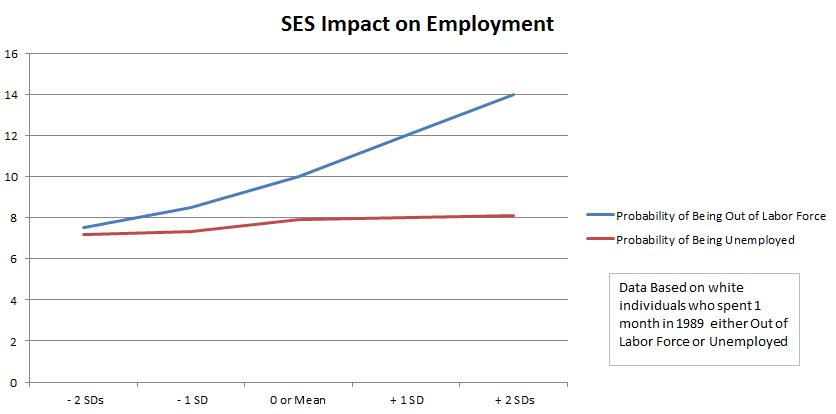
The next sets of data will show the impact that the socioeconomic status of the individual’s background has on employment and unemployment.  First, let’s take a look at the probability that an individual has of being out of the labor force for at least 1 month in 1989:

Interesting curve.  In all the data we’ve seen so far, the curve is to the advantage of the more wealthy households.  In this case, the probability of leaving the labor force goes up as a kid’s parent’s wealth grows. *

Now, let’s look at the same group of folks in the same year but instead of being out of the labor force, let’s measure unemployment:

Virtually straight.  It really doesn’t matter how wealthy your background is when predicting unemployment.

The impact of SES on the employment and/or unemployment of individuals is hard to gauge.  I’m guessing that with further context it’ll make more sense.

* The authors felt this was strange; I don’t.  Rich kids can afford not to work.

Update To Education

On Monday I posted on the impact of parental socioeconomic status as it pertains to their children’s educational outcomes.  In reviewing the post I failed to display 1 of 3 findings the authors made.  I think I did this because the data failed to demonstrate a point that I will be anxious to make in future posts regarding the book.

I will post now the data that speaks to kids who drop out of school only to later come back and earn their GED instead of obtaining a high school dipploma.  The graph is here:

As you can see, SES has a large impact on whether or not a child obtains a GED or stays in school to earn her high school diploma.  The wealthiest families generate graduates 9x more often than the poorest families of kids who drop out but come back to earn either their GED or diploma.

Education: Socioeconomic Impacts – The Bell Curve

Last week I posted on the impact that socioeconomic status had on childhood poverty.  I don’t think anyone was surprised to see that children who come from parents/mothers with a lower standard of living have a greater chance of growing up poor than children whose parents/mother had a higher standard of living:

The data is hard to argue with.  The “well off-ness” of the parents seems to have a powerful impact on the chance of poverty of a child.

The book continues this investigation as it relates to education, both high school and college.

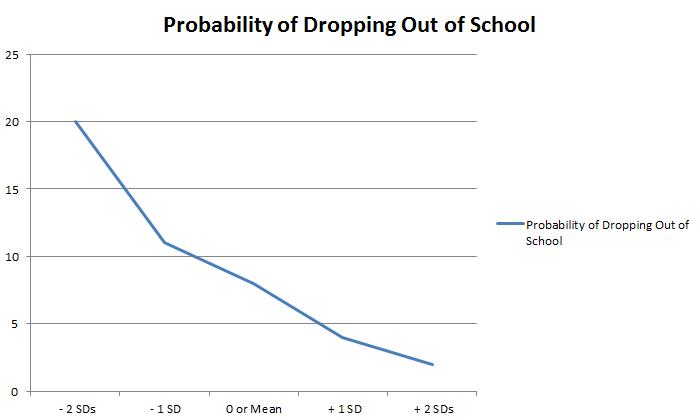
First, the authors discuss high school and the rate of drop-outs.  That is, what is the probability of a kid finishing high school?  And they took a look at this through the lens of the socioeconomic status of the child’s parents.  Again, the scale is broken into 5 parts; the median is in the middle and from the center the scale moves on by 1 standard deviation and then another.

When everything else is held constant, the probability of dropping out of school based on the socioeconomic status of the parents looks like this:

The data is striking.  Kids from poorer households dropout of high school a very higher rates than kids from wealthier households.  If you look at the extremes, the poorest kids drop out at a rate ~10x as high as the kids from the wealthiest households.

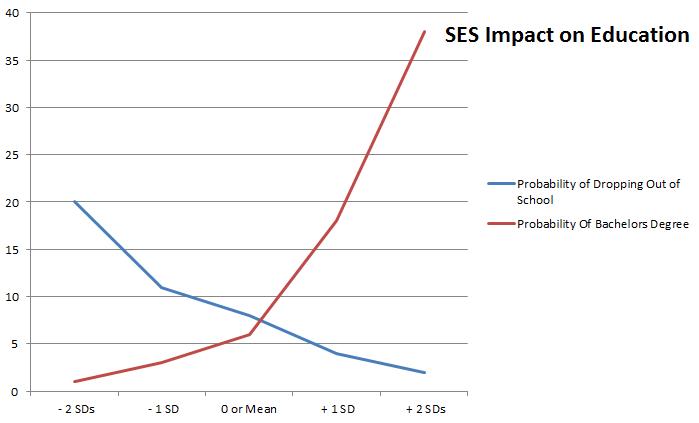
Now take a minute and consider college education and obtaining a 4 year degree.  Consider what you might expect the data to show.  If the data is consistent with our previous peeks into the impact that SES has on aspects of kids, we might make a pretty good guess.

Here’s the data:

Just as we might expect.  The role of the socioeconomic status of the parents is a powerful one for kids who wanna obtain a college degree.  Everything else being equal, there is almost no chance that a kid coming from the poorest families will achieve the the thrill of obtaining a diploma while the same kid from our wealthiest families has near a 40% of graduating.

As we close this section I’m struck by two things:

1.  Even our richest families are producing college graduates at a less than 40% clip.

2.  The wealth of a kids family continues to play a powerful role.

Poverty: Socioeconomic Impacts – The Bell Curve

I’m reading “The Bell Curve” and am finding the book fascinating.  As I mentioned in my previous post on this topic:

That attaining wealth is more and more becoming reserved for the pre-existing well to do’s.

For a long time I’ve fought this belief.  I’ve fought the idea that America is not the land of opportunity.  That we’ve somehow lost the idea that if you work hard enough you can do anything.

I’ve fought it.

And now I’m reading a book, The Bell Curve, and I’ve seen some interesting data.  For example, it seems to be important where you come from if you wanna avoid poverty:

As I continue to make my way through the book, there is good data that reinforces the above statement.  Namely, where you come from, or who you are born to, impacts where you will end up.  Consider the white population:
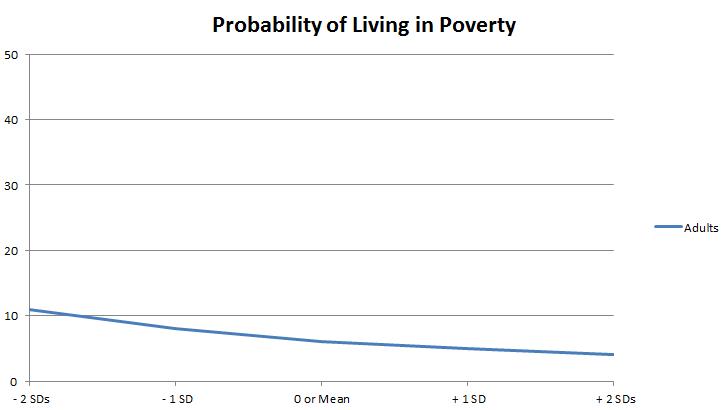
I can only estimate the data above, the book doesn’t provide exact numbers, but you can see that as parental SES goes from 2 standard deviations below the mean to 2 standard deviations above the mean, the chance that an individual finds themselves in poverty is reduced.  In fact, if you look at the numbers, the families at the far poor end of the scale have almost three times the chance to produce poor children than the very well off families at the other end.

What if we dig deeper in the data?  What happens if we look at the probability that a child lives in poverty?  How does socioeconomic status impact that?

Well, it turns out that the data is divided.  For example, consider married white mothers:

Interesting.

It turns out that that being a married mother helps reduce the chance of childhood poverty.  Reduces but only slightly.  However, what is interesting is that the impact of a higher socioeconomic parent is magnified.  In the general public, a higher parental SES ranking meant that an adult had 1/3 the chance of ending up in poverty.  For children, it’s much more dramatic.

For a child, having parents in the lowest SES class means that poverty is ~5.5 times as likely than if that child came from parents in the highest SES rankings.  That is, kids from the most well of parents suffer poverty at rates of about 2%.  Kids from the least well off suffer poverty at rates of about 11%.

Now for the shocker.  Let’s look at single white mothers:

WOW!

Kids of white mothers that are either separated, divorced o r never married suffer massively higher rates of poverty than mothers of kids who are married.  But again, for the sake of this specific conversation, the socioeconomic ranking of the parents is meaningful.  Parents who rank at the very low end raise kids who have approximately a 39% chance of being in poverty.  Mothers who are in the top ranks of socioeconomic ranking?  Their kids only have about a 30% chance of living in poverty, almost a 33% less chance.

The data is hard to argue with.  The “well off-ness” of the parents seems to have a powerful impact on the chance of poverty of a child.



Grocery Barons: If Medical Care Delivery Were Like Food Care Delivery

Just got back from the grocery store.  It was 11:10 PM here in North Carolina.  I just finished working out at the YMCA.  I stopped to have a bite to eat and a beer at the local tap room and then decided I needed to pick up some things from the food store.

It was open.  Would be until tomorrow; they sell food 7×24.

The place was well lit, air conditioned and pleasant.  Music even.

Imagine, a warehouse that sells virtually anything you could wanna eat.  7×24.  On your way home.

Then I saw this:

Biscuits and eggs.  Taters and juice.  This would last my family of 4 two whole breakfasts.  That means for $6.99 I feed 4 people twice.  Or, if you carry the 1, eight people for seven bucks.

That’s less than $1 a meal.

Can you imagine what it would be like if we could sell medical care like we sell food?

More On Airlines Saving Money

Last I spoke about airlines I discussed the fact that we are seeing such problems is because we consumers are what folks often call “greedy.”

 Now I’m sure that we’re gonna get the usual hand-wring about greedy airlines and all sorts of nonsense about corporate profits.  But what we DON’T point out is the insatiable greed of the consumer.  It’s the consumer that has this never ending desire to find the absolute cheapest fare on the internet.  What with Orbitz, Amazon, Expedia and everything, the consumer is driving the airlines to produce the lowest possible basic fare so that they appear near the top in search windows.

Airlines are trying to make a buck in the same way that all companies are trying to make a buck.  Your company tries to make a profit.  The company you work for tries to make a profit.  Heck, even you as a family unit tries to make a profit.  You hope that your income is more than your expenses.  And one way to do this is to reduce your expenses.

Turns out that airlines are doing just that.  Doing that by getting rid of the old and ushering in the new: via Carpe Diem

Singapore-based Scoot Airlines is ripping out aircraft entertainment systems weighing more than two tons to save fuel, and instead offering Apple iPads to passengers, loaded with movies, music, games and television shows. It eventually intends to have users access content via a wireless system onboard planes.
Offering iPads helped the carrier cut 7% off the weight of planes and cope with fuel prices that have jumped about 36% in two years. The budget carrier will  offer the iPads free to passengers in its business-class seat and  will charge economy passengers $17 per trip to rent the tablets.

By saving money the airline is actually saving the consumer money AND increasing their inflight experience.


Poverty And Class In America

There’s been a lot of discussion surrounding the mobility between classes here in America.  At the same time, there’s been a lot of discussion surrounding the importance of education.  Not only getting a high school diploma but on getting a college one as well.  In fact, it’s gone so far as to have people calling for free college education for all Americans.  The argument is that the rich get richer while the poor get poorer.  That income mobility in America is restricted.  That attaining wealth is more and more becoming reserved for the pre-existing well to do’s.

For a long time I’ve fought this belief.  I’ve fought the idea that America is not the land of opportunity.  That we’ve somehow lost the idea that if you work hard enough you can do anything.

I’ve fought it.

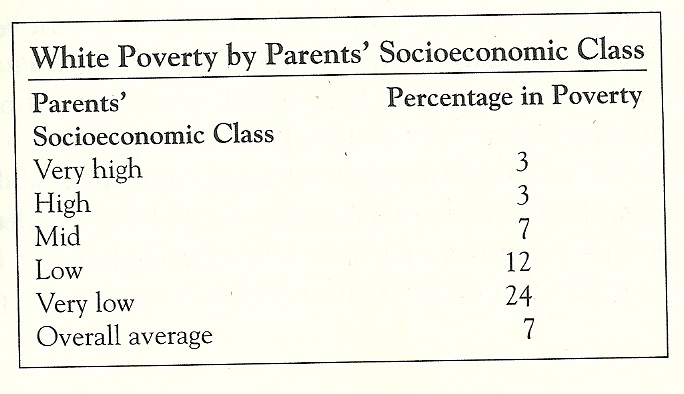
And now I’m reading a book, The Bell Curve, and I’ve seen some interesting data.  For example, it seems to be important where you come from if you wanna avoid poverty:

If you’re born to a family with very low socioeconomic class, you have an 8 times better chance to find yourself in poverty than if you were born to a family with a very high socioeconomic status.

It would seem that class matters.

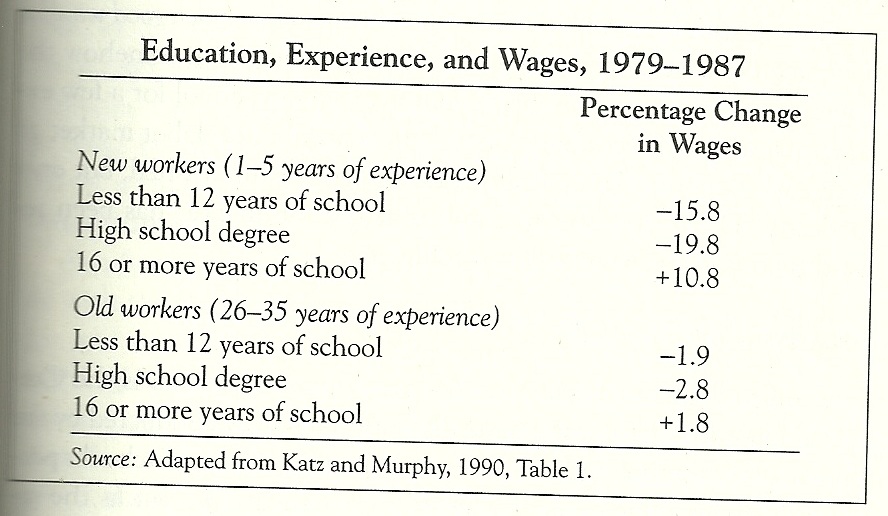
Further, when it comes to wages, the data suggests that there is an education gap that would strengthen the argument that we need to increase college degrees to our kids:

It’s hard to argue the numbers.  High school droop-outs are seeing their wages drop by double digits while college graduates are seeing double digit increases.

Interesting data to be sure.