Category Archives: Politics: National

What Makes America America

I have often thought that makes America unique in the history of the world is not her physical boundaries.  It’s not the vast expanse of land mass bordering two oceans.  It’s not the natural resources.

It’s the people that have cherished the concept of Liberty that have made America what she is.

Continue reading

One At A Time: Taking Schools Back From Teacher’s Unions

It’s no secret that teacher’s unions don’t serve the interest of the students; they serve the interest of the union.  They’re about power.  Power to influence how their members are protected and compensated.  As more and more people come to this realization more and more people are beginning to realize that taking schools back from those unions is a good thing:

(Reuters) – Hundreds of mayors from across the United States this weekend called for new laws letting parents seize control of low-performing public schools and fire the teachers, oust the administrators or turn the schools over to private management.

The U.S. Conference of Mayors, meeting in Orlando, Florida, on Saturday unanimously endorsed “parent trigger” laws aimed at bypassing elected school boards and giving parents at the worst public schools the opportunity to band together and force immediate change.

Now, guess who opposes these types of laws?

Such laws are fiercely opposed by teachers’ unions, which stand to lose members in school takeovers.

I know you’re shocked.  Shocked that a union would oppose a law that diminished its influence.  But, has this process worked?

Parent trigger laws are in place in several states including California, Texas and Louisiana and are under consideration in states including Michigan, Pennsylvania and New York. So far, though, the concept has never successfully been used to turn around a school.

Damn!

But why not?

Parents in two impoverished, heavily minority California cities, Compton and Adelanto, gathered enough signatures to seize control of their neighborhood schools but the process stalled in the face of ferocious opposition from teachers’ unions. Both cases are now tied up in court.

Ahh, not because they were given the chance and then failed.  Rather, they haven’t worked because the unions fight ’em every inch of the way.

The good news?  The power of the unions have continued to fade:

But in a sign of the unions’ diminishing clout, their traditional political allies, the Democrats, abandoned them in droves during the Orlando vote.

Democratic Mayors Michael Nutter of Philadelphia, Antonio Villaraigosa of Los Angeles and Kevin Johnson of Sacramento led the charge for parent trigger – and were backed by scores of other Democrats as well as Republicans from coast to coast.

“Mayors understand at a local level that most parents lack the tools they need to turn their schools around,” Villaraigosa said. Parent trigger laws, he added, can empower parents to do just that.

Let’s hope that the victory in Wisconsin will usher in a new era not just in fiscal reform but in actual education reform.

Equality: Perfectly Providing Equal Opportunity

What if we could, with perfection, create a nation that provided equal opportunity?

Whatever that may mean to you, suppose it’s true.  Every kid has the same chance to get to a good school and graduate from it.  College?  Available to all.  While not important to this conversation, we could say that college could be free.  There would be no need to worry about poor families being unable to send their bright children to the hallowed halls of higher eduction.

Poverty create hurdles due to inability to buy books, electricity or heat?  Gone.  We’ll adjust for it.

Any problem you might have that produces unequal opportunities has been answered.  To your individual liking.

Everyone has the same chance.

Question:

What characteristic or quality would determine who succeeds?

#OccupyWallStreet

Have you heard anything about the Occupy Wall Street idiots?

Me either.

Huh.

We Are All Investors

A recent post over at Poison Your Mind got my attention.  In it, nickgb ponders the assertion that we are all investors.

…I had a much different outrageous pull-quote to emphasize:

Romney’s opponents seem to be aghast that he has made money for investors (aren’t we all investors?), though they studiously ignore other greed-less facts: He never took a dime in salary for heading the Olympics in Salt Lake City nor as governor of Massachusetts, to mention a couple.

Those latter sentences are pretty stupid, because obviously Romney received gains from both of those ventures (both in reputation and financially). But aren’t we all investors? Who says that? Who still gets credit as a journalist after saying something like that?

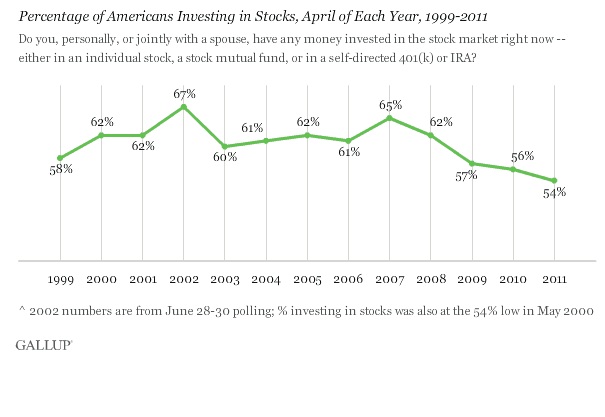
So, I thought I’d take the bait and look into  how many of us are investors:

Not many.  At all.

In fact, the rate is depressingly low.  And even if we excuse the low number due to the economy the highest we’ve been is 67% back in 2002.

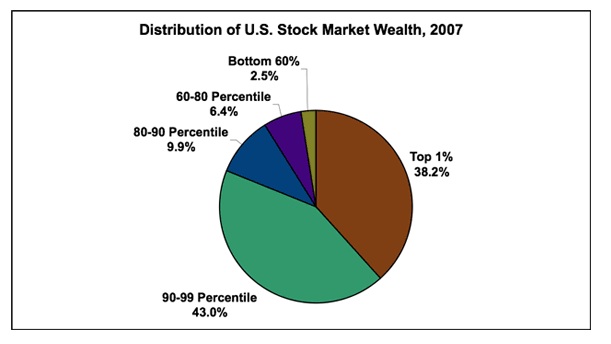
Before I could post this data, however, reflectionephemeral beat me to the punch.  The data he posted is below:

A revealing bit of data to be sure.  One more in the collection of charts that show the distribution of wealth is skewed.  However true that may be, the chart directly above doesn’t speak to investment participation.

At first I was struck by nickgb’s critique of the article, surely no one expects the reader to think that literally ALL of us are investors, but then when I saw the graph by reflectionephemeral, I was more struck by the thought process that would cause one of us to show data that explains the unequal distribution of wealth as the unequal distribution of risk.

Is it possible that as we all discuss this thing we call politic that we have failed to establish basic assumptions, have failed to agree upon a basic set of accepted bedrock givens?

I have full faith that the fellas over at PYM have the best interest of “folks” at heart.  I like to think that I do too.  Why is it that the two of us would take so different paths in responding to nickgb?


Supreme Court Strikes 3 Of 4 Sections Of Arizona Immigration Law

Update: As regards to 5(C).  I disagree with the policy but would have thought that the state could legislate that.  Technically speaking, that means I agree with the legality Arizona was getting at and disagree with the Court.

Supreme Court Announces Ruling

This morning the Supreme Court released it’s ruling on the controversial Arizona immigration law passed in 2010.  The highly anticipated ruling is one of two high visibility cases heard in this session.  The Federal government had sued Arizona as a result of the law.  Specifically 4 sections:

  1. Section 3 – This section made failure to comply with Federal alien-registrations a state misdemeanor.
  2. Section 6 – Authorizes state and local officers to arrest without a warrant a person “the officer has probable cause to believe . . . has committed any public offense that makes the person removable from the United States”
  3. 5(C) – This section makes it a misdemeanor for an unauthorized alien to look for or engage in work.
  4. Section 2(B) – Requires officers conducting a stop, detention, or arrest to make efforts, in some circumstances, to verify the person’s immigration status with the Federal Government

Continue reading

Obamacare Odds

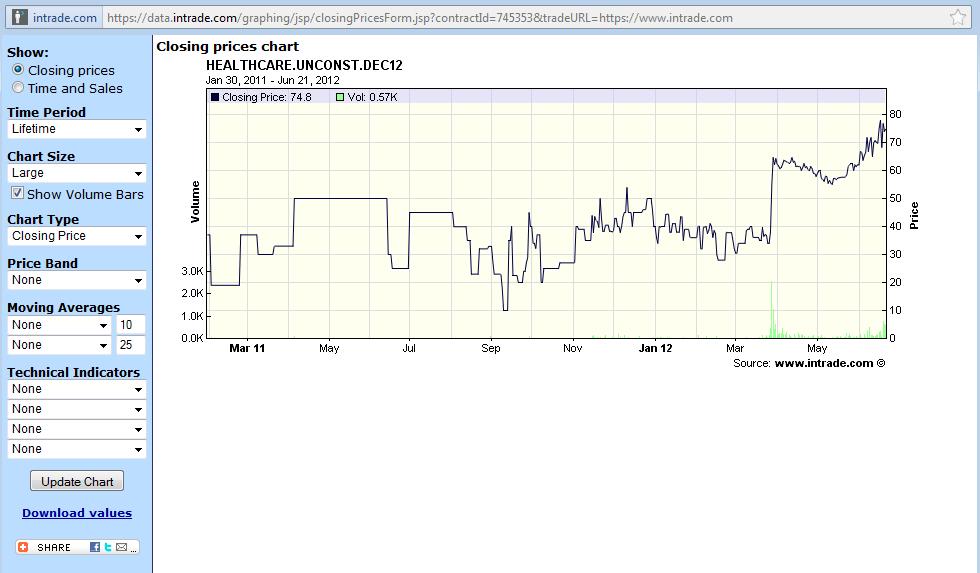
Steady upwards track since April.  Intrade has it at 75% that the law is struck down.

Good.

Executive Privilege: President Obama

Today President Obama protected Fast and Furious documents by issuing Executive Privilege.  I don’t have a lot any knowledge of what this really is so I did a little digging around.

Turns out that our current President is not alone in such actions.  For examples of recent such occasions we learn that Dubya used this power 6 times and President Clinton 14.  Obama certainly isn’t walking down a path not already well worn.

So, what IS Executive Privilege?

Well, in short, it’s this:

The right of the president of the United States to withhold information from Congress or the courts.

Interesting to note that this very succinct definition simply states that that the president may withhold information.  Not one word about the type of information.

A slightly longer but still rather short explanation followed:

The Constitution does not specifically enumerate the president’s right to executive privilege; rather, the concept has evolved over the years as presidents have claimed it. As the courts have ruled on these claims, their decisions have refined the notion of executive privilege and have clarified the instances in which it can be invoked. The courts have ruled that it is implicit in the constitutional Separation of Powers, which assigns discrete powers and rights to the legislative, executive, and judicial branches of government. In reality, however, the three branches enjoy not separate but shared powers, and thus are occasionally in conflict. When the president’s wish to keep certain information confidential causes such a conflict, the president might claim the right of executive privilege.

Again, this seems to offer broad applicability and mentions nothing that the information be directly related to the President himself.  Rather, he can restrict the release of information within the executive branch.

In fact, to this end, the concept of Executive Privilege morphed during Eisenhower:

[another] development in the use of executive privilege became known as the candid interchange doctrine. In an attempt to shield the executive branch from the bullying investigative tactics of Senator joseph r. mccarthy, President Eisenhower directed that executive privilege be applied to all communications and conversations between executive branch employees; without the assurance of confidentiality, he claimed, they could not be completely candid. This doctrine marked a tremendous change in the scope of executive privilege, extending it from the president and the president’s top advisers to the myriad offices and agencies that make up the executive branch.

It seems very clear that this privilege extends to much of the information contained within the executive branch.  It’s interesting hearing the right wing speak out claiming that this privilege extends only to information that the President personally was engaged in.

However, this does not totally remove the shadows of doubt in Obama’s actions.  While the precedent for restricting the release of information goes back to Washington, it did so with a spirit that doesn’t exist today:

The term executive privilege emerged in the 1950s, but presidents since George Washington have claimed the right to withhold information from Congress and the courts. The issue first arose in 1792, when a congressional committee requested information from Washington regarding a disastrous expedition of General Arthur St. Clair against American Indian tribes along the Ohio River, which resulted in the loss of an entire division of the U.S. Army. Washington, concerned about how to respond to this request and about the legal precedent his actions would set, called a cabinet meeting. Although no official record was kept of the proceedings, Thomas Jefferson described the deliberations in his diary. The participants, Jefferson wrote, concluded that Congress had the right to request information from the president and that the president “ought to communicate such papers as the public good would permit & ought to refuse those the disclosure of which would injure the public.” In the case at hand, they agreed that “there was not a paper which might not be properly produced,” so Washington provided all the documents that Congress had requested. This event, though notable as the first recorded deliberation concerning executive privilege, did not carry precedential value until after 1957, when Jefferson’s notes were discovered. In 1958, Attorney General William P. Rogers cited Jefferson’s remarks as precedent for an absolute presidential privilege. Legal scholar Raoul Berger declaimed Rogers’s arguments as “at best self serving assertions by one of the claimants in a constitutional boundary dispute.” Instead, Berger argued, Washington’s willingness to turn over the requested documents shows his recognition of Congress’s right to such materials.

I’m sure Obama’s move is going to enrage the right for some time.  For me, I’m certain that he made this move for political reasons and not for legitimate ones.  For reason, he didn’t restrict this information until the day of the vote for contempt of Holder.  However, Obama certainly isn’t breaking with precedent and is only playing by the rules established by his predecessors.

If you are angry by this move, it would be an example of failing to offer objection to the growth of government power when that power was in “your guy’s” hands.

Make no mistake, I’m distressed by this move made by Obama.  I think it’s motivated by politics alone and is despicable.  But he’s not doing anything that hasn’t been done, and approved of, before.

Media Bias: MSNBC

Both sides cry foul when it comes to the media.  Both sides have data that show the other sides gets preferential treatment when it comes to coverage of “their guy” and they can come up with chapter and verse that shows the positive/negative for the other side is skewed.

It’s fun.

But this, THIS, right here, is crazy.

Here MSNBC doesn’t just take a video and start it at a point that clouds the context or ends it at a point that clouds the context.  No.  They actually parse the video, showing a clip from an early section, cutting in a piece from another section and finally end it all with yet another cutting later on.

I hear they even added a laughing track.

Check it out:

That isn’t selective reporting.  That isn’t commentary that favors one version of ideology over another.

THAT is a blatant distortion of the entire conversation.

THAT is media bias.

Update To Education

On Monday I posted on the impact of parental socioeconomic status as it pertains to their children’s educational outcomes.  In reviewing the post I failed to display 1 of 3 findings the authors made.  I think I did this because the data failed to demonstrate a point that I will be anxious to make in future posts regarding the book.

I will post now the data that speaks to kids who drop out of school only to later come back and earn their GED instead of obtaining a high school dipploma.  The graph is here:

As you can see, SES has a large impact on whether or not a child obtains a GED or stays in school to earn her high school diploma.  The wealthiest families generate graduates 9x more often than the poorest families of kids who drop out but come back to earn either their GED or diploma.