Category Archives: Politics: National

Why Do We Tax Those Whom We Tax?

I might be willing to agree that we should tax people according to their income.  I’d be less inclined to agree that we should increase the rate of taxation as the income moved ever higher.

However the debate went, I would insist on this:

Taxation of the people is meant to pay for the necessary role of government.

There is no way that you could get me to agree that we need to confiscate the wealth of one man and simply hand it to another.

Obama: Government Invented The Internet

You might have heard by now that Obama gave a speech in Virgina.  And in that speech he made a statement.  He made a statement that individuals can’t claim credit for their successes.  Rather, they must acknowledge that what they have labored to craft is the result of the collective.  And, more importantly, that leading the way is the government.  After all, it invented the internet.

Right?

Maybe not.

Most people give credit to the invention of the internet to ARPANet, a DOD agency.

The Advanced Research Projects Agency Network (ARPANET) was the world’s first operational packet switching network and the core network of a set that came to compose the global Internet. The network was funded by the Defense Advanced Research Projects Agency (DARPA) of the United States Department of Defense for use by its projects at universities and research laboratories in the US. The packet switching of the ARPANET was based on designs by Lawrence Roberts of the Lincoln Laboratory.

But did ARPANet really invent the internet?  Not so fast say some:

In February of 1966 I initiated the ARPAnet project. I was Director of ARPA’s Information Processing Techniques Office (IPTO) from late ’65 to late ’69. There were only two people involved in the decision to launch the ARPAnet: my boss, the Director of ARPA Charles Herzfeld, and me.

Numerous untruths have been disseminated about events surrounding the origins of the ARPAnet. Here are some facts.

The creation of the ARPAnet was not motivated by considerations of war. The ARPAnet was not an internet. An internet is a connection between two or more computer networks.

-Bob Taylor

Interesting.

But if ARPANet didn’t create the internet, who, or what, did?

On further analysis we come up with at least five distinct theories, each of which can be credibly discussed. We state from the beginning that we do not personally see the theories as mutually exclusive – we have for many years believed in a multiple origins theory rather than a single point of invention one.

But the theories which need to be examined are:

1. Packet switching represents the origins of the Internet
2. The TCP/IP protocol represents the origins of the Internet
3. A range of telco-led activities from the 1960s represents the true origins
4. The birth of the Internet is best explained through a history of applications rather than the protocols
5. The range of inventions and activities emanating from Xerox Palo Alto laboratories, including Ethernet, represent the true beginnings.

All five theories are interesting.  Personally, I find theory 1 and 3 the most compelling with theory 3 possibly encompassing theory 3 almost completely.  Digital transmission and switching was accomplished in 1962, seven years before ARPANet claimed that accomplishment.    Further, the languages of the internet, C and Unix, were developed not by ARPANet but by AT&T.

Who knew?

In any event, what we CAN conclude is this:

So then, where and when did the Internet begin? The only thing historians seem to agree on is that it was not 1969, or the Pentagon, (or for that matter Al Gore). From there on, there is a wide divergence of views as to when, where, and by whom the Internet may have been invented.

Contrary to what Obama would have you believe, it wasn’t the government that created the internet, it was individuals engaging in business that invented the internet.

Why Democrats Love Big Labor

You don’t think that the democrats need the unions?

Organized labor spends about four times as much on politics and lobbying as generally thought, according to a Wall Street Journal analysis, a finding that shines a light on an aspect of labor’s political activity that has often been overlooked.

Previous estimates have focused on labor unions’ filings with federal election officials, which chronicle contributions made directly to federal candidates and union spending in support of candidates for Congress and the White House.

But unions spend far more money on a wider range of political activities, including supporting state and local candidates…

Indeed.

But it isn’t just the money.  It’s not just the influence that money may be able to buy.  It’s the coercion of actual voters:

…and deploying what has long been seen as the unions’ most potent political weapon: persuading members to vote as unions want them to.

And what do unions spend money on?

The costs reported to the Labor Department range from polling fees, to money spent persuading union members to vote a certain way, to bratwursts to feed Wisconsin workers protesting at the state capitol last year. Much of this kind of spending comes not from members’ contributions to a PAC but directly from unions’ dues-funded coffers.

But these costs are certainly reported as political efforts, yes?

There is no requirement that unions report all of this kind of spending to the Federal Election Commission, or FEC.

So, to review, unions are able to use money collected through dues to support the election of politicians who then pass legislation that allows unions to prevent workers from working unless they belong to a union?  And then “due” them to death.

Nice gig.

I was in Charlotte when Walker won in Wisconsin.  When he beat the unions.  I was watching Maddow.  She was crestfallen that the democratic party was at the brink.  She pointed out that without the unions, the democrats didn’t have any way to raise money.  She was half right.

Corporations and their employees also tend to spread their donations fairly evenly between the two major parties, unlike unions, which overwhelmingly assist Democrats. In 2008, Democrats received 55% of the $2 billion contributed by corporate PACs and company employees, according to the Center for Responsive Politics. Labor unions were responsible for $75 million in political donations, with 92% going to Democrats.

They still get half the take, they just don’t get ALL the union take.

Let’s hope the gig is up.

The Family: SES Impact – The Bell Curve

I’m continuing my way through the book, “The Bell Curve” by Herrnstein and Murray.  I’ve posted already on several of the chapters describing the impact of the socioeconomic status of the families people come from.  Fascinating stuff.

The chapter next on the list deals with the family; specifically the family structure.  The chapter takes a look into what impacts how the family is formed and remains together, or not.

First, let’s take a look at marriage.  Specifically, marriage by the age of 30.  Marriage is very important in society and is critical in creating the building blocks that form successful family units.

So, how does the socioeconomic status of the parents impact the chance of marriage of the child?
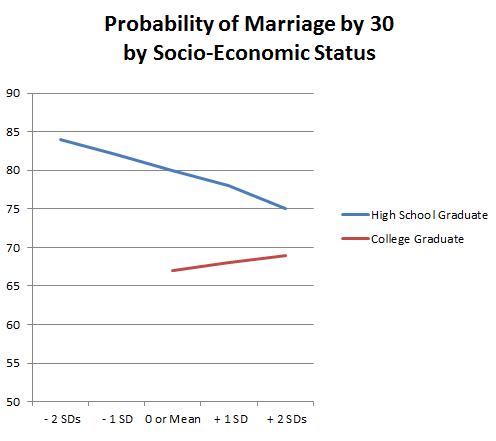
The chart above shows data for white individuals in the study.

Because of the impact of education and its suppression on marriage, it’s useful to separate folks who have a high school diploma only from those who have a college diploma.  As you can see, socioeconomic status of the family of the individual has little impact on marriage.  Most people are married by 30 with an even higher percentage married by 40.

If marriage is important, then divorce is important as well.  After all, it’s the two parent home that’s critical to the success of ensuring kids gain a strong foothold in life.  And the data?

An interesting trend to be sure.  As family wealth increases, the rate of divorce increases as well.  Indeed, by the time we reach 2 standard deviations from the mean SES, the individuals are divorcing at 17 points higher than those on the lower SES end.  This represents a greater than 100% increase.

Here the conversation shifts from marriage and divorce without reference to children to those families formed outside of marriage.  And so enters the illegitimate child.  I tend to agree with the authors that the old-fashioned view of illegitimacy was that it occurred mostly at the lower ends of the socioeconomic scale.  It was “the poor girls” having babies out of wedlock, not the wealthy.

But does the data support that view?  The answer is kinda.
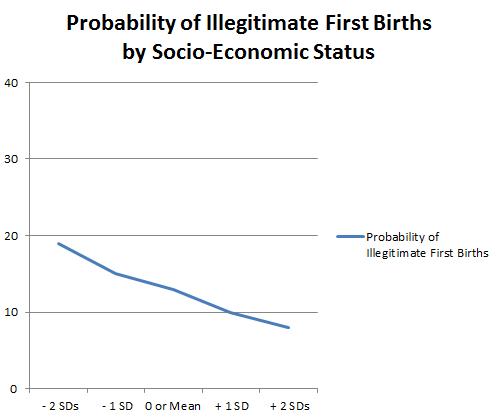
 

The women at the very end of the socioeconomic scale have illegitimate births at a 19% rate while the richest of women are giving birth about 8-9% before marriage.  The 10 points or so isn’t much, but again, does represent nearly a 100% increase in the rate comparing the very wealthy to the very poor.

Here the authors move into an interesting question.  Does poverty cause illegitimacy or does the welfare system cause illegitimacy?  The idea, or the argument, being is that the welfare system enables the single mom to refrain from taking precautions that she might otherwise take if she were to bear the cost of raising the child.

To tease out an answer to this, an interesting question is asked:

Among NLSY white mothers who were at or below the poverty line in the year prior to giving birth, what proportion of the babies were born out of wedlock?  The answer is 44%.  For women above the poverty line?  6%.

What does the data, shown in the usual format, show us?
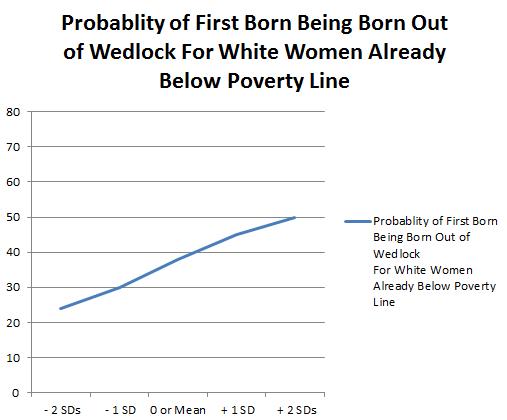
A pretty compelling argument that the wealth of the mother’s family plays a role.

Obama’s View Of Government And Business

It’s long been a narrative that Obama doesn’t like the free market.  Titles such as socialist and statist have been thrown at him.  Pages and pages have been written that Obama is a lover of big government, more regulations and higher and higher taxes.  He’s been a target for not understanding how the economy, or even just business, really works.

He’s had to fight the continual drum beat from the right that he’s not friendly to small business and prefers the government to provide.  That’s he’s anti-capitalist and more for ideals of fairness and equality for all.

But I have to ask you, if you owned your own business, worked hard to get it to where it is today, sacrificed soccer games, vacations and new cars.  Set aside the addition to the living room or gave up on the new boat, how do you think you’d feel if you heard this:

You didn’t build that, somebody else made that happen.


President Obama: How Effective Has He Been

As summer is in full swing, how do voters feel Obama has impacted the nation in his first 3.5 years in the Oval Office?

In some ways, I don’t like polls like this.  I mean, how do people gauge how a president has done, or should have done?  How do they know if he’s doing well or poorly?  In some cases, it may be some social cause that they champion; gay rights or women’s health.  Perhaps for others, it’s military accomplishments; ending Iraq or killing Bin Laden.  But in terms of the economy, I’m not sure how people reach their conclusion.

To be sure, this swings both ways.  Obama is hammering Romney for his time at Bain when jobs were lost and even outsourced to low wage nations.  The idea being that you don’t have to show that in some cases, this move actually CREATED jobs.  All you have to do is throw the stigma of the evil corporate master who only cares for his own bottom line; worker be damned.

So, it is what it is.  And for Obama, the news is bleak:

A new poll says President Obama has changed things for the worse in the United States.

A survey by The Hill, a Washington, D.C., newspaper, says that 56% of likely voters believe Obama has transformed the nation in a negative way, compared with 35% who believe the country has changed for the better on his watch.

“The results signal broad voter unease with the direction the nation has taken under Obama’s leadership and present a major challenge for the incumbent Democrat as he seeks re-election this fall,” reports The Hill.

I’m fairly certain I would have guessed an unease at the president’s job so far.  People are beginning to recognize that while we’ve added jobs, we haven’t added enough.  People are beginning to understand that each spring we seem to get better only to stall in the summer.  Unemployment remains uncomfortably high, people are fleeing the job market and Obama doesn’t have a plan.

There is significant reason to believe that, if elected, we would see another 4 years of stagnant growth, if that, with growing numbers of people taking advantage of an ever increasing federal entitlement system.

The question is, can Romney capitalize?

The Romney Vice President

I don’t know how important a VP pick really is.  Can anyone really say that Biden did or didn’t play a role in getting Obama elected?  Palin certainly drew attention when she was selected by McCain, but McCain could have chosen Reagan and he still would ave lost.

I’m not sure that the pick will really truly matter.  However, it WILL provide gigabits of data for those of us junkies out there.

With that said, I really would like the pick to be someone who has “done” something.  A governor, the head of an agency, a director of this or that, anything.  Anything but another senator or congressman.  It’s for these reasons that I don’t like any talk of a Rubio or a Ryan.  The role of an executive should be filled by someone qualified to be an executive.

My favorite pick to date has been Condi Rice.  And the rumors are flying today:

Political observers are asking whether Mitt Romney could pick Condoleezza Rice as his running mate a day after a story on the Drudge Report said she has emerged as the front-runner.

I think the pick would be perfect.  Rice is an accomplished statesman on her own right.  She’s gifted intellectually, has a resume a mile long and is well liked among conservatives:

Strategists acknowledge picking the former Bush administration secretary of State would be a bold, unconventional choice that could broaden support for Romney among independents.

Romney may wait until the convention to name his choice.  We might be weeks away.  And this may just be a tactic to change the narrative from Bain to something/anything else.

Who knows.  But I think Ms. Rice would be a fantastic choice.

America: Of Things Good And Of Things Bad

I’m home from Brooklyn, you could say “No Sleep ’till We Leave Brooklyn.”  The trip was great but tiring.  Home feels so good.

I woke up in my own bed this morning and was struck by how nice it was to do just that.  To be home in my space, with room and with comfort and with peace.  It would certainly be easy for those who disagree with me to find data, Europeans rank their happiness higher than we do, but I find the creature comforts America has to offer to be a significant satisfier.

In other words, it is better to be poor in America than it is to be at the median in other countries.

However, I am struck that this time of ours, this pleasant state may be peaking.  That the essence of what makes America America is fading.  It’s clear that we’re moving towards a more socialist-democracy favored by Western Europe.  A nation that feels it’s more important reign in individual liberty so that others may receive care and access to goods and services.

It’s hard to go back to my college self and reflect on how I felt about the issues of the day.  I certainly didn’t think about them through the lens of liberty and of limited government.  Rather, I simply went with my then gut.  I was certainly pleased when the minimum wage went up, but I also understood that as I raised the rate on my lawn mowing business I mowed less lawns.  I’ve always opposed taxation but understand that things like roads and cops and schools need to be payed for.  I had some very special teachers; people that shaped my life.  But I had some horrible horrible teachers that I knew had no business teaching.

Anyway, the me of today enjoys the rush of emotion I still get when I consider the incredible courage required to create the America of then.  And the me of today feels more and more like Dr. Chambless:

Somewhere on a country highway today I learned of the gutless assistance John Roberts gave the liberals on the Supreme Court in ruling that the federal government has the Constitutional right to tax all of us if we refuse to purchase something the government demands that we purchase.  Roberts said that the government cannot require us to buy health insurance but can “tax” us if we do not.

This means that if the government decides some day that a certain type of car is best in fighting global warming or that a certain type of school is best for our kids or that a certain type of food is best for our health that we will not have to buy the small car, go to the local school or buy carrots but can be taxed on these decisions to not partake of these goods.

Folks, I am sorry, but it is over for this country.

I believe Thomas Jefferson would say, “But of course” upon reading today’s Supreme Court decision.

The fact is, as we approach the 236th birthday of this dying experiment that it is somewhat of a miracle that a republic could have lasted this long.  The “makers” in our nation are now so outnumbered by the “takers” that we will most likely not be able to get back the liberty we have now lost.

Historians will record, with bewilderment, that the people who were given the gift of liberty on this Earth turned over their gift to the same forces that always destroy liberty to begin with.

And then this on his thoughts on July 4th:

Today was about celebrating the original gift, the concept, the idea of The United States of America.  It was about being joyful that we have had all of these years of relative liberty when compared to the rest of the world – and still have when looking around the globe today.It really does not matter what the future holds for America at this point. 

Every Founding Father who signed the letter to King George on that muggy day in Philadelphia must have known – or should have known – that the moment the ink from their courageous signatures dried it would herald the beginning of the end of their selfless sacrifice for posterity.

No nation that allows covetous men and women to vote can maintain a system of liberty and property rights.  Eventually, those who covet what others have – when allowed to vote – will engage in the abrogation of the rights of their fellowman.  It is inevitable, it is with us now and it will herald, as Ben Franklin said, “….the end of the republic.”

Those of us who still reside in America must realize that we live in a post-Constitution United States. When those among us who care about liberty come to grips with the aforementioned reality we can refocus our energies on delaying the inevitable end of this grand and glorious experiment with human liberty and limited government.

I agree.  It is my hope to delay this as long as we can so that one day my kids too can wake up and enjoy the fruits of America.