Category Archives: Politics: National

Barack Obama: Government Invented The Internet

For the record, I said this first:

Contrary to what Obama would have you believe, it wasn’t the government that created the internet, it was individuals engaging in business that invented the internet.

Now, from the Wall Street Journal:

It’s an urban legend that the government launched the Internet. The myth is that the Pentagon created the Internet to keep its communications lines up even in a nuclear strike. The truth is a more interesting story about how innovation happens—and about how hard it is to build successful technology companies even once the government gets out of the way.

For many technologists, the idea of the Internet traces to Vannevar Bush, the presidential science adviser during World War II who oversaw the development of radar and the Manhattan Project. In a 1946 article in The Atlantic titled “As We May Think,” Bush defined an ambitious peacetime goal for technologists: Build what he called a “memex” through which “wholly new forms of encyclopedias will appear, ready made with a mesh of associative trails running through them, ready to be dropped into the memex and there amplified.”

That fired imaginations, and by the 1960s technologists were trying to connect separate physical communications networks into one global network—a “world-wide web.” The federal government was involved, modestly, via the Pentagon’s Advanced Research Projects Agency Network. Its goal was not maintaining communications during a nuclear attack, and it didn’t build the Internet. Robert Taylor, who ran the ARPA program in the 1960s, sent an email to fellow technologists in 2004 setting the record straight: “The creation of the Arpanet was not motivated by considerations of war. The Arpanet was not an Internet. An Internet is a connection between two or more computer networks.”

If the government didn’t invent the Internet, who did? Vinton Cerf developed the TCP/IP protocol, the Internet’s backbone, and Tim Berners-Lee gets credit for hyperlinks.

But full credit goes to the company where Mr. Taylor worked after leaving ARPA: Xerox. It was at the Xerox PARC labs in Silicon Valley in the 1970s that the Ethernet was developed to link different computer networks. Researchers there also developed the first personal computer (the Xerox Alto) and the graphical user interface that still drives computer usage today.

But, did the government impact the creation of the Internet in any way?

As for the government’s role, the Internet was fully privatized in 1995, when a remaining piece of the network run by the National Science Foundation was closed—just as the commercial Web began to boom. Blogger Brian Carnell wrote in 1999: “The Internet, in fact, reaffirms the basic free market critique of large government. Here for 30 years the government had an immensely useful protocol for transferring information, TCP/IP, but it languished. . . . In less than a decade, private concerns have taken that protocol and created one of the most important technological revolutions of the millennia.”

Other than delaying the innovation for 30 years, the government seems to have done not a thing.

Parenting: SES Impact – The Bell Curve

I’m continuing my series on the chapters of “The Bell Curve”, by Herrnstein and Murray.  If you are interested in the posts so far, just go to the category selections on the right sidebar, I’ve grouped them together under The Bell Curve.

The other day we dealt with welfare and the impact that socioeconomic status has on:

  1. Going on it
  2. Staying on it

The results were mixed.  The answer, it depends.

Today we’re gonna look at parenting and the impact of the SES of the mother on her children.

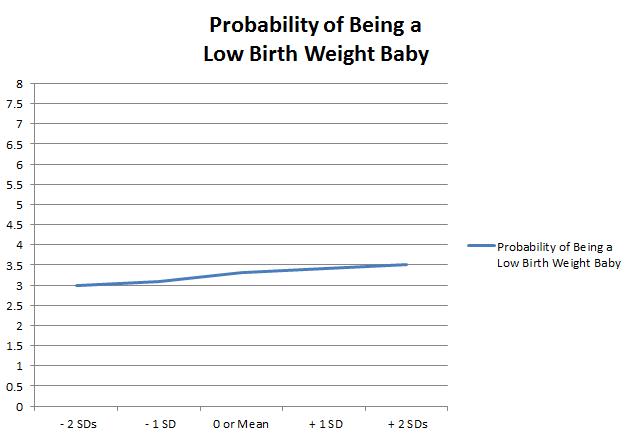
Even before the life of the child has a chance to take off, a critical component of parenting is the birth weight of that child.    By examining the socioeconomic status of the mother we might catch a glimpse of it’s impact on her children:

As you can see from the chart the impact of the socioeconomic status of the mother is small or meaningless.

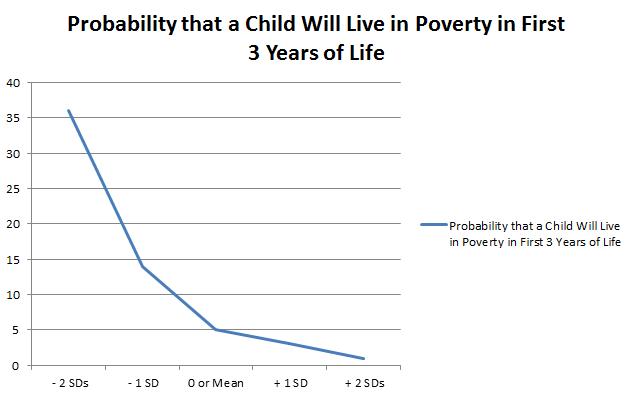
Moving to the early life of the child, the authors explore childhood poverty in the first three years of the child’s life.  Again, holding other variables constant, the impact of the SES of the mother:

That impact is dramatic.  Poor women raises poor kids while the wealthy mothers raise children above the poverty line.  As soon as the mother’s wealth dropped below the average, the probability of childhood poverty rises very steeply.

The next set of data describes the impact of the SES of the mother on the HOME index.

 The Home Observation for Measurement of the Environment (HOME) Inventory is designed to measure the quality and extent of stimulation available to a child in the home environment. The Infant/Toddler HOME Inventory (IT-HOME) comprises 45 items that provide information from the child’s perspective on stimuli found to affect children’s cognitive development. Assessors make observations during home visits when the child is awake and engaged in activities typical for that time of the day and conduct an interview with a parent or guardian. The IT-HOME is organized into six subscales: (1) Responsivity: the extent of responsiveness of the parent to the child; (2) Acceptance: parental acceptance of suboptimal behavior and avoidance of restriction and punishment; (3) Organization: including regularity and predictability of the environment; (4) Learning Materials: provision of appropriate play and learning materials; (5) Involvement: extent of parental involvement; and (6) Variety in daily stimulation. For the IT-HOME, 18 items are based on observation, 15 on interview, and 12 on either observation or interview.

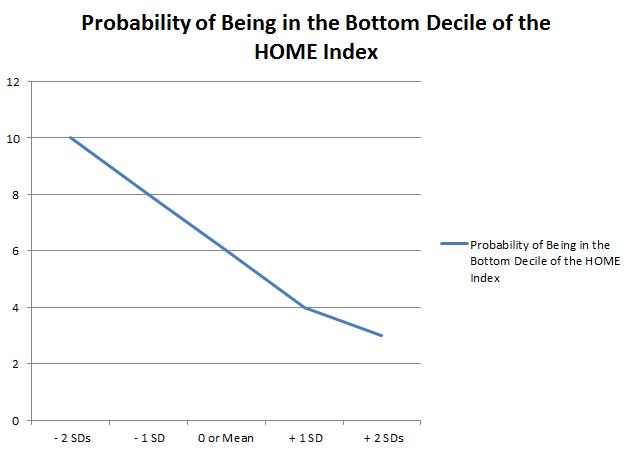
In 1986, 1988 and 1990, the NLSY conducted surveys of the children and mothers using the HOME observations.  From that data, the authors build a probability of scoring in the lowest decile of that index based on the SES of the mother:

Again we see the pattern.  As the wealth of the mother decline, the HOME index score of the family unit becomes worse.  Only 3 in 100 of the wealthiest women have children in the lowest decile in the index while the poorest women have 10 in 100.

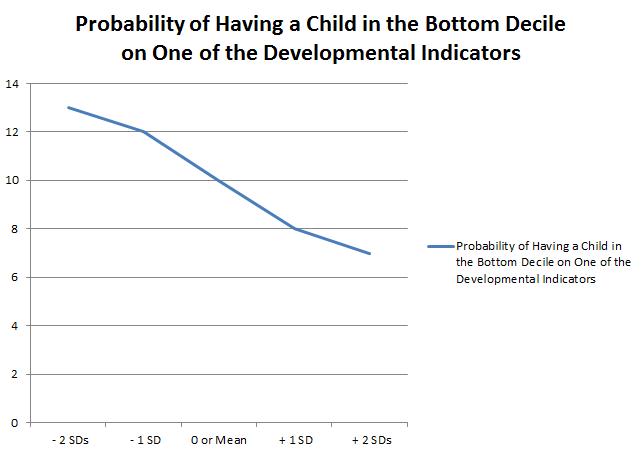
The next topic in the chapter deals with developmental outcomes of the children of moms in the NLSY.  The study administered a host of tests regrading those outcomes.  In short, the book is looking at measuring those children who scored in the bottom decile of the 4 indicators of a given test year.  If they answered “yes” for any of the four tests being in that bottom decile or “no” if they did not.

The results holding all variables equal but SES of the mother:

The data is relatively modest; 5 points separate the top from the bottom.

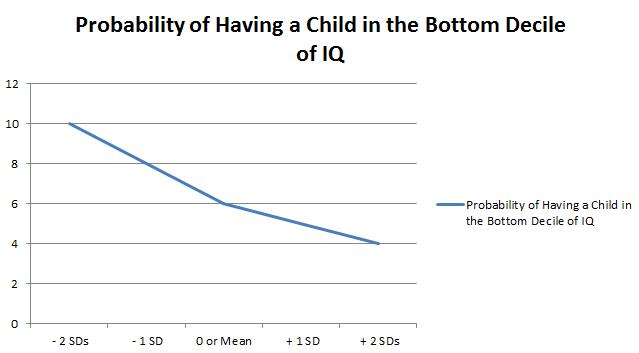
Finally, the last factor studied in the chapter – the IQ of the child.  Here the authors again decided to look at the probability of the child ranking in the bottom DECILE of IQ based on the SES of the mother.  Again, the data:

Again, the impact of the mother’s SES status is mild; moving the ranking from 10% to 4%, highest to lowest.

In conclusion, with the notable exception of living in poverty for the first 3 years of life, the SES of the child’s mother has only mild predictive value in the studied outcomes.

“You Didn’t Build That” – Out Of Context

Obama is taking a lot of heat for his comments in Virgina.  It was in that speech that he made the now infamous, “If you have a business, you didn’t build that.”  The republicans are going crazy with the clip, using it in every ad they can put on TV or the radio.  They’ve got it on Facebook and Twitter.  Obama saying that business owners didn’t build “that.”

And the left is going nuts over context.

First, I’ve always said that the remark IS out of context.  The president clearly was referring to roads and bridges when he mentioned “that.”

Second, this is politics.  These same people who are now fainting over context were no where to be seen when Romney was quoted as saying, “I like to fire people.”  No one was complaining about context when Romney’s comments on self-check out lines was doctored.  It is what it is.

Third, and this is the biggie for me, Obama BELIEVES the message that the republicans are pushing in the out of context quote.  Two months ago, if you were to ask Obama if he felt that businesses were built by their owners or with help from the government, he’d tell you that of COURSE it was built with the help of the government.  Heck, he’s saying that in the speech.

So, here are his remarks:

THE PRESIDENT:  Well, first of all, like I said, the only way you can pay for that — if you’re actually saying you’re bringing down the deficit — is to cut transportation, cut education, cut basic research, voucherize Medicare, and you’re still going to end up having to raise taxes on middle-class families to pay for this $5 trillion tax cut.  That’s not a deficit reduction plan.  That’s a deficit expansion plan.

I’ve got a different idea.  I do believe we can cut — we’ve already made a trillion dollars’ worth of cuts.  We can make some more cuts in programs that don’t work, and make government work more efficiently.  (Applause.)  Not every government program works the way it’s supposed to.  And frankly, government can’t solve every problem.  If somebody doesn’t want to be helped, government can’t always help them.  Parents — we can put more money into schools, but if your kids don’t want to learn it’s hard to teach them.  (Applause.)

But you know what, I’m not going to see us gut the investments that grow our economy to give tax breaks to me or Mr. Romney or folks who don’t need them.  So I’m going to reduce the deficit in a balanced way.  We’ve already made a trillion dollars’ worth of cuts.  We can make another trillion or trillion-two, and what we then do is ask for the wealthy to pay a little bit more.  (Applause.)  And, by the way, we’ve tried that before — a guy named Bill Clinton did it.  We created 23 million new jobs, turned a deficit into a surplus, and rich people did just fine.  We created a lot of millionaires.

There are a lot of wealthy, successful Americans who agree with me — because they want to give something back.  They know they didn’t — look, if you’ve been successful, you didn’t get there on your own.  You didn’t get there on your own.  I’m always struck by people who think, well, it must be because I was just so smart.  There are a lot of smart people out there.  It must be because I worked harder than everybody else.  Let me tell you something — there are a whole bunch of hardworking people out there.  (Applause.)

If you were successful, somebody along the line gave you some help.  There was a great teacher somewhere in your life.  Somebody helped to create this unbelievable American system that we have that allowed you to thrive.  Somebody invested in roads and bridges.  If you’ve got a business — you didn’t build that.  Somebody else made that happen.  The Internet didn’t get invented on its own.  Government research created the Internet so that all the companies could make money off the Internet.

And now, finally, the press is getting around to going after Romney over the context of the quote that he’s using.  And his response?  Just like I’ve been saying.

LARRY KUDLOW: “Why do you think President Obama, what did he mean, if you’ve got a business, you didn’t build it, someone else made that happen? He claims it’s being taken out of context. What do you think it means? Do you think this is Obama anti-business, anti-entrepreneur? Or do you think maybe he has been treated unfairly?”

GOV. ROMNEY: “Well, just read the whole speech. I found the speech even more disconcerting than just that particular line. The context is worse than the quote. The context, he says, you know, you think you’ve been successful because you’re smart, but he says a lot of people are smart. You think you’ve been successful because you work hard, a lot of people work hard. This is an ideology which says hey, we’re all the same here, we ought to take from all and give to one another and that achievement, individual initiative and risk-taking and success are not to be rewarded as they have in the past. It’s a very strange and in some respects foreign to the American experience type of philosophy. We have always been a nation that has celebrated success of various kinds. The kid that gets the honor roll, the individual worker that gets a promotion, the person that gets a better job. And in fact, the person that builds a business. And by the way, if you have a business and you started it, you did build it. And you deserve credit for that. It was not built for you by government. And by the way, we pay for government. Government doesn’t come free. The people who begin enterprises, the people who work in enterprises, they’re the ones paying for government. So his whole philosophy is an upside-down philosophy that does not comport with the American experience. And if we want to get people working again–and that’s my priority–if we want to get people working again, we have to celebrate success and achievement and not demonize it and denigrate the people who have worked hard, who are smart, who have made the kinds of investments to build a brighter future.”

The context of the quote is worse than the quote.  Obama’s using the success of the business owner as a lever to force him to pay more taxes.  And he hides behind “they wanna give something back.”

The Science Behind Fracking

The science behind energy has always been progressing.  hat started out as campfires has turned into nuclear reactions and laser shots.  We’ve gone from wood to whole oil.  Whale oil to kerosene.  Kerosene to coal and gas.  Mix in some windmills and solar panels, we’ve come a long way.

Each new advancement seems to come to as the matrix of inputs, and outputs, change.  We have oil today because we were running out of whales yesterday a delicious fact of life to present to your favorite neighborhood environmentalist].  We’ve gone from totally dependent on fossil fuels to nuclear options.  And today we’re taking advantage of natural gas through fracking procedures.

We change and adapt for several reasons.  Sometimes it’s because we develop technology.  We gave up on whales because the technology of oil extraction produced more value through oil than did hunting whales.  We’re able to tap into reserves of oil previously unreachable through new technologies and due to a changing demand for oil; the price of oil now makes new drilling economically sound.  And sometimes we have impacts to the environment that cause us to change.  As we throw soot into the air from our coal plants we discover that those effects are undesirable.  So we try to clean the exhaust.  That cleaning adds costs and those costs drive new technology.

And all of that, if done correctly, is a good thing.  It’s when the dogma surrounding the “Ought” get’s in the way when things go off track.

We forget to track the value.

Is burning the coal and sending the pollution into the air worth the benefit?  Is mining the coal and hurting/killing the miners worth the benefit?  Is the risk of a meltdown in a reactor worth the energy.  is it worth the cleaner energy that coal provides?  The comparisons can go on and on.

folks aren’t being honest if they don’t acknowledge that there are downsides to today’s energy.  And others aren’t being honest if they don’t acknowledge the benefits we enjoy due to that energy.  If reducing coal emissions meant a slow down in medical research, would that be worth it?  if we reduced the deep sea drilling and added to the cost of crude oil, would the economic impacts of higher cost of energy be worth it?

No one should deny that drilling, deep sea or shallow land, doesn’t impact the environment.  However, there shouldn’t be any doubt to the benefits that drilling provides either.

All this brings me to fracking.  This form of energy extraction isn’t any different than the ones we’ve already discussed.  There are puts and there are takes.  The rub comes in the value.  And this is where I think today’s ‘Green Energy” folks are getting it wrong.

I get that wind and solar are easier on mother Earth.  But they don’t have the economic ability to make themselves viable.  The benefit ain’t worth the downside; dramatically more expensive power.  And those same “Green Energy” folk’s hatred of fracking follows the same blindness to the value proposition that they exhibit in solar and wind.

Fracking gives us access to substantially cheaper gas than we’ve had in the past.  AND we have massive amounts of it.  Are there downsides?  Sure.  But they may not be as bad as they say:

PITTSBURGH — In the debate over natural gas drilling, the companies are often the ones accused of twisting the facts. But scientists say opponents sometimes mislead the public, too.

Critics of fracking often raise alarms about groundwater pollution, air pollution, and cancer risks, and there are still many uncertainties. But some of the claims have little — or nothing— to back them.

Examples?

…reports that breast cancer rates rose in a region with heavy gas drilling are false, researchers told The Associated Press.

Fears that natural radioactivity in drilling waste could contaminate drinking water aren’t being confirmed by monitoring, either.

And concerns about air pollution from the industry often don’t acknowledge that natural gas is a far cleaner burning fuel than coal.

Ironically, the same groups that accuse the right of ignoring the science of global warming*, are the same folks who might be ignoring science themselves.

“The debate is becoming very emotional. And basically not using science” on either side, said Avner Vengosh, a Duke University professor studying groundwater contamination who has been praised and criticized by both sides.

More on the science:

Opponents of fracking say breast cancer rates have spiked exactly where intensive drilling is taking place — and nowhere else in the state. The claim is used in a letter that was sent to New York’s Gov. Andrew Cuomo by environmental groups and by Josh Fox, the Oscar-nominated director of “Gasland,” a film that criticizes the industry. Fox, who lives in Brooklyn, has a new short film called “The Sky is Pink.”

But researchers haven’t seen a spike in breast cancer rates in the area, said Simon Craddock Lee, a professor of medical anthropology at the University of Texas Southwestern Medical Center in Dallas.

David Risser, an epidemiologist with the Texas Cancer Registry, said in an email that researchers checked state health data and found no evidence of an increase in the counties where the spike supposedly occurred.

And Susan G. Komen for the Cure, a major cancer advocacy group based in Dallas, said it sees no evidence of a spike, either.

“We don’t,” said Chandini Portteus, Komen’s vice president of research, adding that they sympathize with people’s fears and concerns, but “what we do know is a little bit, and what we don’t know is a lot” about breast cancer and the environment.

And back to the radioactive water:

Another instance where fears haven’t been confirmed by science is the concern that radioactivity in drilling fluids could threaten drinking water supplies.

Critics of fracking note the deep underground water that comes up along with gas has high levels of natural radioactivity. Since much of that water, called flowback, was once being discharged into municipal sewage treatment plants and then rivers in Pennsylvania, there was concern about public water supplies.

But in western Pennsylvania, the Pittsburgh Water and Sewer Authority did extensive tests and didn’t find a problem in area rivers. State environmental officials said monitoring at public water supply intakes across the state showed non-detectable levels of radiation, and the two cases that showed anything were at background levels.

And finally the irony:

Critics of fracking also repeat claims of extreme air pollution threats, even as evidence mounts that the natural gas boom is in some ways contributing to cleaner air.

Marcellus air pollution “will cause a massive public health crisis,” claims a section of the Marcellus Shale Protest website.

Yet data from the U.S. Energy Information Administration show that the shale gas boom is helping to turn many large power plants away from coal, which emits far more pollution. And the U.S. Environmental Protection Agency passed new rules to force drillers to limit releases of methane from wells and pumping stations.

Some environmental groups now say that natural gas is having a positive effect on air quality.

Earlier this year, the group PennFuture said gas is a much cleaner burning fuel, and it called gas-fired power plants “orders of magnitude cleaner” than coal plants.

Does burning gas impact air quality and the environment around it?  Sure.  To a degree.  But is it worth it?  Is it worth burning gas in order to bring to our doorsteps life saving medications, educational advancements, new advancements in cancer research?  Also, sure.

We need to watch and make sure that we’re taking care to increase our value.  We don’t kill whales for whale oil just because there’s whale oil in the ocean.  And maybe one day, when we can more effectively split the atom, we’ll stop drilling for oil.  But until then, please, run through the value proposition.

*It’s important to point out that there is a difference in accepting man made warming and accepting catastrophic global climate change.  And much of the emotional back and forth in this debates comes from ignoring this fact.
 

Welfare: SES Impact – The Bell Curve

I’m continuing my series on the chapters of “The Bell Curve”, by Herrnstein and Murray.  If you are interested in the posts so far, just go to the category selections on the right sidebar, I’ve grouped them together under The Bell Curve.

So far we’ve taken a look at the impacts that the socioeconomic status of the parents of white women in the NLSY have on various life outcomes.  Included in those outcomes so far is poverty, education, Employment and the family.  This post deals with welfare and the dependency on welfare.

The first look at the impact of SES has welfare is what the probablity is of a white woman going on welfare within a year of her first birth.  The data presented below shows that probability with poverty and marital status  taken into account:

As probability of going on welfare moved from the poorest, about 28%, to the wealthiest, about 19%, the trend is down.  However, the authors report that the results are not statistically significant.

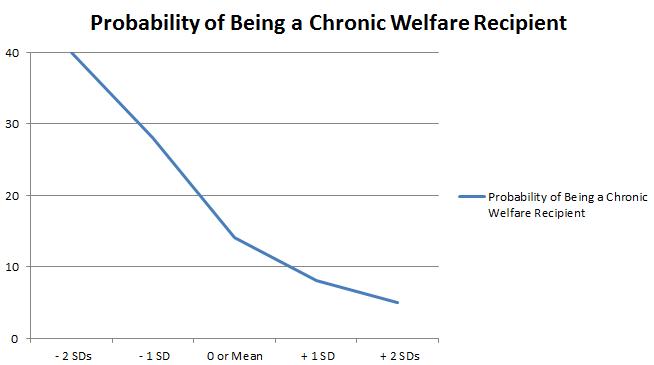
But another picture arises altogether when we look at chronic welfare recipients:


Here the results are dramatic.    The probability of a white woman in the NLSy study is greatly influenced by the socioeconomic status of her parents.  The authors don’t explain what might cause the change in the mild predictive value of SES in welfare at all vs. the highly predictive value that it plays in chronic welfare dependency.  However, they do hint that education plays a role somehow.

Senator Harry Reid: Filibuster, Amendments And Debate

On Friday I posted that there may be a reason behind the claim that republicans are obstructing the democrats in the senate.  Nickgb called shenanigans:

How about on the GOP members that use a filibuster threat to prevent anything from passing or, if they get to add those amendments, just use it to add pills to everything.

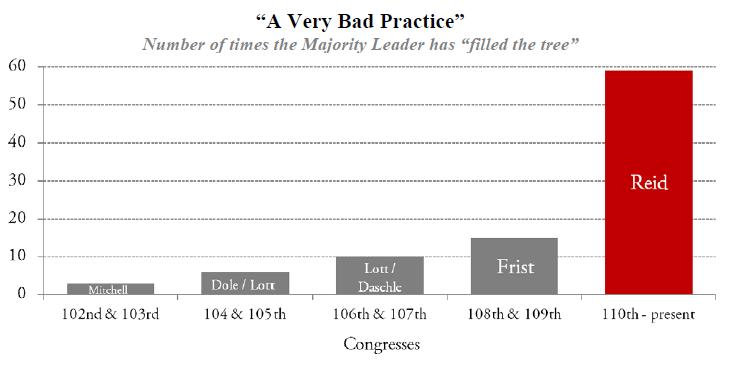
In the past, I’ve been unable to to find data on senate majority leaders use of the practice called “filling the tree.”  However, with the use of the term “poison pill” I was able to find this:

Senator Robert Byrd understood the importance of allowing for a full debate and amendment process in order to preserve the Senate as a unique institution in our democracy – “the one place in the whole government where the minority is guaranteed a public airing of its views.” The Senate, he taught, “was intended to be a forum for open and free debate and for the protection of political minorities.” Indeed, “as long as the Senate retains the power to amend and the power of unlimited debate, the liberties of the people will remain secure.”

Allowing the minority to debate and amend legislation has given way to the Democrats’ election-year political strategy of blaming Republicans as obstructionists. Majority Leader Reid has done this by preventing Republicans from amending pending legislation, ending debate before it starts, and by-passing the committee process.

And how does the current majority leader score?

Counting the 102ns through the 109th congress, we have 9 sessions.  Combined they haven’t accumulated the instances that Reid has in just more than 2.

And blocking debate?

Now, to be sure, Frist was leader for only two sessions, Reid just over 2.  That would put Frist at 12.5 per session.  Reid is at just over 25 if his total doesn’t rise at all in the remaining time of his 3rd session.

Obstructionist Congress

Congress is having a hard time getting anything done.  This is true in general but has been especially true with this specific session.  The common complain from the left is that the minority won’t even let votes come to the floor and live by a simple majority.  Everything requires 60 vote to pass.

The republicans are just blocking everything Obama wants to do.  For example:

Senate Republicans on Thursday blocked an “insourcing” bill from Democrats that would have ended tax breaks for companies that move jobs overseas.

The Bring Jobs Home Act also would have given a tax incentives to companies that bring jobs back to the United States. The measure failed to advance on a 56-42 vote, with 60 votes needed to end debate on the bill.

Earlier in the week, Republicans also blocked the Disclose Act, which would have required the disclosure of campaign contributions of more than $10,000.

Seemingly another example of the republicans abusing the power of the minority.  However, might there be another side to the story?

Republicans were considering supporting the insourcing bill until Senate Majority Leader Harry Reid (D-Nev.) said he wouldn’t include any GOP amendments.

The democrats have “ruled” as the majority since Obama took office.  He even referred to his unwillingness to consider republican ideas when has said, “I won.”  There may be fewer bills being passed, there certainly is debate on whether that’s a feature or a bug.  But f blame is going to be cast, it needs to be cast where it belongs.

The Rich Don’t Pay Their Fair Share

Obama’s now famous quote out of Virgina, ” If you’ve got a business — you didn’t build that.  Somebody else made that happen. ” is surprising not because he believes that.  No, it’s surprising because he actually said it out loud.

Everybody knows that Obama is a big government guy.  We all know that he sees the world through the lens of unequal results rather than unequal opportunities.  But one has to wonder if Obama himself hasn’t channeled the villains in Atlas Shrugged:

“He didn’t invent iron ore and blast furnaces, did he?”

“Who?”

“Rearden. He didn’t invent smelting and chemistry and air compression. He couldn’t have invented his Metal but for thousands and thousands of other people. His Metal! Why does he think it’s his? Why does he think it’s his invention? Everybody uses the work of everybody else. Nobody ever invents anything.”

She said, puzzled, “But the iron ore and all those other things were there all the time. Why didn’t anybody else make that Metal, but Mr. Rearden did?”

If it were as easy as picking mangos that had dropped from the tree, everyone would be a mango seller.*

But the context of Obama’s speech wasn’t about government building out infrastructure, it was about the rich paying more taxes; paying their fair share.  But what is that fair share?  Ask a liberal and you’ll get a look that’s either:

  1. Glassy and confused
  2. Arrogantly silent – as if the question is beneath them to answer

But tell them that the rich already pay their fair share and they’ll start to object.  Tell them that they pay MORE than their fair share and you’ll see real denial.

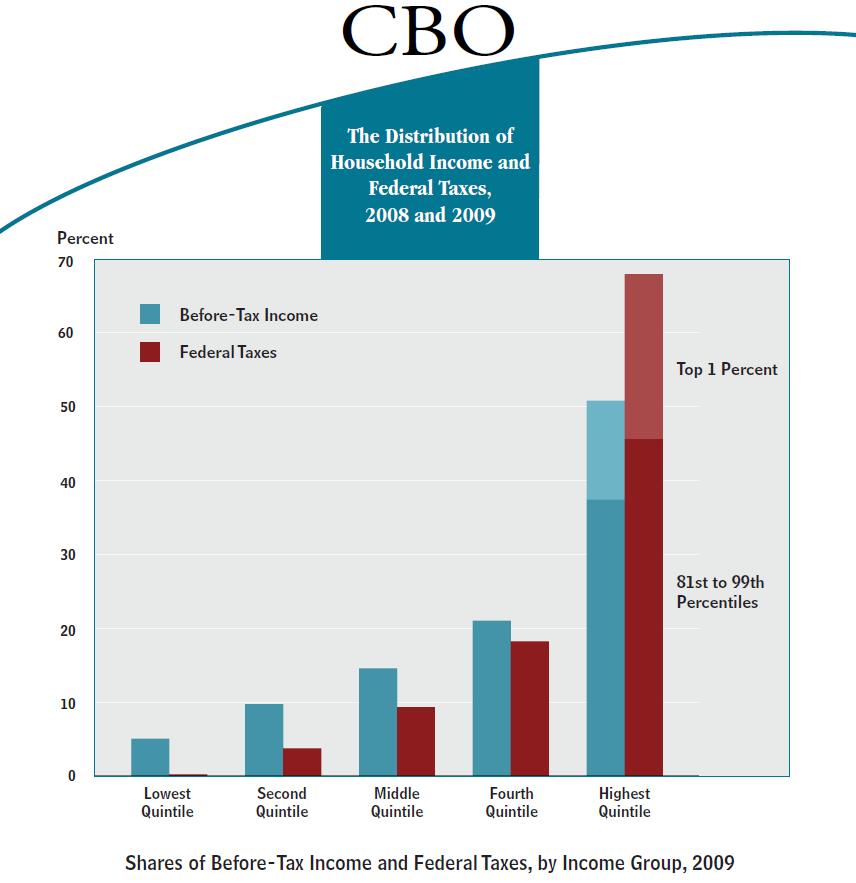
Take the above chart.

Every single income group earns more share of the income than they pay share of taxes.  Everyone, that is, except the wealthy.

Fair indeed.

* My wife’s family is Puerto Rican; I visit often.  Every time I visit when the mangos are in season, there are people with bags gathering them from the little rural roads.  It’s dangerous enough to drive those narrow winding roads, but with the folks on the roads to boot?  Anyway, these people then lug the mangos 1/8 of a mile to the main road and sell them to people driving by.  Mangos literally lying in the ditch are picked by some people and sold to to others.  This makes me think of liberals every time.

The Nature Of Health Insurance

The nature of health insurance is to protect us against the risk of requiring medical care.  If we get hurt or sick, we have the mechanism of insurance to protect us.  Depending on our individual circumstances, we purchase different kinds of policies.  The very young may choose a simple plan that protects against only the most extreme costs.  Those of us who are more likely to require care may purchase a plan that accommodates those contingencies.

But it’s all about managing risk.

After the supreme court upheld Obamacare, we have moved from insurance protecting us from risk to insurance offering prepaid medical care.  When an “insurance plan” covers office visits, routine tests and other incidentals, we are nt paying someone to take the risk from us, we’re paying someone to give us medical care.

And what happens when that happens?

Raleigh, N.C. — The University of North Carolina system requires all students to have health insurance coverage, but the cost of a plan the system offers has more than doubled in two years.

The insurance requirement started in 2010, and about one-third of students on the system’s 16 university campuses buy their policy through UNC’s provider, New York-based insurer Chartis. The rest of the students have other coverage, usually through their parents.

The average cost of the Chartis policy started at $695 a year, but it rose to $847 last year. Tuition bills that are now arriving in student mailboxes for the 2012-13 school year include a $1,418 health insurance premium.

Why the rise in prices?  Greedy insurance companies?

Bruce Mallette, the UNC system’s vice president for academic and student affairs, blamed the increase on a high number of claims by students on the policy.

“It was a very affordable plan,” Mallette said. “If you look nationally, the pricing we had in the first two years was very, very competitive, and students utilized it and utilized it and utilized it.”

Right.

People demand value.  When they’re forced to buy something they don’t want, they’re gonna use it.  And by using it they raise the price.  The next guy, not wanting to be left behind, uses HIS policy.  It’s a spiral.

Consider a table of 10 people having dinner.  They agree to just “split the bill 10 ways.”  The first guy orders a BLT.  The second a steak, the third wants a bowl of chili but senses that he’s paying for the prior two guy’s high priced meal – so he too orders steak.  And so on.

Prices are going up folks, not down.


Building Codes: Free Market vs. Regulation

So many times you hear the right rail against government regulations as being too tight, too restrictive and representing too large a burden.  We complain that over regulation leads to less risk taking and can dampen growth and creating of companies, products and jobs.

On the other hand, the left will jump up and point out that we all love clean water, fresh air and safe cars, medicines and food.  Without regulation, the saying goes, evil greedy corporations will just do whatever they want in the name of profit.

I suspect that there’s validity in  not just one side, but both.

Take, for example, the case of the BP oil spill in the gulf a number of years ago.  The government regulates oil rigs and mandates certain safety equipment in order to eliminate or reduce the chance of spills.  However, the government isn’t in a place to be experts in oil rig or deep water drilling technology.  Further, the government agencies are subject to politics, lobbying efforts and corruption.

We saw that very problem with the agency charged with developing those safety standards.

Next, take California.  California requires that every house constructed have a sprinkler system installed.  The argument, “certainly homes are safer.”  But no one knows by how much and if the cost of building more expensive homes is worth the gain.  If taken far enough, government regulations can rise the cost of housing far above what an average person can afford.  The very real world examples of this are the land use restrictions found in cities around the country.

But, back to regulating safety.  Is it radical to suggest that people should decide how safe they want to be?  Or, put another way, can we trust individuals to conduct their own cost/benefit analysis?

If so, I would suggest that private industry competing for customers and profit, would solve the solution the best way.  And that method?

Insurance:

CHESTER COUNTY, S.C. —

Hurricane-force winds hit 136 miles an hour inside a massive wind tunnel in Chester County.

105 powerful fans were aimed at two masonry buildings set up to look like small businesses, or a strip mall. The two buildings took a tremendous beating Tuesday.

The two cinder block buildings look identical on the outside, except for their color.

One building is built with a better roof, including reinforced flashing and stronger materials. It also has more rebar running down the block walls and tied together in the corners.

The other building is constructed in the common way most similar structures are built.

During the first test, 95 mile an hour winds pound both buildings. The commonly built structure loses the flashing and part of the roof.   A second test pumps the winds to above 130 miles an hour.  Within minutes, the outer wall of the common building buckles and falls outward, sending pieces of concrete block everywhere. At the same time, the roof shifts as well.

The reinforced building has no visible damage except for a broken front picture window where a two-by-four was shot out of a cannon to simulate flying debris in a storm.

Advanced techniques, both in building and then in testing were undertaken to determine how best to design and construct a stronger more tolerant building in the face of severe weather.

And who conducted this test?  Government regulators?  Not at all:

Julie Rochman heads the Insurance Institute for Business and Home Safety.  Funded by a large group of insurance companies, the group runs a test facility unlike any other in the world.

The implications of this test?

A large crowd of reporters, photographers and insurance and building executives were on hand to watch the power-packed artificial storm.

One of them, Mark Pizzi, is president of Nationwide Insurance.  He flew in from Ohio for the event.  Pizzi said twenty-five percent of small businesses destroyed in a disaster never reopen.

He hopes this test can change that down the road.

“I look at it this way. This test today is about business, staying in business,” he said.

And as a result, the industry advanced the methods of construction and did so in a way that makes sense:

Rochman said the better roofing materials on one of the test buildings only cost about $150. The whole building, which survived the powerful winds virtually intact, cost only $3,000 more to build.

And the whole reason is profit.  The endless desire to make more money.  On one hand, insurance companies now have a better way to conduct risk analysis on the buildings they insure.  Those that are unsafe will be charged a higher rate, those that are built to the new suggestions; a cheaper rate.  But more than that, the insurance companies hope to save money directly:

Rochman told Channel 9 that the education coming out of these tests is having a strong influence on the construction and insurance industry.  The goal, she said, is to prevent loss.

It turns out that insurance companies don’t like the buildings they insure to blow away in the wind.

Problem solved.  And Obama didn’t build that.