Category Archives: Lobby/PAC

IRS Targetted Tea Party Affiliated Groups

Right now the report is only mentioning Cincinnati.  I’m not sure what caused the IRS to review its data or how they determined the discrimination took place, but it sure would be fun to see if they are willing to audit other IRS offices:

(Reuters) – U.S. tax auditors inappropriately targeted applications from conservative political groups seeking tax-exempt status, an Internal Revenue Service official acknowledged on Friday.

Lois Lerner, director of the IRS tax-exempt office, said the practice was “was absolutely incorrect and it was inappropriate.”

Lerner, speaking at an American Bar Association conference in Washington, said, “We would like to apologize for that.”

None of the groups that were given extra scrutiny have been rejected yet for tax-exempt status, she said.

Organizations that used the words “patriots” or “Tea Party” in their filings were flagged by the Internal Revenue Service for further review, something conservatives complained about during the 2012 election campaign.

I think it’s important to note that the IRS is reporting, as above, that no group given extra scrutiny has yet been rejected.

The Decline of the Union Worker

If the decline of the union means that American companies begin hiring more people, I’m all for the decline of the American union:

Last July was a good month for factory workers in Anderson, Ind., where a Honda parts supplier announced plans to build a new plant and create up to 325 jobs. But it was a grim month in the Cleveland suburbs, where an industrial plastics firm told the state of Ohio it was closing a plant and laying off 150 people.

Nearly all of the Ohio workers belonged to a labor union. Workers at the Indiana plant don’t. Their fates fit a post-recession pattern: American factories are hiring again, but they’re not hiring union members.

But nationally, is there a trend that would suggest that union shops are doing better than or worse than non-union shops?

U.S. manufacturers have added a half-million new workers since the end of 2009, making the sector one of the few bright spots in an otherwise weak recovery. And yet there were 4 percent fewer union factory workers in 2012 than there were in 2010, according to federal survey data. On balance, all of the job gains in manufacturing have been non-union.

This isn’t rocket surgery.  It’s been a fact for a long time now that unions are nothing more than modern day racketeer outfits.  While they may provide better compensation for their members, they restrict the number of jobs that otherwise might have been available.  Further, and perhaps more insidious, is the fact that the monies generated from their members goes straight into the hands of politicians.

Good riddance.

A Characteristic of Unions

I think that it’s important to begin any conversation regarding unions, uniting, negotiating and representing one another with some acknowledgments.

  1. I absolutely support the effort of an individual to negotiate a higher wage, better working conditions more vacation or increased training.
  2. Further, I acknowledge and support that several employees working together to negotiate these benefits are a stronger negotiating team than an individual.
  3. Employers typically look to hire labor at its cheapest price point but they absolutely look at value, not bottom line dollar cost.

So it is that I have no issue with an employee, alone or with fellow like minded employees, walking into the bosses office and negotiating higher benefits or compensation.  What I do NOT support is the legal protections that change that negotiation from one where two people each seeking their own self-interests are negotiating to one where one of the groups is given such legal protection that the negotiation turns into a racket or where extortion is taking place.

And this is where my problem with organized labor falls.  They have legal protections that allow them to negotiate in bad faith and extort the employer.

Wanna use the tactic that if you are not compensated in the way and manner you want that you’ll walk out?  Fine, but then the boss may fire you in response.

With all of that said, I’m sure there is room for debate and disagreement on the issue of union and organized labor.  However, on one point I am continually astounded that the gentle left won’t critique unions.  And that’s on their tactics.

Discussions surrounding unions always brings to mind union thugs.  The guys that go to the homes of employees who might be on the fence during strikes or organization votes.  Threats against homes and families of those members who might not be towing the line.  And even physical violence to the employers themselves whether it be harm to the individual or vandalism to the property.

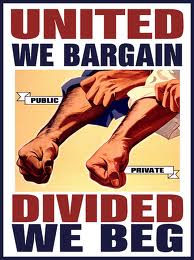
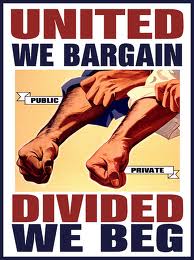
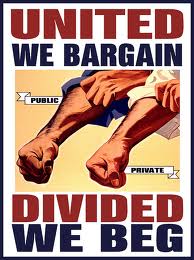
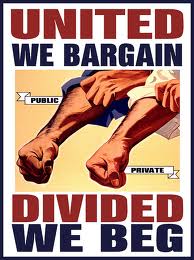
This surprise of mine extends to voting methods favored by unions.  An important tactic to form a union is to utilize  public vote, one where the vote of each employee is made in public for all to see.  The idea is that if the vote is private then the employee is able to make a “No” vote without fear of retribution.  Consistently unions and labor supporters work to take away the privacy of the vote not through open and fair compelling arguments but by legislation.  When their ideas lose in the court of public opinion labor uses the law to pass their agenda.

And this feeling that unions must be supported but not the individuals that make them up is shown in the fight against “Right to Work” legislation.  Laws that don’t ban unions but simply take away their power to coerce an employee to belong or not.  No one is saying that a union, in all of its ugliness can’t exist, the law is simply saying that it has to be voluntary.

I simply don’t understand the support of union violence against people and property that is routinely ignored by the left.

And in case the threat is only veiled and simply easy to miss, labor supporters are outright calling for violence:

“We’re going to pass something that will undo 100 years of labor relations and there will be blood, there will be repercussions,  we will re-live the battle of the overpass,” said state Rep. Doug Geiss (D-Taylor).

Blood – Repercussions – Battle

So, what is “The Battle of the Overpass”?

The battle of the overpass was a bloody fracas in 1937 between union organizers and Ford Motor Co. security guards. Walter Reuther was famously thrown down a flight of stairs and another union organizer was left with a broken back.

A literal battle involving organized labor.

This movement is literally violent.  Explicitly violent.  The push to improve the rights of individuals is being conducted by those who are looking to extend and protect rights to the employee who simply doesn’t want to organize, to vote in private and negotiate on his own behalf.

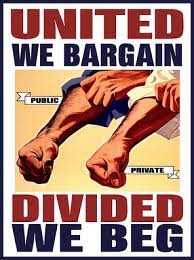
 

Why Democrats Love Big Labor

You don’t think that the democrats need the unions?

Organized labor spends about four times as much on politics and lobbying as generally thought, according to a Wall Street Journal analysis, a finding that shines a light on an aspect of labor’s political activity that has often been overlooked.

Previous estimates have focused on labor unions’ filings with federal election officials, which chronicle contributions made directly to federal candidates and union spending in support of candidates for Congress and the White House.

But unions spend far more money on a wider range of political activities, including supporting state and local candidates…

Indeed.

But it isn’t just the money.  It’s not just the influence that money may be able to buy.  It’s the coercion of actual voters:

…and deploying what has long been seen as the unions’ most potent political weapon: persuading members to vote as unions want them to.

And what do unions spend money on?

The costs reported to the Labor Department range from polling fees, to money spent persuading union members to vote a certain way, to bratwursts to feed Wisconsin workers protesting at the state capitol last year. Much of this kind of spending comes not from members’ contributions to a PAC but directly from unions’ dues-funded coffers.

But these costs are certainly reported as political efforts, yes?

There is no requirement that unions report all of this kind of spending to the Federal Election Commission, or FEC.

So, to review, unions are able to use money collected through dues to support the election of politicians who then pass legislation that allows unions to prevent workers from working unless they belong to a union?  And then “due” them to death.

Nice gig.

I was in Charlotte when Walker won in Wisconsin.  When he beat the unions.  I was watching Maddow.  She was crestfallen that the democratic party was at the brink.  She pointed out that without the unions, the democrats didn’t have any way to raise money.  She was half right.

Corporations and their employees also tend to spread their donations fairly evenly between the two major parties, unlike unions, which overwhelmingly assist Democrats. In 2008, Democrats received 55% of the $2 billion contributed by corporate PACs and company employees, according to the Center for Responsive Politics. Labor unions were responsible for $75 million in political donations, with 92% going to Democrats.

They still get half the take, they just don’t get ALL the union take.

Let’s hope the gig is up.

One At A Time: Taking Schools Back From Teacher’s Unions

It’s no secret that teacher’s unions don’t serve the interest of the students; they serve the interest of the union.  They’re about power.  Power to influence how their members are protected and compensated.  As more and more people come to this realization more and more people are beginning to realize that taking schools back from those unions is a good thing:

(Reuters) – Hundreds of mayors from across the United States this weekend called for new laws letting parents seize control of low-performing public schools and fire the teachers, oust the administrators or turn the schools over to private management.

The U.S. Conference of Mayors, meeting in Orlando, Florida, on Saturday unanimously endorsed “parent trigger” laws aimed at bypassing elected school boards and giving parents at the worst public schools the opportunity to band together and force immediate change.

Now, guess who opposes these types of laws?

Such laws are fiercely opposed by teachers’ unions, which stand to lose members in school takeovers.

I know you’re shocked.  Shocked that a union would oppose a law that diminished its influence.  But, has this process worked?

Parent trigger laws are in place in several states including California, Texas and Louisiana and are under consideration in states including Michigan, Pennsylvania and New York. So far, though, the concept has never successfully been used to turn around a school.

Damn!

But why not?

Parents in two impoverished, heavily minority California cities, Compton and Adelanto, gathered enough signatures to seize control of their neighborhood schools but the process stalled in the face of ferocious opposition from teachers’ unions. Both cases are now tied up in court.

Ahh, not because they were given the chance and then failed.  Rather, they haven’t worked because the unions fight ‘em every inch of the way.

The good news?  The power of the unions have continued to fade:

But in a sign of the unions’ diminishing clout, their traditional political allies, the Democrats, abandoned them in droves during the Orlando vote.

Democratic Mayors Michael Nutter of Philadelphia, Antonio Villaraigosa of Los Angeles and Kevin Johnson of Sacramento led the charge for parent trigger – and were backed by scores of other Democrats as well as Republicans from coast to coast.

“Mayors understand at a local level that most parents lack the tools they need to turn their schools around,” Villaraigosa said. Parent trigger laws, he added, can empower parents to do just that.

Let’s hope that the victory in Wisconsin will usher in a new era not just in fiscal reform but in actual education reform.

An Open Letter To Occupy Raleigh

I want to be very clear; I openly mock the Occupy movement.

There isn’t one single characteristic about #OWS that distinguishes it from any other leftist movement.  Listening to the rhetoric coming from Occupy you would not be able to identify whether or not your are listening to:

  1. A Greenpeace protest to save seals in Greenland.
  2. A university protest to bring attention to the wages of house keepers on campus.
  3. NAACP protests concerned about the treatment of an individual.
  4. A communist party meeting discussing the evils of profits.

There is nothing that distinguishes you from anything that we’ve already seen.

It’s anger unleashed on the world with no discernible focus.  There is no clear indication that you have a point.

You are open to mockery.

Read more »

Right To Work: The Negative Impacts Of Unions

One of the benefits to the Tea Party election of 2010 has been the effort to reduce labor’s influence in America.  You’ve seen it in Wisconsin, you saw it in Indiana and now the results coming in from Tennessee.

States are turning to “Right to Work” legislation that allows employees to opt in or opt out of a union.  To be clear, some state allow you to opt out of a union, however, you still “get” to pay the union dues – wonderful option opting out is, yes?

So, how is Tennessee benefiting from their labor stance?

Michigan may be Motor City’s home in most people’s minds, but Tennessee has emerged as another major hub of auto manufacturing and related industries. Big domestic and foreign automakers have several facilities here and are expanding rapidly.

Tennessee, one of many Super Tuesday GOP primary states, has mostly been spared the trauma of mass layoffs, closures and bailouts that plagued the Rust Belt. Business and free-market groups cite a key advantage: It is a right-to-work state, effectively preventing Big Labor from being a major player there.

It’s growing.  And growing rapidly.

And the advantage of Right to Work laws are such that even shops that ARE union are forced to innovate, to invent to become more productive.  If they don’t, they fail.  This same incentive is not in place in full union states.  When all shops are controlled by the unions, the productivity of one slow plant isn’t different than the productivity of the other slow plant.

And why might businesses wanna come to these Right to Work states?

Tennessee’s law has held down labor costs. VW pays $27 an hour for new employees in wages and benefits, about half of the $52 an hour labor cost in Detroit. When the unionized GM agreed to reopen the Spring Hill plant last year, it forced the UAW to accept a starting wage of $15.78

It keep the cost of labor down.  Now, you may ask how that’s a good thing; how paying someone $27 an hour is better for that someone than paying them $52 an hour.

Critics cite the lower wages as proof that the laws hurt workers. But locals say that’s offset by lower living expenses. Nashville’s cost of living is 11% below the U.S. average, the Census Bureau reports. Detroit’s is only 1% below.

Tennessee isn’t immune to the auto industry’s ups and downs, but seems to weather them well.

“We got through the recession without major layoffs,” Woolley said. “There were a lot of curtailments and furloughs (for workers), a lot of short workweeks, but now we are back at full speed.”

When labor is less expensive, the things made with that labor are less expensive as well.  And, as always, while unions may increase wages for their members, they increase wages to the point that fewer and fewer workers are hired in the first place.

Big Labor’s place in America has gone by the roadside; and THAT is great news.


Democrat Women Silent On Liberal Slurs

I posted earlier about the fact that liberals don’t expect themselves, themselves as an identified “group” to live up a certain level of values.  The individual and specific father of three 4 who teaches school and considers himself a devote Christian?  Does he have, and live by, values?  Sure.

Same for the soccer mom who volunteers at the hospital, organizes fund raisers for charities and contributes to others and considers herself a lifelong liberal?  Her?  Is she an example of a person living a “values-based” life?  Sure.

But it ends there.  As a group, there is no demand that values be important.

Read more »

Religious Freedom: Double Standard

When I think of the proper separation of church and state I think of the concept of the institutions.  I really think the intent of the separation came about because back in the history of the founding, the head of England was also the head of the church.  They were, in many respects, the same.

This lead to the condition where the official function of state was to discourage, and even make it illegal to practice, other religions.  I don’t think it was the goal of the time to make sure government didn’t contain religion, only that it not BE religion. There are numerous instances of examples of this belief.

Read more »

Citizens United

The 2012 election should be interesting.  If for no other reason than to see what the impact of corporations being on equal footing with labor unions and the press.

If, for example, the Teamsters are able to contribute and influence, if, for example, the New York Times can endorse  candidate, why cannot ACME Plumbing do the same?