Category Archives: Economics

Market Adjustment

What’s the best way to increase English proficiency among a group of people who might otherwise have no need to speak English?

Create a market where English is important:

SAO PAULO –  Prostitutes in one of Brazil’s biggest cities are beginning to sign up for free English classes ahead of this year’s Confederations Cup and the 2014 World Cup.

Cida Vieira, president of the Association of Prostitutes in the city of Belo Horizonte, said Tuesday that 20 have already signed up for the courses and she expects at least 300 of the group’s 4,000 members to follow suit. The association is organizing the classes and seeking volunteer teachers.

When the market identifies a shortage, it will provide the solution.


Managing Hours Worked In 2013

A buddy of mine works in IT.  The firm is a medium sized outfit; well over 50 employees.  Heading into the New Year they were pulled into a meeting.  The news?

Hours were going to be cut.  Instead of a 5-day work week the schedule would now be built around a 4-day work week.

Good news indeed if time is more valuable than dollars.  However, at some point, to most people, some number of hours are less important than dollars and so it is that we wake up each morning to go to work.  And apparently the folks at this company are a titch uncomfortable with the new schedule.

My immediate thought was that the employer was trying to dodge the new health care rules coming in 2014.  Further questioning seemed to confirm my suspicion.  And what rules are those?

Many businesses plan to bring on more part-time workers next year, trim the hours of full-time employees or curtail hiring because of the new health care law, human resource firms say.

Under the Affordable Care Act, businesses that employ at least 50 full-time workers — or the equivalent, including part-time workers — must offer health insurance to staffers who work at least 30 hours a week. Employers that don’t provide coverage must pay a $2,000-per-worker penalty, excluding the first 30 employees.

The so-called employer mandate to offer health coverage doesn’t take effect until Jan. 1, 2014. But to determine whether employees work enough hours on average to receive benefits, employers must track their schedules for three to 12 months prior to 2014 — meaning many are restructuring payrolls now or will do so early next year.

About a quarter of businesses surveyed by consulting firm Mercer don’t offer health coverage to employees who work at least 30 hours a week. Half of them plan to make changes so fewer employees work that many hours.

Elections have consequences.  There are no solutions, only trade-offs.  And the trade off for this health care bill?

The health care law will particularly affect companies with 40 to 45 workers that plan to expand and hire. Many are holding off so they don’t cross the 50-employee threshold, says Christine Ippolito, principal at Compass Workforce Solutions, a human resource consulting firm in Melville, N.Y.

Others already over the 50-employee threshold plan to add more part-time workers or cut the hours of full-timers, says Rob Wilson, head of Employco, a human resource outsourcing firm. Many, he says, will hire more temporary workers, whom they won’t have to cover.

Nearly half of retailers, restaurants and hotels will be affected by the law, according to Mercer. They employ large numbers of part-time and seasonal employees, including many who work about 30 hours a week.

Since such low-wage workers are widely available, it often hasn’t been cost-effective or necessary for employers to offer them coverage. Providing them benefits could be costly because employees must pay no more than 9.5% of their wages in insurance premiums, forcing employers to contribute significantly more than they do for higher-wage workers.

“I think you may see employees with fewer hours as a consequence,” says Neil Trautwein, vice president of the National Retail Federation.

Thirty-one percent of franchisees surveyed recently by the International Franchise Association said they plan to pare staff to get under the 50-employee threshold.

This is a direct response to the legislation that was pushed by the President.  This isn’t a long-term consequence to a policy shift.  Rather, the slow down in hiring, the shift to more part time workers is a rational response to an agenda pushed by Obama.


Laffer Curve – California Dreamin

California is broke.  Way broke. And spending is the problem.  So what did California do?  They enacted new laws calling for new taxes on the rich:

The big state tax news is that California voters said to sock it to the rich–specifically those with income of $250,000 and up. California Proposition 30, which Gov. Jerry Brown’s budget and public education in particular depended on, passed.

Proposition 30 creates three new upper income tax brackets for the next seven years. For example, folks with $250,000 to $300,000 a year in income will pay 10.3%, up from 9.3%. The new top income tax rate–for folks with income of $1 million-plus–will be 13.3%, up from a current top rate of 10.3%. That eclipses New Yorkers’ combined state and local top rate of 12.7% and Hawaii’s top rate of 11%. The income tax hikes are retroactive to Jan. 1, 2012, but the extra bill isn’t due until April 15, 2013.

The expected result?  Well, if past results can predict future ones, I would expect that California sees more people leaving:

Nearly four million more people have left the Golden State in the last two decades than have come from other states. This is a sharp reversal from the 1980s, when 100,000 more Americans were settling in California each year than were leaving. According to Mr. Kotkin, most of those leaving are between the ages of 5 and 14 or 34 to 45. In other words, young families.

Meanwhile, taxes are harming the private economy. According to the Tax Foundation, California has the 48th-worst business tax climate. Its income tax is steeply progressive. Millionaires pay a top rate of 10.3%, the third-highest in the country. But middle-class workers—those who earn more than $48,000—pay a top rate of 9.3%, which is higher than what millionaires pay in 47 states.

People aren’t gonna put up with it; they aren’t going to continue to work harder for less, pay more for smaller houses and face ever increasing costs associated with energy and transportation.

The Laffer Curve wins again.

Empty Seats Olympic Style

Much attention was made during the 2012 Olympic games in London over the row after row of empty seats for many of the venues.  It seems that tickets are being allocated to various countries, agencies, athletes and families who simply don’t want to attend those events.

I might suggest we’ll see it in Russia too:

MOSCOW –  The upper house of Russia’s parliament has passed a bill calling for fines of up to $30,000 for anyone scalping tickets to the 2014 Winter Olympics in Sochi.

The bill, passed Wednesday by the Federation Council, now needs to be signed into law by President Vladimir Putin.

For low-level scalping by individuals, the fine would be five to 10 times the ticket’s face value, but penalties will be heavier for scalping done as a business.

Russian Olympic Committee head Alexander Zhukov told a news conference that “we as Olympic organizers have an obligation under our contract with the International Olympic Committee to prevent speculative price hikes for hotels and Olympic tickets.”

There needs to be a market for these tickets.  For those who don’t wanna go to the venue or the game, they need an easy method for selling those tickets to someone who does.  And at fair market value.

For an example of the London experience:

Germany, Canada, Norway and Slovakia are represented here as having produced suspects in a strict crackdown on ticket scalping and other ticket fraud, stretching from venues across the city to global Internet outlets.

Since the first full day of competition, the Metropolitan Police Department has swept up more than 30 people for scalping or ticket “touting,” including a 29-year-old man who was sentenced this week to 28 days in jail for hawking tickets outside the Olympic boxing venue.

In a separate action this week, three Norwegian companies, which operate 12 websites, have agreed to provide full refunds for up to 15,000 tickets that they were not authorized to sell, the result of an ongoing inquiry by Britain’s Office of Fair Trade.

The string of criminal arrests and civil actions represent yet another slice of ticket woes that have shadowed the Summer Games in which organizers have been scrambling since the start to fill empty seats across the venues.

Just make these tickets available to the market and the market will adjust the price until the stadium is full, or more full than it otherwise would be.

But in classic “big government style”:

The troubles prompted the chairman of the British Olympic Association, Colin Moynihan, to call for the International Olympic Committee to take over the ticketing operation and provide a centralized system for ticket distribution.

There’s no reason for these laws to be on the books.  And there’s no reason for the centralization of ticket distribution.

Set the tickets free!


A Characteristic of Unions

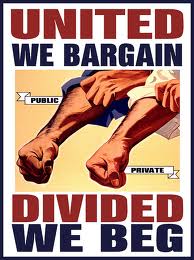
I think that it’s important to begin any conversation regarding unions, uniting, negotiating and representing one another with some acknowledgments.

  1. I absolutely support the effort of an individual to negotiate a higher wage, better working conditions more vacation or increased training.
  2. Further, I acknowledge and support that several employees working together to negotiate these benefits are a stronger negotiating team than an individual.
  3. Employers typically look to hire labor at its cheapest price point but they absolutely look at value, not bottom line dollar cost.

So it is that I have no issue with an employee, alone or with fellow like minded employees, walking into the bosses office and negotiating higher benefits or compensation.  What I do NOT support is the legal protections that change that negotiation from one where two people each seeking their own self-interests are negotiating to one where one of the groups is given such legal protection that the negotiation turns into a racket or where extortion is taking place.

And this is where my problem with organized labor falls.  They have legal protections that allow them to negotiate in bad faith and extort the employer.

Wanna use the tactic that if you are not compensated in the way and manner you want that you’ll walk out?  Fine, but then the boss may fire you in response.

With all of that said, I’m sure there is room for debate and disagreement on the issue of union and organized labor.  However, on one point I am continually astounded that the gentle left won’t critique unions.  And that’s on their tactics.

Discussions surrounding unions always brings to mind union thugs.  The guys that go to the homes of employees who might be on the fence during strikes or organization votes.  Threats against homes and families of those members who might not be towing the line.  And even physical violence to the employers themselves whether it be harm to the individual or vandalism to the property.

This surprise of mine extends to voting methods favored by unions.  An important tactic to form a union is to utilize  public vote, one where the vote of each employee is made in public for all to see.  The idea is that if the vote is private then the employee is able to make a “No” vote without fear of retribution.  Consistently unions and labor supporters work to take away the privacy of the vote not through open and fair compelling arguments but by legislation.  When their ideas lose in the court of public opinion labor uses the law to pass their agenda.

And this feeling that unions must be supported but not the individuals that make them up is shown in the fight against “Right to Work” legislation.  Laws that don’t ban unions but simply take away their power to coerce an employee to belong or not.  No one is saying that a union, in all of its ugliness can’t exist, the law is simply saying that it has to be voluntary.

I simply don’t understand the support of union violence against people and property that is routinely ignored by the left.

And in case the threat is only veiled and simply easy to miss, labor supporters are outright calling for violence:

“We’re going to pass something that will undo 100 years of labor relations and there will be blood, there will be repercussions,  we will re-live the battle of the overpass,” said state Rep. Doug Geiss (D-Taylor).

Blood – Repercussions – Battle

So, what is “The Battle of the Overpass”?

The battle of the overpass was a bloody fracas in 1937 between union organizers and Ford Motor Co. security guards. Walter Reuther was famously thrown down a flight of stairs and another union organizer was left with a broken back.

A literal battle involving organized labor.

This movement is literally violent.  Explicitly violent.  The push to improve the rights of individuals is being conducted by those who are looking to extend and protect rights to the employee who simply doesn’t want to organize, to vote in private and negotiate on his own behalf.


Fiscal Cliff: Musings From The Common Man

I’m sure that most Americans don’t pay attention to the goings on in the same way that I do.  Lot’s of people have a life, for example, and do fun things.  Likewise I don’t hold out much hope that the average Joe is very informed, so, random interviews with random people kinda mean, well, not much in the way of solid policy advice.

But this is cute:

Unemployment Benefits: A Rational Course

I’ve long been an opponent of the unemployment policy usually advocated by our government.  In my moments of most extreme Libertarian I can make the case for no unemployment benefit system at all.  People, understanding that they won’t have a program to fall back on will make efforts to protect against the downside.  This might take the form of more aggressive saving or, perhaps, not getting fired in the first place.

However, not all terminations are due to performance, many are due to economic conditions out of the control of the employee.  Further, it’s unlikely that I’d be able to prevail in my rather “draconian” response to unemployment.  So, knowing that benefits are going to be provided, how best to work within the system to create the best outcome?

Other than its existence, I have two problems with unemployment benefits:

  1. The benefit too closely approximates the typical wage.
  2. The duration of the program is too long.

The system creates the wrong incentives.  In the first place, it reduces the value of working.  For example, if I lose my $10 an hour job and can pull $325 in benefits, the marginal value of me returning to work is $75.  [Maybe $125 or so – I seem to remember the first fifty is “free.]  So the value of working 40 hours moves from $400 to $75.  An hourly rate of $1.88.  In the second place, the system is built with the incentive to delay returning to the workplace until the benefits expire.

So, what to do?

It seems to me that if I had bought into building a system that worked, that is I agreed to set aside the ideology and build a program I might not 100% agree with, I would first define the goals.  It might go like this:

  1. Provide folks assistance to get through the transition to the next job.
  2. Return folks to the workforce as soon as possible.

And the method I would use to build the program that solves both of these goals would be this:

  1. Determine the mean time to return to work without the debilitating incentive of making money while not working.
  2. Pay the unemployed a lump sum regardless of employment status.
    1. Either literally pay the individual a lump sum in the form of one check.
    2. Guarantee weekly benefits for the duration of the identified mean regardless of employment status.

This satisfies the [dubious] requirement of the government providing assistance in the face of adversity while also removing the perverse incentive not to return to the workforce.  In fact, it might actually provide the incentive to return more quickly; who can pass-up on “double dipping.”


Parenting: Socio-Economic vs IQ – The Bell Curve

In considering the many ills that face society, there has been a large focus on the socio-economic status of the family or of the individual in the desire to explain the condition at hand.  For example, if a child grows up to become a criminal, we ask, “what was the socio-economic condition of that child or his parents?”

The idea behind this, of course, is that if we can isolate the failure to the economic inequality of society, then we can begin to “fix it” through governmental programs bent on promoting “equality.”

But what if there was another reason why people did the things they do?  In this section, I speak about Parenting as discussed in the book, “The Bell Curve.”

In the chapter regarding parenting, the first condition discussed is low birth weight babies.  Previously I have shown data that suggests that the SES status of the mother has little bearing on the determination of that condition in children.

But IQ:
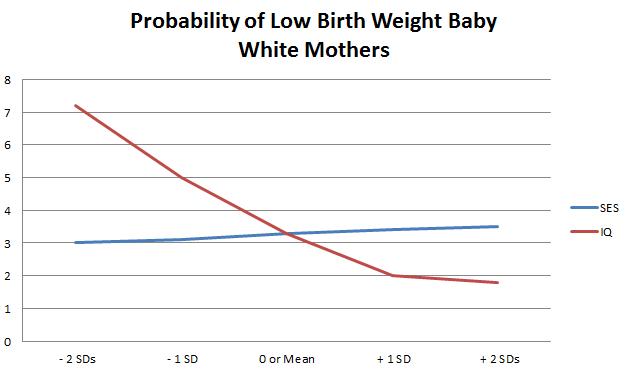
 

As mentioned, the impact of the socio-economic status of the mother is nominal; the IQ of the mother is not.  A low IQ has a major impact on the chance of a baby being born with a low birth weight; SES – not as much.

After being born, the child must face life.  Specifically the prospect of being poor.  Initially, the authors held all variable constant and displayed the prospects of a child remaining poor in the fist 3 years of life based on the mother’s SES.  It didn’t look good.  But what happens if we include IQ:
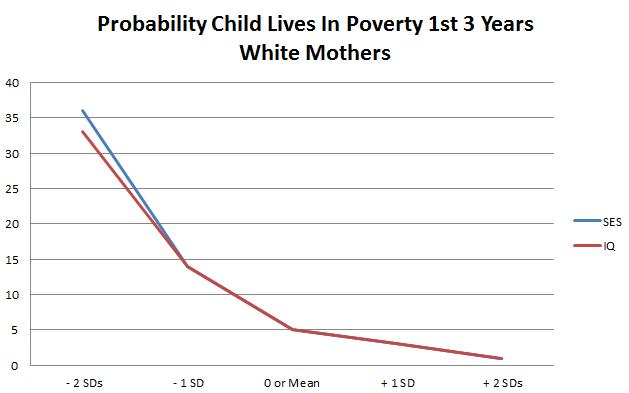
No change.  The poverty rate of the child is equally determined by the SES and the IQ of the mother.  With the data showing such an exact match as both SES and IQ moved from low to high, I suspect that there is a case where one is determined by the other.

Again, following the sections in this chapter, the topic switches to the Home Index:

The Home Observation for Measurement of the Environment (HOME) Inventory is designed to measure the quality and extent of stimulation available to a child in the home environment. The Infant/Toddler HOME Inventory (IT-HOME) comprises 45 items that provide information from the child’s perspective on stimuli found to affect children’s cognitive development. Assessors make observations during home visits when the child is awake and engaged in activities typical for that time of the day and conduct an interview with a parent or guardian. The IT-HOME is organized into six subscales: (1) Responsivity: the extent of responsiveness of the parent to the child; (2) Acceptance: parental acceptance of suboptimal behavior and avoidance of restriction and punishment; (3) Organization: including regularity and predictability of the environment; (4) Learning Materials: provision of appropriate play and learning materials; (5) Involvement: extent of parental involvement; and (6) Variety in daily stimulation. For the IT-HOME, 18 items are based on observation, 15 on interview, and 12 on either observation or interview.

This index was applied to the population in the study and the result showed that the socio-economic status of the mother played a role in the HOME Index rating.  However, IQ played an even more significant role:
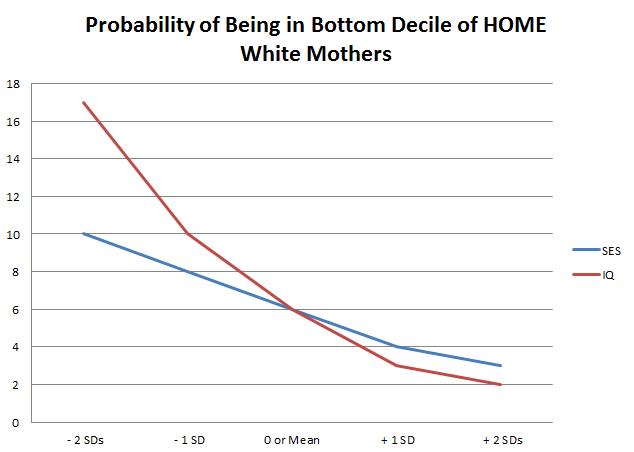
As you can see, a lower IQ is more devastating than a poor mother while I high IQ is more beneficial than a wealthy mother.

As the child grows, the development of the child can be impacted by the  conditions of the home, poverty and parenting skills are, of course, two of those conditions.  In an attempt to measure this development, the authors conducted a survey of 4 developmental indicators and if a child scored in the bottom decile for any of the 4, they scored a “Yes” on the “development index.”  If not, they scored a no.

The results:
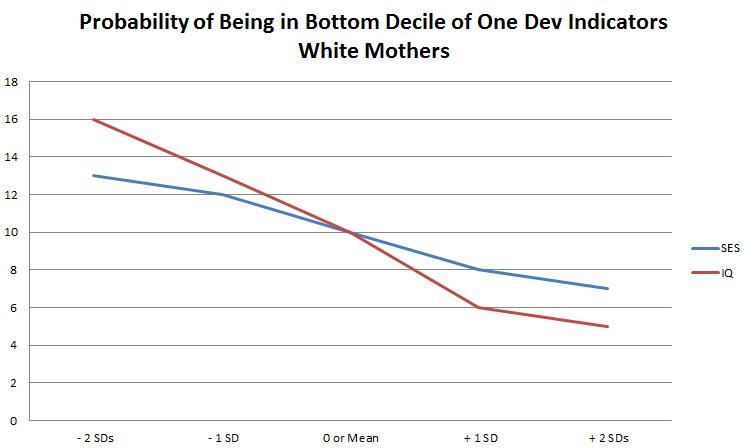
The pattern is again, presented.  IQ at the low end is more detrimental than poverty while at the high end, IQ is more advantageous than being wealthy.  However, in this specific study that difference is marginal.

The final section of the chapter looks into the IQ of the child and tries to determine the significance of been raised in a home more exposed to the challenges of poverty vs. being raised in a more affluent home.  Additionally, the same investigation is conducted using the key variable of IQ:
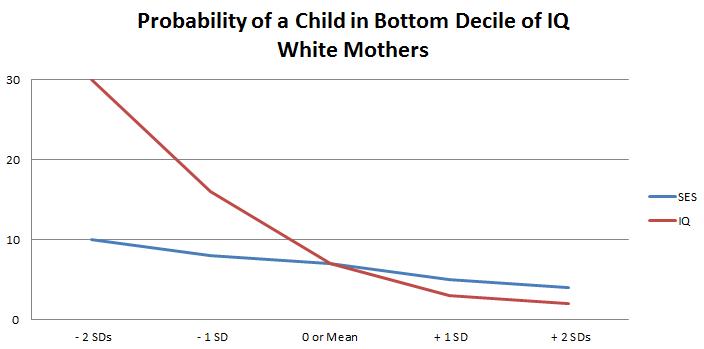
The result is consistent with data already being demonstrated in this and other chapters.  The argument can be made that when isolating the socio-economic status of families and of mothers in the study the well being of the child generally suffers as that mother becomes poorer.  However, when all variables are held constant save IQ, those other factors are diminished to the point of being statistically insignificant.

IQ matters.

Another Government Creation, Another Bailout?

In the same way that government created the housing bubble, the government has created the college-loan bubble.

Once upon a time, government officials decided it would help them keep their jobs if they could claim they had expanded the middle class.  Unfortunately, none of them really understood economics or even the historical factors that led to the emergence of the middle class in the first place.  But they did know two things:  Middle class people tended to own their own homes, and they sent their kids to college.

So in true cargo cult fashion, they decided to increase the middle class by promoting these markers of being middle class.  They threw the Federal government strongly behind promoting home ownership and college education.  A large part of this effort entailed offering easy debt financing for housing and education.  Because the whole point was to add poorer people to the middle class, their was a strong push to strip away traditional underwriting criteria for these loans (e.g. down payments, credit history, actual income to pay debt, etc.)

We know what happened in the housing market.  The government promoted home ownership with easy loans, and made these loans a favorite investment by giving them a preferential treatment in the capital requirements for banks.  And then the bubble burst, with the government taking the blame for the bubble.  Just kidding, the government blamed private lenders for their lax underwriting standards, conviniently forgetting that every President since Reagan had encouraged such laxity (they called it something else, like “giving access to the poor”, but it means the same thing).

What are the chances that we bail out all those kids who’ve majored in such “in demand” course work as Art History, Religious Studies, Women’s Studies and others?

I’d say pretty high.

America’s Vision of Prosperity

I’m pretty sure this explains a lot.  And why I’m continually surprised by conversations that I have with people out and about.  America is changing how she views the path to prosperity and security.

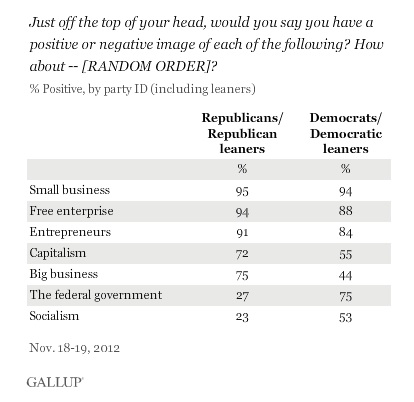
53% of democrats have a positive image of socialism.  While I’m sure few respondents don’t have an accurate definition of the word socialist or socialism, the idea is the same; “Someone else labors to my benefit.”