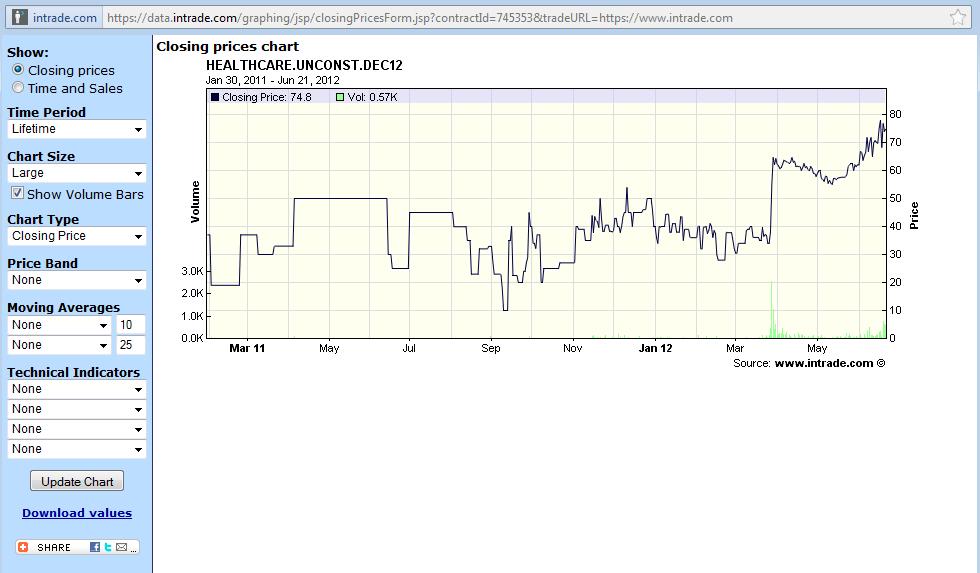
Steady upwards track since April. Intrade has it at 75% that the law is struck down.
Good.

Steady upwards track since April. Intrade has it at 75% that the law is struck down.
Good.
Posted in Economy, Health Care, Liberty, Politics: National
Tagged Barack Obama, Intrade, Obamacare, Supreme Court
Here I am showing Kells how to create a page break.
 So I type a “howl” lotta cool stuff:
Pino Rocks. Pino is always right. Pino is great.
Pino Rocks. Pino is always right. Pino is great.
Pino Rocks. Pino is always right. Pino is great.
And NOW I wanna insert a “Page Break” right after this sentence.

So I go to the Tool Bar above and look for the row of symbols that has a “B” as the first character:
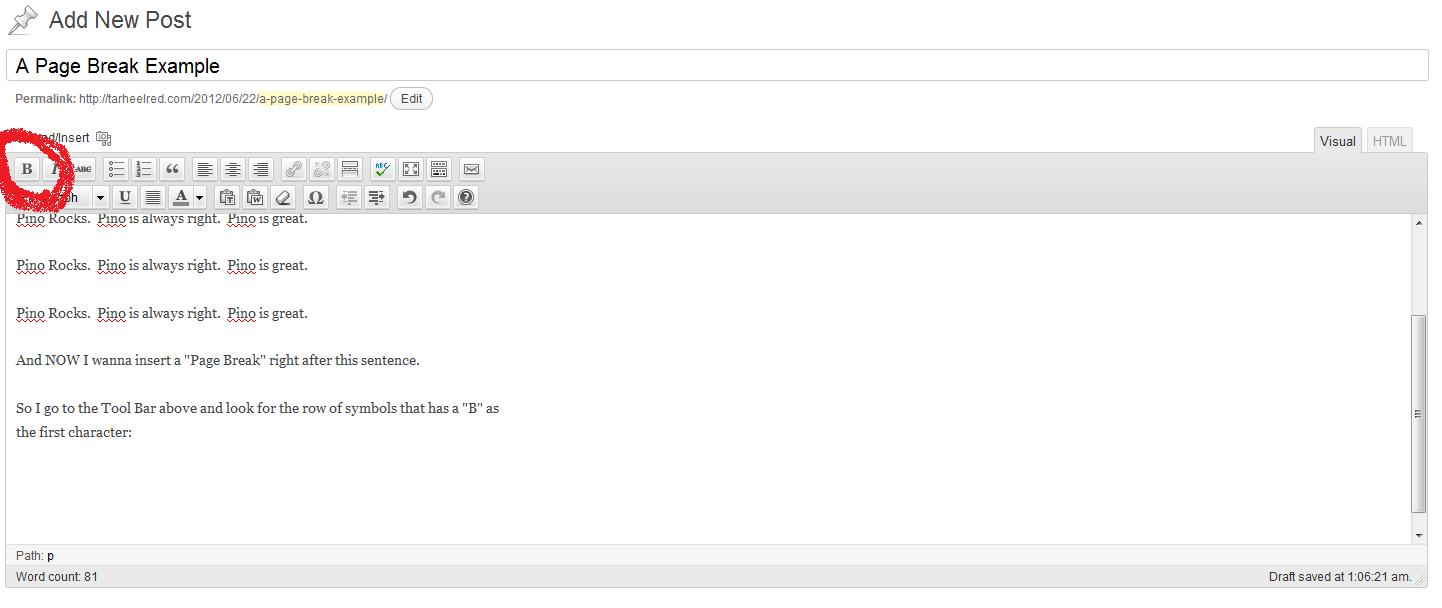
Then I slide over 11 icons until I see the “Rectangle dotted line Rectangle” icon.
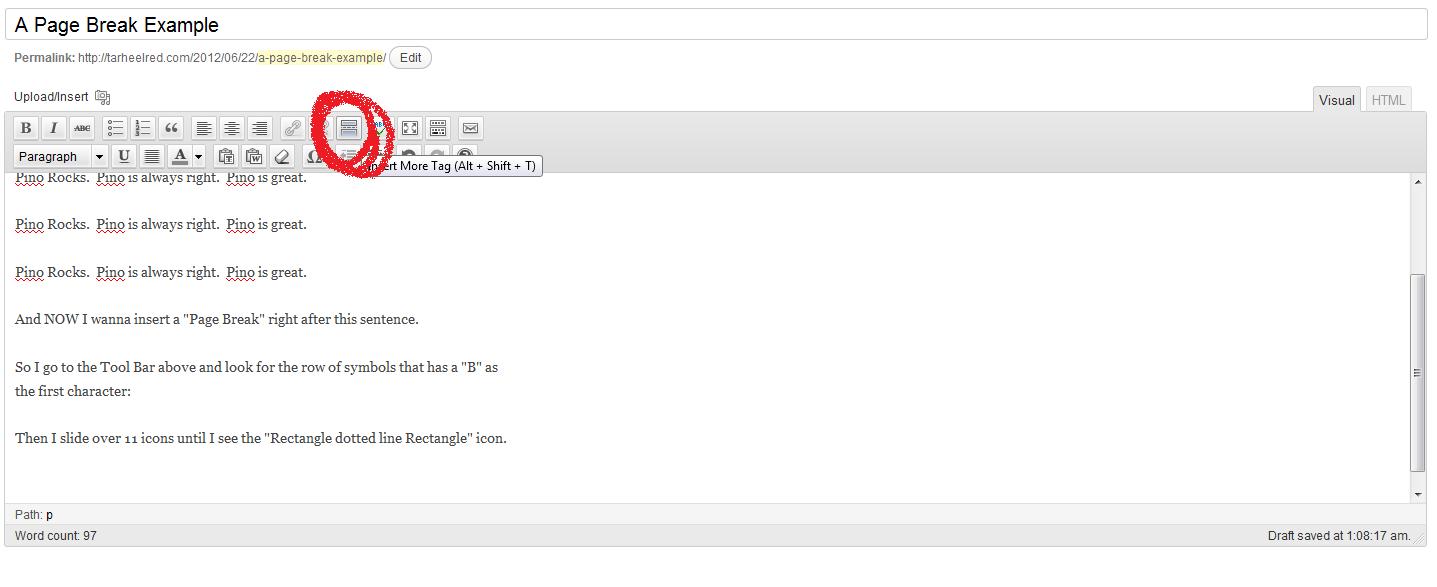
When I do, it looks like this:
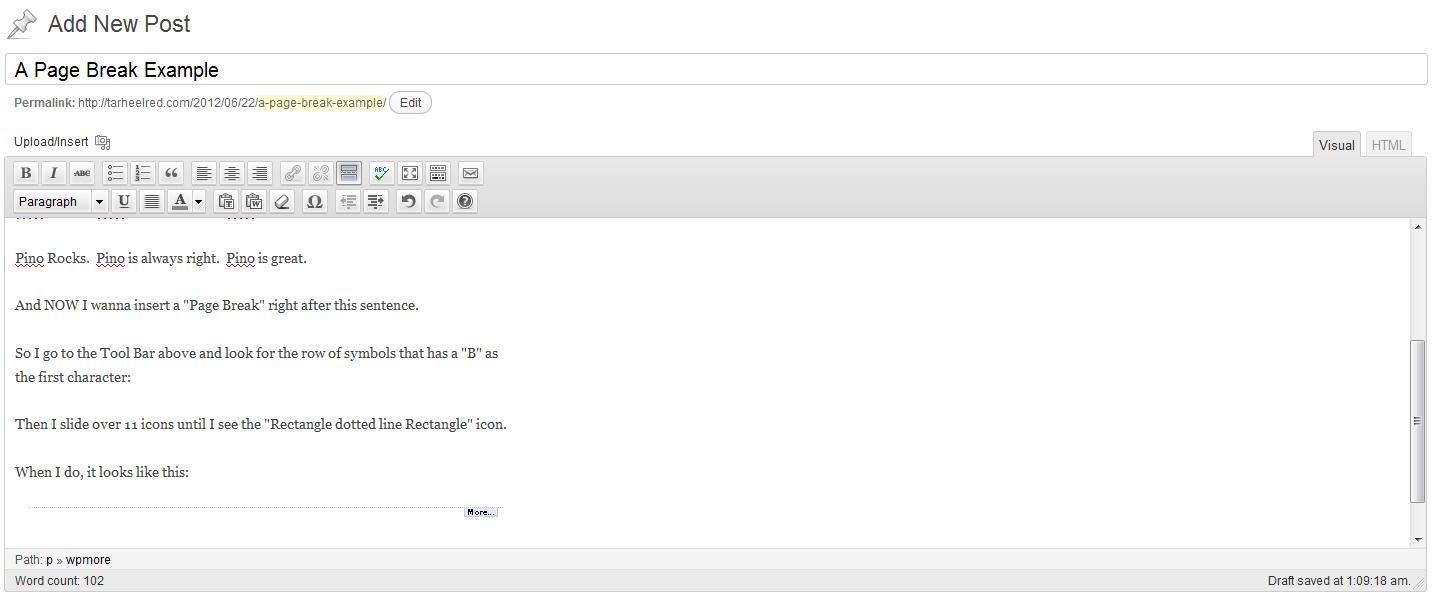
I hit “enter” and type away.
Viola!
Black is happy!

To be fair, I don’t think that Jon Stewart, CNN or the reporter are bias in their reporting. For his sake, Stewart is just running a clip that makes his point and probably just missed it.
But for CNN and the reporter, their mistake is a little bit more egregious. Again, I don’t think there’s bias, rather, they think they have a story – they might well have- and they are just trying to push the numbers they have to make that story more compelling.
Watch. Hint, it’s all over by 00:35
The error was in the numbers the CNN reporter was displaying.
Here is the graphic she used:
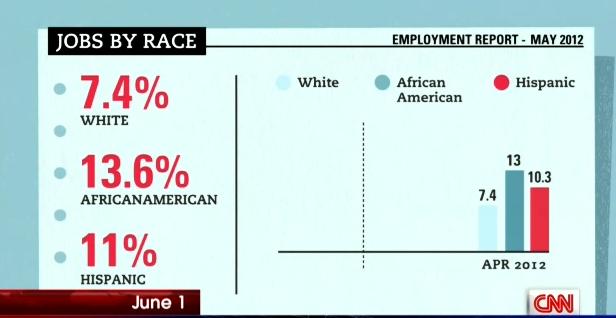
So the numbers and the graph are:
The graph accurately reflects the White unemployment. The graph does NOT reflect AfricanAmerican unemployment. In fact, it shows it lower. Then again, the graph doesn’t show Hispanic unemployment correctly either, however it too shows the data as lower than the raw numbers.
Which is right?
Let’s listen:
… in the black community 14% compared to whites which is 7%. Latino community 11% compared to white’s 7%.
In the dialogue we have white unemployment at 7%. Both the data and the chart show it at 7.4% She reports that black unemployment is 14% but the data shows 13.6% and the chart shows 13%. Depending on which you believe, that’s a whole point. Next she moves to Latinos. In both comparisons she mentions 11%; consistent with the data but not the graph.
Again, I don’t think there is bias here. Jon is setting the table for his bit. But Lordy, how do we trust that these people are saying true things?

I’ve been posting data that comes from the book “The Bell Curve” in a rather chapter by chapter format. I started with Poverty and then moved to Education. This post deals with Employment.
I should mention that the data discussed comes from a study the authors use throughout their book. They have decided to use this data because of the size, scope and amount of relevant data points gathered. That study is The National Longitudinal Survey of Youth [NLSY].
From the book:
The NLSY is a very large [12,686 persons], nationally representative sample of American youths aged 14-22 in 1979, when the study began, and have been followed ever since.
In the beginning chapters of the book, the authors use the NLSY extensively. However, the work that they have done and the results being shown in these early chapters are the result of including only non-Latino whites in the analysis. I’ll explain the authors reasoning in following posts – or you can go ahead and read it for yourself 😉
The next sets of data will show the impact that the socioeconomic status of the individual’s background has on employment and unemployment. First, let’s take a look at the probability that an individual has of being out of the labor force for at least 1 month in 1989:

Interesting curve. In all the data we’ve seen so far, the curve is to the advantage of the more wealthy households. In this case, the probability of leaving the labor force goes up as a kid’s parent’s wealth grows. *
Now, let’s look at the same group of folks in the same year but instead of being out of the labor force, let’s measure unemployment:
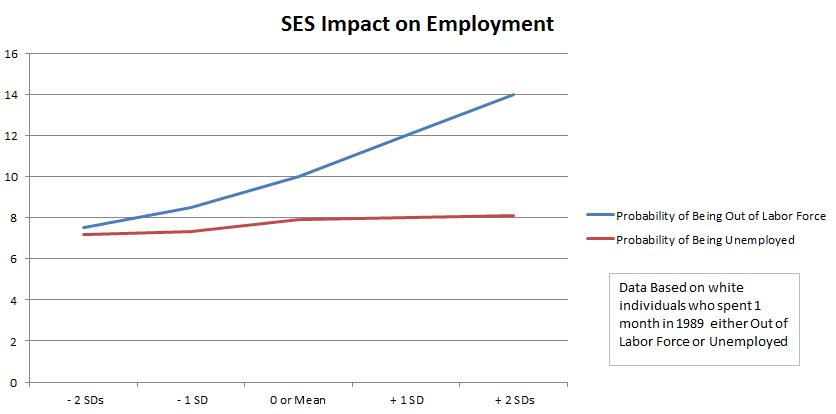 Virtually straight. It really doesn’t matter how wealthy your background is when predicting unemployment.
The impact of SES on the employment and/or unemployment of individuals is hard to gauge. I’m guessing that with further context it’ll make more sense.
* The authors felt this was strange; I don’t. Rich kids can afford not to work.
Posted in Economics, Middle Class, The Bell Curve
Tagged Employment, Socioeconomic, Unemployment
Today President Obama protected Fast and Furious documents by issuing Executive Privilege. I don’t have a lot any knowledge of what this really is so I did a little digging around.
Turns out that our current President is not alone in such actions. For examples of recent such occasions we learn that Dubya used this power 6 times and President Clinton 14. Obama certainly isn’t walking down a path not already well worn.
So, what IS Executive Privilege?
Well, in short, it’s this:
The right of the president of the United States to withhold information from Congress or the courts.
Interesting to note that this very succinct definition simply states that that the president may withhold information. Not one word about the type of information.
A slightly longer but still rather short explanation followed:
The Constitution does not specifically enumerate the president’s right to executive privilege; rather, the concept has evolved over the years as presidents have claimed it. As the courts have ruled on these claims, their decisions have refined the notion of executive privilege and have clarified the instances in which it can be invoked. The courts have ruled that it is implicit in the constitutional Separation of Powers, which assigns discrete powers and rights to the legislative, executive, and judicial branches of government. In reality, however, the three branches enjoy not separate but shared powers, and thus are occasionally in conflict. When the president’s wish to keep certain information confidential causes such a conflict, the president might claim the right of executive privilege.
Again, this seems to offer broad applicability and mentions nothing that the information be directly related to the President himself. Rather, he can restrict the release of information within the executive branch.
In fact, to this end, the concept of Executive Privilege morphed during Eisenhower:
[another] development in the use of executive privilege became known as the candid interchange doctrine. In an attempt to shield the executive branch from the bullying investigative tactics of Senator joseph r. mccarthy, President Eisenhower directed that executive privilege be applied to all communications and conversations between executive branch employees; without the assurance of confidentiality, he claimed, they could not be completely candid. This doctrine marked a tremendous change in the scope of executive privilege, extending it from the president and the president’s top advisers to the myriad offices and agencies that make up the executive branch.
It seems very clear that this privilege extends to much of the information contained within the executive branch. It’s interesting hearing the right wing speak out claiming that this privilege extends only to information that the President personally was engaged in.
However, this does not totally remove the shadows of doubt in Obama’s actions. While the precedent for restricting the release of information goes back to Washington, it did so with a spirit that doesn’t exist today:
The term executive privilege emerged in the 1950s, but presidents since George Washington have claimed the right to withhold information from Congress and the courts. The issue first arose in 1792, when a congressional committee requested information from Washington regarding a disastrous expedition of General Arthur St. Clair against American Indian tribes along the Ohio River, which resulted in the loss of an entire division of the U.S. Army. Washington, concerned about how to respond to this request and about the legal precedent his actions would set, called a cabinet meeting. Although no official record was kept of the proceedings, Thomas Jefferson described the deliberations in his diary. The participants, Jefferson wrote, concluded that Congress had the right to request information from the president and that the president “ought to communicate such papers as the public good would permit & ought to refuse those the disclosure of which would injure the public.” In the case at hand, they agreed that “there was not a paper which might not be properly produced,” so Washington provided all the documents that Congress had requested. This event, though notable as the first recorded deliberation concerning executive privilege, did not carry precedential value until after 1957, when Jefferson’s notes were discovered. In 1958, Attorney General William P. Rogers cited Jefferson’s remarks as precedent for an absolute presidential privilege. Legal scholar Raoul Berger declaimed Rogers’s arguments as “at best self serving assertions by one of the claimants in a constitutional boundary dispute.” Instead, Berger argued, Washington’s willingness to turn over the requested documents shows his recognition of Congress’s right to such materials.
I’m sure Obama’s move is going to enrage the right for some time. For me, I’m certain that he made this move for political reasons and not for legitimate ones. For reason, he didn’t restrict this information until the day of the vote for contempt of Holder. However, Obama certainly isn’t breaking with precedent and is only playing by the rules established by his predecessors.
If you are angry by this move, it would be an example of failing to offer objection to the growth of government power when that power was in “your guy’s” hands.
Make no mistake, I’m distressed by this move made by Obama. I think it’s motivated by politics alone and is despicable. But he’s not doing anything that hasn’t been done, and approved of, before.
Both sides cry foul when it comes to the media. Both sides have data that show the other sides gets preferential treatment when it comes to coverage of “their guy” and they can come up with chapter and verse that shows the positive/negative for the other side is skewed.
It’s fun.
But this, THIS, right here, is crazy.
Here MSNBC doesn’t just take a video and start it at a point that clouds the context or ends it at a point that clouds the context. No. They actually parse the video, showing a clip from an early section, cutting in a piece from another section and finally end it all with yet another cutting later on.
I hear they even added a laughing track.
Check it out:
That isn’t selective reporting. That isn’t commentary that favors one version of ideology over another.
THAT is a blatant distortion of the entire conversation.
THAT is media bias.
Posted in Elections 2012, Politics: National
Tagged Andrea Mitchell, Media Bias, Mitt Romney, MSNBC
On Monday I posted on the impact of parental socioeconomic status as it pertains to their children’s educational outcomes. In reviewing the post I failed to display 1 of 3 findings the authors made. I think I did this because the data failed to demonstrate a point that I will be anxious to make in future posts regarding the book.
I will post now the data that speaks to kids who drop out of school only to later come back and earn their GED instead of obtaining a high school dipploma. The graph is here:

As you can see, SES has a large impact on whether or not a child obtains a GED or stays in school to earn her high school diploma. The wealthiest families generate graduates 9x more often than the poorest families of kids who drop out but come back to earn either their GED or diploma.
Posted in Economics, Education, Middle Class, Politics: National, The Bell Curve

We all know what just happened. Obama announced on Friday that he would no longer authorize the deportation of children in the country illegally:
(Reuters) – Hundreds of thousands of illegal immigrants who were brought into the United States as children will be able to avoid deportation and get work permits under an order on Friday by President Barack Obama.
I immediately came out in support of the policy and think that the time has long ago passed when we need to craft a better immigration policy here in America. As I enjoyed the weekend, however, I began to look past the immediate good news of the policy and think through how we got here.
And I don’t like it at all.
The President issued an Executive Order. By it, he simply stated that he would no longer enforce the deportation of these kids. He did NOT change their status or any laws that speak to that status. He just told us what he would do, or not do, with those found in violation of those laws. I don’t think that rewrote any law or is breaking any laws in doing what he did.
However. Think this through.
When we make it easier for Presidents to change laws based on discretion of prosecution, what’s to prevent a future President from changing tax law in the same manner:
I now declare that I am instructing my administration to stop prosecuting individuals who fail to pay more than 15% of their income in taxes.
Just like that the President can effectively change tax law without the need to involve congress.
I ask you, is this what we want?
Posted in Government, Politics: National
Tagged Barack Obama, Dream Act, Executive Order, Government Abuse
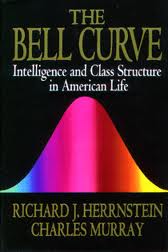
Last week I posted on the impact that socioeconomic status had on childhood poverty. I don’t think anyone was surprised to see that children who come from parents/mothers with a lower standard of living have a greater chance of growing up poor than children whose parents/mother had a higher standard of living:
The data is hard to argue with. The “well off-ness” of the parents seems to have a powerful impact on the chance of poverty of a child.
The book continues this investigation as it relates to education, both high school and college.
First, the authors discuss high school and the rate of drop-outs. That is, what is the probability of a kid finishing high school? And they took a look at this through the lens of the socioeconomic status of the child’s parents. Again, the scale is broken into 5 parts; the median is in the middle and from the center the scale moves on by 1 standard deviation and then another.
When everything else is held constant, the probability of dropping out of school based on the socioeconomic status of the parents looks like this:
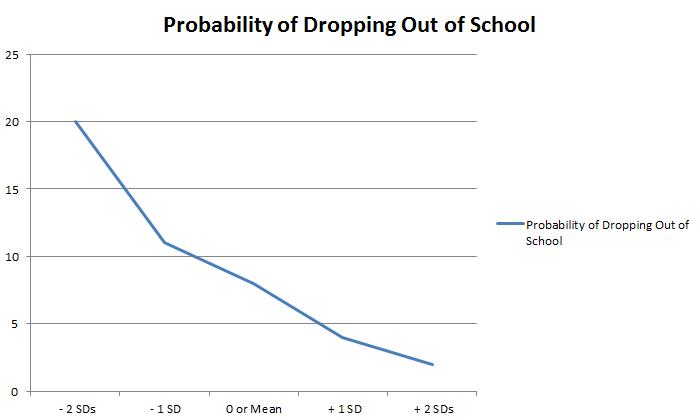 The data is striking. Kids from poorer households dropout of high school a very higher rates than kids from wealthier households. If you look at the extremes, the poorest kids drop out at a rate ~10x as high as the kids from the wealthiest households.
Now take a minute and consider college education and obtaining a 4 year degree. Consider what you might expect the data to show. If the data is consistent with our previous peeks into the impact that SES has on aspects of kids, we might make a pretty good guess.
Here’s the data:
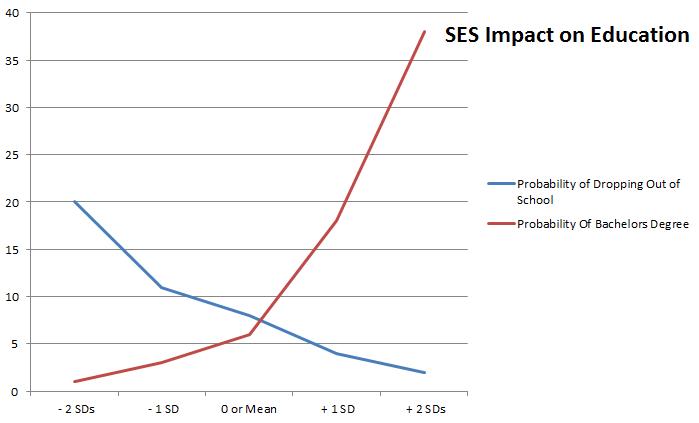
Just as we might expect. The role of the socioeconomic status of the parents is a powerful one for kids who wanna obtain a college degree. Everything else being equal, there is almost no chance that a kid coming from the poorest families will achieve the the thrill of obtaining a diploma while the same kid from our wealthiest families has near a 40% of graduating.
As we close this section I’m struck by two things:
1. Even our richest families are producing college graduates at a less than 40% clip.
2. The wealth of a kids family continues to play a powerful role.
Posted in Economics, Education, Middle Class, Politics: National, The Bell Curve
Tagged Charles Murray, Education, Richard Herrnstein, Socioeconomic

Let’s be honest here; America is a nation OF immigrants. Not only that, but the greatness of our nation is in large part the product of the greatness of those immigrants. This isn’t, or shouldn’t be, surprising. After all, it is the precise individual who is willing to risk everything to come to an unknown land in order to build a better life for himself that creates the very greatness we’re discussing.
With that said I’ve been baffled by the resistance republicans have to immigrants and immigration reform. Baffled for two reasons:
All of which makes what Obama did today distressing:
(Reuters) – About 800,000 young illegal immigrants who came to the United States as children could be spared deportation under new immigration rules announced by President Barack Obama on Friday …
I’m not distressed that Obama made bad policy here, he didn’t. Allowing immigrants who wanna live and work here the legal opportunity is absolutely the right thing. And for this, I am in rare but enthusiastic support of the President. Rather I’m distressed because the republicans have so utterly failed in the whole immigration debate.
This decision will garner support from the Latino vote. And to be sure, those folks won’t suddenly turn into died in the wool leftists. But, BUT, we know that politics is a team sport and soon, not very long to be sure, as people begin to affiliate with a “tribe” they will become a member of that tribe and we’ll find it hard to convert them back to their natural support.
Congratulations to President Obama. Here I think he did the right thing. And the right lost a massive opportunity to do the right thing as well.