Bookstore Account
-
Recent Posts
Recent Comments
- Vrkaine on Ellen Cancelled
- Our Immigration Policy | Tarheel Red on Wherein Pino Solves Immigration
- Scott Erb on Facebook
- Scott Erb on Wahoo and Ragnar
- Scott Erb on Wherein Pino Solves Immigration
- Pino on Noble Intentions
- Scott Erb on Noble Intentions
- Pino on I. Have. No. Words.
- Scott Erb on I. Have. No. Words.
Archives
- February 2022 (1)
- January 2022 (1)
- January 2021 (4)
- November 2020 (2)
- July 2020 (1)
- June 2020 (1)
- January 2020 (2)
- October 2019 (1)
- July 2019 (1)
- May 2019 (1)
- April 2019 (2)
- February 2019 (1)
- January 2019 (1)
- November 2018 (1)
- June 2018 (4)
- April 2018 (2)
- March 2018 (2)
- February 2018 (5)
- November 2017 (2)
- October 2017 (7)
- September 2017 (1)
- August 2017 (8)
- July 2017 (3)
- June 2017 (2)
- May 2017 (4)
- April 2017 (3)
- March 2017 (4)
- February 2017 (1)
- January 2017 (1)
- December 2016 (1)
- November 2016 (7)
- October 2016 (1)
- September 2016 (2)
- August 2016 (4)
- July 2016 (1)
- June 2016 (1)
- May 2016 (15)
- April 2016 (1)
- March 2016 (4)
- February 2016 (4)
- January 2016 (1)
- December 2015 (1)
- November 2015 (8)
- October 2015 (6)
- September 2015 (2)
- August 2015 (2)
- July 2015 (9)
- June 2015 (8)
- May 2015 (2)
- April 2015 (7)
- March 2015 (1)
- February 2015 (2)
- January 2015 (1)
- December 2014 (2)
- November 2014 (4)
- October 2014 (1)
- September 2014 (1)
- August 2014 (2)
- July 2014 (5)
- June 2014 (2)
- May 2014 (2)
- April 2014 (7)
- March 2014 (11)
- February 2014 (21)
- January 2014 (25)
- December 2013 (18)
- November 2013 (11)
- October 2013 (40)
- September 2013 (31)
- August 2013 (40)
- July 2013 (24)
- June 2013 (19)
- May 2013 (54)
- April 2013 (33)
- March 2013 (38)
- February 2013 (32)
- January 2013 (39)
- December 2012 (28)
- November 2012 (54)
- October 2012 (37)
- September 2012 (21)
- August 2012 (40)
- July 2012 (44)
- June 2012 (41)
- May 2012 (21)
- April 2012 (45)
- March 2012 (41)
- February 2012 (46)
- January 2012 (63)
- December 2011 (66)
- November 2011 (55)
- October 2011 (74)
- September 2011 (45)
- August 2011 (82)
- July 2011 (61)
- June 2011 (56)
- May 2011 (51)
- April 2011 (30)
- March 2011 (34)
- February 2011 (39)
- January 2011 (48)
- December 2010 (41)
- November 2010 (35)
- October 2010 (31)
- September 2010 (33)
- August 2010 (46)
- July 2010 (23)
- June 2010 (40)
- May 2010 (43)
- April 2010 (49)
- March 2010 (65)
- February 2010 (29)
- January 2010 (38)
- December 2009 (51)
- November 2009 (48)
- October 2009 (36)
- September 2009 (12)
- August 2009 (10)
- July 2009 (21)
- June 2009 (8)
- May 2009 (6)
- April 2009 (2)
- March 2009 (1)
- February 2009 (16)
- January 2009 (35)
From the Blue
From the Red
Categories
Meta
Why Do We Tax Those Whom We Tax?
I might be willing to agree that we should tax people according to their income. I’d be less inclined to agree that we should increase the rate of taxation as the income moved ever higher.
However the debate went, I would insist on this:
Taxation of the people is meant to pay for the necessary role of government.
There is no way that you could get me to agree that we need to confiscate the wealth of one man and simply hand it to another.
Why Democrats Love Big Labor
You don’t think that the democrats need the unions?
Organized labor spends about four times as much on politics and lobbying as generally thought, according to a Wall Street Journal analysis, a finding that shines a light on an aspect of labor’s political activity that has often been overlooked.
Previous estimates have focused on labor unions’ filings with federal election officials, which chronicle contributions made directly to federal candidates and union spending in support of candidates for Congress and the White House.
But unions spend far more money on a wider range of political activities, including supporting state and local candidates…
Indeed.
But it isn’t just the money. It’s not just the influence that money may be able to buy. It’s the coercion of actual voters:
…and deploying what has long been seen as the unions’ most potent political weapon: persuading members to vote as unions want them to.
And what do unions spend money on?
The costs reported to the Labor Department range from polling fees, to money spent persuading union members to vote a certain way, to bratwursts to feed Wisconsin workers protesting at the state capitol last year. Much of this kind of spending comes not from members’ contributions to a PAC but directly from unions’ dues-funded coffers.
But these costs are certainly reported as political efforts, yes?
There is no requirement that unions report all of this kind of spending to the Federal Election Commission, or FEC.
So, to review, unions are able to use money collected through dues to support the election of politicians who then pass legislation that allows unions to prevent workers from working unless they belong to a union? And then “due” them to death.
Nice gig.
I was in Charlotte when Walker won in Wisconsin. When he beat the unions. I was watching Maddow. She was crestfallen that the democratic party was at the brink. She pointed out that without the unions, the democrats didn’t have any way to raise money. She was half right.
Corporations and their employees also tend to spread their donations fairly evenly between the two major parties, unlike unions, which overwhelmingly assist Democrats. In 2008, Democrats received 55% of the $2 billion contributed by corporate PACs and company employees, according to the Center for Responsive Politics. Labor unions were responsible for $75 million in political donations, with 92% going to Democrats.
They still get half the take, they just don’t get ALL the union take.
Let’s hope the gig is up.
The Family: SES Impact – The Bell Curve
I’m continuing my way through the book, “The Bell Curve” by Herrnstein and Murray. I’ve posted already on several of the chapters describing the impact of the socioeconomic status of the families people come from. Fascinating stuff.
The chapter next on the list deals with the family; specifically the family structure. The chapter takes a look into what impacts how the family is formed and remains together, or not.
First, let’s take a look at marriage. Specifically, marriage by the age of 30. Marriage is very important in society and is critical in creating the building blocks that form successful family units.
So, how does the socioeconomic status of the parents impact the chance of marriage of the child?
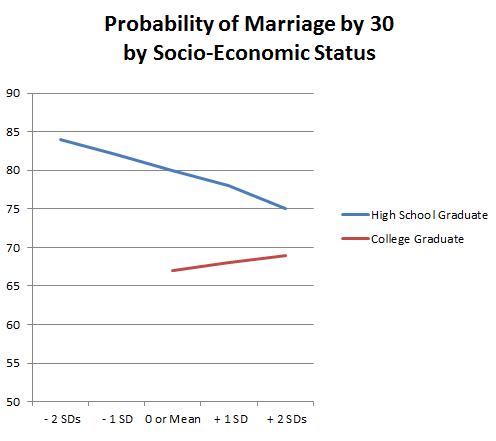
The chart above shows data for white individuals in the study.
Because of the impact of education and its suppression on marriage, it’s useful to separate folks who have a high school diploma only from those who have a college diploma. As you can see, socioeconomic status of the family of the individual has little impact on marriage. Most people are married by 30 with an even higher percentage married by 40.
If marriage is important, then divorce is important as well. After all, it’s the two parent home that’s critical to the success of ensuring kids gain a strong foothold in life. And the data?
An interesting trend to be sure. As family wealth increases, the rate of divorce increases as well. Indeed, by the time we reach 2 standard deviations from the mean SES, the individuals are divorcing at 17 points higher than those on the lower SES end. This represents a greater than 100% increase.
Here the conversation shifts from marriage and divorce without reference to children to those families formed outside of marriage. And so enters the illegitimate child. I tend to agree with the authors that the old-fashioned view of illegitimacy was that it occurred mostly at the lower ends of the socioeconomic scale. It was “the poor girls” having babies out of wedlock, not the wealthy.
But does the data support that view? The answer is kinda.
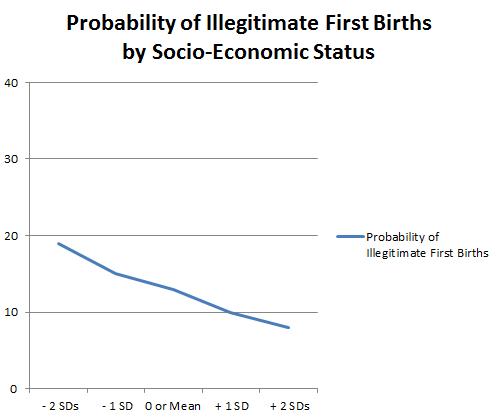
The women at the very end of the socioeconomic scale have illegitimate births at a 19% rate while the richest of women are giving birth about 8-9% before marriage. The 10 points or so isn’t much, but again, does represent nearly a 100% increase in the rate comparing the very wealthy to the very poor.
Here the authors move into an interesting question. Does poverty cause illegitimacy or does the welfare system cause illegitimacy? The idea, or the argument, being is that the welfare system enables the single mom to refrain from taking precautions that she might otherwise take if she were to bear the cost of raising the child.
To tease out an answer to this, an interesting question is asked:
Among NLSY white mothers who were at or below the poverty line in the year prior to giving birth, what proportion of the babies were born out of wedlock? The answer is 44%. For women above the poverty line? 6%.
What does the data, shown in the usual format, show us?
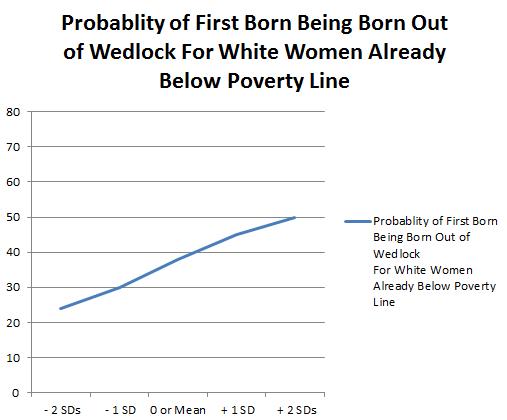
A pretty compelling argument that the wealth of the mother’s family plays a role.

Posted in Economics, Middle Class, Politics: National, The Bell Curve
Tagged Charles Murray, Richard Herrnstein, Single Mom, Socioeconomic
The Romney Vice President
I don’t know how important a VP pick really is. Can anyone really say that Biden did or didn’t play a role in getting Obama elected? Palin certainly drew attention when she was selected by McCain, but McCain could have chosen Reagan and he still would ave lost.
I’m not sure that the pick will really truly matter. However, it WILL provide gigabits of data for those of us junkies out there.
With that said, I really would like the pick to be someone who has “done” something. A governor, the head of an agency, a director of this or that, anything. Anything but another senator or congressman. It’s for these reasons that I don’t like any talk of a Rubio or a Ryan. The role of an executive should be filled by someone qualified to be an executive.
My favorite pick to date has been Condi Rice. And the rumors are flying today:
Political observers are asking whether Mitt Romney could pick Condoleezza Rice as his running mate a day after a story on the Drudge Report said she has emerged as the front-runner.
I think the pick would be perfect. Rice is an accomplished statesman on her own right. She’s gifted intellectually, has a resume a mile long and is well liked among conservatives:
Strategists acknowledge picking the former Bush administration secretary of State would be a bold, unconventional choice that could broaden support for Romney among independents.
Romney may wait until the convention to name his choice. We might be weeks away. And this may just be a tactic to change the narrative from Bain to something/anything else.
Who knows. But I think Ms. Rice would be a fantastic choice.
New Must Read Website
I’m not sure how many of you read XKCD.com. If you don’t, you should; he’s great and smart and funny.
But he’s launched a new site, a site called What If. Apparently the blogger gets email with “what if…..” questions. This new site is his way of answering those questions.
What If you don’t read What If?
Your life will be just a little less fun.
More Free Market Airline Style
I’ve mentioned in the past that the airlines are employing some unique methods in order to raise additional revenues while protecting passengers who may not wanna take part in higher fares.
One of those examples is paying extra for prime seats. For example, I’ve pointed out that some airlines are experimenting with charging folks extra for aisle and window seats.
Personally, this makes great sense to me. I absolutely LOVE not sitting in the middle seat and am willing to pay money not too. Others, however, are not willing to pay additional fees in order to travel and are thus more than happy to trade a middle seat for money.
We all win.
Well, here’s another example:
…according to a survey by Airfarewatchdog.com, a fare-tracking site that found 16% of respondents were willing to pay to be at the front of the line when their flight lands. Of that group, 10% would pay $10 and 3% would pay as much as $20.
I’m traveling again this week and the example below really happened to me:
An early exit can also give fliers more time to make their connections. Airlines have gotten better at getting passengers to their destinations on time. In the first four months of this year, major U.S. carriers had an on-time arrival rate of 84.54%, their best performance for that period in 18 years, according to the Transportation Department’s Bureau of Transportation Statistics.
But even if their flight’s not delayed, passengers often have little cushion to make a connecting flight. Paying a few more dollars to be first off the plane could be an advantage, Hobica says.
I had one hour to get from my flight to my connection. It appeared we were gonna be late and I’d rather have the extra time by being in front of the plane rather than in the back. In this case, I didn’t have to pay extra [I would have], but I DID have to trade an aisle seat for a middle seat. But I saved 17 rows. And at 6 people per row, that’s a lot of time.
Personally, I’m all for these free market measures that airlines use to spread the cost of flying to those who want the extras.