Laffer Curve – California Dreamin

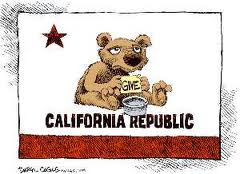
California is broke.  Way broke. And spending is the problem.  So what did California do?  They enacted new laws calling for new taxes on the rich:

The big state tax news is that California voters said to sock it to the rich–specifically those with income of $250,000 and up. California Proposition 30, which Gov. Jerry Brown’s budget and public education in particular depended on, passed.

Proposition 30 creates three new upper income tax brackets for the next seven years. For example, folks with $250,000 to $300,000 a year in income will pay 10.3%, up from 9.3%. The new top income tax rate–for folks with income of $1 million-plus–will be 13.3%, up from a current top rate of 10.3%. That eclipses New Yorkers’ combined state and local top rate of 12.7% and Hawaii’s top rate of 11%. The income tax hikes are retroactive to Jan. 1, 2012, but the extra bill isn’t due until April 15, 2013.

The expected result?  Well, if past results can predict future ones, I would expect that California sees more people leaving:

Nearly four million more people have left the Golden State in the last two decades than have come from other states. This is a sharp reversal from the 1980s, when 100,000 more Americans were settling in California each year than were leaving. According to Mr. Kotkin, most of those leaving are between the ages of 5 and 14 or 34 to 45. In other words, young families.

Meanwhile, taxes are harming the private economy. According to the Tax Foundation, California has the 48th-worst business tax climate. Its income tax is steeply progressive. Millionaires pay a top rate of 10.3%, the third-highest in the country. But middle-class workers—those who earn more than $48,000—pay a top rate of 9.3%, which is higher than what millionaires pay in 47 states.

People aren’t gonna put up with it; they aren’t going to continue to work harder for less, pay more for smaller houses and face ever increasing costs associated with energy and transportation.

The Laffer Curve wins again.

Empty Seats Olympic Style

Much attention was made during the 2012 Olympic games in London over the row after row of empty seats for many of the venues.  It seems that tickets are being allocated to various countries, agencies, athletes and families who simply don’t want to attend those events.

I might suggest we’ll see it in Russia too:

MOSCOW –  The upper house of Russia’s parliament has passed a bill calling for fines of up to $30,000 for anyone scalping tickets to the 2014 Winter Olympics in Sochi.

The bill, passed Wednesday by the Federation Council, now needs to be signed into law by President Vladimir Putin.

For low-level scalping by individuals, the fine would be five to 10 times the ticket’s face value, but penalties will be heavier for scalping done as a business.

Russian Olympic Committee head Alexander Zhukov told a news conference that “we as Olympic organizers have an obligation under our contract with the International Olympic Committee to prevent speculative price hikes for hotels and Olympic tickets.”

There needs to be a market for these tickets.  For those who don’t wanna go to the venue or the game, they need an easy method for selling those tickets to someone who does.  And at fair market value.

For an example of the London experience:

Germany, Canada, Norway and Slovakia are represented here as having produced suspects in a strict crackdown on ticket scalping and other ticket fraud, stretching from venues across the city to global Internet outlets.

Since the first full day of competition, the Metropolitan Police Department has swept up more than 30 people for scalping or ticket “touting,” including a 29-year-old man who was sentenced this week to 28 days in jail for hawking tickets outside the Olympic boxing venue.

In a separate action this week, three Norwegian companies, which operate 12 websites, have agreed to provide full refunds for up to 15,000 tickets that they were not authorized to sell, the result of an ongoing inquiry by Britain’s Office of Fair Trade.

The string of criminal arrests and civil actions represent yet another slice of ticket woes that have shadowed the Summer Games in which organizers have been scrambling since the start to fill empty seats across the venues.

Just make these tickets available to the market and the market will adjust the price until the stadium is full, or more full than it otherwise would be.

But in classic “big government style”:

The troubles prompted the chairman of the British Olympic Association, Colin Moynihan, to call for the International Olympic Committee to take over the ticketing operation and provide a centralized system for ticket distribution.

There’s no reason for these laws to be on the books.  And there’s no reason for the centralization of ticket distribution.

Set the tickets free!


Holidays

To All My Liberal, Democrat Friends:

Please accept with no obligation, implied or implicit, my best wishes for an environmentally conscious, socially responsible, low-stress, non-addictive, gender-neutral celebration of the winter solstice holiday, practiced within the most enjoyable traditions of the religious persuasion of your choice, or secular practices of your choice, with respect for the religious/secular persuasion and/or traditions of others, or their choice not to practice religious or secular traditions at all. I also wish you a fiscally successful, personally fulfilling and medically uncomplicated recognition of the onset of the generally accepted calendar year 2013, but not without due respect for the calendars of choice of other cultures whose contributions to society have helped make America great. Not to imply that America is necessarily greater than any other country nor the only America in the Western Hemisphere. Also, this wish is made without regard to the race, creed, color, age, physical ability, religious faith or sexual preference of the wishee.


To My Conservative, Republican Friends:

Merry Christmas and Happy New Year.

An Argument In Favor Of Guns

There has been tons, I mean TONS, of reporting lately on the negative aspects of an armed citizen.  Let us not forget the benefits of said armed citizens:

Henderson, N.C. — Police are investigating a fatal shooting Sunday at a Henderson home that appeared to result from a home invasion.

Deyon Durham, 24, of 279 Faulkner St., was found shot to death at 1221 Montgomery St. shortly after 7 a.m., police said.

The initial investigation suggests that Durham was breaking and entering at the home when the homeowner, whose name was not released, shot him.

I understand that the scene in Henderson remains a tragedy; a young man in the prime of his life has perished.  But the home of an innocent citizen has been defended.

And, just like in the face of numerous other tragedies around the country, there is a back story that may have prevented the tragedy.  In this case, how was Mr. Durham free in society?

Durham had convictions, starting in 2005, for indecent liberties with a minor, sexual battery, breaking and entering vehicles, larceny and failure to register as a sex offender, according to state Division of Adult Correction records.

In parallel to those tragedies that are gathering more media attention across America, this one could have been prevented by methods other than taking guns out of legal citizen’s hands.  Perhaps, for example, by locking Mr. Durham up.

Small Businesses Pessimistic

ho ever you might wanna blame for the shenanigans in Washington, the result is not good for small business CEOs, their expectations and, presumably, their staffs:

SAN FRANCISCO, November 30, 2012 – Small business owners as a group are now the most pessimistic they have been since the third quarter of 2010, according to the latest Wells Fargo/Gallup Small Business Index. The Index fell 28 points to negative 11 (-11) in the post-election survey conducted Nov. 12-16, 2012.

Most interesting to Americans in general is the expectations surrounding jobs:

Likely related to owners’ pessimism, one in five small business owners (21 percent) expects to decrease the number of jobs at their company over the next 12 months – the largest percentage of small businesses expecting to reduce jobs since the inception of the Wells Fargo/Gallup Small Business Index in 2003. One in four owners (26 percent) reported a reduction in the number of jobs at their company over the past 12 months, representing the largest percentage since the fourth quarter of 2010.

There is little hope that the situation in Washington is going to work out for the small businessman.  Some of the blame can certainly be attributed to the expectation that republicans would refuse to work with Obama.  However, a significant amount of that pessimism most certainly is attributed to the anti-business attitude that the Obama administration brings to Washington.

Contemplations

I’m in danger.

I’m in danger of moving on from the horrors of the world and living my self absorbed life.  I have my family, my job and my concerns to keep me busy and focused.  Absorbed.

I’m in danger of letting Connecticut become a statistic.

And the only way out is to visualize the scene.  To imagine being the teacher in that class.  Being the father of that student.  Being the husband of that principal.

But I can’t do that every day, every night.  I can’t stop moving to keep this day fresh; the point isn’t that.  The point is to internalize and to move on.  To remember, to be sure, but move past the shade.

For me, the lesson from this tragedy is that the world is an imperfect place full of people who are, well, human.  We live among men who are full of failings, constantly striving to be better, but just as often failing.  The world is a harsh harsh place.

The natural response to this tragedy, and the others like it, is to say, “What can we do to ensure this never ever happens again?”  But that question isn’t based in the reality of that world in which we find ourselves.  Tragedy is going to find us again.  And it’s going to hurt.

I don’t think the answer lies in how we regulate our guns.  Rather, I think it’s in how we regulate our hearts.  How we can better love those close to us.  Those far from us and those around us.  Could that day 1 week ago have been avoided had more understanding or love been applied to that boy?  I dunno.  Could some of the tragedies that we live through be avoided were there more understanding?  More empathy?  More love?

I have to think so.

We’re not going to be able to regulate our way out of this.  We can’t let ourselves to think that this isn’t ever going to happen again.  But we can try, through the various options open to us, work to make the next time occur further in the future.  To reduce the number of next times.

And to make sure that those around us know that they are loved by us.


There Are No Words

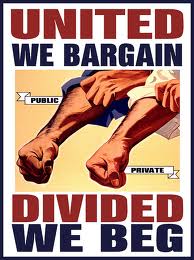
A Characteristic of Unions

I think that it’s important to begin any conversation regarding unions, uniting, negotiating and representing one another with some acknowledgments.

  1. I absolutely support the effort of an individual to negotiate a higher wage, better working conditions more vacation or increased training.
  2. Further, I acknowledge and support that several employees working together to negotiate these benefits are a stronger negotiating team than an individual.
  3. Employers typically look to hire labor at its cheapest price point but they absolutely look at value, not bottom line dollar cost.

So it is that I have no issue with an employee, alone or with fellow like minded employees, walking into the bosses office and negotiating higher benefits or compensation.  What I do NOT support is the legal protections that change that negotiation from one where two people each seeking their own self-interests are negotiating to one where one of the groups is given such legal protection that the negotiation turns into a racket or where extortion is taking place.

And this is where my problem with organized labor falls.  They have legal protections that allow them to negotiate in bad faith and extort the employer.

Wanna use the tactic that if you are not compensated in the way and manner you want that you’ll walk out?  Fine, but then the boss may fire you in response.

With all of that said, I’m sure there is room for debate and disagreement on the issue of union and organized labor.  However, on one point I am continually astounded that the gentle left won’t critique unions.  And that’s on their tactics.

Discussions surrounding unions always brings to mind union thugs.  The guys that go to the homes of employees who might be on the fence during strikes or organization votes.  Threats against homes and families of those members who might not be towing the line.  And even physical violence to the employers themselves whether it be harm to the individual or vandalism to the property.

This surprise of mine extends to voting methods favored by unions.  An important tactic to form a union is to utilize  public vote, one where the vote of each employee is made in public for all to see.  The idea is that if the vote is private then the employee is able to make a “No” vote without fear of retribution.  Consistently unions and labor supporters work to take away the privacy of the vote not through open and fair compelling arguments but by legislation.  When their ideas lose in the court of public opinion labor uses the law to pass their agenda.

And this feeling that unions must be supported but not the individuals that make them up is shown in the fight against “Right to Work” legislation.  Laws that don’t ban unions but simply take away their power to coerce an employee to belong or not.  No one is saying that a union, in all of its ugliness can’t exist, the law is simply saying that it has to be voluntary.

I simply don’t understand the support of union violence against people and property that is routinely ignored by the left.

And in case the threat is only veiled and simply easy to miss, labor supporters are outright calling for violence:

“We’re going to pass something that will undo 100 years of labor relations and there will be blood, there will be repercussions,  we will re-live the battle of the overpass,” said state Rep. Doug Geiss (D-Taylor).

Blood – Repercussions – Battle

So, what is “The Battle of the Overpass”?

The battle of the overpass was a bloody fracas in 1937 between union organizers and Ford Motor Co. security guards. Walter Reuther was famously thrown down a flight of stairs and another union organizer was left with a broken back.

A literal battle involving organized labor.

This movement is literally violent.  Explicitly violent.  The push to improve the rights of individuals is being conducted by those who are looking to extend and protect rights to the employee who simply doesn’t want to organize, to vote in private and negotiate on his own behalf.


Government Response to Sandy

Government is inefficient, but I repeat myself.

Sandy created massive problems, and New York found themselves utterly unprepared:

Sandy flooded both tubes of the Brooklyn-Battery Tunnel, now called the Hugh L. Carey Tunnel, which was one of the major and longest transportation disruptions of the storm. It also ravaged the Rockaways in Queens, particularly the waterfront community of Breezy Point, where roughly 100 homes burned to the ground in a massive wind-swept fire.

Among the other crises Cuomo and New York City Mayor Michael Bloomberg faced on a daily basis during Sandy were the shortage of temporary housing, which continues, the long disruption of electricity and gasoline, generators in health care facilities swamped by floodwaters, restoring power from swamped electrical infrastructure and repairing commuter rail lines.

But it didn’t have to be this way:

More than three decades before Superstorm Sandy, a state law and a series of legislative reports began warning New York politicians to prepare for a storm of historic proportions, spelling out scenarios eerily similar to what actually happened: a towering storm surge; overwhelming flooding; swamped subway lines; widespread power outages. The Rockaway peninsula was deemed among the “most at risk.”

But most of the warnings and a requirement in a 1978 law to create a regularly updated plan for the restoration of “vital services” after a storm went mostly unheeded, either because of tight budgets or the lack of political will to prepare for a hypothetical storm that may never hit.

I’ll withhold my typical scorn of “the government should take care of us.”  After all, this is a state law meant to address problems that the state would face.  However, I will point out the main problem with government solutions:

They don’t work very well.

Had individual citizens taken efforts to protect themselves rather than holding out some fantastical hope of government assistance, the whole region would be better off.

Kansas Day of Prayer

There is some amount of controversy in Kansas:

The Freedom From Religion Foundation is urging Kansas Governor Sam Brownback to rescind his religious proclamations and opt not, in his official capacity, to attend or endorse the overtly Christian event “Going to the Heart,” which is scheduled to broadcast live from Topeka, Kan., on Dec. 8 from 3-6 p.m. CST.

Brownback not only publicly declared Dec. 8 a “Day of Restoration,” but recorded a promotional video for the national simulcast, calling on citizens to “pray to God, in humility and in unity to ask for his favor and assistance in these difficult times.”

I happen to feel that the United States is explicitly founded on the basis of a nation endowed by the Creator; we are a Spiritual nation.

However, I am further convinced that we are not an explicitly Christian nation.  Further, I’m aware of the rulings of the Supreme Court that has severely restricted any government involvement in matters spiritual.

The worry that occupied the framers was not the public displays of religion or of government officials calling on days of prayer; indeed, Washington himself was very explicit regarding his belief that America was a Divine Experiment and often issued orders of prayer.  Rather, the concern was that the government not establish a religion.  That the government not pass laws requiring the joining of any religion or of passing any legislation that would require taxes to fund a state religion.

That being said, what would the general public say if, instead of asking citizens to “pray to God” implored them to “pray to Allah?”

Especially interesting because both the Christian God and the Muslim Allah are the God of Abraham.  In other words, the same divine entity.