
Category Archives: Politics: National

Thelma And Louise

I’m guessing we go over.

John Boehner has said that he’ll give House members 48 hours to get back to Washington.  That means if he were to call them right now they wouldn’t get to their offices until Saturday.  Which leaves 2 days to pass legislation.

And that’s if he agrees to pass the Senate version of the bill.

As it stands right now, I think that the problem is this:

  • The President will not budge on his demand that the tax rate on wealthy Americans goes up.  That is a deal breaker for him.
  • The democrats will not agree to spending cuts other than defense.
  • The republicans will not raise the tax rate on anyone.

The fiscal cliff is made up of two parts.  The first is the expiration of the Bush-era tax cuts.  Because these rates were pushed through using reconciliation, they were set to expire in 2011.  However, as part of a negotiation, the rates were extended for 1 year.  This agreement will end December 31st at midnight.  Failure to extend the Bush tax rates will result in a massive tax hike for every American.

The second part is the agreement made that will mandate budgetary cuts; spending cuts.  Among the items set to be cut is the defense budget.  This is seen to be unappealing to republicans.

A guilty pleasure of mine would be to see us go over this cliff in full.  I want to see how American’s react to the tax hike that will impact them January 1.  This would include the extraordinarily large impact of the AMT that would impact millions of Americans.

However, my sick sense of cosmic justice aside, I really am looking for a permanent extension to the Bush tax cuts.  It not only is the right thing to do, but trying to raise the rates like Obama has been insisting is only a political ploy not meant to address any of the fiscal issues that we have right now.  With the rates made permanent, the economy will be able to remove the uncertainty and move forward in recovery.

As for the cuts.  I say let ’em come.  The impact will be short-term dramatic.  I suspect the economy will move into recession but it will be quick and short.  However, the long term benefit of the cuts will reduce the size of government spending and allow the economy to grow more quickly than it otherwise might.

My desire aside I feel that the ball is in the Senate’s court.  Financial bills originate in the House and move to the Senate for consideration.  The Senate should pass the bill or amend it and return it to the House.  Under Boenher, the House has passed two such bills that are simply waiting to be considered by Harry Reid.  For whatever reason, Reid will not hear those bills and allow the Senate to act.

Right now, the delay in passing a bill is squarely on Harry Reid and the democrats.

Did the Community Reinvestment Act (CRA) Lead to Risky Lending?

Yes it did:

Yes, it did. We use exogenous variation in banks’ incentives to conform to the standards of the Community Reinvestment Act (CRA) around regulatory exam dates to trace out the effect of the CRA on lending activity. Our empirical strategy compares lending behavior of banks undergoing CRA exams within a given census tract in a given month to the behavior of banks operating in the same census tractmonth that do not face these exams. We find that adherence to the act led to riskier lending by banks: in the six quarters surrounding the CRA exams lending is elevated on average by about 5 percent every quarter and loans in these quarters default by about 15 percent more often. These patterns are accentuated in CRA-eligible census tracts and are concentrated among large banks. The effects are strongest during the time period when the market for private securitization was booming.

This should not be contentious or surprising or controversial.

The government wanted to increase the home ownership rate among US citizens.  The government created conditions that would increase that rate.  Such conditions led to practices that helped that increase.

In short; riskier lending.

And at the heart of it all?  The usual suspects; Fran and Fred:

To satisfy CRA examiners, “flexible” lending by large banks rose an average 5% and those loans defaulted about 15% more often, the 43-page study found.

The strongest link between CRA lending and defaults took place in the runup to the crisis — 2004 to 2006 — when banks rapidly sold CRA mortgages for securitization by Fannie Mae and Freddie Mac and Wall Street.

CRA regulations are at the core of Fannie’s and Freddie’s so-called affordable housing mission. In the early 1990s, a Democrat Congress gave HUD the authority to set and enforce (through fines) CRA-grade loan quotas at Fannie and Freddie.

It passed a law requiring the government-backed agencies to “assist insured depository institutions to meet their obligations under the (CRA).” The goal was to help banks meet lending quotas by buying their CRA loans.

But they had to loosen underwriting standards to do it. And that’s what they did.

Oh boy, this won’t play well in the press.

A Characteristic of Unions

I think that it’s important to begin any conversation regarding unions, uniting, negotiating and representing one another with some acknowledgments.

  1. I absolutely support the effort of an individual to negotiate a higher wage, better working conditions more vacation or increased training.
  2. Further, I acknowledge and support that several employees working together to negotiate these benefits are a stronger negotiating team than an individual.
  3. Employers typically look to hire labor at its cheapest price point but they absolutely look at value, not bottom line dollar cost.

So it is that I have no issue with an employee, alone or with fellow like minded employees, walking into the bosses office and negotiating higher benefits or compensation.  What I do NOT support is the legal protections that change that negotiation from one where two people each seeking their own self-interests are negotiating to one where one of the groups is given such legal protection that the negotiation turns into a racket or where extortion is taking place.

And this is where my problem with organized labor falls.  They have legal protections that allow them to negotiate in bad faith and extort the employer.

Wanna use the tactic that if you are not compensated in the way and manner you want that you’ll walk out?  Fine, but then the boss may fire you in response.

With all of that said, I’m sure there is room for debate and disagreement on the issue of union and organized labor.  However, on one point I am continually astounded that the gentle left won’t critique unions.  And that’s on their tactics.

Discussions surrounding unions always brings to mind union thugs.  The guys that go to the homes of employees who might be on the fence during strikes or organization votes.  Threats against homes and families of those members who might not be towing the line.  And even physical violence to the employers themselves whether it be harm to the individual or vandalism to the property.

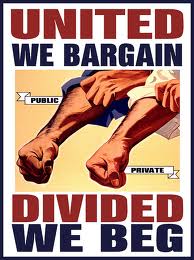
This surprise of mine extends to voting methods favored by unions.  An important tactic to form a union is to utilize  public vote, one where the vote of each employee is made in public for all to see.  The idea is that if the vote is private then the employee is able to make a “No” vote without fear of retribution.  Consistently unions and labor supporters work to take away the privacy of the vote not through open and fair compelling arguments but by legislation.  When their ideas lose in the court of public opinion labor uses the law to pass their agenda.

And this feeling that unions must be supported but not the individuals that make them up is shown in the fight against “Right to Work” legislation.  Laws that don’t ban unions but simply take away their power to coerce an employee to belong or not.  No one is saying that a union, in all of its ugliness can’t exist, the law is simply saying that it has to be voluntary.

I simply don’t understand the support of union violence against people and property that is routinely ignored by the left.

And in case the threat is only veiled and simply easy to miss, labor supporters are outright calling for violence:

“We’re going to pass something that will undo 100 years of labor relations and there will be blood, there will be repercussions,  we will re-live the battle of the overpass,” said state Rep. Doug Geiss (D-Taylor).

Blood – Repercussions – Battle

So, what is “The Battle of the Overpass”?

The battle of the overpass was a bloody fracas in 1937 between union organizers and Ford Motor Co. security guards. Walter Reuther was famously thrown down a flight of stairs and another union organizer was left with a broken back.

A literal battle involving organized labor.

This movement is literally violent.  Explicitly violent.  The push to improve the rights of individuals is being conducted by those who are looking to extend and protect rights to the employee who simply doesn’t want to organize, to vote in private and negotiate on his own behalf.


Kansas Day of Prayer

There is some amount of controversy in Kansas:

The Freedom From Religion Foundation is urging Kansas Governor Sam Brownback to rescind his religious proclamations and opt not, in his official capacity, to attend or endorse the overtly Christian event “Going to the Heart,” which is scheduled to broadcast live from Topeka, Kan., on Dec. 8 from 3-6 p.m. CST.

Brownback not only publicly declared Dec. 8 a “Day of Restoration,” but recorded a promotional video for the national simulcast, calling on citizens to “pray to God, in humility and in unity to ask for his favor and assistance in these difficult times.”

I happen to feel that the United States is explicitly founded on the basis of a nation endowed by the Creator; we are a Spiritual nation.

However, I am further convinced that we are not an explicitly Christian nation.  Further, I’m aware of the rulings of the Supreme Court that has severely restricted any government involvement in matters spiritual.

The worry that occupied the framers was not the public displays of religion or of government officials calling on days of prayer; indeed, Washington himself was very explicit regarding his belief that America was a Divine Experiment and often issued orders of prayer.  Rather, the concern was that the government not establish a religion.  That the government not pass laws requiring the joining of any religion or of passing any legislation that would require taxes to fund a state religion.

That being said, what would the general public say if, instead of asking citizens to “pray to God” implored them to “pray to Allah?”

Especially interesting because both the Christian God and the Muslim Allah are the God of Abraham.  In other words, the same divine entity.

Crime: Socio-Economic vs IQ – The Bell Curve

It’s here, the last chapter comparison between the impact of the socioeconomic status of the family or the mother of the children and the IQ of the same.

I last posted on crime back in late July and then I mentioned:

When I picked up the book I was looking for books on “How to Raise Chickens” as a result of a post of mine some time back.  I saw the book on the shelves and was taken by the title.  I bought it and it was immediately relegated to my stack.  Some time later, Boortz was speaking about the author and I decided I better begin the book.  At this time I was still unaware of the controversy of the book.  Then I posted on it.  I was then made aware of the controversy.

As I mentioned then, I wasn’t aware of the massive controversy of the book.  I simply saw it on the shelf, bought it and then heard it referenced on the radio.  I started reading it and then posted on it.  Only later did I learn of that controversy.  And when I actually hit the big chapter, chapter 13, I understood why.

Now, as then, I won’t go further than chapter 12 [11 actually, I don’t find 12 interesting] and for the same reasons.  However, the controversy that surrounds the later sections of the book shouldn’t diminish the value that the first chapters deliver.

Now.  Crime.

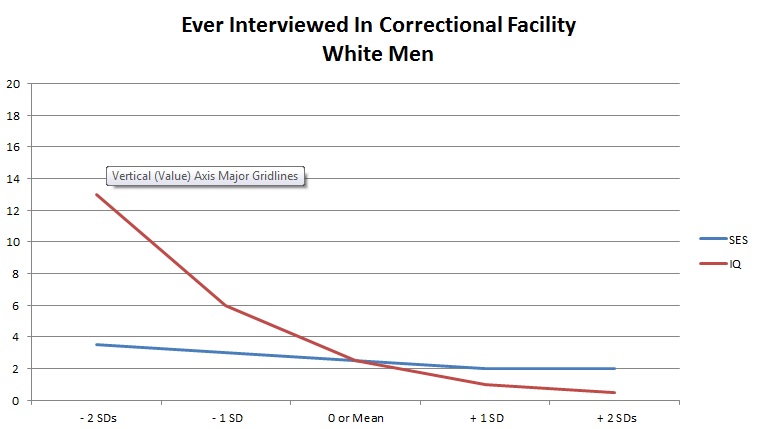
The authors look to quantify crime in two ways:

  1. Asking if the man ever was engaged in criminal activity.
  2. Reporting if the man was interviewed in a correctional facility.

As they point out, both have weaknesses.  The self-reporting may not be accurate but does have the upside of capturing uncaught criminal activity.  The other has valid crime involvement but doesn’t capture criminals who haven’t been caught.  The “smart” ones.

The results are below:

And then:

In both cases, when controlling for other factors, the SES status of the family fades and becomes meaningless.  In fact, as SES increases so to does the rate of self reported crime.  And in both cases, a man possessing a low IQ is at significant risk for each category.


Fiscal Cliff: Musings From The Common Man

I’m sure that most Americans don’t pay attention to the goings on in the same way that I do.  Lot’s of people have a life, for example, and do fun things.  Likewise I don’t hold out much hope that the average Joe is very informed, so, random interviews with random people kinda mean, well, not much in the way of solid policy advice.

But this is cute:

Parenting: Socio-Economic vs IQ – The Bell Curve

In considering the many ills that face society, there has been a large focus on the socio-economic status of the family or of the individual in the desire to explain the condition at hand.  For example, if a child grows up to become a criminal, we ask, “what was the socio-economic condition of that child or his parents?”

The idea behind this, of course, is that if we can isolate the failure to the economic inequality of society, then we can begin to “fix it” through governmental programs bent on promoting “equality.”

But what if there was another reason why people did the things they do?  In this section, I speak about Parenting as discussed in the book, “The Bell Curve.”

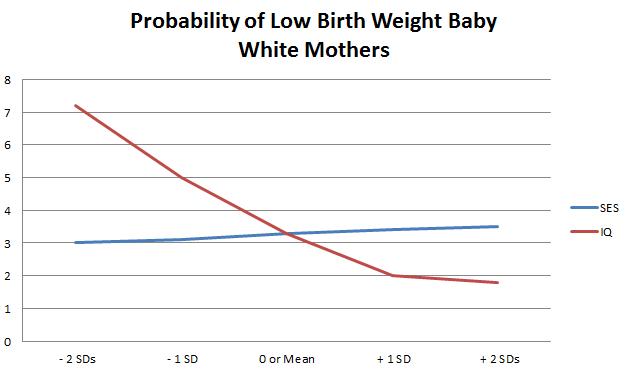
In the chapter regarding parenting, the first condition discussed is low birth weight babies.  Previously I have shown data that suggests that the SES status of the mother has little bearing on the determination of that condition in children.

But IQ:


As mentioned, the impact of the socio-economic status of the mother is nominal; the IQ of the mother is not.  A low IQ has a major impact on the chance of a baby being born with a low birth weight; SES – not as much.

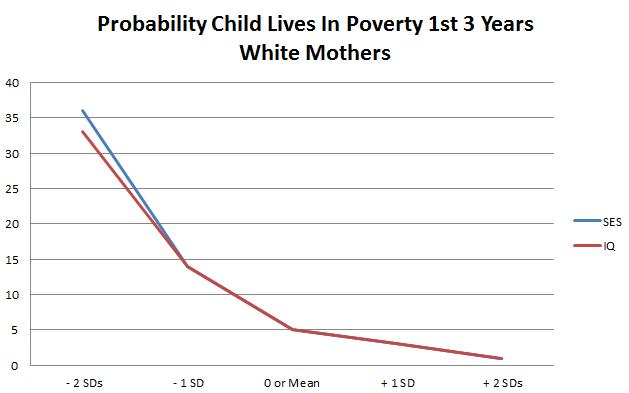
After being born, the child must face life.  Specifically the prospect of being poor.  Initially, the authors held all variable constant and displayed the prospects of a child remaining poor in the fist 3 years of life based on the mother’s SES.  It didn’t look good.  But what happens if we include IQ:

No change.  The poverty rate of the child is equally determined by the SES and the IQ of the mother.  With the data showing such an exact match as both SES and IQ moved from low to high, I suspect that there is a case where one is determined by the other.

Again, following the sections in this chapter, the topic switches to the Home Index:

The Home Observation for Measurement of the Environment (HOME) Inventory is designed to measure the quality and extent of stimulation available to a child in the home environment. The Infant/Toddler HOME Inventory (IT-HOME) comprises 45 items that provide information from the child’s perspective on stimuli found to affect children’s cognitive development. Assessors make observations during home visits when the child is awake and engaged in activities typical for that time of the day and conduct an interview with a parent or guardian. The IT-HOME is organized into six subscales: (1) Responsivity: the extent of responsiveness of the parent to the child; (2) Acceptance: parental acceptance of suboptimal behavior and avoidance of restriction and punishment; (3) Organization: including regularity and predictability of the environment; (4) Learning Materials: provision of appropriate play and learning materials; (5) Involvement: extent of parental involvement; and (6) Variety in daily stimulation. For the IT-HOME, 18 items are based on observation, 15 on interview, and 12 on either observation or interview.

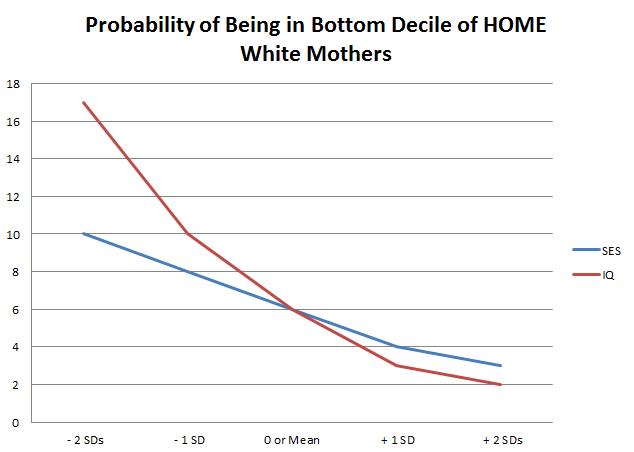
This index was applied to the population in the study and the result showed that the socio-economic status of the mother played a role in the HOME Index rating.  However, IQ played an even more significant role:

As you can see, a lower IQ is more devastating than a poor mother while I high IQ is more beneficial than a wealthy mother.

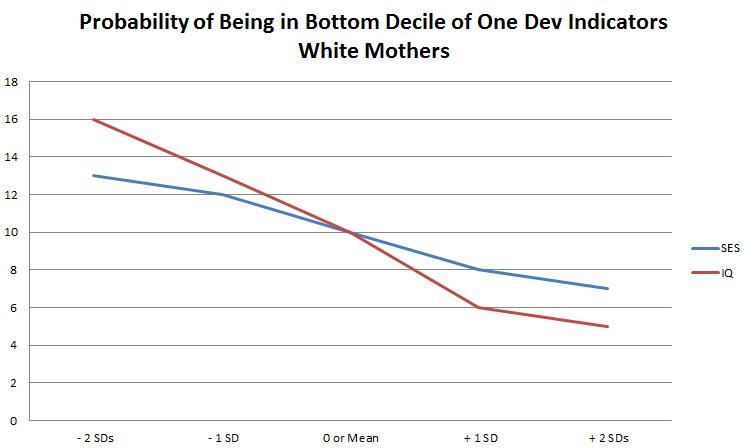
As the child grows, the development of the child can be impacted by the  conditions of the home, poverty and parenting skills are, of course, two of those conditions.  In an attempt to measure this development, the authors conducted a survey of 4 developmental indicators and if a child scored in the bottom decile for any of the 4, they scored a “Yes” on the “development index.”  If not, they scored a no.

The results:

The pattern is again, presented.  IQ at the low end is more detrimental than poverty while at the high end, IQ is more advantageous than being wealthy.  However, in this specific study that difference is marginal.

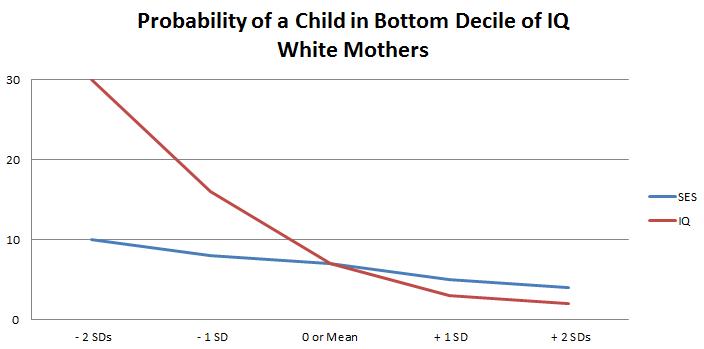
The final section of the chapter looks into the IQ of the child and tries to determine the significance of been raised in a home more exposed to the challenges of poverty vs. being raised in a more affluent home.  Additionally, the same investigation is conducted using the key variable of IQ:

The result is consistent with data already being demonstrated in this and other chapters.  The argument can be made that when isolating the socio-economic status of families and of mothers in the study the well being of the child generally suffers as that mother becomes poorer.  However, when all variables are held constant save IQ, those other factors are diminished to the point of being statistically insignificant.

IQ matters.

Of Taxes: Federal, State, Local And All

I suspect that even pedestrian news watchers have heard of the fiscal cliff by now.  I hold out very little hope, however, that even a basic understanding of what that means is had.  Which, I suppose, is par for the course.

However, here on the hallowed pages of TarHeel Red, it means that the federal government has some decisions to make.  We could, for example, go off the cliff.  Some think that not such a bad idea.  Me, for example.  I think that taking the hard steps required to cut spending, even defense spending, are long past due.  Sadly, I’m joined in this analysis by Hoard Dean.  I’m suspicious of the twist of fate that cause him to agree with me; I’m afraid to discover which of us has made the mistake in calculus.

However, there are other courses to take.  We could make permanent the Bush era tax cuts.  For everybody.  For some.  We could take this opportunity to cut spending even more, maybe even in a REAL way that real Americans understand.  For example, the local specialty beer shop around the corner sells individual bottles of goodness for $2 American.  I like to stop in and buy a six-pack every  other week.  My spend is $24 a month.

But let’s say that I budget an increase, I want to not only buy those 2 six-packs a month, but I wanna add the full liter of specialty beer.  I up my spend from 24 bucks to $31.  But then….then, well, Obama wins the election and my financial adviser says that I should cut back, so I say, “Okay.”  And instead of buying 12 beers a month I buy 14; an extra $4.

My man goes crazy, he’s out of his head crazy.  He demands to know how I agreed to cut the amount of money I spend on beer and THEN expanded it.  I tell him simple, “I had budgeted a $31 expenditure.  I reduced it to $28.  I cut out nearly 10%!”

Serious.  Politicians, all of ’em, dem and repub, look us in the eye and say this with a straight face.

Anyway.  The cliff.

Obama wants to raise the rate of taxation on the rich.  And when he says that, he means the rate of federal income tax.  He frames the question in terms of the federal income tax rate.  So, I usually speak about the federal income tax rate.  And this is what I say:

According to the CBO, in aggregate, the poorest 60% of us don’t pay a federal income tax.  Worse, the top quintile, the wealthiest 20%, pay more than 94% of federal incomes taxes according to the most recent numbers in 2009.

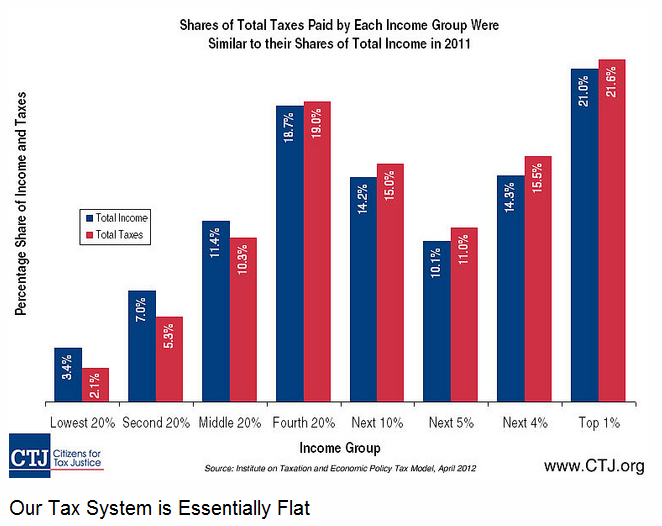
When Obama claims that the rich don’t pay their fair share, he’s not making sense.  The rich are paying dramatically more than their fair share.  However, I have folks that disagree with me.  And those that do point to this graph:

This graph, built by Citizens for Tax Justice, shows that as a % of income, we all typically pay about the same share of taxes.  For a time I couldn’t square the data.  The report from the CBO didn’t seem to jive with the data coming from CTJ.

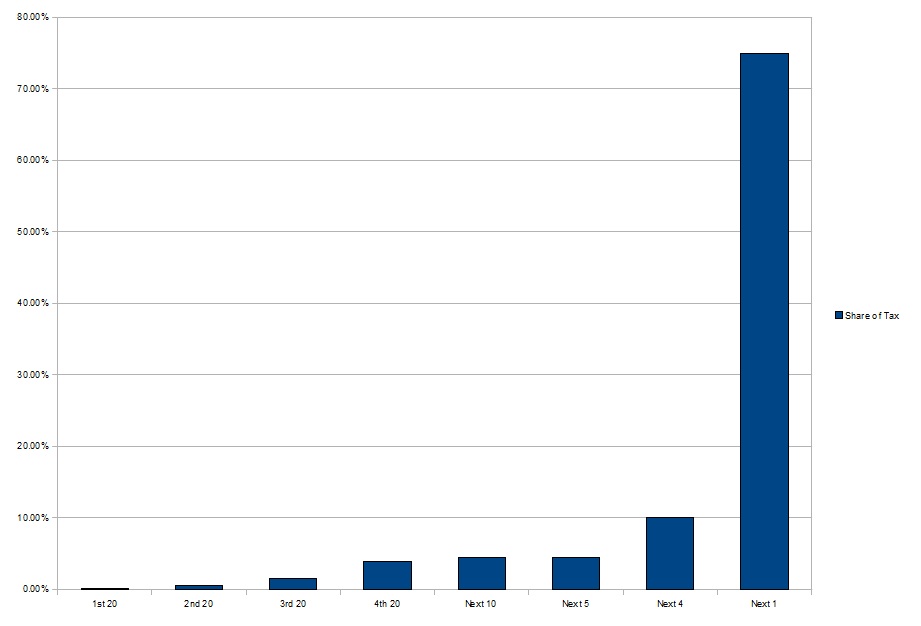
Then I realized my mistake.  We’re talking about two different units.  The CBO data that I was using was reporting share of tax revenue.  The CTJ is using share of income.  When I used the “back of an envelope” – I had too, the CTJ data is in 2011 numbers and the CBO data is in 2009.  Further, I used the average of the quintiles and not the total population so my numbers may be off.  However, if the details can be run, I’d be interested in seeing that.  This is what I came up with:

Now we’re talking apples and apples.  I broke out the quintiles in that weird way that folks do; listing the first 4 and then breaking down the last by the “nest 10”, “the next 5”, “the next 4” and “the top 1.”  What this means is that if you gather than top quintile in one group you would see that they pay 93.93% of all taxes.  And this is on an earning of 50.0% of all income.

Holy moly.

The top 20% of Americans earn 50% of the income and yet pay 94% of the taxes.

Oil Spills – Oil Companies – BP

BP has been issued a bill for the oil spill in the Gulf back in 2010:

NEW ORLEANS — BP said Thursday that it will pay $4.5 billion in a settlement with the U.S. government over the disastrous 2010 oil spill in the Gulf of Mexico and plead guilty to criminal charges related to the deaths of 11 workers and lying to Congress.

The day of reckoning comes more than two years after the nation’s worst offshore oil spill. The figure includes nearly $1.3 billion in criminal fines — the biggest criminal penalty in U.S. history — along with payments to certain government entities.

The settlement, which is subject to approval by a federal judge, includes payments of nearly $2.4 billion to the National Fish and Wildlife Foundation, $350 million to the National Academy of Sciences and about $500 million to the Securities and Exchange Commission. The SEC accused BP of misleading investors by lowballing the amount of crude spewing from the ruptured well.

Now, I’m all for BP having to pay for the cleanup to all agencies that were harmed by the spill.  I think that allowing companies to poison rivers that does nothing to harm the company is a moral hazard that creates problems for everyone.*

And I don’t mind that government sets the amounts of those fines.  What I DO object to is the nature in which these fines are arrived at; politics, deal making and more than likely cronyism.

If we want to protect ourselves from oil spills we have to acknowledge two things:

  1. We can not prevent a spill from ever happening again.  The only thing that we can hope for is to increase the mean time between failure and decrease the meant time to repair.
  2. What we really object to is the damage done by the spill, not that there was a spill per se.  Therefore, if we can quantify the dollar cost to restore the damage, we should be alright with the transfer of that cost.

If we’re able to do this, and codify it so that the rules are clear and understandable, the oil companies will understand this and include it in their business models.  In fact, I suspect that the fines will be significantly high that those companies will have to take out insurance policies to protect them in the event of a spill.  And this is a good thing.

See, if the oil company requires insurance they’ll have to get it from another company that sells insurance.  These insurance companies, being rational, will not issue said policy UNLESS the oil company can demonstrate adequate safety processes.   In short, the insurance will drive increased safety and prevention.  And it will do it in a mostly free market way.  Today prevention agencies are government run and filled with execs from oil companies that are named based on politics.  These agencies aren’t adequate in writing and enforcing the rules.  But if insurance companies are in charge of that, we can be MORE sure that the whole thing is more modern and appropriate.

So, hell yeah BP should pay.  But the fine should have been known and predictable up front.  If it was, I claim that the next oil spill will occur further in the future than it otherwise would and be restored much quicker and wit less overall damage to the environment.

* I do NOT object to the poisoning of rivers that DOES harm the polluter.  In this case “rivers” is the name I’m giving to the general environment.

Elections Have Consequences

It’s simple, really.  When there is an incentive to save money, there should be no surprise that incentives will drive behavior.  Consider Community College of Allegheny County:

To Community College of Allegheny County’s president, Alex Johnson, cutting hours for some 400 temporary part-time workers to avoid providing health insurance coverage for them under the impending Affordable Health Care Act is purely a cost-saving measure at a time the college faces a funding reduction.

But to some of the employees affected, including 200 adjunct faculty members, the decision smacks of an attempt to circumvent the national health care legislation that goes into effect in January 2014.

“It’s kind of a double whammy for us because we are facing a legal requirement [under the new law] to get health care and if the college is reducing our hours, we don’t have the money to pay for it,” said Adam Davis, an adjunct professor who has taught biology at CCAC since 2005.

Temporary part-time employees received an email notice from Mr. Johnson on Tuesday informing them that the new health care act defines full-time employees as those working 30 hours or more per week.

As a result, the college as of Dec. 31 will reduce temporary part-time employee hours to 25 per week. For adjuncts, the workload limit will be reduced from 12 to 10 credits per semester.

The decision affects only temporary part-time employees and not permanent part-time employees who already are eligible to participate in the college’s health care plan.

My hope is that the folks impacted voted for Obama; you should reap the rewards of the decisions you make.

But that’s not all:

Darden Restaurants Inc. — parent of the Red Lobster, Olive Garden and Capital Grille eateries in Colorado and elsewhere — is cutting back hours of workers at some of its locations in an apparent effort to reduce insurance costs related to the new health-care reform law.

The Orlando, Fla., Sentinel newspaper reports that the Orlando-based company (NYSE: DRI) “has stopped offering full-time schedules to many hourly workers in at least a few” of its locations.

The Sentinel quotes the company as saying it plans to limit employees at some restaurants in four unidentified markets to 28 hours a week. Darden said the move is intended “to help us address the cost implications health care reform will have on our business.”

Under the federal Affordable Care Act, the health-reform law that some call Obamacare, companies with at least 50 employees must provide health insurance, starting in 2014, to all those who work at least 30 hours a week. Those that don’t will pay a penalty.

I suspect that this will play out across America more and more.  As the ramifications of electing Obama continue to see the light of day, more and more we are going to see this reaction by business.  Fewer people hired, higher ratios hired as part time employees, more efforts to drive productivity by more and more automation.

It really is important to understand that there really aren’t solutions; only tradeoffs.

Want healthcare?  Lose jobs.  Sacrifice growth, accept higher unemployment.

If you voted for Obama, this is on you.  This is what you wanted, this is what you explicitly put into motion.

We warned you.