Category Archives: Politics: National

South Carolina Dreamin’

UPDATE – Corrected Sanchez to Sanford!

I admit, when Mark Sanford lost all sense of self back in the days of his affair, I was a little more than just disappointed.  When folks would ask me who I hoped would run, Sanchez was at or near the top of my lost.

But then, well, then he lost all sense of self.

He cheated, in more ways than one:

  1. He cheated on his wife – From all reports a remarkable woman.
  2. He cheated the state out of money for personal gain.
  3. He lied about it all.

He’s engaged now.  Engaged to his mistress so maybe there is something to those “matters of the heart”.  But there’s a good way and a bad way to handle such matters.  Hiking the trail clearly is one of the bad ways.

And that doesn’t begin to explain the lying.

But it looks like Mr. Sanford is gonna make a run at redemption:

Former South Carolina governor Mark Sanford will announce on Wednesday that he is going to run for the congressional seat he held in the 1990s.

Sanford outlined his plans in an interview published by National Review Online.

I firmly believe that we need more people like Mr. Sanford was before his loss of sense.  The only question I have is this:

Should he be forgiven?


Energy Subsidy

I was thinking about energy subsidies this weekend.  I know  I know, geeky shit to be sure, however – I WAS stuck watching a dance conference with my daughter in Baltimore, so slack please!

Anyway, during the election season, Obama was attacked for his green energy subsidies.  That, in his attempt to pick winners and losers, he mostly picked losers.  All of which, of course, was to highlight the waste of money that is green energy subsidies.

It occurred to me, that depending on the type of subsidy, it’s okay that we encourage alternative energy research and advancement.

To be sure, I don’t like the government actually spending money or guaranteeing loans, to one company or technology over another.  However, when it comes to reducing the tax burden so that we advance investment, I don’t see any reason why we should pick oil and gas over solar and wind.

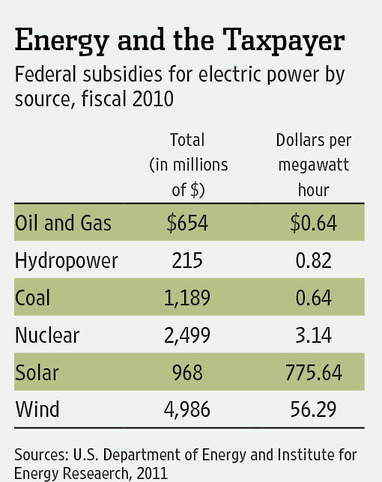
With that said, this is an interesting graph:

From the article:

The folks at the Institute for Energy Research used the Energy Department data to calculate a subsidy per unit of electricity produced. Per megawatt hour, natural gas, oil and coal received 64 cents, hydropower 82 cents, nuclear $3.14, wind $56.29 and solar a whopping $775.64.

So for every tax dollar that goes to coal, oil and natural gas, wind gets $88 and solar $1,212. After all the hype and dollars, in 2010 wind and solar combined for 2.3% of electric generation—2.3% for wind and 0% and a rounding error for solar. Renewables contributed 10.3% overall, though 6.2% is hydro. Some “investment.”

Zooming out for all energy, the Congressional Research Service did its own analysis of tax incentives last year. It found that in 2009 fossil fuels accounted for 78% of U.S. energy production but received only 12.6% of tax incentives. Renewables accounted for 11% of energy production but received 77% of the tax subsidies—and that understates the figure because it leaves out direct spending.

Which brings me to my initial thought:

By the way, these subsidy comparisons don’t consider that the coal, oil, and natural gas industries paid more than $10 billion of taxes in 2009. Wind and solar are net drains on the Treasury.

All of this suggests a radical idea. Why not eliminate all federal energy subsidies? This would get the government out of the business of picking winners and losers—mostly losers.

Mr. Obama’s plan to eliminate oil and gas subsidies would lower the budget deficit by less than $3 billion a year, but creating a true level playing field in energy, and allowing markets to determine which energy sources are used, would save $37 billion. That’s an energy plan that makes sense.

I like that idea best.  Less government.

Addressing Gun Violence

On Tuesday President Obama will receive a report from Joe Biden on gun violence and how to address it.  I admit that I’m torn on the whole issue.  Personally, I don’t care for guns at all.  I played with BB guns as a kid, to be sure, but that’s where it stopped.  I held my brother’s .22 and 16 gauge, but never owned my own weapon.  I once shot a friend’s hand gun, but didn’t like it.

I know that lot’s of people own guns to protect themselves.  Many more own guns because they like to collect them.  And even more because they life to hunt.  And I’m all good with that.  But I don’t want’em in my house.  I have young kids and believe the stats that say a gun owner’s family is more likely to be harmed by their own gun than that gun will be used in self defense.

But I feel its very important to defend the rights of those that DO wanna keep a gun.  I think that if an individual feels that, in balance, the risk of owning gun isn’t greater than the benefit provided by that gun, he should have the ability to purchase and keep that weapon.  He should be able to buy and use ammunition.

In short, a man has a right to buy guns.  And when I say guns, I mean any guns.

Part of the reason that the 2nd Amendment was written and codified was the belief that citizens be able to defend themselves.  From intruders AND their government.  In fact, Jefferson felt that an armed citizenry was a last resort to a tyrannical government.

So, what to be made of the world today?

I think the wrong questions will be asked in the report.  I think the wrong questions have been asked in the public discourse.  I think that people are seeing people committing atrocities with guns and are fixating on the guns; not the people.  I think that we need to look at data.  Data that suggests violence due to guns is on a downward trend.    I think that we need to look at data that would suggest that banning assault weapons increases violence, not decreases it.  And I think that we need to understand that being exposed to the inconveniences of too much liberty is preferable to the those attending too small a degree of it.

To those that would ban an assault rifle.  How much less of a tragedy would it be if an armed intruder, carrying a pistol, or 4, would take the lives of, say, 10 children rather than the number taken in Sandy Hook?  How will you be able to stand in front of the parents and claim that it could have been worse?

The answer?  You can’t.

A life taken too early due to violence is a tragedy.  And whether that life is taken by a hand gun or a rifle is not meaningful.

But the restriction of liberty is.  And THAT is what we need to guard against.

Now, are there things that we can do?  Happily, yes.

I think that we have a good opportunity to increase our background checks.  Both in number and in depth.  I think that we can do more to keep guns out of the hands of criminals and of the mentally unstable.

We should increase our databases regarding gun crimes.  And speaking of gun crimes, we need to focus on the characteristics of criminals with guns.  And then target them.  Instead of crafting laws that take guns out of the hands of law abiding citizens, we need to craft laws that take guns out of the hands of criminals.  Guilty of a gun crime?  Subject your property to an immediate search warrant.

And technology might be able to help us.  We should consider, at least consider, the technology that allows a gun to be fired based on a fingerprint profile.  Should a private sale occur, the gun could be taken to a dealer to swap that profile.  Have a family of 5?  Submit a profile for 5.

There is a lot of work to be done, to be sure.  But there is a lot of Liberty to be lost as well.  And we must remain ever vigilant that the sacrifices of those who came before us are not lost to fear.

On Crazy And Irrelevant

A few days ago Paul Krugman jumped the shark:

Should President Obama be willing to print a $1 trillion platinum coin if Republicans try to force America into default? Yes, absolutely. He will, after all, be faced with a choice between two alternatives: one that’s silly but benign, the other that’s equally silly but both vile and disastrous. The decision should be obvious.

So, there ya have it.  Paul’s contribution to the debt ceiling problems.  And his reasoning?

For those new to this, here’s the story. First of all, we have the weird and destructive institution of the debt ceiling; this lets Congress approve tax and spending bills that imply a large budget deficit — tax and spending bills the president is legally required to implement — and then lets Congress refuse to grant the president authority to borrow, preventing him from carrying out his legal duties and provoking a possibly catastrophic default.

I think Paul is forgetting that we can service our debt very easily with existing revenues.  The money we don’t have is for additional spending.  There really is very little danger of defaulting on our debt.

Anyway, cooler, calmer and more rational minds have saved the day:

The U.S. Treasury Department said on Saturday it will not produce platinum coins as a way of generating $1 trillion in revenue and avoiding a battle in Congress over raising the U.S. debt ceiling.

The idea of creating $1 trillion by minting platinum coins has gained some currency among Democrats in recent days as a way of sidestepping congressional Republicans who are threatening to reject a necessary increase in the debt ceiling unless deep spending cuts are made.

The Treasury Department and the Federal Reserve, both independent of one another, each concluded this was not a viable option.

“Neither the Treasury Department nor the Federal Reserve believes that the law can or should be used to facilitate the production of platinum coins for the purpose of avoiding an increase in the debt limit,” said Treasury spokesman Anthony Coley in a statement.

File this under “no kidding”.

Another Company Cuts Hours

Yesterday I posted about an IT firm cutting hours as a result of the economic conditions ahead.

Hours were going to be cut.  Instead of a 5-day work week the schedule would now be built around a 4-day work week.

My suspicion is that the firm is targeting a work week that comes in under 30 hours a week.

Well, there is a company that is making no bones about it:

A fast-food chain is slashing employee hours so franchise owners don’t have to pay health benefits. Around 100 local Wendy’s workers have learned their hours are being cut. A spokesperson says a new health care law is to blame.

The penalty for failure to offer insurance is $2,000 per employee.  In this case, $200,000 is a lot of money:

The company has announced that all non-management positions will have their hours reduced to 28 a week. Gary Burdette, Vice President of Operations for the local franchise, says the cuts are coming because the new Affordable Health Care Act requires employers to offer health insurance to employees working 32-38 hours a week. Under the current law they are not considered full time and that as a small business owner, he can’t afford to stay in operation and pay for everyone’s health insurance.

The irony, of course, is that fast food chains typically employ the younger worker.  Folks who might be entering the job market for the first time and are learning valuable work skills.   Skills that they may not otherwise acquire.  And the reason they are being impacted is a law that attempts to help provide medical care to the population.  Well, these kids are the healthiest segment OF that population.


Dysfunction of Government

Look, I like Rand Paul.  I resonate with much of what he says.  And this even more so.

Ignore the comments about term limits – I can go back and forth on that one.  Just listen to his comments on how the Fiscal Cliff Senate legislation was passed.

No printed bill.

Made available online at 01:36.

Voted on at 01:39.

Partisan politics aside, there is no earthly way that an argument can be made that this is an example of how we want legislation debated, written, studied and then voted on.

No way.

Harry Reid and Political Advice

Speaking on the floor of the Senate, Harry Reid felt it an important use of his time to provide some political advice to the Speaker of the House.

“As Speaker Boehner saw on New Year’s Day, when he allows every member of the House to vote – and not only the Republican members of the House to vote — Congress can enact bills into laws,” he said on the floor. “No major legislation can pass the Senate without the votes of both Democrats and Republicans. During the 113th Congress, the Speaker should strive to make that the rule in the House of Representatives, as well.”

Interesting advice to be sure.  And in some ways, Reid is right.  The idea of not voting on legislation that has been passed in one chamber and then been sent to the other for consideration is an idea that would garner significant support from the American public.  Heck, even from me.

However, I wonder if the majority leader would consider taking his own advice and allow House bills that he fears come for a vote in his Senate?

I suspect not.

Fiscal Cliff “Averted”

The last charge of the 112 Congress has taken place.  With just hours before the session was set to close, the congress passed the bill that will now go to Obama’s desk for signature.  Only in my most vindictive moments did I want us to go over the cliff.  I wanted the average person who voted for the current President to face the economic damage first hand.  If nothing else, the prospect of facing an additional $2,500 in taxes with the possibility of the AMT hitting them, they  may have learned what happens when a tax happy spend happy administration gets in power.

As it is, we have very little to be happy about.  The first, if not only, is the fact that the Bush Tax Cuts are now permanent for everyone earning less then $450,000.  About time!  Although now that they are permanent, watch the left begin calling them the Obama Tax Cuts – as if.

The other positive is that the AMT’s annual correction is also permanent.  No more posturing on that one.

But there is a TON to hate.  Taxes going up for anyone in this economy is only going to do more harm than good.  And those taxes are on business and investors.  Not to mention investment itself.

And the worst part?  There wasn’t ANY spending cuts of meaning.  Rather we have that battle in two months.  Oh yeah, I forgot the third thing – no debt ceiling limit rise.

All that means is that we get to go through this all over again in a few short months.

Clinton-Era Tax Rates

Through all the discussion surrounding the fiscal cliff negotiations we have heard the relentless drumbeat of an argument that during the surplus years of President Clinton, the tax rates were higher than they are now.  If it worked then, they theory goes, it can work now.

Makes sense.  Kinda.

But no one is asking for a return to the Clinton-era rates.  They’re asking for a return to the Clinton-era tax rates for SOME, not all.

And, of course, the idea is only to revert to the Clinton-era revenue rates.  Not the spending rates.

What if we went back to the spending of that Clinton era?  Why, during 1999 the federal budget was $1,701 billion.  Adjusted for inflation, that comes to $2,350 billion.  And what is our expected revenue for 2012?  About $2,468 billion.

A surplus of $118 billion.

Obama and the Fiscal Cliff

Obama is confused.

Today he’s remarking that the republicans aren’t negotiating seriously:

In an interview broadcast Sunday, Obama told NBC’s “Meet the Press” that Republicans are responsible for the stalemate that brought lawmakers back to Capitol Hill on a Sunday afternoon.

“They say that the biggest priority is making sure that we deal with the deficit in a serious way. But the way they’re behaving is that their only priority is making sure that tax breaks for the wealthiest Americans are protected,” Obama said. “That seems to be their only overriding, unifying theme,”

To be clear, there is only one party in these negotiations that have, as their entire offer, a single overriding theme.  And that is the President himself.  The President’s entire offer, the whole of it, consists of raising taxes on the wealthy.

And that’s it.

No spending cuts.  No entitlement reforms.  No talk about any effort to reduce the deficit or attack the debt.

Just tax the rich.  And he knows that this isn’t going to address any of the problems we face, on the contrary – it will only make it worse.

But if that was the only aspect of Obama’s confusion, he could be forgiven.  We know that he’s nothing more than a class warrior who hasn’t an inkling of a clue on anything economic.  But he should know how bills make their way through Capital Hill:

Obama said the Senate should vote on legislation to make sure middle-class taxes are not raised and that 2 million people don’t lose unemployment benefits .

The Senate doesn’t initiate financial bills; the House does.  And they have.  Two of them.  Both waiting for Reid and the democrats to take them up, amend them and vote on them.  The pressure is squarely on the Senate right now.  Not the republicans.