Category Archives: Politics: National

Decay

Life.

Life happens and then we have to deal with it.  Often times it’s messy but sometimes it’s breathtaking.

However, when tragedy comes, and it will, we need to begin to re-evaluate our response.  For me, the tragedy is a time to reflect on the love we have for one another, how delicate our lives are in the balance.  Have we done good?

Can we do more?

But what we cannot do is legislate away the boogieman.

No matter how badly I want to, I can’t make it against the law for the brain tumor to take my dad.

And you can’t legislate fun:

LOVELAND, Colo. — A 2nd grader has been suspended from school in Loveland for a make believe game he was playing.

The 7-year-old says he was trying to save the world. But school administrators say he broke a key rule during his pretend play.

“I was trying to save people and I just can’t believe I got dispended,” says Alex Evans, who doesn’t understand his suspension any better than he can pronounce it.

“It’s called ‘rescue the world,’” he says.

He was playing a game during recess at Loveland’s Mary Blair Elementary School and threw an imaginary grenade into a box with pretend evil forces inside.

“I pretended the box, there’s something shaking in it, and I go ‘pshhh.’”

The boy didn’t throw anything real or make any threats against anyone. He explains he was pretending to be the hero. “So nothing can get out and destroy the world.”

But his imaginary play broke the school’s real rules. The school lists “absolutes” designed to keep a safe environment. The list includes absolutely no fighting, real or imaginary; no weapons, real or imaginary.

That is insane.  We’ve gone too far.

Don’t like people shooting people with guns?  Make shooting people with guns illegal.  Then, make the penalty as harsh as required to drive down the incidence of people shooting people with guns.

But let the boys play “Rescue the world.”

The Opposite of Banning Guns

The debate surrounding guns brings out a bunch of interesting stories.  But this one is pretty interesting:

No town in the U.S. has been as public about its support for guns as Kennesaw, population about 30,000, where city leaders for 30 years have required that every household have at least one gun. The Dec. 14 killings of 20 children and six adults, the second-deadliest school shooting in U.S. history, has done little to change that, residents say in interviews.

The state of Georgia allows citizens to carry guns openly as long as they hold permits, in a region where guns have long been prized and firearms are part of the culture, Crowe said.

“It’s ingrained in us,” he said. “It’s about responsibility as much as anything and I am passing that on to my kids.”

Kennesaw, about 30 miles northwest of Atlanta, had about 5,000 people when its City Council adopted an ordinance requiring heads of households to own a gun and enough ammunition to use it, said police Lieutenant Craig Graydon, 47, who’s fielded questions about the law for 26 years.

An interesting take indeed.


Entitlement Programs

I’m gonna step in the mind of a bigger state thinker for a second.

In this mind, the goal is to identify all individuals and/or families that are in some sort of need.  This need could be based on a scale of sorts; usually income based.  That is, if income is too low, programs should be created or funded in order that some definition of “basic needs” is met.

These basic needs could be supplemented by straight cash, tax breaks, food programs, rent programs, energy programs or any other such program.

Okay, I may disagree with that mindset, but for now, that’s the mindset I’m in.  Now, given this reality, the goal, as a criteria for success, would be to make sure that all qualified individuals and/or families, would be identified and enrolled.  We don’t want a shadow population of folks who are in need of assistance or care, to exist.

In this aspect, I get that the bigger state thinker would want to expand the rolls of these programs.  I get that, right?

To the point that we want to include all qualified individuals in the program, I understand why someone would want to make sure the program “grew”.  I can even see the logic behind expanding the criteria of “need” to include an ever growing population.  What I am NOT sure about, and what I really truly guard against, is, “Do our goals change when all qualified individuals are enrolled?”

In other words, when all the poor and less fortunate have been enrolled in these programs, is there any effort to get them UNqualified?  For example, give them what ever it is that is needed to be able to create a level of income that allows them to leave the program.

To me, there are two kinds of charitable giving, two kinds of programs that can be set up.  One is where resources are gathered and distributed just to make the ends meet.  Food to feed the hungry, coats to warm the cold.  Stuff like that.  I think of that as “give a man a fish” kinda program.

Me?  I’m interested in the “teach a man to fish” kinda programs.  And I just don’t see the rigor, the discipline, the will or, frankly, even the desire on part of the policy makers to craft such steps into their programs.  I don’t see a willingness to exhibit the tough love that even parents engage in with their own children.  A love that says, hell-demands, that by paying your rent and your heat and your car payment, I am not helping you in life, I am, in fact, hurting you.

Liberals often claim that the right cares more about the unborn than about the orphan or the single mom or the poor.  There may be something to that, maybe.  But given that it’s the conservative that is more charitable than the liberal, I don’t buy it.  Rather, I see it that the programs favored by the conservative more resemble the “programs” that they teach and enforce upon their own children.  Namely sacrifice, hard work, goal deferral and plain old “do the job right”.

I just don’t get how feeding and housing a person for years and years helps them.

Am I wrong?

Spending Cuts

Before the compromise that pushed the sequestration out 3 months, I was in favor of allowing the cuts to take place.  I know that the result would have been recession but it would have been short and only technically accurate.  In reality the cuts would strengthen the economy and we would find ourselves better off.

However, the compromise isn’t such a bad thing.  On the one hand it forces the senate to actually take up a budget AND we still can let the cuts take place.

But are we serious?

“I think the sequester is going to happen,” Representative Paul Ryan, chairman of the House budget panel and the party’s 2012 vice presidential nominee, told the NBC program “Meet The Press.”

House Republicans, most of whom had strongly opposed any tax rate increases in the “fiscal cliff” debate, have now started to shift their focus away the issue of tax increases and toward the spending cuts.

“We think these sequesters will happen because the Democrats have opposed our efforts to replace those cuts with others and they’ve offered no alternative,” Ryan said.

I hope that this means the republicans are serious.  It’s very clear that, whether Obama really has capital or not, he THINKS he does, and isn’t going to negotiate.

Fine.

Time to take our medicine.

Shaking My Head At The Data

I was over at Coyote Blog the other day when I saw a discussion surrounding this chart:

Coyote was taking Kevin Drum to task for his analysis of the data described by this chart.  Specifically:

Republicans like to say we have a spending problem, not a taxing problem, but the evidence doesn’t back that up. Total government spending didn’t go up much during the Clinton era, and it’s actually declined during the Obama era. In the last two decades, it’s only gone up significantly during the Bush era, the same era in which taxes were cut dramatically.

What we have isn’t a spending problem. That’s under control. What we have is a problem with Republicans not wanting to pay the bills they themselves were largely responsible for running up.

I looked at the chart and had to go, “Huh, he might have a point.”  Then I read Coyote’s complaint:

This is the total of all government spending at all levels, not just Federal.  In fact, had he shown Federal spending (likely more appropriate given he is trying to draw conclusions about Presidents), the numbers would have continued up over the last few years.

How can Drum really make an argument dealing specifically with federal implications and use data that includes state and local spending?  If he wants to discuss federal expenditures he should use data that describes ONLY federal expenditures.  Not data that gives Obama credit for local fiscal restraint.

The Decline of the Union Worker

If the decline of the union means that American companies begin hiring more people, I’m all for the decline of the American union:

Last July was a good month for factory workers in Anderson, Ind., where a Honda parts supplier announced plans to build a new plant and create up to 325 jobs. But it was a grim month in the Cleveland suburbs, where an industrial plastics firm told the state of Ohio it was closing a plant and laying off 150 people.

Nearly all of the Ohio workers belonged to a labor union. Workers at the Indiana plant don’t. Their fates fit a post-recession pattern: American factories are hiring again, but they’re not hiring union members.

But nationally, is there a trend that would suggest that union shops are doing better than or worse than non-union shops?

U.S. manufacturers have added a half-million new workers since the end of 2009, making the sector one of the few bright spots in an otherwise weak recovery. And yet there were 4 percent fewer union factory workers in 2012 than there were in 2010, according to federal survey data. On balance, all of the job gains in manufacturing have been non-union.

This isn’t rocket surgery.  It’s been a fact for a long time now that unions are nothing more than modern day racketeer outfits.  While they may provide better compensation for their members, they restrict the number of jobs that otherwise might have been available.  Further, and perhaps more insidious, is the fact that the monies generated from their members goes straight into the hands of politicians.

Good riddance.

Laffer Curve: PGA Style

Imagine a curve.  On the left hand side the value is zero.  Then, as you move from left to right, the slope goes up peaking somewhere then slides down back to zero.  That’s the Laffer Curve.

If you tax income at 0%, you realize $0.00 of tax revenue.  If you tax income at 100% you will also realize $0.00 of tax revenue; no one works for free.  In between is the sweet spot.

And it appears that, for Lefty, a 63% take is just too much:

LA QUINTA, Calf. — Phil Mickelson started his 2013 PGA Tour season at the Humana Challenge in partnership with the Clinton Foundation with a tie for 37th place. But after a final-round 66, Mickelson did more than hint that the 2014 season may see some big changes for the World Golf Hall of Famer.

“Well, it’s been an interesting offseason. And I’m going to have to make some drastic changes,” Mickelson said at the Palmer Course at PGA West in La Quinta. “I’m not going to jump the gun and do it right away, but I will be making some drastic changes.”

And what changes might he be making?

PHIL MICKELSON: Well, it’s been an interesting offseason. And I’m going to have to make some drastic changes. I’m not going to jump the gun and do it right away, but I will be making some drastic changes.

Q. Meaning leaving from California?

PHIL MICKELSON: I’m not sure.

Q. Moving to Canada?

PHIL MICKELSON: I’m not sure what exactly, you know, I’m going to do yet. I’ll probably talk about it more in depth next week. I’m not going to jump the gun, but there are going to be some. There are going to be some drastic changes for me because I happen to be in that zone that has been targeted both federally and by the state and, you know, it doesn’t work for me right now. So I’m going to have to make some changes.

And why does he think he needs to make these changes?

PHIL MICKELSON: Yeah. I’ll probably go into it more next year or next week. But if you add up, if you add up all the federal and you look at the disability and the unemployment and the Social Security and the state, my tax rate’s 62, 63 percent. So I’ve got to make some decisions on what I’m going to do.

France learned it.  And now California is about to.  When you tax the living snot out of people they are going to react.  They’ll either move or quit.

And that results in $0.00 tax revenue.

On Guns, Defense and Militia

I can remember arguing the position just 10 – 12 years ago with conservative friends of mine that the 2nd amendment protected the rights of citizens to keep arms within a regulated militia.  That the amendment did not create an unlimited right to own any weapon in any quantity for any reason.

Interestingly it was a liberal friend that convinced me that states and cities that had much more lenient gun laws had lower crime rates.  That data, combined with a better understanding of individual liberty, has shifted my position to the right; how far is still unclear.

With that said, I have a question for the gun control advocates:

Would you trade the right of individual citizens to keep weapons in exchange for the creation of local militia outside the jurisdiction of the federal government?

That is, if the city of Raleigh decided that it needed stores of weapons, ammunition and other instrument of war, it could assemble such armament and recruit or conscript soldiers, train them and command them?  Further, this militia would e subject to no law other than state law and would not be subordinate to the President?

I strongly resonate with the argument that citizens do not need weapons of war.  And I don’t think that it’s healthy to stockpile weapons either.  However, I’m neither convinced that a rifle, with a magazine of arbitrary size, requiring a trigger pull for each shot, is necessarily a weapon of war or less lethal than a handgun, or 4.  However, I DO acknowledge that the founders clearly were concerned of a tyrannical government and the people’s right to defend themselves against that government.

I would love to be able to sit and have a beer with Jefferson, who argued that a standing army was among the greatest threats to the liberty of citizens.  Would he still feel that way in light of today’s Geo-poltical conditions?

Anyway.  When gun control advocates use the militia defense in their argument for more and more control, what does that mean?

The Cost of Entitlements

UPDATE:  Added link to the AE Ideas post.

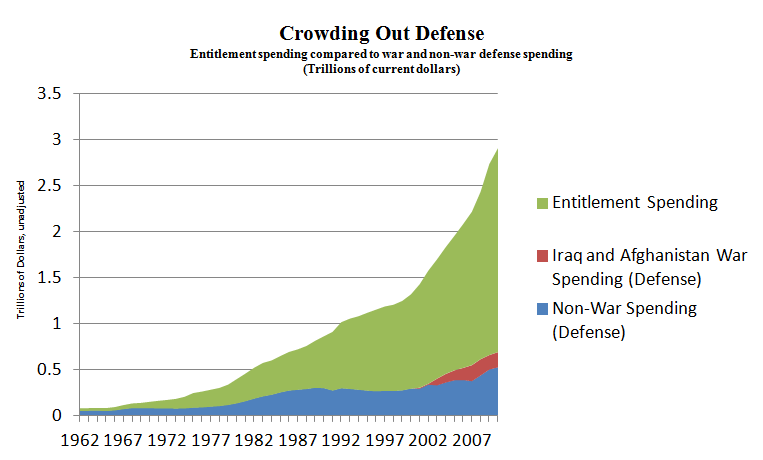
Browsing over at AE Ideas when I saw this chart:

Some things:

1.  Defense spending has been pretty constant since 1985.

2.  Spending on entitlement programs has not.

Jon Stewart – Pure Platinum

Look, Stewart is funny, wickedly funny.  His timing, expressions and body language are the best. And the fact that his patter is politics only makes it better; I like politics, he makes political humor.

What’s not to love?

But lot’s of people forget that the man is a clown.  He’s an entertainer.  He’s on a stage making people laugh at jokes. Think Abbott and Costello.  Andrew Dice Clay.  Rodney Dangerfield.

Gifted all.

He isn’t a commentator.  He’s isn’t a reporter.  He isn’t a writer.

So I love it when folks use Stewart as a source of news or to make a point.  I especially love it when he turns his schtick back on the liberal establishment that loves him so:

!!!!

The Daily Show with Jon Stewart Mon – Thurs 11p / 10c
Paul Krugman & the Trillion Dollar Coin
www.thedailyshow.com
Daily Show Full Episodes Political Humor & Satire Blog The Daily Show on Facebook