Category Archives: Government

Dysfunction of Government

Look, I like Rand Paul.  I resonate with much of what he says.  And this even more so.

Ignore the comments about term limits – I can go back and forth on that one.  Just listen to his comments on how the Fiscal Cliff Senate legislation was passed.

No printed bill.

Made available online at 01:36.

Voted on at 01:39.

Partisan politics aside, there is no earthly way that an argument can be made that this is an example of how we want legislation debated, written, studied and then voted on.

No way.

Harry Reid and Political Advice

Speaking on the floor of the Senate, Harry Reid felt it an important use of his time to provide some political advice to the Speaker of the House.

“As Speaker Boehner saw on New Year’s Day, when he allows every member of the House to vote – and not only the Republican members of the House to vote — Congress can enact bills into laws,” he said on the floor. “No major legislation can pass the Senate without the votes of both Democrats and Republicans. During the 113th Congress, the Speaker should strive to make that the rule in the House of Representatives, as well.”

Interesting advice to be sure.  And in some ways, Reid is right.  The idea of not voting on legislation that has been passed in one chamber and then been sent to the other for consideration is an idea that would garner significant support from the American public.  Heck, even from me.

However, I wonder if the majority leader would consider taking his own advice and allow House bills that he fears come for a vote in his Senate?

I suspect not.

Obama and the Fiscal Cliff

Obama is confused.

Today he’s remarking that the republicans aren’t negotiating seriously:

In an interview broadcast Sunday, Obama told NBC’s “Meet the Press” that Republicans are responsible for the stalemate that brought lawmakers back to Capitol Hill on a Sunday afternoon.

“They say that the biggest priority is making sure that we deal with the deficit in a serious way. But the way they’re behaving is that their only priority is making sure that tax breaks for the wealthiest Americans are protected,” Obama said. “That seems to be their only overriding, unifying theme,”

To be clear, there is only one party in these negotiations that have, as their entire offer, a single overriding theme.  And that is the President himself.  The President’s entire offer, the whole of it, consists of raising taxes on the wealthy.

And that’s it.

No spending cuts.  No entitlement reforms.  No talk about any effort to reduce the deficit or attack the debt.

Just tax the rich.  And he knows that this isn’t going to address any of the problems we face, on the contrary – it will only make it worse.

But if that was the only aspect of Obama’s confusion, he could be forgiven.  We know that he’s nothing more than a class warrior who hasn’t an inkling of a clue on anything economic.  But he should know how bills make their way through Capital Hill:

Obama said the Senate should vote on legislation to make sure middle-class taxes are not raised and that 2 million people don’t lose unemployment benefits .

The Senate doesn’t initiate financial bills; the House does.  And they have.  Two of them.  Both waiting for Reid and the democrats to take them up, amend them and vote on them.  The pressure is squarely on the Senate right now.  Not the republicans.

Top Tax Rate

What should the rate be on the top earners?

Well, according to a poll conducted by the Hill, 75% of Americans feel that it should be 30% or less.

While Americans may feed on the chum thrown to them in the form of “Tax the Rich”, most people continue to feel that tax rates ought to remain modest.

Thelma And Louise

I’m guessing we go over.

John Boehner has said that he’ll give House members 48 hours to get back to Washington.  That means if he were to call them right now they wouldn’t get to their offices until Saturday.  Which leaves 2 days to pass legislation.

And that’s if he agrees to pass the Senate version of the bill.

As it stands right now, I think that the problem is this:

  • The President will not budge on his demand that the tax rate on wealthy Americans goes up.  That is a deal breaker for him.
  • The democrats will not agree to spending cuts other than defense.
  • The republicans will not raise the tax rate on anyone.

The fiscal cliff is made up of two parts.  The first is the expiration of the Bush-era tax cuts.  Because these rates were pushed through using reconciliation, they were set to expire in 2011.  However, as part of a negotiation, the rates were extended for 1 year.  This agreement will end December 31st at midnight.  Failure to extend the Bush tax rates will result in a massive tax hike for every American.

The second part is the agreement made that will mandate budgetary cuts; spending cuts.  Among the items set to be cut is the defense budget.  This is seen to be unappealing to republicans.

A guilty pleasure of mine would be to see us go over this cliff in full.  I want to see how American’s react to the tax hike that will impact them January 1.  This would include the extraordinarily large impact of the AMT that would impact millions of Americans.

However, my sick sense of cosmic justice aside, I really am looking for a permanent extension to the Bush tax cuts.  It not only is the right thing to do, but trying to raise the rates like Obama has been insisting is only a political ploy not meant to address any of the fiscal issues that we have right now.  With the rates made permanent, the economy will be able to remove the uncertainty and move forward in recovery.

As for the cuts.  I say let ’em come.  The impact will be short-term dramatic.  I suspect the economy will move into recession but it will be quick and short.  However, the long term benefit of the cuts will reduce the size of government spending and allow the economy to grow more quickly than it otherwise might.

My desire aside I feel that the ball is in the Senate’s court.  Financial bills originate in the House and move to the Senate for consideration.  The Senate should pass the bill or amend it and return it to the House.  Under Boenher, the House has passed two such bills that are simply waiting to be considered by Harry Reid.  For whatever reason, Reid will not hear those bills and allow the Senate to act.

Right now, the delay in passing a bill is squarely on Harry Reid and the democrats.

Public Transportation – Going Private

There’s often talk of public transportation.  And I get the idea; the more accessible work, shopping and other services are to folks who might be struggling, the better off those folks might be.  A second argument surrounds the environment.  The more people use mass transit, the better off we are in terms of gas use, pollution and, recently, CO2 emissions.

Not to mention the fact that traffic just sucks and anything that we can do to minimize it is a plus.

All arguments aside, suppose, for the same of this discussion, that I cede all points.  That mass transit is the way to go, my question is this:

Does it matter what agency provides that transit?

The answer is:

Apparently so.

By now you’ve heard about the perks that come with working in Silicon Valley. Free lunch, 20 percent time — that’s the work time you can use to pursue independent projects.

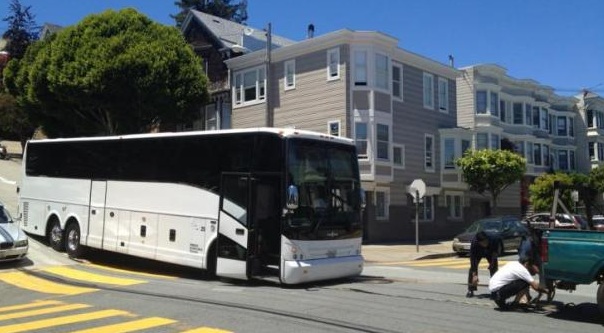
Well, another perk? A private bus that picks you up in your neighborhood in San Francisco and shuttles you down to your corporate campus about an hour south in the suburbs of Silicon Valley.

During rush hour in San Francisco, you see them everywhere, said Eric Rodenbeck, the creative director of Stamen Design in the Mission District of San Francisco.

“They’re just so big,” Rodenbeck says. “These buses are two stories high and they’re barrelling down residential streets, and no one knows where they’re going except the people who are on them.”

So now the complaint against “Big Business” is that they bus people to work.  It’s almost like if the government isn’t providing it for you, it’s just this great big secret conspiracy or something:

“You know it’s almost like this masonic ritual,” Rodenbeck says.  “If you’ve got the key, this whole other city layer unlocks itself to you. And that’s the kind of urban puzzle we like to solve.”

I mean, serious.

So what we have are private companies shelling out their own money to transport people from where they live to where they work.  All this to reduce traffic, reduce emissions, pollution and dependence on oil and other fossil fuels and it STILL isn’t good enough:

Rodenbeck says he thinks the locations are secret because the companies are “sensitive to this idea that they are funding a change in the infrastructure in San Francisco without it being regulated.”

The San Francisco Municipal Transportation Agency is in the midst of studying what’s essentially emerging as a private mass-transportation system, says Jerry Robbins, a transportation planner for the agency.

“The increase in employer buses has sparked some reaction from residents,” Robbins says.

He says that since tech companies contract out the work to private bus companies, which are regulated by the state, the city has little say in what they do.

But Robbins says the agency has fielded complaints that the the private shuttle buses, which often stop at public bus stops, are causing delays and traffic.

Again, private companies are providing transportation, almost exactly like that being provided by the government, but residents don’t like it because it’s not regulated.

But how many folks does this private system haul everyday?

When the map was finished, Stamen counted busses from Apple, eBay, Electronic Arts, Facebook, Google and Yahoo, and they found the buses ran through almost every neighborhood in San Francisco. Stamen estimates that about 14,000 people ride the private shuttle buses every day.

Fourteen Thousand.  People.  Everyday.  In government speak that is 28,000 trips. Everyday.  For free.  And how does the private sector seduce such riders?

“It’s pretty sweet,” Birch said. “They let us choose the type of seats and decor inside. And it’s got dim lighting with the Google colors.”

There’s also free Wi-Fi on the shuttles, and Birch said it’s basically another hour of work.

The tech world is driven by young, educated largely urban workers. But companies like Facebook, Google and Apple are located in the suburbs of Silicon Valley, which is about an hour south of the San Francisco.

“I think a lot of young people who work at the tech companies they want the city life they want something that’s fun and entertaining, and you don’t get that in the suburbs,” Birch said.

Yeah.  By offering what people want.

Look, I like buses more than I like cars.  And I like trains more than I like buses.  And I like lite rail more than I like trains.  But more than any of that I like solutions that actually work.  So maybe the public sector should take some clues from the private sector and begin to work to loosen the grip of public transportation and let it move into the private space.

You might just get free WiFi.

 

Did the Community Reinvestment Act (CRA) Lead to Risky Lending?

Yes it did:

Yes, it did. We use exogenous variation in banks’ incentives to conform to the standards of the Community Reinvestment Act (CRA) around regulatory exam dates to trace out the effect of the CRA on lending activity. Our empirical strategy compares lending behavior of banks undergoing CRA exams within a given census tract in a given month to the behavior of banks operating in the same census tractmonth that do not face these exams. We find that adherence to the act led to riskier lending by banks: in the six quarters surrounding the CRA exams lending is elevated on average by about 5 percent every quarter and loans in these quarters default by about 15 percent more often. These patterns are accentuated in CRA-eligible census tracts and are concentrated among large banks. The effects are strongest during the time period when the market for private securitization was booming.

This should not be contentious or surprising or controversial.

The government wanted to increase the home ownership rate among US citizens.  The government created conditions that would increase that rate.  Such conditions led to practices that helped that increase.

In short; riskier lending.

And at the heart of it all?  The usual suspects; Fran and Fred:

To satisfy CRA examiners, “flexible” lending by large banks rose an average 5% and those loans defaulted about 15% more often, the 43-page study found.

The strongest link between CRA lending and defaults took place in the runup to the crisis — 2004 to 2006 — when banks rapidly sold CRA mortgages for securitization by Fannie Mae and Freddie Mac and Wall Street.

CRA regulations are at the core of Fannie’s and Freddie’s so-called affordable housing mission. In the early 1990s, a Democrat Congress gave HUD the authority to set and enforce (through fines) CRA-grade loan quotas at Fannie and Freddie.

It passed a law requiring the government-backed agencies to “assist insured depository institutions to meet their obligations under the (CRA).” The goal was to help banks meet lending quotas by buying their CRA loans.

But they had to loosen underwriting standards to do it. And that’s what they did.

Oh boy, this won’t play well in the press.

Laffer Curve – California Dreamin

California is broke.  Way broke. And spending is the problem.  So what did California do?  They enacted new laws calling for new taxes on the rich:

The big state tax news is that California voters said to sock it to the rich–specifically those with income of $250,000 and up. California Proposition 30, which Gov. Jerry Brown’s budget and public education in particular depended on, passed.

Proposition 30 creates three new upper income tax brackets for the next seven years. For example, folks with $250,000 to $300,000 a year in income will pay 10.3%, up from 9.3%. The new top income tax rate–for folks with income of $1 million-plus–will be 13.3%, up from a current top rate of 10.3%. That eclipses New Yorkers’ combined state and local top rate of 12.7% and Hawaii’s top rate of 11%. The income tax hikes are retroactive to Jan. 1, 2012, but the extra bill isn’t due until April 15, 2013.

The expected result?  Well, if past results can predict future ones, I would expect that California sees more people leaving:

Nearly four million more people have left the Golden State in the last two decades than have come from other states. This is a sharp reversal from the 1980s, when 100,000 more Americans were settling in California each year than were leaving. According to Mr. Kotkin, most of those leaving are between the ages of 5 and 14 or 34 to 45. In other words, young families.

Meanwhile, taxes are harming the private economy. According to the Tax Foundation, California has the 48th-worst business tax climate. Its income tax is steeply progressive. Millionaires pay a top rate of 10.3%, the third-highest in the country. But middle-class workers—those who earn more than $48,000—pay a top rate of 9.3%, which is higher than what millionaires pay in 47 states.

People aren’t gonna put up with it; they aren’t going to continue to work harder for less, pay more for smaller houses and face ever increasing costs associated with energy and transportation.

The Laffer Curve wins again.

Small Businesses Pessimistic

ho ever you might wanna blame for the shenanigans in Washington, the result is not good for small business CEOs, their expectations and, presumably, their staffs:

SAN FRANCISCO, November 30, 2012 – Small business owners as a group are now the most pessimistic they have been since the third quarter of 2010, according to the latest Wells Fargo/Gallup Small Business Index. The Index fell 28 points to negative 11 (-11) in the post-election survey conducted Nov. 12-16, 2012.

Most interesting to Americans in general is the expectations surrounding jobs:

Likely related to owners’ pessimism, one in five small business owners (21 percent) expects to decrease the number of jobs at their company over the next 12 months – the largest percentage of small businesses expecting to reduce jobs since the inception of the Wells Fargo/Gallup Small Business Index in 2003. One in four owners (26 percent) reported a reduction in the number of jobs at their company over the past 12 months, representing the largest percentage since the fourth quarter of 2010.

There is little hope that the situation in Washington is going to work out for the small businessman.  Some of the blame can certainly be attributed to the expectation that republicans would refuse to work with Obama.  However, a significant amount of that pessimism most certainly is attributed to the anti-business attitude that the Obama administration brings to Washington.

Government Response to Sandy

Government is inefficient, but I repeat myself.

Sandy created massive problems, and New York found themselves utterly unprepared:

Sandy flooded both tubes of the Brooklyn-Battery Tunnel, now called the Hugh L. Carey Tunnel, which was one of the major and longest transportation disruptions of the storm. It also ravaged the Rockaways in Queens, particularly the waterfront community of Breezy Point, where roughly 100 homes burned to the ground in a massive wind-swept fire.

Among the other crises Cuomo and New York City Mayor Michael Bloomberg faced on a daily basis during Sandy were the shortage of temporary housing, which continues, the long disruption of electricity and gasoline, generators in health care facilities swamped by floodwaters, restoring power from swamped electrical infrastructure and repairing commuter rail lines.

But it didn’t have to be this way:

More than three decades before Superstorm Sandy, a state law and a series of legislative reports began warning New York politicians to prepare for a storm of historic proportions, spelling out scenarios eerily similar to what actually happened: a towering storm surge; overwhelming flooding; swamped subway lines; widespread power outages. The Rockaway peninsula was deemed among the “most at risk.”

But most of the warnings and a requirement in a 1978 law to create a regularly updated plan for the restoration of “vital services” after a storm went mostly unheeded, either because of tight budgets or the lack of political will to prepare for a hypothetical storm that may never hit.

I’ll withhold my typical scorn of “the government should take care of us.”  After all, this is a state law meant to address problems that the state would face.  However, I will point out the main problem with government solutions:

They don’t work very well.

Had individual citizens taken efforts to protect themselves rather than holding out some fantastical hope of government assistance, the whole region would be better off.