Category Archives: Government

Cars Are Not Airplanes And Other Things That Are True

So, I have to tell you how hard it was to resist the temptation to go down the obvious post title on this one.

It was really really hard.

There, now ya know.

But really, cars and airplanes are not strictly the same thing.  And, for that matter, neither is the making of cars and the flying of airplanes the same thing either.  However, companies that make cars and companies that fly airplanes ARE kinda the same.  Same in enough ways that they make for useful comparisons.

Continue reading

The Limits Of Government Power

In the last 6 years, the government has done stuff that leaves me wondering if there is a  limit to what it can do.

For example, we see bills such as the Patriot Act passed into law that really push the limits on government intrusion.  If they can do “that”, what can’t they do?

Then there were the wars in foreign nations.  If we can just do “that”, is there any thing that we can’t do?

Then TARP, TARP II and the bailout of the car companies.

All of which leads us to Obamacare and the preventative care mandate.

What can’t they do?

Continue reading

Chisago County: Entitlement Program Case Study

I grew up “In the Land of Sky Blue Waters.”  I know those people, my people.  I know how they feel about government, how they feel about compassion and how they feel about responsibility.

I know what it’s like to have a neighbor lose a barn to fire.  I know what it’s like to have the community come together to rebuild that barn, to donate seed and feed, horses and cattle.  I know what it’s like to have a barn raising.

I know what those people in the New York Times article are getting at, hinting at and struggling with.

Continue reading

Federal Workers: Overpaid Compared to Private Employees

It used to be that taking a government job meant that you sacrificed some on the salary side but gained some on the “job for life” side.  Safe career but lower pay.

We’re not seeing that any longer.

Continue reading

Mitt Romney: I Don’t Care About Poor People

Recently Mitt Romney made a statement that many, on both sides, are using to against him.  From the Blue, Romney is being attacked on that comment by having it taken out of context.  The left is going to say that Romney said:

Former Massachusetts Gov. Mitt Romney said on Wednesday that he’s “not concerned about the very poor,”

When in fact he said:

“I’m in this race because I care about Americans. I’m not concerned about the very poor. We have a safety net there. If it needs repair, I’ll fix it,” the Republican front-runner said Wednesday on CNN, following his victory in the Florida primary.

Be that as it may, it’s election politics and the tactic is used by both the Red and the Blue.

But is the statement true?

Continue reading

Right To Work: Indiana

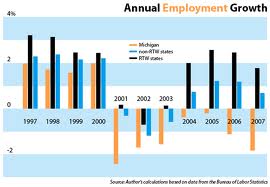
We’re in a place where we need to create jobs.  We need to be able to take folks who are on the unemployment rolls and move them to the tax roles.  And to do that, we have got to make hiring someone a better option than not hiring someone.

Employees provide productivity.  They do this in the same way that machines and assembly lines do.  In the exact same manner and means that a company owner will seek out the cheapest source of copper or lumber or wool, she will seek out the cheapest source of labor.

Continue reading

The Impact Of Marriage: Poverty And Children

I have been making the point that one of the contributors to poverty, income disparity and perhaps income mobility is marriage.  I’ve been making the case that marriage tends to bring people out of poverty and failing to get married tends to make one more likely to experience poverty.

For example, I’ve demonstrated that the GINI, or disparity in income, falls as the marriage rate increases in a population:

  • 50% Marriage:  .3446
  • 60% Marriage:  .3353
  • 70% Marriage:  .3227
  • 80% Marriage:  .3015

As the marriage rate went up, the GINI went down.  In other words, as my population increased its marriage rate the inequality diminished.  In fact, by moving from a 50% marriage rate to an 80% rate, the GINI moved by 12%.

Let’s do it again.  10,000 new salaries, same constraints:

  • 50% Marriage:  .3471
  • 60% Marriage:  .3416
  • 70% Marriage:  .3248
  • 80% Marriage:  .3093

Again, a continuing trend toward equality.

As the population marries, the GINI falls.  And this is just a mathematical observation, it has nothing to do with the social benefits that occur due to marriage.

Further, data from the Urban Institute and American University shows that marriage impacts poverty in more concrete ways:

The gains from marriage extend to material hardship as well. About 30 percent of cohabiting couples and 33-35 percent of single parents stated that sometime in the past year they did not meet their essential expenses. These levels are twice the 15 percent rate experienced by married parents. Even among households with similar incomes, demographic and educational characteristics, married couples suffer fewer serious material 21 hardships. Moreover, despite their less promising marriage market, low-income and less educated mothers who are married experience significantly less material hardship than low income,
less-educated mothers not married.

Marriage retained an advantage in limiting hardship even among families with the same incomes relative to needs. The variables used for controlling for the effect of income to-needs ratios were the income-to-needs ratios in the current wave of SIPP (the prior four month period) as well as the mean level and the stability of income-to-needs ratios during the 28 months prior to the current wave. Not surprisingly, higher current welfare ratios, higher past welfare ratios, and lower instability of welfare ratios were all associated with less hardship. However, the inclusion of the income variables left intact virtually all of the differences by marital and family status.

Families that fit in the same income that are married fare better than families that are not married.

The other day I posted on poverty and how to avoid it.  One of the key barriers to middle class is not getting married:


The Immediate Prerequisites to Success Are:

  1. Receive a good education [graduate high school]
  2. Work full time
  3. Marry [And do it before having kids]

But do we have data?  Have we been able to demonstrate that marriage is a determining factor?

Yes.  There is data that backs up the idea that marriage, and just marriage, would reduce our poverty rate significantly:

Economists Isabel Sawhill of Brookings and Adam Thomas of Harvard have conducted a fascinating analysis of whether higher marriage rates would reduce poverty in the United States.4 Employing statistical modeling, they analyzed data from the Census Bureau to determine how poverty would be affected if poor people behaved differently. In particular, they modeled the effect on poverty rates of more work, more marriage, more education, and fewer children by poor adults. In the case of marriage, they simply matched unmarried people by age, education, and race until the marriage rate for the nation equaled the marriage rate in 1970. This exercise showed that if we could turn back the clock and achieve the marriage rate that prevailed in 1970, poverty would be reduced by well over 25 percent.

Impressive indeed.  Simply returning to 1970 rates of marriage, we would be able to realize a significant improvement in our poverty numbers.  And to put this in perspective, social welfare programs aren’t even close when it comes to effectiveness:

By way of comparison, doubling cash welfare would reduce poverty by less than one-third as much as increasing marriage rates.

We could double spending and reduce  poverty.  But it would only be one-third as effective as getting people to get married.

And as a way of comparison, look at the impact of poverty on kids and what reducing that impact by getting married would do:
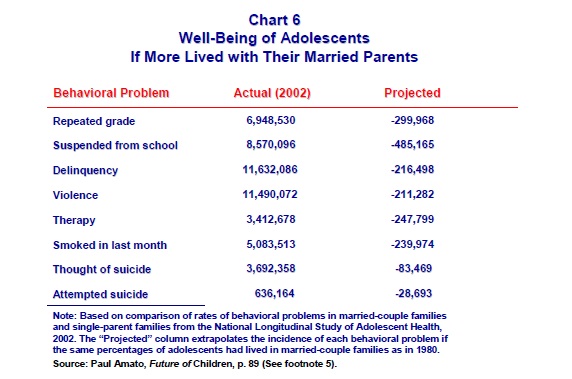
Marriage, and the declining marriage rate, is a key to poverty in the United States.

State Issued ID

I moved to North Carolina in 1999.  Today marks the first day that I can remember where I have left my property without my ID on my body.

See, it’s my job to get the kids ready for school in the morning.  I do this by rustling them out of bed and getting them to the door, drop them off and then come home.  After which I begin my day; calls, reports, e-mails and the normal whatnot.  When I get a break, I shower, get dressed and make my way to the office.

Continue reading

State of Illinois Targetting The Young, Elderly, Poor, Minority Democrats

That is if you believe the Democrats when they say that Voter ID laws are discriminatory.  See, the logic goes like this:

The very young, poor, rural, urban, minority Democrat citizens in our nation are disproportionally unable to obtain State ID.  Further, this inability to obtain such ID is based solely on cost.  State ID’s are prohibitively expensive.

I checked.  Here in North Carolina you can obtain State ID by:

  1. You will need 2 documents from this category which provide your full name and date of birth. Listed below are acceptable documents you can use, provided they include your full name (including middle name)
    1. Drivers License from any state, territory or province of Canada.
    2. Birth Certificate
    3. Original Social Security Card
    4. School records or diplomas
    5. US Military ID
    6. Passport
    7. Marriage Certificate
    8. Court Documents
  2. Proof Of Social Security
    1. Social Security Card
    2. 1099 Form
    3. W-2 Form
    4. DD-124 Form
    5. Property Tax Form
    6. Pay Stub
    7. Military ID
    8. Medicare/Medicaid Card
  3. Proof of Residency
    1. Any document issued by the state of North Carolina or the federal government
    2. Bank statement or other corporate document
    3. Lease or housing contract
    4. Utility bill
    5. School Records
    6. Letter from homeless shelter

With some combination of these documents a resident of North Carolina can obtain a state ID.  That and $10.00.

The burden to obtain an ID is not significant or overly burdensome.

So, anyway, back to Illinois.  How is the state of Illinois now discriminating against the young, elderly, urban, rural Democrats in the state?

They are requiring the discriminatory practice of providing state ID to purchase…Liquid Plumber.  Hat Tip Dan Mitchell

CHICAGO (CBS) – A new state law requires those who buy drain cleaners and other caustic substances to provide photo identification and sign a log.

The law, which took effect Sunday, requires those who seek to buy caustic or noxious substances, except for batteries, to provide government-issued photo identification that shows their name and date of birth. The cashier then must log the name and address, the date and time of the purchase, the type of product, the brand and even the net weight.

What possible excuse could the Republicans of the state make for such discriminatory practices?

State Rep. Jack Franks (D-Woodstock) obtained passage of the new law following attacks in which drain cleaner was poured on two Chicago women, badly scarring them.

Truly unbelievable.  Democrats feel perfectly okay to require state ID to buy Draino but not to vote.

Politics anyone?

Voter Fraud And Voter ID Laws

In June of last year our North Carolina governor Bev Purdue vetoed a bill that would have required voters present government issued ID at the ballot.  In other words, our citizens would have to prove they are who they say they are.

Bev’s comments upon vetoing this bill:

“The right to choose our leaders is among the most precious freedoms we have – both as Americans and North Carolinians. North Carolinians who are eligible to vote have a constitutionally guaranteed right to cast their ballots, and no one should put up obstacles to citizens exercising that right.

“We must always be vigilant in protecting the integrity of our elections. But requiring every voter to present a government-issued photo ID is not the way to do it. This bill, as written, will unnecessarily and unfairly disenfranchise many eligible and legitimate voters. The legislature should pass a less extreme bill that allows for other forms of identification, such as those permitted under federal law.

“There was a time in North Carolina history when the right to vote was enjoyed only by some citizens rather than by all. That time is past, and we should not revisit it.

“Therefore, I veto this bill.”

I read the Constitution of North Carolina, I have to assume that Gov. Purdue was speaking about that state Constitution because she is acting as state Governor AND the United States Constitution has no “Right to Vote” language in it.  And this is what the Constitution says:

Section 1.  Who may vote.

Every person born in the United States and every person who has been naturalized, 18 years of age, and possessing the qualifications set out in this Article, shall be entitled to vote at any election by the people of the State, except as herein otherwise provided.


Sec. 2.  Qualifications of voter.

(1)        Residence period for State elections.  Any person who has resided in the State of North Carolina for one year and in the precinct, ward, or other election district for 30 days next preceding an election, and possesses the other qualifications set out in this Article, shall be entitled to vote at any election held in this State.  Removal from one precinct, ward, or other election district to another in this State shall not operate to deprive any person of the right to vote in the precinct, ward, or other election district from which that person has removed until 30 days after the removal.

(2)        Residence period for presidential elections.  The General Assembly may reduce the time of residence for persons voting in presidential elections.  A person made eligible by reason of a reduction in time of residence shall possess the other qualifications set out in this Article, shall only be entitled to vote for President and Vice President of the United States or for electors for President and Vice President, and shall not thereby become eligible to hold office in this State.

(3)        Disqualification of felon.  No person adjudged guilty of a felony against this State or the United States, or adjudged guilty of a felony in another state that also would be a felony if it had been committed in this State, shall be permitted to vote unless that person shall be first restored to the rights of citizenship in the manner prescribed by law.

It is pretty clear.  You have to be:

  1. 18
  2. A citizen
  3. A 1 year resident

It is a reasonable request that an individual representing his desire to vote prove that.  Any claim that this is NOT reasonable is based in pure politics.  There are those who claim that requiring such proof would disenfranchise voters who, as it turns out, would vote for candidate of a certain political persuasion.  It can not be ignored that the desire to create a system that so easily creates conditions where people who are not who they say they are can vote is a system that is inherently and purposely flawed in order to create election day advantages.

I bring this up because the state Republicans were unable to overcome the Governor’s veto and it appears the bill will remain just that, a bill.