Category Archives: Economics

The Economics Of Pay

I’m a vocal opponent of the minimum wage.  The idea, of course, is that when you implement a minimum price for labor, you get an excess of labor.  In other words, higher unemployment.  I’m equally a vocal opponent of a “maximum wage.”  When you place a maximum price on labor, you get a shortage of it.  In other words, you can’t find people to hire.

For this reason I take the decidedly unpopular combination of policy stances that we should abolish the minimum wage AND allow corporate CEOs to earn as much money as they can command.

However, this does not mean that I am in favor of just throwing money at the executive suite.  The money should be commensurate with the level of competence.   And a recent study is finding that it’s not always the case:

To determine how much to pay a CEO, corporate compensation committees look at how much the chiefs of similar companies earn, which has the result of lumping together all CEO talent into one pool. Elson and Ferrere argued that expertise in management isn’t the same, and isn’t as good, as having a deep base of knowledge in one particular industry.

Many of the skills that make a chief executive successful don’t translate to another company. “The theoretical underpinning of [peer grouping] became the notion of transferability,” Elson said. “That was false. The superstar theory of the CEO failed, and if transferability failed, the peer system has to fail.”

“There’s been a sense for some time that the external view of pay-setting has been a problem in ratcheting up pay,” said Paul Hodgson, chief research analyst at corporate governance research company GMI Ratings.

Elson and Ferrere said benchmarking against what other CEOs make is flawed in several ways that inflate pay packages.

One problem is that the definition of what constitutes a “similar” company can be manipulated to skew pay higher by including larger companies or ones in different industries. Institutional shareholders are “very, very suspicious” of that practice, Hodgson said.

Even without manipulation, Elson said companies should decide how much to pay a CEO based on performance, not how much his or her counterparts earn. “If you don’t have that internal benchmark you’ve made a mistake to begin with,” he said.

Make no mistake, highly successful corporate managers earn every dollar they make.  But when companies don’t link pay to success, they are hurting themselves.

Euvoluntary Trade: The Essence of Economics?

Consider trades made between two people.  This could be the raw market where a farmer trades wheat to a lumber jack for wood.  Or it can be the more common form of trade involving cash money.  As long as the trade meets certain criteria, the trade is “desirable”

The main points of euvoluntary exchange:

  1. Euvoluntary trade unambiguously makes each party to the transaction at least no worse off than without the trade.
  2. Even if bargaining from a weak position due to poor alternatives, voluntary trade still makes each party to the transaction at least no worse off than without the trade.
  3. Voluntary trades made under conditions of radical uncertainty may make one or more party to a trade worse off than without the trade. The expectation of gains drives people to trade.
  4. Involuntary trades can be expected to make at least one party worse off along some dimension than without the trade.

The whole idea is really pretty cool.

These People Really Believe That We Need To Ban Profits

I was a political ignoramus just 6 years ago.  Certainly I could express my views on the big ones, capital punishment, immigration and abortion.  But the more nuanced perspectives would come later.

What surprises me is that at one time, I may actually have held views that I now hold in disdain.  I’m not sure I was ever this far left, but the views expressed by delegates at the Democrat Convention regarding corporate profits are without defense.

By the way, whats up with Van Jones not shaking hands with Peter Schiff?  I mean, not even shaking hands?

The State Of “College Material”

I love me some Jack Chambless.  Dr. Chambless is an economics professor at Valencia College.  He’s a relentless champion of Libertarian ideas.
His most recent post is classic.  In it he describes his tradition at the start of every term:

I start the first day with some sort of essay question designed to uncover socialist thinking among my students.  Over the years I have asked people to comment on everything from Joe Montana selling his mansion for $49 million while others are homeless to their opinion on what the government should do to help them achieve the American Dream.

This week I asked my students – approximately 110 of them – to answer this question:”What one specific thing has President Obama done to make the American economy stronger?”

The responses are awesome:

 “Obama has made taxes according to a households income/class.  He made things stronger for every class by doing that.”

Obviously the income tax has long been progressive.

“President Obama has created jobs since he got elected in 2008.  Before him, the economy was suffering, especially middle class families. His campaign was focused alot on creating jobs. This accomplishment has benefited the economy greatly.”

Even Obama isn’t running on his jobs record.

“President Obama has made it so that everyone must pay taxes and people who are more wealthy pays the most taxes.”

Except, of course, Obama is making it so that fewer people pay taxes.  Though to be fair, he IS trying to make the rich make up for that.

“He has raised taxes on the rich and lowered taxes on the middle class.   Also, he has cut military funding.”

Huh?

“He has offered more financial incentives to the American family with his Cash for Clunkers campaign.  This lead for the American family to upgrade to a new car & supply buisness to the failing America car market.”

The Cash For Clunkers program was a wild failure.  The larger concept of the auto bailout’s is more debatable but a reasonable response is that those bailouts only might have helped Detroit.  But this can only be true by acknowledging that it prevented expansion in other areas that would have made up for the demand.

“the Government, under Obama, has slowed the rate our countries US dollar was inflating at the end of Bush’s terms.”

“One specific thing that Obama has done to make this economy stronger is giving jobs all across the U.S. for the middle class.”

“President Obama’s stimulation package.”

“President Obama has made bigger percentages of taxes that people have to pay for their money.”

“He has tried to make America have more equal classes rather than the rich getting richer and the poor getting poorer and eventually diminishing the middle class.”

“He has funded programs for the research of new alternative energy proving thousands of people job opportunities, and the possibility of the creation of a new type of energy market.”

“President Obama has allow all ages to go back to school.”

“Health care benefits has improved.”

“Obama has made the country stronger by giving his best to try to stabilize the economy.”

“Obama, in his early presidency, verbally excited Americans by the idea of change and this encouraged slight economic growth.”

“One thing I believe President Obama did to make the country stronger is the stimulus check act.”

“Tax cuts to overseas businesses to entice them to bring their work stateside.”

“One thing Obama help improve the economy is to provide more jobs for the unemployed people.”

In my heart I hope that we can beat Obama this fall, in my head, I don’t think we have a chance.  Which is to say that I agree with Dr. Chambliss’ observation:

These are only a sampling of what is rattling around in the brains of our college students.  Imagine what even more ignorant Americans are probably thinking.

President Obama can take great comfort in knowing that we are a nation of economically-illiterate human beings armed with voter registration cards.  He will win in November.  No one wants to hear any sensible economics from Romney or Ryan.

January 20, 2017 – that seems like a long way off….

If We Try Very Hard We Too Can Be Italy

This guys is serious.  He’s honestly making the case that the United States doesn’t pay enough in taxes and that if we only paid more, we could enjoy the benefits of Italy:

Italy may be in a funk, with a shrinking economy and a high unemployment rate, but the United States can learn a lot from it, and not just about the benefits of public health care. Italians live longer. Their poverty rate is much lower than ours. If they lose their jobs or suffer some other misfortune, they can turn to a more generous social safety net.

Mr. Porter makes this case with what I can only assume is a straight face.  What he calls a “funk” is really an economy that is one of the worst in Europe, perhaps only behind Greece.  And he’s actually trying to make the case that we, the United States, can learn a lot from Italy.

We can.  But not in the way that the author is trying to point out.  What we have to learn from Italy is what NOT to do.  Certainly not WHAT to do.

Consider:

No wonder we can’t afford to keep more children alive. In 2007, the most recent year for which figures are available, the United States government spent about 16 percent of its output on social programs — things like public health, food and housing for the poor. In Italy, that figure was 25 percent.

Here again, Porter is lamenting the fact that the United States spends “only” 16%  of our output, GDP[?], while Italy spends 25%.  Yet no mention that Italy is deeply in debt and failing to grow its way out of the danger zone.

In short, the government has spent too much money.  So much so that Italy is deeply in danger of economic catastrophe.  Hardly a fair price to pay for  extended unemployment benefits.

It’s safe to say that when presented an argument that we need to raise taxes in order to emulate Italy you are dealing with a deeply partisan statist.


The Middle Class: Definition and Status

For a long time now, and especially since the recession of 2008, there has been discussion surrounding the the middle class.  Specifically how that group of Americans are doing.  I admit that I’m late to the game, but I have been very interested in this topic.

One of the most frustrating aspects to looking at this subject is that there isn’t a clear and definite definition of what the middle class is.  Who’s in, who’s out.

For a number of people the middle class represents an idea.  The idea that you can own your own home, send your kids to college and put a little bit away for retirement.  If that sounds familiar, it should.  This is how the president carves out his vision of the middle class.  And while I don’t necessarily disagree with this campy, it doesn’t satisfy my desire for a hard definition.

I think I’ve finally found one:

The middle-income tier—defined in this Pew Research analysis as all adults whose annual household income is two-thirds to double the national median.

In dollars and sense, this comes out to:

The new study reviewed 2010 data from the Census Bureau and Federal Reserve, defining “middle class” as the tier of adults whose household income falls between two-thirds and double the national median income, or $39,418 to $118,255 in 2010 for a family of three.

Note the definition includes household size.  In this case, the household size is 3.  This would include both configurations; two adults and one child or one adult with two children.

As expected, the Pew Report paints a depressing view from the middle:

Since 2000, the middle class has shrunk in size, fallen backward in income and wealth, and shed some—but by no means all—of its characteristic faith in the future.

Is this really true?

I haven’t taken the time yet to read the report, it came out only today, but I’m very interested to see how they ran the numbers and came to their conclusion.  For example, the Associated Press article makes this point:

By this definition, “middle class” makes up about 51 percent of U.S. adults, down from 61 percent in 1971.

However, no attempt has been made, that I’ve yet seen in my scanning, that would take into account a possible morphing of that middle class family structure.  In other words, how many families in 1971 fit into the 2 adults 1 child version of the family of three and how many fit into the 1 and 2 version?  Clearly a family consisting of 2 working aged adults is going to have a higher income than a family consisting of only one such adult with not one, but two children to care for.  Daycare alone is going to be double if even the two parent family has daycare expenses.

Good stuff.


Romney’s Tax Plan

A recent report from the Tax Policy Center is showing that the Romney tax plan will result in an added tax burden on folks with the lowest incomes:

Our major conclusion is that any revenue-neutral individual income tax change that incorporates the features Governor Romney has proposed would provide large tax cuts to high-income households, and increase the tax burdens on middle- and/or lower-income taxpayers.

I haven’t read all of the report nor have I taken much time to study the plan offered by the Governor.  However, the broad brush strokes seem to be that there would be a 20% reduction in the tax rate at all tax brackets.  Further, Romney would broaden the base by eliminating deductions.  Last, Romney claims that his policies would spark the economy into 4% growth as opposed to the anemic sub 2% that we’ve grown accustomed too.

It should be no secret that I’m a small tax small spend kinda guy.  So I’m a little concerned that the main thrust is surrounding tax rates and not spending rates.  Cutting taxes is fine, but unless we shrink government, we’re only left with larger deficits.

I’m also a big believer in the concept of the Laffer Curve.  This is the idea that tax rates of 0% and 100% will result in the same amount of tax revenue.  And that as tax rates increase from 0% more and more tax revenue will be generated until a peak is hit at which point any further increase in the tax rate will result in lower revenue.  I think this is true.  It’s important to emphasize the concept of both sides of the curve and I think that Romney may be forgetting the 0% side and arch of the philosophy.

I’m not so optimistic that we’re sitting on the exact right peak right now and that either a tax hike or a tax cut would reduce revenue.  But I think there might be better ways to spur the economy without introducing tax cuts.  For example, end this continued nonsense surrounding the extension of the Bush tax cuts.  Make ’em permanent and move on.  The taxes in Obamacare?  Remove them too.

Right now, I think that tax certainty would be a sufficient spark to the economy and one that could generate the 4% growth Romney is targeting.

I’ll leave the discussion with one caveat.  I think that we need to reduce our corporate tax so that we’re among the most competitive in the world in this space and not the worst in the world.  Further, I would edit the code to say that all earnings realized in a foreign nation and taxed at the national rate can be brought to America without being subject to further American corporate taxes.  It’s hard to defend the practice of taxing money earned in France, using French -ahem- roads and bridges and then taxing that money further for the construction of American roads and bridges.

More On The Laws Of Economics

I’m reading an article for an upcoming post when I came across this:

We have a shortage of every kind of doctor, except for plastic surgeons and dermatologists.

It strikes me that plastic surgery and dermatology are both examples of medical “care” not subject to insurance and the accompanying government regulation.

And the prices of plastic surgery?


From the report:

Cosmetic surgery is one of the few types of medical care for which consumers pay almost exclusively out of pocket.  Even so, the demand for cosmetic surgery has exploded in recent years.  According to the American Society of Plastic Surgeons, 1.7 million cosmetic surgical procedures were performed in 2008.  That is more than 40 times the number performed two decades ago (for example, 413,208 in 1992).

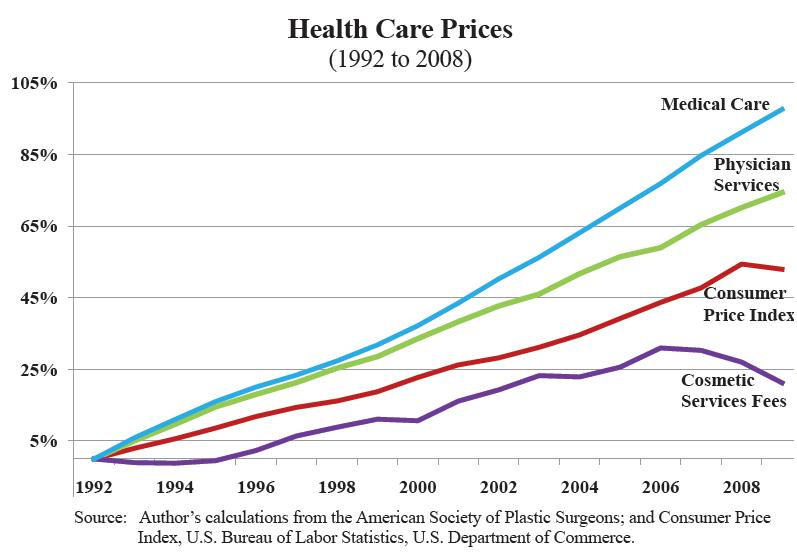
Despite this huge increase, cosmetic surgeons’ fees have remained relatively stable.  Since 1992, medical care prices have increased an average of 98 percent. The price of physician services rose by 74 percent.  [See the figure.] The increase in the price of all goods, as measured by the consumer price index (CPI), was 53 percent. Yet, an index of cosmetic surgery  prices only rose only about 21 percent. Thus, while the price of medical care  generally rose almost twice as fast as the CPI, the price of cosmetic surgery went up less than half as much. Put another way, while the real price of health care  paid for by third parties rose, the real price of self-pay medicine fell.

When exposed to the free market, commodities and services will respond with cheaper prices and higher quality.

Victim Of The Feminist Revolution – School Children?

Am reading Super Freakonomics tonight after swimming at the “Y”.  Consider this:

In 1960, about 40% of female teachers scored in the top quintile of IQ and other aptitude test, with only 8% in the bottom.  Twenty years later, fewer than half as many were in the top quintile, while more than twice as many in the bottom.

Between 1967 and 1980, U.S. test scores fell by about 1.25 grade-level equivalents.

Jeepers.

Cost Of Raising A Child

For some reason as I was driving home yesterday, a thought occurred to me:

If one group of people paid $5.00 for a beer and another group of people paid $2.00 for a beer, would one group of people drink more beer than the other?

Or

If one group of people paid ~$200,000 to have a child and another group of people paid ~$0.00 to have a child, which group of people would have more children?

So, here I am looking at the data:

A middle-income family may spend $234,900 to raise a child born in 2011 to the age of 18, a 3.5 percent increase in a year, according to a government report.

That is a lot of money.  But the costs are not fixed:

The typical two-parent middle-income family spent $12,290 to $14,320 in 2011 on each child, the study found. Households that make less spend less, USDA researchers said. A family earning less than $59,410 a year will probably spend $169,080 in 2011 dollars to rear a child, while parents earning more than $102,870 may pay $389,670, according to the study.

And it can get worse than that.  According to this calculator the cost of raising a child can be as high as $434,180 if you earn more than $100k.

Earn less than $57,800 and you pay $133,710.  That’s $7,300 this year alone.

With government assistance to those poorest among us, that $7,300 can be completely covered reducing the real cost to near zero.

So, given the differences in the cost of raising children, I came to the conclusion that wealthy individuals have fewer children than do those less wealthy.

Was I right?  According to the Census I was:

The births per 1,000 women below 100% of the poverty line in 2008 was 96.3.  Births per 1,000 women above 200% of the poverty line that same year was almost exactly half : 47.7.

If income levels are pulled out, there is a steady climb in births per 1,000 from the wealthiest to the least wealthy.  A notable exception are the very poorest mothers:

Income Births Per 1,000
Less than $10,000. 33.7
$10,000 to $14,999. 103.8
$15,000 to $24,999. 86
$25,000 to $34,999. 80.3
$35,000 to $49,999. 72.3
$50,000 to $74,999. 64.4
$75,000 to $99,999. 57.4
$100,000 to $149,999. 51.8
$150,000 to $199,999. 49.3
$200,000 and over. 49.8

Certainly much more than the cost of raising a child goes into the decision of whether or not to have a baby.  Perhaps something as simple as the cost of contraception goes into the amount of pregnancies among the wealthy and the poor.  But it would be foolish to wave away the fact that the cost of raising a child is much higher for those who have more money and thus acts as a drag on the birthrate among that population.