Tag Archives: North Carolina

Robber Barons!

Those drug companies that we love to hate!  How dare they, how DARE they make money on our misfortunes!?!  Seems they ain’t so bad after all.

The Bridges to Access program will provide free drugs to single people with household income of less than $27,075; $36,425 for couples; and $55,125 for a family of four.

Last year, GSK gave away drugs worth about $438 million to nearly 415,000 patients through various assistance programs.

Just goes to show, when left to it’s own devices, the market works.

Loan Me Your Money or Else!

Dave Ribar recently posted about the prices banks are charging their customers for overdraft protection on their debit cards.  Lemme start off by saying “Guilty!”  Yes, that’s right, even I, Pino, have drifted off the fiscal responsibility fairway and into the rough, perhaps even recently.*  However, I digress.

In Dave’s post he quotes a New York Times report on the subject:

When Peter Means returned to graduate school after a career as a civil servant, he turned to a debit card to help him spend his money more carefully.

So he was stunned when his bank charged him seven $34 fees to cover seven purchases when there was not enough cash in his account…

Reading this it almost sounds as if Peter’s whole involvement and responsibility in what is about to come is that he “turned to his debit card to help him spend his money more carefully.”   In fact, when you continue reading you see that Peter was “stunned” when the bank charged him money for not spending his money more carefully.  [I mean, after all, he DID turn to his debit card!]  See, when it comes to spending money more carefully, you would think that would involve actions that were, well, careful.  Things like:

  1. Reading contracts.
  2. Keeping track of money spent
  3. Keeping track of money not spent

But hey, Peter is a young graduate school student.  Right?  Oops.

Mr. Means, who is 59 and lives in Colorado,

Turns out Peter is 59.  And is still learning how to be careful with his money.  And, it would seem, is still learning about life:

figured employees at his bank, Wells Fargo, would show some mercy…

Now, why would Peter feel that a party to a contract agreed upon by both participants would “show mercy”?  I mean, where would one get this idea that when you agree to do something, you are, well, expected to do that thing?  Ahh, haa, I forgot:

Peter Means returned to graduate school after a career as a civil servant…

It’s because young Peter entered into a life as a government sop.  But surly, certainly, Peter needed the money that he spent on his card knowing all along that his balance was dangerously close to zero.  Right?  No?

He paid $4.14 for a coffee at Starbucks … He got the $6.50 student discount at the movie theater…

Dave follows up on the unfortunate story of poor young Peter with some very good analysis of the business of fees that banks charge to their customers.  The best of which is the acknowledgment that these transactions are, in essence, loans made on the spot , on behalf of the bank, without the explicit knowledge of the bank.  That is, the bank is being depended upon to provide the money on behalf of Peters everywhere without the upfront knowledge of said loan or the ability to DENY that loan.   I mean think of it.  Peter is going to a Starbucks, without money, and purchasing a $4 cup of gourmet coffee.  How many among us would borrow Peter that money?  And how many of us would expect a bank to extend a line of credit to a borrower, with zero money, zero or little income and little if any chance of seeing that loan repaid?

Few.  Maybe none.

So, if Peter really is looking to learn how to spend his money more carefully, perhaps he should appreciate the tender mercies of responsibility.

After all, I am VERY sure that the $238 lesson is far FAR cheaper than the tuition that he is paying for those graduate level classes in whatever it is he is taking.

* My wife and I have an investment account and I use my checking account as a transfer station for my money.  I misjudged once, okay, 6 times, one month and as such, I resonate with the emotions that Peter is struggling with.
** I took that opportunity as a teachable moment and linked my savings account to my debit card–just as Mr. Ribar suggested.

The Health Care Lottery

Much debate has been made about the uninsured in America.  I have tried and tried and tried to make the point in my personal conversations that you can not claim you can’t afford thing “A” when you voluntarily spend the money that could purchase thing “A” and instead buy thing “B”.  That is to say, if I have enough money to book, but instead purchase a DVD, I can not claim to be unable to buy the book.  I simply decided to prioritize the DVD higher than the book.

The same is true of health insurance.  If I have money to purchase health insurance but instead choose to buy thing “B”, I can not claim to be unable to afford health insurance.  I just decided not to buy it.  Now, I understand that there are things in life that seem to qualify as “must have”.  Shelter, food and clothing to name a few.  People even claim that an internet connection and phone service can qualify as required services.  So I tried to find an item that in no way could be classified as “required”.  I came up with lottery tickets.

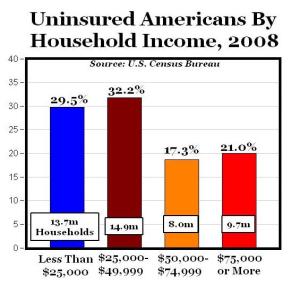
Now, looking at uninsured data found at Carpe Diem, there seem to be three rough categories of people:

uninsured by income

  1. Those that make less than $25,000 a year
  2. Those that make from $25,000 to $50,000 a year
  3. Those that make more than $50,000 a year

Those three breakdowns seem to describe the uninsured equally.  About 30% of the uninsured population are in each category.   Let’s see if my theory holds true for the lower income population.

Using data reported by 4 Professors at Duke University, we are able to see lottery participation rates as well as annual per capita amounts.

Lottery Play by Demographic

What it shows is remarkable.  Combining the players making less than $25,000 per year we see that just about HALF of the population plays the lottery.  Further, those people who play are spending near $600 a year!  This means that these players have near $600 of annual disposable income that they are choosing to spend on the lottery.  By going here, I can find a policy that covers a single 25-year-old man for $52 a month.  Or, $612 a year – almost exactly what is being played on the lottery.

Given that a group of people have disposable income of near $600 and that an insurance policy costs nearly $600, can you realistically say that those folks are unable to afford health insurance?

Me either.

Because I Say It – It's True

I don’t understand why government feels the need to interject itself in the normal workings of a contract.  When I agree to have someone work on my yard, we enter into an agreement that they will provide the service and that I will pay the bill.  Similar, when I purchase goods over the internet, I enter into the same type of agreement.  basically, two parties are promising to trade and to pay according to that trade.  We both understand the implicit penalties associated with either of us defaulting.  either I won’t pay or they will take me to court.  Based on these promises and follow through by both parties, business is allowed to be conducted.

All of this can be done without involvement by the government.  Oh sure, we know it’s there.  We know that if we can’t resolve any conflict, one of us could be arrested and forced to appear in court.  And to that end, the government could send on officer of the law to our house or business to enforce that summons or judgment.  But in general, we expect the government to stay out of the normal execution of the contract.

So why, now, would the government insert itself into the normal functioning of a contract between parties?

The Consumer Economic Protection Act allows a clerk of court to continue a foreclosure hearing for up to 60 days. The delay would give a homeowner more time to work out a payment plan with the mortgage holder or service so the debtor can remain in the home.

For the life of me, I couldn’t understand why anyone would think that this was a good idea.  I tried looking at this from every angle I could think of and I didn’t see that this was solving any problem what so ever.  And then I read a little further:

“When a home is foreclosed, it’s bad for our families, it’s bad for our communities, it’s bad for our businesses, and it’s bad for North Carolina,” Perdue said. “This bill makes it easier for homeowners to work out a deal with their lenders and avoid foreclosure.”

And so there is was.  The Governor is not really trying to make the flow of business easier, she is trying to make re-election easier.   See, if we can give advantage to some group of people by punishing another group of people and that first group is larger or harder to otherwise control, the politician will always choose to provide that advantage.

That is not, however, to ignore the fact that this is BAD for the very people she is mentioning.  The stress of an impending foreclosure can take a huge toll on a family.  And really, what can happen in 60 days that will prevent the inevitable.?  Really, the family would be better served to go through the very well understood process of foreclosure and begin rebuilding as soon as possible.  And don’t forget, for every family that is foreclosed on, there is another family that will move into a new home.  And business?  How can the delay be good for business?  Lenders base their decision to lend on the fact that, in the event of non-payment, they can reclaim their risk.  This is preventing that process and will result in more expensive lending practices up front.

No, be very clear, this is not about helping businesses, this is about helping politics.

Aha….Why Cost of Insurance is so High in Maine

Alright, so we have been discussing health care, health insurance and everything wrong with all of that.  As always, the Democrats cry out “We need this.  We just NEED this damn it!  And then they walk away to their voting place and vote for someone who wants to be in power, which is different than someone wanting to be a Senator, and presto, we have a voice in Washington that is going to legislate this health care for everyone thing.  On the other side, you have republicans, seriously going about the days business when they hear this nonsense and look up from their work and say “No”.  In much the same way a father says “no” to the 7th request for another cookie before bed.

And so, republicans are labeled as the party of “No”.  But this time around, the republicans have offered some solutions to bring the price of health care down.  Down for everyone.  Down to the point that every single person in the country can have insurance.  And one of the methods in doing that is to free insurance companies to sell policies to people outside of the state the reside in.  That is, as a citizen of North Carolina, I could purchase health insurance from a company in Washington state.  Or Arizona.  Or anywhere for that matter.  What THIS would do is free the consumer to choose and not be subject to the regulations placed upon the insurance providers in that state.  But even this causes Liberals to scream.

For example, a recent study found that Maine ranks 6th in the nation when it comes to expensive individual policies.  Sixth.  And folks around the lefty campfire are saying that the reason for the high prices is due to the monopoly that exists in Maine.  They claim that because Wellpoint has a 90%+ customer saturation base, they are able to charge whatever they want.  The problem is, those liberals are reporting only on the results, not the cause of the problem.

See, it turns out that in 1993 Maine passed laws requiring coverage to every citizen.

Blink.  Blink.

But that’s not bad enough.  Not only are they required to sell insurance to everyone that applies, they are also unable to distinguish based on gender, health status, claims experience or time with coverage.

Now, after that law passed, what do you supposed happened to the price?  Yeah, right through the roof.  And it drove out all but a few providers that specialized in mandatory care and THEY, in turn, bought up the remaining companies.  Net/net:  Noe one wants to do business in Maine and THAT’S why there is only one provider.

Damn.

Next thing these liberals are going to mandate is that all kids make the varsity.

The Price of a Stamp

So, in my last post I spoke some about the minimum wage and the buying power associated with it.  I used a concept shown to my by Mark Perry.  That is, comparing the cost of goods from 50 years ago to that price today.  I added a little twist and included the price of that good had it too kept up with inflation.

I thought it would be interesting to do the same thing with the cost of government controlled goods.  Like a postage stamp.

Here goes.

Cost of a stamp in 1958:  $0.04

Inflation Price:  $0.30

Real Price Today:  $0.44

So, while the price of products today is going down relative to it’s 1958 inflation price, the cost of postage is going up.  By almost 50%.

Union Mentality

This from WRAL.com:

Although it is still unclear how many teaching positions could be cut because of the state’s long-awaited budget, educators are just now learning that their salary for the upcoming school year will be the same as last year.

How is that possible?

Now Who?

While this news doesn’t take me by surprise, I am sorry to lose a guy like Lawson.  As far as I know, Lawson was a Libertarian running under the banner of the Republicans.  I thought that Lawson was a fine candidate in his own right and deserved to hold the seat no matter who was sitting there now.  But with Rep. Price sitting there, we really need someone to come along and offer Change We Can Believe In.

I have been trying to get Rep Price to clarify his position on the Health Care bill moving through the House.  I can’t do it.  His staff at all of his offices ware very vague when asked about his position.  As far as answering me:

I have not talked to Congressman Price in person.  I would not want to speak for him.

Now, with the recess in progress, I have been asking if he is going to hold any Town Halls.  As always, I am referred to his website.

It will be updated with any information.

When?

When new information is made available.

Do you think that he is going to conduct a Town Hall meeting?

I don’t know, I am not sure.  But I think that he is talking about having a Town Hall conducted over the phone.

It is the same attitudes and non-answers when I ask for more detailed information on the specifics of the bill.  For example, where does he stand on single payer?  Where does the Congressman stand on the thought of denying private plans if I want to change plans?  I get sent to the website.  From there I am able to e-mail the Congressman.  However, when you do go and send this “e-mail” you are simply sent the blurb that was the non helpful information on the website.

Silly.

We really need to see someone run and win against this man.

A Lot Different Than Motorcycles

I live out in the county of Wake county.  There are a lot of old windy country roads.  Many of them are heavily wooded and would cause a person to think, “I would LOVE to ride bike through these roads”.  But the fact remains that these roads are barely, BARELY, two lane roads.  There is NO shoulder to speak of; the white line delineating the edge of the lane to the right side almost all of the time has 2-4 inches before giving way to grass, rocks or a ditch.  And we constantly have bikers riding these roads.

These raos are roads where cars are moving at speeds of 45-65 miles per hour.  Sure, most of that is speeding, but even at 45 MPH, the bike has no chance when facing a car.  Further, these bikers don’t just ride single file and give way to traffic, they often ride in groups; small or large.  Each of which presents it’s own problems.

I really don’t think that the roads here in Wake county are meant for bike riders.  There is not enough room on the side of the road and the speeds these guys are carrying is just too dangerous.  Both for the car traffic and for the bikers.

Which is why this comment reported on by the News and Observer makes me upset:

“…the N.C. Coalition for Bicycle Driving, an organization that works to educate bikers on safe ways to ride, while emphasizing that bicycles have as much right to the roadways as cars do. People often forget the high speeds that bicycles can go, Pein said.

“We’re essentially motorcyclists with an organic engine,” he said.”

No.  No they are not.  Motorcycles are capable of full speed.  They are able to keep up with traffic and not force it to change speeds.  Further, motorcycles are required to carry insurance.  Last, motorcycles have licenses, inspections and purchase gas; all of which entitles them to the use of roadways.  Bicycles have none of these.  Simply put, bicycles on roadways are “unsafe at any speed”.

What is Good for Me is Not Good for You

Stunning.  Truly stunning.

As the State is considering adding new taxes to the mix, they are at the same time telling local municipalities that they, in fact, can not tax those same businesses.

CHAPEL HILL — Local governments are watching anxiously as state lawmakers consider eliminating one of their revenue streams.

It’s called the privilege license tax, a fee that businesses pay for the privilege of operating within a local government’s jurisdiction.

Some lawmakers say the state needs to replace an unfair hodge-podge of fees that differ by locale and businesses without clear reason.

I wonder why?

Actually, I don’t.  See.  It’s much MUCH easier to be smart with someone else’s money than it is to be with your own.  Which is why governments, ALL of them, are not to be trusted with MY money.  This has nothing to do with conservative vs. liberal [although I do posit that conservatives are more for small government than libs are].  It has to do with the fact that the best people able to make decisions about their money are those people that EARNED it.  But hey, we all know that politicians are better able to spend our money than we are!