Tag Archives: North Carolina

About as Good as You Could Hope For

I posted yesterday about a North Carolina Democrat that was going to vote against the health care bill; and he did.  I also mentioned that we needed Heath Shuler; and we got him.  The ones we missed I knew we were going to miss.

  • G.K. Butterfield, District 1
  • Bob Etheridge, District 2
  • David Price, District 4
  • Mel Watt, District 12
  • Brad Miller, District 13

Those that voted against:

This dog of a bill made its way through the House but will have a much tougher way finding its way through the Senate.  First, it has to get 60 votes to prevent a filibuster and I don’t think it will get that.  The Senator from Connecticut seems to have committed that he will not support the bill.  Further, there are several Democrats that are more fiscally conservative than others, and they may save the day.  Further, thhe vote in Virginia and in Jersey may be weighing on these guy’s minds; American’s don’t want this thing.

I LIKE This Guy

I just finished a post about Minnesota Democrats being split on the health care bill.  Good for them.  Then I lamented the fact that they just be holding out for more “what’s in it for them.”  Shame on them.

Note to Minnesota Democrats; THIS is how ya git’er done!

WASHINGTON — North Carolina Rep. Mike McIntyre has announced that he will vote against a $1.2 trillion health-care bill in the House of Representatives, saying that reform needs to fiscally responsible and done in targeted steps.

Not only is McIntyre standing up for what is fiscally sound, but he is doing it at significant risk to his standing within the Democratic party:

President Barack Obama met with Democratic lawmakers in closed-door meetings Saturday to woo last-minute commitments.

I like the use of the word “woo.”

But even more than this, Rep. McIntyre actually articulates his reasons.  And these aren’t the normal crappy politician speak we normally hear from these folks:

  • The bill “costs way too much – more than $1 trillion dollars on top of a $12 trillion national debt.”
  • It doesn’t address long-term health costs.
  • It raises too many taxes and includes new requirements “that will harm the ability of too many small businesses to compete and create jobs.”
  • “It tries to do too much too soon, instead of targeted changes that can immediately help people.”

Republicans should grab this guy and thank him for the two gifts he has delivered:

  • Voting against this bill.
  • Publicizing the Conservative’s objections to this bill better than Conservatives.

Now all we have to do is work on Rep. Heath Shuler.

Infant Mortality Rate

The race is on.  Health Care reform’s time has come-or gone.  Whatever side you come down on, the debate is intense.  And so it has been with friends and colleagues of mine.  One one side you have those that claim the United States spends more money per year on health care and has one of the worst systems in the industrial world.  On the other side you have the opposite.  These people admit that while we may spend more than any other nation on health care this claim would be equally true of expenditures on blue jeans, pro sporting tickets, aquariums, X-boxes and lawn mowers.  Further, rather than being one of the worst providers of medical care, these folks would argue that the Unites States delivers the best care in the world.

Who is right?  Let’s go to the data.  I am going to focus on the infant mortality rate – IMR.  Those who champion universal health care claim that the United States ranks 30th in the world in IMR.  A quick check shows that indeed, we do:
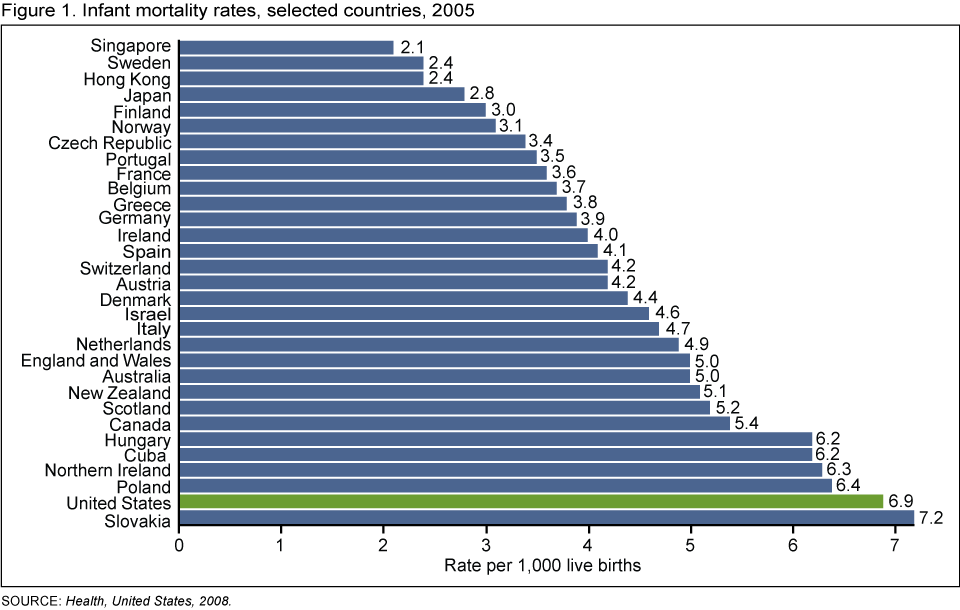
IMR Ranking

Further, they claim that infant mortality rate is an indicator of health care services in a country.  For this to be true, three conditions must be met:

  1. All nations are reporting their numbers correctly/consistently.
  2. The infants that are dying are of the same type.
  3. Factors other than medical services are being accounted for.

Consistency in Reporting

We know for a fact that not all nations count the infant mortality rate the same.   In the United States, we use the WHO definition:

Live birth refers to the complete expulsion or extraction from its mother of a product of conception, irrespective of the duration of the pregnancy, which, after such separation, breathes or shows any other evidence of life – e.g. beating of the heart, pulsation of the umbilical cord or definite movement of voluntary muscles – whether or not the umbilical cord has been cut or the placenta is attached. Each product of such a birth is considered live born.

In Europe, for example, they use a different definition:  [see page 122]

The infant mortality rate is defined as the number of infant deaths (days 0-364) after live birth at or
after 22 completed weeks of gestation in a given year, expressed per 1000 live births in the same
year.

And yet, even this definition is not standard across the European Countries: [see page 122]

Almost all countries provided data on overall infant mortality rates. However, many fewer were able to provide data on infant mortality rates by gestational age or birth weight, since infant deaths are registered in separate systems and not linked to perinatal data. These data were available for gestational age only from Flanders and Brussels in Belgium, Denmark, Estonia, Latvia, Malta, Austria, Poland, Finland, Sweden, the UK, and Norway.

This means, of course, that for countries like Portugal, France, Belgium, Greece, Germany, Spain, Switzerland, Austria, Italy and the Netherlands the method for counting don’t abide to even the less restrictive definition that the rest of the EU uses.  And all of these countries rank higher than the United Sates in the ranking by the CDC.  Further, the United States actually OVER reports the live births and subsequent deaths.

What happens when adjustments are made for these differences?

Norway boasts one of the lowest infant mortality rates in the world. But when the main determinant of mortality — weight at birth — is factored in, Norway has no better survival rates than the United States.

Which Infants Are Dying

The reason for the death is important in measuring IMR as well.  If, for example, there is an indicator that results in a much larger IMR than another, and that indicator is present in one population but not another, that would explain a difference in the two IMR rankings.  One of the first things that we should look at in determining if these IMR rankings are accurate is to identify if such in indicator exists.  And it does:

In 2004, the U.S. infant mortality rate (excluding births at less than 22 weeks of gestation) was 5.8, nearly twice the rate of 3.0 for Sweden, one of the two European countries with the lowest infant mortality rate (along with Norway).

Using direct standardization (10), we applied the U.S. gestational-age specific infant mortality rates to Sweden’s distribution of births by gestational age. If the United States had Sweden’s distribution of births by gestational age, the U.S. infant mortality rate (excluding births at less than 22 weeks of gestation) would go from 5.8 to 3.9 infant deaths per 1,000 live births—a decline of 33%.

US adjusted

In fact, if we use the numbers above, and just the numbers above, the US moves from its current ranking of 30th to a ranking of 12; tied with Germany.  And this does not even include the adjustments that certainly would move many of those countries 1-11 even lower.

And how does the US rank in Preterm Birth Percentage?
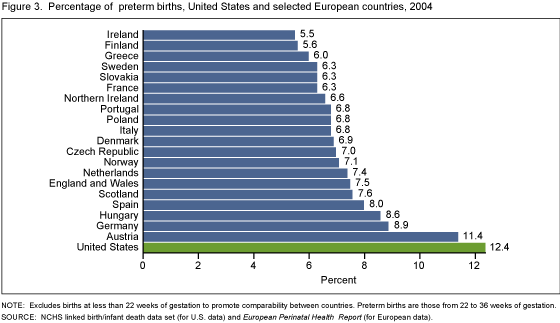
Preterm Rate

We rank among the highest in the world.  The ranking that WHO and the CDC and the CIA report are now, perhaps, showing a different story.  They may not be showing a picture of the medical delivery service in America for infants, rather, they may be showing that America delivers far more Preterm babies than the rest of the world.  Or, or, that we REPORT more preterm live births than the rest of the world.  If even one of these two statistics were reported, the US would jump either near the very top or would move up 18 spots on the list.

Non-medical Factors

Lastly, when looking at the IMR as an indicator on the medical delivery, or health care, system, it is equally important to look into factors that contribute to IMR that have nothing to do with that system.  And again, we see that there are such factors:

IMR by Race

It jumps out of the page; black babies dies at a higher rate than any other followed by Hawaiian and Native American.  And why the discrepancy in black women?

the largest difference in rates between the two groups was for preterm birth/low birthweight infants— infants born to Black women had an infant death rate due to preterm birth/low birthweight four times higher than those born to White women.

LBW by race
And why are we seeing black women delivering babies with such low birthrates?  Two possible reasons:

One reason African-American mothers have babies who weigh less at birth is that they are at greater risk for such conditions as high blood pressure and preeclampsia.

And the other:

Also, minority women are subject to stress caused by perceived racial discrimination, the researchers said.

David and Collins spoke with black women who had babies with normal weights at birth, comparing them with black women whose babies’ birth weight was very low — under three pounds.

They asked the mothers if they had ever been treated unfairly because of their race when looking for a job, in an educational setting or in other situations.

Those who felt discriminated against had a twofold increase in low birth weights. And for those who experienced discrimination in three “domains,” the increase was nearly threefold.

In David and Collins’ study of black women who gave birth in two Chicago hospitals, 16 percent said their partner was in jail during the pregnancy.

“We interpreted this finding as another indicator of stress, but one caused by institutional rather than interpersonal racial discrimination,” David said.

Net/net, the United States has work to do.  We have whole groups of people who need to be served.  There are improvements that can be made.  But the raw statistic showing that the United States has such a low IMR is simply not accurate.  And where it is accurate, it can be explained in large part, to conditions that may have nothing to do with medical service delivery.

In fact, the US has reason to shout out to our medical system:

Since 2000, 42 of the world’s 52 surviving babies weighing less than 400g (0.9 lbs.) were born in the United States.

The New WCPSS

I waited to post on this until after the election yesterday.  It comes as no surprise that John Tedesco won the run-off in Wake County’s district 2.  There were 3 candidates, John won 49.99% of the vote in October.  Because he failed to get the required 50.01%, a run-off was required.  However, his opponent withdrew leaving John an easy path to victory.

So it’s official.  Control of the board has moved from those who favor diversity to those who favor neighborhood schools.  Time will tell on the ability of the board to turn this ocean liner quickly, but I am sure that the look and feel of the district is going to change at least some and maybe significant.

Anyway, with that said, there was an interesting piece the other day in the News and Observer regarding diversity in the county.

I wasn’t part of the movement 30 years ago; shoot, I was 11.  But the thinking was that to help the black community, you had to bus some of the minority students out and move some of the white kids in; busing.  From a macro-economics standpoint, I can see the reasoning.  However, the white families didn’t wanna bus their kids.  And, ironically, neither did the black families.  This unique and almost unanimous disapproval caused much dissent among the families impacted.  However, Wake was able to continue this practice until a ruling made it illegal to assign students based on race.

Time for a new plan.  Going back to the drawing board, the district saw that race trended along socioeconomic lines.  And because the previous ruling didn’t limit busing based on income, a new day dawned.  Now, here is where I am a bit cloudy.  I am not sure of the thinkers in the district understood what they found.  I’m not sure if they were still trying to assign based on race and simply found a loophole or if they really were trying to identify at risk students.  Data shows that when normalized for income and other risk factors, black kids achieve at the same levels as do white kids.  Which is, of course, no surprise.

But the real kicker is that achievement trends strongly with income.  And low-income kids come from very high at risk families.  What the district should have done was announced that race based busing was not the secret sauce after all.  Rather, it was at risk busing that they really were after.  And income is a very large indicator of academic achievement.

Back to our news article.

An analysis of school system data by The News & Observer shows that many of the county’s neighborhoods, especially in suburban areas, have become relatively racially diverse. Available statistics indicate that less than 20 percent of Wake neighborhoods are more than 75 percent minority, and slightly more than a third appear to be 75 percent or higher white. Census data from 2000 showed a similar situation, spurred by growth and the entry of minorities into the middle class over the past few decades.

This seems like good news.  In Wake County, at least, we have a population that has mixed together well.  And from a pure social perspective, I think that’s a tribute to our community.  Not only that, but the mix of ideas and cultures only serves to make us a better and stronger community.

But when we look through the lens of income, the view is drastically different.

But The N&O’s analysis also shows a county split by income into halves. If all children went to their neighborhood schools, poor students would cluster in the county’s eastern half while students from more affluent families would be concentrated in Wake’s western side.

The N&O analysis, using neighborhood-level demographic data collected by the school system, shows that in the vast majority of northern and western Wake neighborhoods, fewer than 20 percent of students receive free and reduced-price lunches. On the other side of the line, in eastern and much of southern Wake, all but a handful of neighborhoods have more than 20 percent economically disadvantaged students.

And this is where a change in assignments has to occur very carefully.  I don’t think that any of the pro-diversity crowd feels that we need racially diverse classrooms to help people learn, I think they feel that we need economically diverse classrooms to help people learn.  And just like it did 30 years ago, I am afraid that fact will get overlooked in the analysis.

The challenge for the board is not small.  The market divides people very well, and I am a proponent of that market.

In Wake County, the strongest divider may be the price of real estate. For all their racial diversity, neighborhoods such as Cary’s Park Village has only students whose family can afford a home valued at $200,000 or more.

You simply are not going to have a  lot of poor kids going to these high dollar neighborhood schools.  Maybe that’s why parents moved to those neighborhoods to begin with; because the school is strong and well supported.  Probably.  I know that when we oved into our house that was a concern.

So we’ll see.  I’m not scared so much that we are changing.  The current system has its flaws.  What I am concerned about is that the underlying logic behind the changes won’t have changed much in 30 years.

And We Needed More Proof

The government, by fiat, has taken over control of an industry.  Elsewhere, we have demonstrated that when exposed to the open market, supply is enhanced and prices plummet.  But not now.  In the name of public welfare, the government has said

We shall save you!

And it’s costing us big time.

Health care?  Nope.

Booze.

Raleigh, N.C. — Alcohol is a $720 million a year business in North Carolina, and state law allows North Carolina government to have a monopoly on sales. However, a number of ABC stores across the state are barely surviving or are losing money.

Unreal.  You could open a liquor store where ever two roads meet and make money.  How is it that these guys fail?

“They can’t make them operate better. They can’t make them a profit,” Shaw said.

Right.  I forgot.  Government.

The best part?  Dry counties can have liquor stores.

The study also suggests the market is over-saturated with stores. Some counties are considered “dry” and don’t allow alcohol sales, but state law allows 500 voters in those counties to vote for an ABC board to run a store.

I think we should let these guys run health care; you?

Where Brad and Britt Have it Wrong

I was listening to the Brad and Britt show this morning on my way to work.  The show was dominated by Rep Foxx’ comments regarding terrorism and the health care bill.   And, prolly as it should, the discussion turned back to the whole health care debate in general.  The old, should we or shouldn’t we thing concerning health care.  Now don’t get me wrong.  I love me some health care debate.  Not at all.  But what killed me was Britt’s comment:

Look, these people are already going to the emergency room and we’re paying for that.  We might as well insure them, use the power of numbers to reduce the cost, so that we all save money!

I wonder if he would say this:

Look, we are buying these people food and clothing.  We’re sending them checks every month.  We may as well take some of their paycheck early in life, invest it for them so that when they need it, they can have it later in life!

My guess.  He wouldn’t.  Which is why I call bullshit.

We all have Liberty given to us.  We can make choices or not make choices.  The consequences are there to be had.  Either you are for protecting that Liberty or you are not.

Brad and Britt are not.  They are political hacks making a buck off the radio.

Pure.

And.

Simple.

This Is What It Will Look Like

A foretaste of the feast too come:

LOS ANGELES – It was bound to happen: Some people who aren’t at high risk for swine flu complications got the much-in-demand vaccine.

Sometimes they were healthy adults or senior citizens instead of kids, pregnant women and people with health problems.

Before Los Angeles County health officials stepped up screening at their flu clinics, Natalie Thompson sailed through the long line and got the vaccine along with her 8-year-old son, even though she’s not in one of the priority groups.

“If I can get it, I’m not gonna say no,” said Thompson, 35, of Hollywood Hills.

Another mom, Katy Radparvar, didn’t say no either.

“Our doctor doesn’t have it yet,” said the 41-year-old woman who was vaccinated along with her three children at a public health vaccination site in suburban Encino last week.

Public health officials don’t want to be vaccine police. Many don’t turn anyone away who wants the vaccine, though some locations are tougher than others.

“For many this is a frustrating process and we really sympathize with those who show up at a clinic and can’t get vaccinated,” said Los Angeles County public health director Dr. Jonathan Fielding.

Across the country, thousands have waited in line and many have been turned away, as manufacturers have trickled out the slow-to-produce vaccine. Things are improving, and now about 25 million doses are available, the government says.

Aware of scant supplies up front, Santa Barbara County clinics administered their 4,400 shots to pregnant women only. San Diego County is only immunizing those on the priority list, but is taking the word of residents.

Look, it’s simple.  Like anything in this world, there is never enough of it to satisfy everyone’s desire for it at full capacity.  That is, if free, there would never be enough Coke, gasoline, tennis shoes or hair brushes.  Medical care is the same.  And when organizing a nation, that fact should not escape anyone; especially the leaders.  The hard thing to acknowledge is that we know people will get sick.  Some people will die.

The good news is that medical technology will continue to hum along generating new and better services and techniques that will cure or heal people today that a mere five years ago would have been fatal.  And you simply HAVE to take solace in that.

Predictable

I have posted here and here about the price wars going on between some of the worlds largest retailers.  These companies are duking it out for the right to sell books to the public at a price LESS than their competition.  That’s right.  The GALL.  The utter horrible greed these companies exhibit is unconscionable.  To sell books cheap.

And the result?

By JEFFREY A. TRACHTENBERG

The American Booksellers Association has asked the U.S. Department of Justice to investigate the book price war under way between Wal-Mart Stores Inc., Amazon.com Inc. and Target Corp. to determine if it constitutes “illegal predatory pricing.”

In a letter dated Oct. 22, the ABA said it believes that the discount pricing—which has led to 10 of the most anticipated hardcover titles being priced as low as $8.98 on Walmart.com—amounts to such an act and that it is “damaging to the book industry and harmful to consumers.”

The letter said while it may appear that the prices will generate “more reading and a greater sharing of ideas in the culture,” many of the independent stores that belong to the ABA won’t be able to compete.

Unreal.

What we have here is capitalism at it’s best.  Competition driving down the price of goods that people want.  And we see organized unions working to stop the effort.

The best analysis:

Although independent booksellers typically stock only a smattering of best sellers, the steep discounting of such well-known authors ultimately could cause consumers to question whether all hardcover books are priced too high, at $25 or so.

Right.  So selling a product well above its natural market value is a good thing?  Freakin leftists.

The Rich Just Keep Getting….Poorer?

It’s a bar room brawl folks.  Target is getting into the fight over low priced books.

The Minneapolis-based discounter said Monday that it will offer some of this season’s most anticipated book titles at $8.99, in line with recent moves by Walmart.com and Amazon.com.

What is the goal of corporations?  To make money, of course.  How do you make more money?  By attracting more customers, of course.  And how do you increase the number of customers?  By reducing price or increasing quality.  And how do you raise the quality of a book already written?  You can’t.  So what is your only alternative?  Reduce the price.

And a million people across the United States will get quality books for a cheaper price.

Did Target do this willingly?

All three sellers are almost certainly taking a loss on the sales of these books in order to bring in customers.

I’m guessing no.  The power of capitalism baby.  Responsible for yanking hundreds of millions of people out of bone jarring poverty.

Know what I’m also guessing?  I’m guessing all we’d hear about from the left is:

But the price war, occurring as the critical holiday shopping season gets under way, is bad news for independent bookstores, as well as the large chain bookstores Borders Group Inc. and Barnes & Noble Inc. These chains have seen their sales and profits squeezed by discounting and a decline in their music business.

Analysts also note that the price wars also don’t bode well for the overall book industry, which may likely cut authors’ advances and editors’ salaries.

“I don’t see an end in sight,” said Michael Norris, a senior analyst with Simba Information. “There is going to be a longer-term cost to cheap books. This book war drives out chain stores and independent bookstores.” He noted that Amazon.com, Target and Walmart don’t “value books” in the same way.

“Bookstores are invested in the future of books, but the others are not,” he continued.

More crap from the Leftists.  Fake outrage for the benefit of just another capitalist evil corporation, Barnes and Noble or Borders.  Or maybe they’ll defend the independent booksellers.  You know, that group of people who price books so high that only the wealthy and privileged can afford them?  Or maybe that group of people who will only hire part-time employees at minimum wage without benefits.  Yeah, let’s defend them by all means.

But wait, the left could lash out and defend the poor authors and editors!  Yeah yeah, those poor poor authors!

  • John Grisham – $9 million in 2007
  • Stephen King – $45 million in 2007
  • Dean Koontz – $44.2 million in 2004

Oh, salary of an “editor” for a major author?  ‘Bout a hundred k.

The benefit of getting books into an affordable range at the cost of reducing Mr. King’s millions?  Easy call for the left.  But we’ll never hear it from them.

Because It Worked So Well The First Time

Unbelievable!

People often forget the lessons that history serves up to us.  We are destined to relive the errors of our past.  This happens in war, in love and, it seems, it politics.

You would think that with a recession just ending, an economy that won him the election and a financial crisis “the biggest since the Great Depression” Mr. Obama would know not to take these history lessons to heart.

But he isn’t, he’s going right back to the well that put us in this situation to begin with.

WASHINGTON (Reuters) – The Obama administration on Monday launched a program to help the depressed U.S. housing market by effectively allowing state and local housing finance agencies to borrow from the U.S. Treasury.

The initiative, announced as new data showed a downturn in homebuilder sentiment, aims to restart a source of mortgage financing for first-time and low-income buyers that has been largely shut down by credit market gridlock.

Described as temporary by the U.S. Treasury, the Department of Housing and Urban Development and the Federal Housing Finance Agency, the program will allow state and local agencies to issue bonds through government-sponsored mortgage finance giants Fannie Mae and Freddie Mac. Those bonds would then be purchased by the Treasury.

“Through this initiative, the administration aims to help … jump start new lending to borrowers who might not otherwise be served and to better support the financing costs of their current programs,” U.S. Treasury Secretary Timothy Geithner said in a statement.

At the very root cause of this most recent crisis is the fact that it was easy for people to borrow money to buy houses.  Many of these people would not have been able to afford to borrow that money in the past.  With the added demand on the housing market, the price of homes sky rocketed.  This in turn caused further investment in that market and so on and so on.  Finally, when those folks who borrowed money they couldn’t afford failed to pay that money back, the wheels came off.  The rest, as they will say, is history.

So what are we doing?  Ignoring history and doing the exact same thing; borrowing money to people who can’t afford it.