
Energy Subsidy

I was thinking about energy subsidies this weekend.  I know  I know, geeky shit to be sure, however – I WAS stuck watching a dance conference with my daughter in Baltimore, so slack please!

Anyway, during the election season, Obama was attacked for his green energy subsidies.  That, in his attempt to pick winners and losers, he mostly picked losers.  All of which, of course, was to highlight the waste of money that is green energy subsidies.

It occurred to me, that depending on the type of subsidy, it’s okay that we encourage alternative energy research and advancement.

To be sure, I don’t like the government actually spending money or guaranteeing loans, to one company or technology over another.  However, when it comes to reducing the tax burden so that we advance investment, I don’t see any reason why we should pick oil and gas over solar and wind.

With that said, this is an interesting graph:
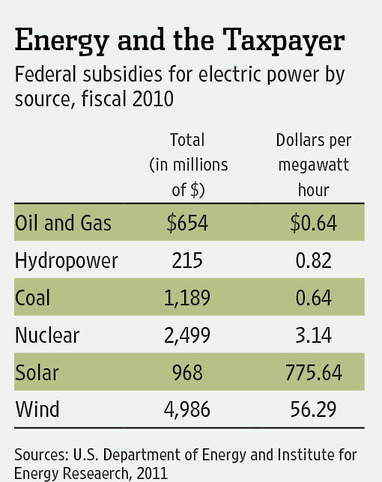
From the article:

The folks at the Institute for Energy Research used the Energy Department data to calculate a subsidy per unit of electricity produced. Per megawatt hour, natural gas, oil and coal received 64 cents, hydropower 82 cents, nuclear $3.14, wind $56.29 and solar a whopping $775.64.

So for every tax dollar that goes to coal, oil and natural gas, wind gets $88 and solar $1,212. After all the hype and dollars, in 2010 wind and solar combined for 2.3% of electric generation—2.3% for wind and 0% and a rounding error for solar. Renewables contributed 10.3% overall, though 6.2% is hydro. Some “investment.”

Zooming out for all energy, the Congressional Research Service did its own analysis of tax incentives last year. It found that in 2009 fossil fuels accounted for 78% of U.S. energy production but received only 12.6% of tax incentives. Renewables accounted for 11% of energy production but received 77% of the tax subsidies—and that understates the figure because it leaves out direct spending.

Which brings me to my initial thought:

By the way, these subsidy comparisons don’t consider that the coal, oil, and natural gas industries paid more than $10 billion of taxes in 2009. Wind and solar are net drains on the Treasury.

All of this suggests a radical idea. Why not eliminate all federal energy subsidies? This would get the government out of the business of picking winners and losers—mostly losers.

Mr. Obama’s plan to eliminate oil and gas subsidies would lower the budget deficit by less than $3 billion a year, but creating a true level playing field in energy, and allowing markets to determine which energy sources are used, would save $37 billion. That’s an energy plan that makes sense.

I like that idea best.  Less government.

Police State

I don’t generally buy into the “Black Helicopter” crowd regarding conspiracy of government.  For example, touching on the gun debate, I’m not sure it’s a given that if we register guns that one day the government will confiscate them.

However, I’ve always had a push me pull you relationship with law enforcement.  I distrust 22 year old men with a uniform and a gun.  I’m deeply indebted to the mature officer that puts limb and life on the line to defend me and mine.

But this doesn’t help the cause:

A Ramsey County man who videotaped a sheriff’s deputy in public is now fighting a citation for obstruction and disorderly conduct.

A St. Paul Pioneer Press report says the deputy was loading another man into an ambulance, and 28-year-old Andrew Henderson videotaped the action.

Sheriff’s deputy Jacqueline Muellner confiscated the camera, saying Henderson was violating the other man’s privacy rights. Henderson says when he got the camera back the next day the recording was gone.

Muellner cited Henderson for obstructing legal process. The American Civil Liberties Union has agreed to represent him for free.

Maybe there’s room for slack on the part of the cops.  They are, after all, the ones out there putting it all out there.  And having someone tape you may come across as trying to “entrap” you.  So I get it.

But still.

At least the force is saying the right things:

Ramsey County sheriff’s spokesman Randy Gustafson says it’s not the department’s policy to take people’s cameras. He says people are within their rights to record deputies’ activities.

It reminds me of the time I witnessed a DUI arrest in progress.  The entrance to my apartment building had a small flower median.  One lane in, one lane out.  And the officer was parked behind the community sign IN THE WRONG LANE.  The car drove in, not expecting a parked car with headlights on, and hit the brakes.

He was walked and arrested.

I watched the whole thing.  And the officers clearly didn’t like it at all.

Addressing Gun Violence

On Tuesday President Obama will receive a report from Joe Biden on gun violence and how to address it.  I admit that I’m torn on the whole issue.  Personally, I don’t care for guns at all.  I played with BB guns as a kid, to be sure, but that’s where it stopped.  I held my brother’s .22 and 16 gauge, but never owned my own weapon.  I once shot a friend’s hand gun, but didn’t like it.

I know that lot’s of people own guns to protect themselves.  Many more own guns because they like to collect them.  And even more because they life to hunt.  And I’m all good with that.  But I don’t want’em in my house.  I have young kids and believe the stats that say a gun owner’s family is more likely to be harmed by their own gun than that gun will be used in self defense.

But I feel its very important to defend the rights of those that DO wanna keep a gun.  I think that if an individual feels that, in balance, the risk of owning gun isn’t greater than the benefit provided by that gun, he should have the ability to purchase and keep that weapon.  He should be able to buy and use ammunition.

In short, a man has a right to buy guns.  And when I say guns, I mean any guns.

Part of the reason that the 2nd Amendment was written and codified was the belief that citizens be able to defend themselves.  From intruders AND their government.  In fact, Jefferson felt that an armed citizenry was a last resort to a tyrannical government.

So, what to be made of the world today?

I think the wrong questions will be asked in the report.  I think the wrong questions have been asked in the public discourse.  I think that people are seeing people committing atrocities with guns and are fixating on the guns; not the people.  I think that we need to look at data.  Data that suggests violence due to guns is on a downward trend.    I think that we need to look at data that would suggest that banning assault weapons increases violence, not decreases it.  And I think that we need to understand that being exposed to the inconveniences of too much liberty is preferable to the those attending too small a degree of it.

To those that would ban an assault rifle.  How much less of a tragedy would it be if an armed intruder, carrying a pistol, or 4, would take the lives of, say, 10 children rather than the number taken in Sandy Hook?  How will you be able to stand in front of the parents and claim that it could have been worse?

The answer?  You can’t.

A life taken too early due to violence is a tragedy.  And whether that life is taken by a hand gun or a rifle is not meaningful.

But the restriction of liberty is.  And THAT is what we need to guard against.

Now, are there things that we can do?  Happily, yes.

I think that we have a good opportunity to increase our background checks.  Both in number and in depth.  I think that we can do more to keep guns out of the hands of criminals and of the mentally unstable.

We should increase our databases regarding gun crimes.  And speaking of gun crimes, we need to focus on the characteristics of criminals with guns.  And then target them.  Instead of crafting laws that take guns out of the hands of law abiding citizens, we need to craft laws that take guns out of the hands of criminals.  Guilty of a gun crime?  Subject your property to an immediate search warrant.

And technology might be able to help us.  We should consider, at least consider, the technology that allows a gun to be fired based on a fingerprint profile.  Should a private sale occur, the gun could be taken to a dealer to swap that profile.  Have a family of 5?  Submit a profile for 5.

There is a lot of work to be done, to be sure.  But there is a lot of Liberty to be lost as well.  And we must remain ever vigilant that the sacrifices of those who came before us are not lost to fear.

On Crazy And Irrelevant

A few days ago Paul Krugman jumped the shark:

Should President Obama be willing to print a $1 trillion platinum coin if Republicans try to force America into default? Yes, absolutely. He will, after all, be faced with a choice between two alternatives: one that’s silly but benign, the other that’s equally silly but both vile and disastrous. The decision should be obvious.

So, there ya have it.  Paul’s contribution to the debt ceiling problems.  And his reasoning?

For those new to this, here’s the story. First of all, we have the weird and destructive institution of the debt ceiling; this lets Congress approve tax and spending bills that imply a large budget deficit — tax and spending bills the president is legally required to implement — and then lets Congress refuse to grant the president authority to borrow, preventing him from carrying out his legal duties and provoking a possibly catastrophic default.

I think Paul is forgetting that we can service our debt very easily with existing revenues.  The money we don’t have is for additional spending.  There really is very little danger of defaulting on our debt.

Anyway, cooler, calmer and more rational minds have saved the day:

The U.S. Treasury Department said on Saturday it will not produce platinum coins as a way of generating $1 trillion in revenue and avoiding a battle in Congress over raising the U.S. debt ceiling.

The idea of creating $1 trillion by minting platinum coins has gained some currency among Democrats in recent days as a way of sidestepping congressional Republicans who are threatening to reject a necessary increase in the debt ceiling unless deep spending cuts are made.

The Treasury Department and the Federal Reserve, both independent of one another, each concluded this was not a viable option.

“Neither the Treasury Department nor the Federal Reserve believes that the law can or should be used to facilitate the production of platinum coins for the purpose of avoiding an increase in the debt limit,” said Treasury spokesman Anthony Coley in a statement.

File this under “no kidding”.

No One Likes To Be Blamed

By Tuesday, if you believe the deadline Biden has for his report, Obama is going to receive a report on how to curb violence.  By the way, wouldn’t it be nice if the President could demand as timely a report on such things as budgets?  Anyway, the report ….

We all have ideas on what we might like to see in the report.  It goes all the way from ban every single gun in America to posting armed guards at every single school.

Crazy all.

But I think that reasonable people understand a couple things:

  1. Gun violence in America is heading down.
  2. There really is very little need for assault weapons and large capacity clips.
  3. The most recent string of mass shootings involved mentally retarded individuals.
  4. That allowing our 6 year old kids to play with toy guns makes a parent a bit queezy.
  5. Hollywood’s obsession with violence creates a “culture of violence”.
  6. Same for video games.

But no one likes to hear that when the target of blame falls on them or theirs.  The NRA doesn’t wanna hear that guns kill people.  And the parents of children with learning disabilities don’t wanna hear that the shooters were crazy.  Parent’s don’t wanna think that there is anything wrong with cops and robbers or cowboys and indians.

And Hollywood doesn’t wanna hear that their movies cause violent reactions:

Listen, I don’t know if violent movies cause kids to fantasize about violent acts and that those fantasies then are played out.  But I DO know that if Hollywood feels they can wade into matters politic then they are certainly fair game when it comes time to lay blame.

Another Company Cuts Hours

Yesterday I posted about an IT firm cutting hours as a result of the economic conditions ahead.

Hours were going to be cut.  Instead of a 5-day work week the schedule would now be built around a 4-day work week.

My suspicion is that the firm is targeting a work week that comes in under 30 hours a week.

Well, there is a company that is making no bones about it:

A fast-food chain is slashing employee hours so franchise owners don’t have to pay health benefits. Around 100 local Wendy’s workers have learned their hours are being cut. A spokesperson says a new health care law is to blame.

The penalty for failure to offer insurance is $2,000 per employee.  In this case, $200,000 is a lot of money:

The company has announced that all non-management positions will have their hours reduced to 28 a week. Gary Burdette, Vice President of Operations for the local franchise, says the cuts are coming because the new Affordable Health Care Act requires employers to offer health insurance to employees working 32-38 hours a week. Under the current law they are not considered full time and that as a small business owner, he can’t afford to stay in operation and pay for everyone’s health insurance.

The irony, of course, is that fast food chains typically employ the younger worker.  Folks who might be entering the job market for the first time and are learning valuable work skills.   Skills that they may not otherwise acquire.  And the reason they are being impacted is a law that attempts to help provide medical care to the population.  Well, these kids are the healthiest segment OF that population.


The Advantage Of Private Charity Over Goverment Programs

I have several problems with government provided programs.  One being that I’m not sure it’s the role of government to perform those services.  Not withstanding, I don’t feel that the public programs work overly well.  Or, perhaps better said, they don’t work as well as a similar program in private hands.

Consider an example:

Donnelly is the island’s state nurse and administrator of the Mary D Fund, a charity she created to provide year-round residents with much needed financial help during the harsh winter months. Last year, the 85-year-old mother of seven gave grants totaling $50,000 to roughly 30 percent of the island’s 1,000 residents.

The charity takes no government money, relying instead on individual donations and grants. By not taking taxpayer money or having government oversight, Donnelly says she is able to better manage where the money goes.

It’s not that I doubt the nobility of such government programs, although that might be easy to do in some cases, rather I doubt the incentives to care about where the money goes and how it gets there.

I especially like how Ms. Donnelly handles two issues that have frustrated me personally:

Recipients must meet three requirements: They must be year-round residents of Block Island, they must request the help in person or by letter, and they must give Donnelly the actual bill to pay. She also tells them “they have to take a money-management course” to help mininmize future financial squeezes.

1.  They must request help in person or by letter.

2.  They have to take a money-management course.

I really think that the idea of making the assistance people receive to be invisible is a wrong one.  I think that we would have fewer folks comfortable on government programs if they had to personally go to a meeting where the money was handed to them by a member of the community.

Second, I hate the aspect of the “fixing the result” aspect of government relief.   By the time someone has no food, generally the ability to help the individual has been largely missed.  I am convinced that successful programs are ones that resolve the reason someone has a need, not ones that simply provide the need.

Anyway, what a great story.

Market Adjustment

What’s the best way to increase English proficiency among a group of people who might otherwise have no need to speak English?

Create a market where English is important:

SAO PAULO –  Prostitutes in one of Brazil’s biggest cities are beginning to sign up for free English classes ahead of this year’s Confederations Cup and the 2014 World Cup.

Cida Vieira, president of the Association of Prostitutes in the city of Belo Horizonte, said Tuesday that 20 have already signed up for the courses and she expects at least 300 of the group’s 4,000 members to follow suit. The association is organizing the classes and seeking volunteer teachers.

When the market identifies a shortage, it will provide the solution.


Managing Hours Worked In 2013

A buddy of mine works in IT.  The firm is a medium sized outfit; well over 50 employees.  Heading into the New Year they were pulled into a meeting.  The news?

Hours were going to be cut.  Instead of a 5-day work week the schedule would now be built around a 4-day work week.

Good news indeed if time is more valuable than dollars.  However, at some point, to most people, some number of hours are less important than dollars and so it is that we wake up each morning to go to work.  And apparently the folks at this company are a titch uncomfortable with the new schedule.

My immediate thought was that the employer was trying to dodge the new health care rules coming in 2014.  Further questioning seemed to confirm my suspicion.  And what rules are those?

Many businesses plan to bring on more part-time workers next year, trim the hours of full-time employees or curtail hiring because of the new health care law, human resource firms say.

Under the Affordable Care Act, businesses that employ at least 50 full-time workers — or the equivalent, including part-time workers — must offer health insurance to staffers who work at least 30 hours a week. Employers that don’t provide coverage must pay a $2,000-per-worker penalty, excluding the first 30 employees.

The so-called employer mandate to offer health coverage doesn’t take effect until Jan. 1, 2014. But to determine whether employees work enough hours on average to receive benefits, employers must track their schedules for three to 12 months prior to 2014 — meaning many are restructuring payrolls now or will do so early next year.

About a quarter of businesses surveyed by consulting firm Mercer don’t offer health coverage to employees who work at least 30 hours a week. Half of them plan to make changes so fewer employees work that many hours.

Elections have consequences.  There are no solutions, only trade-offs.  And the trade off for this health care bill?

The health care law will particularly affect companies with 40 to 45 workers that plan to expand and hire. Many are holding off so they don’t cross the 50-employee threshold, says Christine Ippolito, principal at Compass Workforce Solutions, a human resource consulting firm in Melville, N.Y.

Others already over the 50-employee threshold plan to add more part-time workers or cut the hours of full-timers, says Rob Wilson, head of Employco, a human resource outsourcing firm. Many, he says, will hire more temporary workers, whom they won’t have to cover.

Nearly half of retailers, restaurants and hotels will be affected by the law, according to Mercer. They employ large numbers of part-time and seasonal employees, including many who work about 30 hours a week.

Since such low-wage workers are widely available, it often hasn’t been cost-effective or necessary for employers to offer them coverage. Providing them benefits could be costly because employees must pay no more than 9.5% of their wages in insurance premiums, forcing employers to contribute significantly more than they do for higher-wage workers.

“I think you may see employees with fewer hours as a consequence,” says Neil Trautwein, vice president of the National Retail Federation.

Thirty-one percent of franchisees surveyed recently by the International Franchise Association said they plan to pare staff to get under the 50-employee threshold.

This is a direct response to the legislation that was pushed by the President.  This isn’t a long-term consequence to a policy shift.  Rather, the slow down in hiring, the shift to more part time workers is a rational response to an agenda pushed by Obama.


Dysfunction of Government

Look, I like Rand Paul.  I resonate with much of what he says.  And this even more so.

Ignore the comments about term limits – I can go back and forth on that one.  Just listen to his comments on how the Fiscal Cliff Senate legislation was passed.

No printed bill.

Made available online at 01:36.

Voted on at 01:39.

Partisan politics aside, there is no earthly way that an argument can be made that this is an example of how we want legislation debated, written, studied and then voted on.

No way.