The Future is Now

This is what Obama thinks is better:

Raleigh, N.C. — Wake County officials have temporarily closed the county’s H1N1 vaccine clinics due to a depleted supply of the vaccine.

To be fair, Wake County is reporting:

“While the five Wake County H1N1 clinics that opened this morning have run out of vaccine, many physicians and pharmacies in our community do have vaccine available.” said Wake County Community Health Director Sue Lynn Ledford.

And here comes more news of tomorrow:

The closure started at 4 p.m. after the county distributed more than 6,000 doses of the vaccine at five clinics.

Karen North waited in line two hours to get her sons vaccinated at the Public Health Center, G-35, 10 Sunnybrook Road in Raleigh, on Monday.

Can you say Soviet bread lines?

Soviet Bread Line

Are they waiting for bread or medicine?

And the most chilling part?

“At this point, we are just trying to prioritize and get those patients who would benefit from it the most right now,” said Dr. Sharmell Wilson, of Growing Child Pediatrics.

You can ration by price or you can ration by fiat.

What Have We Become

Stumbled across a letter to Joe Lieberman tonight over at American Hatriotism today.  It’s awesome.  Basically you have someone over there talking about how awful, simply AWFUL, Mr. Lieberman is for coming out against the health care bill.  After a WHOLE bunch of discussion on the fact, we get to the point where a letter is penned and delivered to the Senator’s office.  I’ve captured all I could stand the beginning and then added my response to it.  If ya want, stop on over the Hatriotism and see if the comment got any action:

Dear Mr. Lieberman,

Do you sleep well while …..

so many Americans struggle to bear the pain and anguish they are experiencing today?

Far be it that people ought to struggle.

somewhere in America a hard working student finds out there is no means, no money, no way to college?

Is that hard-working student willing to work hard at a job?

a mother and father are struggling to provide the bare necessities for their disabled child?

Good bless then for being able to supply the necessities for their child; disabled or not.

an elderly man who fought for his country eats a can of beans for dinner and must dress in several layers of clothing because he can not afford a decent meal or to heat his meager home?

We thank him for his service; service to ensure that we are all free.  Free to be responsible.  Or not to be responsible.

a Mother over-medicates her baby with tylenol for his earache because she can not take him to the urgent care or doctor for treatment?

She should take the bay to urgent care or the doctor for treatment.

a family will huddle in the cold behind a dumpster to block the wind because they have nowhere else to go?

Before they go to the government, they should go to church.

a husband and wife lie in bed discussing how to break it to their children that they will soon lose their home and have to move?

The tender mercies of learning not to borrow money you can’t afford to pay back.

a couple that saved thousands for a home they will now lose when the bank takes it away?

This should be sent to Senator Frank actually.

a father tells his family he has lost his job and they can no longer count on him to take care of them?

A real father would say that he has lost his job and will do whatever it takes to take care of them.  Even if it means working 3 others.

a mother tells her children there isn’t anything left in the house to eat?

How many different ways can you say the same thing?

another father wonders how many more days, weeks, months before he will work again and worries how they’ll make it until then?

Jeez.

The whole rest of your letter is the same point on and on and on.

And the real tragedy?  Passing a law isn’t going to change any of that.

The Mind of a Leftist

Washington state has to play the “add-value” card, not “low-cost-leader” ace

That’s the headline from the Seattle Times this morning discussing why Puget Sound lost out on the Boeing factory to South Carolina.

We all look for value in the things that we buy.  Old Milwaukee is a cheaper beer than Long Hammer.  You can buy WAY more of it than you can that better beer for the money.  But, then again, Long Hammer is a better beer.  So, what do you buy?  Well, that depends.  On YOUR value proposition.  Almost every American I know enjoys this freedom, this Liberty.  The ability to tend to your individual tastes and take advantage of choices.  We do it with beer, with gas and even with eye glasses.

Why wouldn’t a corporation do the same?  In fact, value is one of the key considerations for corporations.  If they do NOT go after the best value, you could argue that they aren’t acting in the best interest of their shareholders.  Which makes this just laughable:

Boeing’s decision to establish a second 787 production line in South Carolina was a “race to the bottom” on pay punch to the solar plexus of the Puget Sound region.

Boeing didn’t decide to establish its second production line in South Carolina because of low pay.  They established their second production line in South Carolina because it offered more VALUE.  But Mr. Talson, contrary to his headline, hammers home the point of low pay:

After all, South Carolina’s new Boeing workers will make about $15 an hour compared with on average the $26 earned by veterans in the company’s Washington-state factories.

But wait, it gets even better.  As if lower pay isn’t enough, these Southern states offer such “amenities” as :

few unions and light environmental regulations

Further, those States have *gasp*

spent billions of dollars on incentives, such as cutting taxes and providing job training.

How dare those States create tax structures such that businesses can survive and even flourish.  And don’t even get me started on job training; down right repressive!

After these first few salvos, the tone of the article changes.  Mostly nonsense not having to do with why South Carolina won the line and Washington lost it.  But then comes this gem:

Washington workers are caught in the same downdraft that has been affecting Americans for at least 30 years: slowing growth of middle-class incomes, declining benefits and, through most of the 2000s, stagnant wages.

Ahh, huh?

When you ask the Minneapolis Federal Reserve Bank, they disagree:

non-monetary gains

Whatever.  Different topic for a different post.  However, its stunning what people can just write.  Because they want to.  Simply stunning.

About as Good as You Could Hope For

I posted yesterday about a North Carolina Democrat that was going to vote against the health care bill; and he did.  I also mentioned that we needed Heath Shuler; and we got him.  The ones we missed I knew we were going to miss.

  • G.K. Butterfield, District 1
  • Bob Etheridge, District 2
  • David Price, District 4
  • Mel Watt, District 12
  • Brad Miller, District 13

Those that voted against:

This dog of a bill made its way through the House but will have a much tougher way finding its way through the Senate.  First, it has to get 60 votes to prevent a filibuster and I don’t think it will get that.  The Senator from Connecticut seems to have committed that he will not support the bill.  Further, there are several Democrats that are more fiscally conservative than others, and they may save the day.  Further, thhe vote in Virginia and in Jersey may be weighing on these guy’s minds; American’s don’t want this thing.

Change You Can Believe In

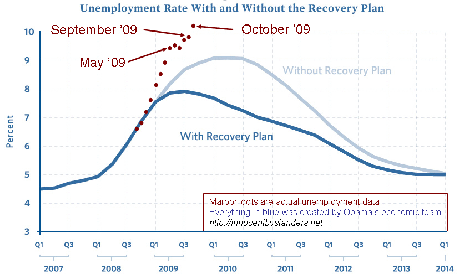
A picture is worth a thousand words:

stimulus-vs-unemployment-october-dots

From Innocent Bystanders via TJIC

Freakin’ Obama.

I LIKE This Guy

I just finished a post about Minnesota Democrats being split on the health care bill.  Good for them.  Then I lamented the fact that they just be holding out for more “what’s in it for them.”  Shame on them.

Note to Minnesota Democrats; THIS is how ya git’er done!

WASHINGTON — North Carolina Rep. Mike McIntyre has announced that he will vote against a $1.2 trillion health-care bill in the House of Representatives, saying that reform needs to fiscally responsible and done in targeted steps.

Not only is McIntyre standing up for what is fiscally sound, but he is doing it at significant risk to his standing within the Democratic party:

President Barack Obama met with Democratic lawmakers in closed-door meetings Saturday to woo last-minute commitments.

I like the use of the word “woo.”

But even more than this, Rep. McIntyre actually articulates his reasons.  And these aren’t the normal crappy politician speak we normally hear from these folks:

  • The bill “costs way too much – more than $1 trillion dollars on top of a $12 trillion national debt.”
  • It doesn’t address long-term health costs.
  • It raises too many taxes and includes new requirements “that will harm the ability of too many small businesses to compete and create jobs.”
  • “It tries to do too much too soon, instead of targeted changes that can immediately help people.”

Republicans should grab this guy and thank him for the two gifts he has delivered:

  • Voting against this bill.
  • Publicizing the Conservative’s objections to this bill better than Conservatives.

Now all we have to do is work on Rep. Heath Shuler.

You Had Me at "Split": Until You Didn't

Apparently the Minnesota delegation of Democrat Congressmen are split on the health care bill being considered this afternoon:

Firmly in favor: McCollum and Walz; may vote “yes”: Oberstar and Ellison; solid “no”: Peterson

I am relatively surprised.  Minnesota is a hugely Democratic state.  Perhaps this is due to the fact that there is a significant amount of agricultural population as well as a high ratio of teachers.  However, even with that said, Minnesota is one of the States that is fighting the Federal takeover of health care.

But, but.  Politicians simply can STOP being politicians:

“It can be a smart strategy for members to hold out until the last minute to support their party’s legislation because they might be able to extract something from this,” said Kathryn Pearson, political science professor at the University of Minnesota.

Sigh.  What are we to do?

Infant Mortality Rate

The race is on.  Health Care reform’s time has come-or gone.  Whatever side you come down on, the debate is intense.  And so it has been with friends and colleagues of mine.  One one side you have those that claim the United States spends more money per year on health care and has one of the worst systems in the industrial world.  On the other side you have the opposite.  These people admit that while we may spend more than any other nation on health care this claim would be equally true of expenditures on blue jeans, pro sporting tickets, aquariums, X-boxes and lawn mowers.  Further, rather than being one of the worst providers of medical care, these folks would argue that the Unites States delivers the best care in the world.

Who is right?  Let’s go to the data.  I am going to focus on the infant mortality rate – IMR.  Those who champion universal health care claim that the United States ranks 30th in the world in IMR.  A quick check shows that indeed, we do:
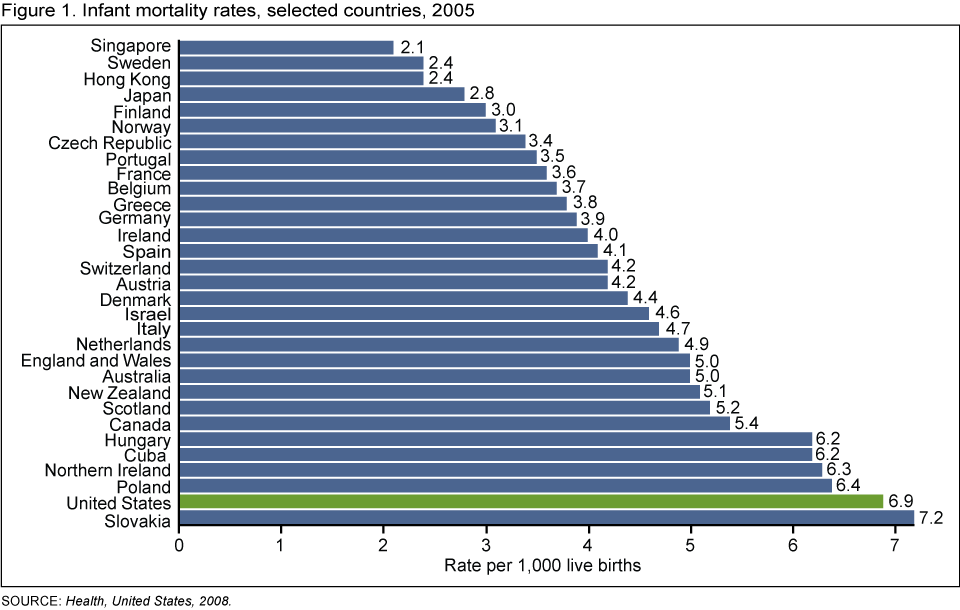
IMR Ranking

Further, they claim that infant mortality rate is an indicator of health care services in a country.  For this to be true, three conditions must be met:

  1. All nations are reporting their numbers correctly/consistently.
  2. The infants that are dying are of the same type.
  3. Factors other than medical services are being accounted for.

Consistency in Reporting

We know for a fact that not all nations count the infant mortality rate the same.   In the United States, we use the WHO definition:

Live birth refers to the complete expulsion or extraction from its mother of a product of conception, irrespective of the duration of the pregnancy, which, after such separation, breathes or shows any other evidence of life – e.g. beating of the heart, pulsation of the umbilical cord or definite movement of voluntary muscles – whether or not the umbilical cord has been cut or the placenta is attached. Each product of such a birth is considered live born.

In Europe, for example, they use a different definition:  [see page 122]

The infant mortality rate is defined as the number of infant deaths (days 0-364) after live birth at or
after 22 completed weeks of gestation in a given year, expressed per 1000 live births in the same
year.

And yet, even this definition is not standard across the European Countries: [see page 122]

Almost all countries provided data on overall infant mortality rates. However, many fewer were able to provide data on infant mortality rates by gestational age or birth weight, since infant deaths are registered in separate systems and not linked to perinatal data. These data were available for gestational age only from Flanders and Brussels in Belgium, Denmark, Estonia, Latvia, Malta, Austria, Poland, Finland, Sweden, the UK, and Norway.

This means, of course, that for countries like Portugal, France, Belgium, Greece, Germany, Spain, Switzerland, Austria, Italy and the Netherlands the method for counting don’t abide to even the less restrictive definition that the rest of the EU uses.  And all of these countries rank higher than the United Sates in the ranking by the CDC.  Further, the United States actually OVER reports the live births and subsequent deaths.

What happens when adjustments are made for these differences?

Norway boasts one of the lowest infant mortality rates in the world. But when the main determinant of mortality — weight at birth — is factored in, Norway has no better survival rates than the United States.

Which Infants Are Dying

The reason for the death is important in measuring IMR as well.  If, for example, there is an indicator that results in a much larger IMR than another, and that indicator is present in one population but not another, that would explain a difference in the two IMR rankings.  One of the first things that we should look at in determining if these IMR rankings are accurate is to identify if such in indicator exists.  And it does:

In 2004, the U.S. infant mortality rate (excluding births at less than 22 weeks of gestation) was 5.8, nearly twice the rate of 3.0 for Sweden, one of the two European countries with the lowest infant mortality rate (along with Norway).

Using direct standardization (10), we applied the U.S. gestational-age specific infant mortality rates to Sweden’s distribution of births by gestational age. If the United States had Sweden’s distribution of births by gestational age, the U.S. infant mortality rate (excluding births at less than 22 weeks of gestation) would go from 5.8 to 3.9 infant deaths per 1,000 live births—a decline of 33%.

US adjusted

In fact, if we use the numbers above, and just the numbers above, the US moves from its current ranking of 30th to a ranking of 12; tied with Germany.  And this does not even include the adjustments that certainly would move many of those countries 1-11 even lower.

And how does the US rank in Preterm Birth Percentage?
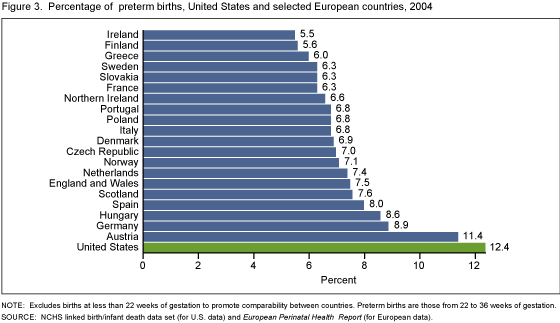
Preterm Rate

We rank among the highest in the world.  The ranking that WHO and the CDC and the CIA report are now, perhaps, showing a different story.  They may not be showing a picture of the medical delivery service in America for infants, rather, they may be showing that America delivers far more Preterm babies than the rest of the world.  Or, or, that we REPORT more preterm live births than the rest of the world.  If even one of these two statistics were reported, the US would jump either near the very top or would move up 18 spots on the list.

Non-medical Factors

Lastly, when looking at the IMR as an indicator on the medical delivery, or health care, system, it is equally important to look into factors that contribute to IMR that have nothing to do with that system.  And again, we see that there are such factors:

IMR by Race

It jumps out of the page; black babies dies at a higher rate than any other followed by Hawaiian and Native American.  And why the discrepancy in black women?

the largest difference in rates between the two groups was for preterm birth/low birthweight infants— infants born to Black women had an infant death rate due to preterm birth/low birthweight four times higher than those born to White women.

LBW by race
And why are we seeing black women delivering babies with such low birthrates?  Two possible reasons:

One reason African-American mothers have babies who weigh less at birth is that they are at greater risk for such conditions as high blood pressure and preeclampsia.

And the other:

Also, minority women are subject to stress caused by perceived racial discrimination, the researchers said.

David and Collins spoke with black women who had babies with normal weights at birth, comparing them with black women whose babies’ birth weight was very low — under three pounds.

They asked the mothers if they had ever been treated unfairly because of their race when looking for a job, in an educational setting or in other situations.

Those who felt discriminated against had a twofold increase in low birth weights. And for those who experienced discrimination in three “domains,” the increase was nearly threefold.

In David and Collins’ study of black women who gave birth in two Chicago hospitals, 16 percent said their partner was in jail during the pregnancy.

“We interpreted this finding as another indicator of stress, but one caused by institutional rather than interpersonal racial discrimination,” David said.

Net/net, the United States has work to do.  We have whole groups of people who need to be served.  There are improvements that can be made.  But the raw statistic showing that the United States has such a low IMR is simply not accurate.  And where it is accurate, it can be explained in large part, to conditions that may have nothing to do with medical service delivery.

In fact, the US has reason to shout out to our medical system:

Since 2000, 42 of the world’s 52 surviving babies weighing less than 400g (0.9 lbs.) were born in the United States.

This is Where We are Wrong

The situation playing out in Seattle frustrates me.  Frustrates me on two levels:

  1. What I consider basic human rights are being denied to a group of people.
  2. Conservatives are continually alienating whole demographics who would otherwise embrace us.

Supporters of gay rights were buoyed by first-day returns that showed Referendum 71 leading by a narrow margin Tuesday evening.

The results were disappointing to religious conservatives, whose aggressive efforts to get the expanded partnership law thrown out had gained momentum in recent months.

I. Simply. Don’t. Get. It.

As conservatives, we hold that individual Liberty is the cornerstone to our version of government.  Liberty extended to all living people.  And personal responsibility from those same people.  In that vein, extending civil liberties, civil rights should be the our rallying call.  This issue is NOT a Liberal issue, it is a Conservative issue.  We have the opportunity to take this away from the Democrats, make it our own and pull millions of people to our side.

But we don’t.  And we continue to blow it.

The New WCPSS

I waited to post on this until after the election yesterday.  It comes as no surprise that John Tedesco won the run-off in Wake County’s district 2.  There were 3 candidates, John won 49.99% of the vote in October.  Because he failed to get the required 50.01%, a run-off was required.  However, his opponent withdrew leaving John an easy path to victory.

So it’s official.  Control of the board has moved from those who favor diversity to those who favor neighborhood schools.  Time will tell on the ability of the board to turn this ocean liner quickly, but I am sure that the look and feel of the district is going to change at least some and maybe significant.

Anyway, with that said, there was an interesting piece the other day in the News and Observer regarding diversity in the county.

I wasn’t part of the movement 30 years ago; shoot, I was 11.  But the thinking was that to help the black community, you had to bus some of the minority students out and move some of the white kids in; busing.  From a macro-economics standpoint, I can see the reasoning.  However, the white families didn’t wanna bus their kids.  And, ironically, neither did the black families.  This unique and almost unanimous disapproval caused much dissent among the families impacted.  However, Wake was able to continue this practice until a ruling made it illegal to assign students based on race.

Time for a new plan.  Going back to the drawing board, the district saw that race trended along socioeconomic lines.  And because the previous ruling didn’t limit busing based on income, a new day dawned.  Now, here is where I am a bit cloudy.  I am not sure of the thinkers in the district understood what they found.  I’m not sure if they were still trying to assign based on race and simply found a loophole or if they really were trying to identify at risk students.  Data shows that when normalized for income and other risk factors, black kids achieve at the same levels as do white kids.  Which is, of course, no surprise.

But the real kicker is that achievement trends strongly with income.  And low-income kids come from very high at risk families.  What the district should have done was announced that race based busing was not the secret sauce after all.  Rather, it was at risk busing that they really were after.  And income is a very large indicator of academic achievement.

Back to our news article.

An analysis of school system data by The News & Observer shows that many of the county’s neighborhoods, especially in suburban areas, have become relatively racially diverse. Available statistics indicate that less than 20 percent of Wake neighborhoods are more than 75 percent minority, and slightly more than a third appear to be 75 percent or higher white. Census data from 2000 showed a similar situation, spurred by growth and the entry of minorities into the middle class over the past few decades.

This seems like good news.  In Wake County, at least, we have a population that has mixed together well.  And from a pure social perspective, I think that’s a tribute to our community.  Not only that, but the mix of ideas and cultures only serves to make us a better and stronger community.

But when we look through the lens of income, the view is drastically different.

But The N&O’s analysis also shows a county split by income into halves. If all children went to their neighborhood schools, poor students would cluster in the county’s eastern half while students from more affluent families would be concentrated in Wake’s western side.

The N&O analysis, using neighborhood-level demographic data collected by the school system, shows that in the vast majority of northern and western Wake neighborhoods, fewer than 20 percent of students receive free and reduced-price lunches. On the other side of the line, in eastern and much of southern Wake, all but a handful of neighborhoods have more than 20 percent economically disadvantaged students.

And this is where a change in assignments has to occur very carefully.  I don’t think that any of the pro-diversity crowd feels that we need racially diverse classrooms to help people learn, I think they feel that we need economically diverse classrooms to help people learn.  And just like it did 30 years ago, I am afraid that fact will get overlooked in the analysis.

The challenge for the board is not small.  The market divides people very well, and I am a proponent of that market.

In Wake County, the strongest divider may be the price of real estate. For all their racial diversity, neighborhoods such as Cary’s Park Village has only students whose family can afford a home valued at $200,000 or more.

You simply are not going to have a  lot of poor kids going to these high dollar neighborhood schools.  Maybe that’s why parents moved to those neighborhoods to begin with; because the school is strong and well supported.  Probably.  I know that when we oved into our house that was a concern.

So we’ll see.  I’m not scared so much that we are changing.  The current system has its flaws.  What I am concerned about is that the underlying logic behind the changes won’t have changed much in 30 years.