Category Archives: Politics: National

The State Of “College Material”

I love me some Jack Chambless.  Dr. Chambless is an economics professor at Valencia College.  He’s a relentless champion of Libertarian ideas.
His most recent post is classic.  In it he describes his tradition at the start of every term:

I start the first day with some sort of essay question designed to uncover socialist thinking among my students.  Over the years I have asked people to comment on everything from Joe Montana selling his mansion for $49 million while others are homeless to their opinion on what the government should do to help them achieve the American Dream.

This week I asked my students – approximately 110 of them – to answer this question:”What one specific thing has President Obama done to make the American economy stronger?”

The responses are awesome:

 “Obama has made taxes according to a households income/class.  He made things stronger for every class by doing that.”

Obviously the income tax has long been progressive.

“President Obama has created jobs since he got elected in 2008.  Before him, the economy was suffering, especially middle class families. His campaign was focused alot on creating jobs. This accomplishment has benefited the economy greatly.”

Even Obama isn’t running on his jobs record.

“President Obama has made it so that everyone must pay taxes and people who are more wealthy pays the most taxes.”

Except, of course, Obama is making it so that fewer people pay taxes.  Though to be fair, he IS trying to make the rich make up for that.

“He has raised taxes on the rich and lowered taxes on the middle class.   Also, he has cut military funding.”

Huh?

“He has offered more financial incentives to the American family with his Cash for Clunkers campaign.  This lead for the American family to upgrade to a new car & supply buisness to the failing America car market.”

The Cash For Clunkers program was a wild failure.  The larger concept of the auto bailout’s is more debatable but a reasonable response is that those bailouts only might have helped Detroit.  But this can only be true by acknowledging that it prevented expansion in other areas that would have made up for the demand.

“the Government, under Obama, has slowed the rate our countries US dollar was inflating at the end of Bush’s terms.”

“One specific thing that Obama has done to make this economy stronger is giving jobs all across the U.S. for the middle class.”

“President Obama’s stimulation package.”

“President Obama has made bigger percentages of taxes that people have to pay for their money.”

“He has tried to make America have more equal classes rather than the rich getting richer and the poor getting poorer and eventually diminishing the middle class.”

“He has funded programs for the research of new alternative energy proving thousands of people job opportunities, and the possibility of the creation of a new type of energy market.”

“President Obama has allow all ages to go back to school.”

“Health care benefits has improved.”

“Obama has made the country stronger by giving his best to try to stabilize the economy.”

“Obama, in his early presidency, verbally excited Americans by the idea of change and this encouraged slight economic growth.”

“One thing I believe President Obama did to make the country stronger is the stimulus check act.”

“Tax cuts to overseas businesses to entice them to bring their work stateside.”

“One thing Obama help improve the economy is to provide more jobs for the unemployed people.”

In my heart I hope that we can beat Obama this fall, in my head, I don’t think we have a chance.  Which is to say that I agree with Dr. Chambliss’ observation:

These are only a sampling of what is rattling around in the brains of our college students.  Imagine what even more ignorant Americans are probably thinking.

President Obama can take great comfort in knowing that we are a nation of economically-illiterate human beings armed with voter registration cards.  He will win in November.  No one wants to hear any sensible economics from Romney or Ryan.

January 20, 2017 – that seems like a long way off….

Government Can Make It All Better

I generally resent the idea that the government can do things better.  In many, if not most things, the government does them worse, not at all better, than if left to someone else to do.

However, in some cases it’s even worse.  The government does it worse than if it were just left alone:

Tree sections are stacked floor to ceiling. They’re like rounds chopped from a carrot, the carrot being a tree trunk. They’re the size of dinner plates. When the football team scores, they rattle on their shelves.

Growth rings tell how old the sectioned tree was. But when Swetnam holds up one, he points to something else: fire scars. They’re black marks, about the size of a fingernail clipping, left by fires.

“The first time here, back in the 1600s, it looks like, and it created a wound there. Basically the fire was hot enough to burn through the bark,” he says. But the fire wasn’t hot enough to kill the tree. So the next few rings show normal growth.

“Until the next fire occurs, and it creates another scar,” he says. “And another, and another, and another, and another, and another.”

Scars from thousands of sections show how often fires burned in the Southwest. It was every five or 10 years, mostly — small fires that consumed grass and shrubs and small seedlings, but left the big Ponderosa pine and Douglas fir just fine. This was the norm.

Then something happened.

“Around 1890 or 1900, it stops,” Swetnam says. “We call it the Smokey Bear effect.”

Settlers brought livestock that ate the grass, so fires had little fuel. Then when the U.S. Forest Service was formed, its marching orders were “no fires.”

And it was the experts who approved the all-out ban on fires in the Southwest. They got it wrong.

That’s the view of fire historian Stephen Pyne.

“The irony here is that the argument for setting these areas aside as national forests and parks was, to a large extent, to protect them from fire,” Pyne says. “Instead, over time they became the major habitat for free-burning fire.”

So instead of a few dozen trees per acre, the Southwestern mountains of New Mexico, Arizona, Colorado and Utah are now choked with trees of all sizes, and grass and shrubs. Essentially, it’s fuel.

And now fires are burning bigger and hotter. They’re not just damaging forests — they’re wiping them out. Last year, more than 74,000 wildfires burned over 8.7 million acres in the U.S.

That included the huge Wallow fire in Arizona.

“It burned more than 40,000 acres in the first eight hours,” says Swetnam, the tree ring expert. “A tornado of fire.”

Fires in the Southwest have been getting bigger and bigger over the past two decades.

“Now the fire behaviors are just off the charts,” Swetnam says. “I mean, they are extraordinary. Actually, I think in some cases, they’re fire behavior that probably these forests haven’t seen in millennia or maybe even tens of thousands of years.”

Over the past several years, even as fewer fires have struck the Southwest, they’ve burned more land. The U.S. Forest Service now spends about half its budget on firefighting.


Employment: Socioeconomics vs IQ – The Bell Curve

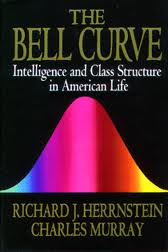
This post continues the comparison of the impact of the socioeconomic status of individuals and the IQ of those same individuals.  I’m going off the book “The Bell Curve” written by Herrnstein and Murray.  So far I’ve covered the comparison with respect to poverty and education.  This post will deal with employment, keeping it and looking for it.

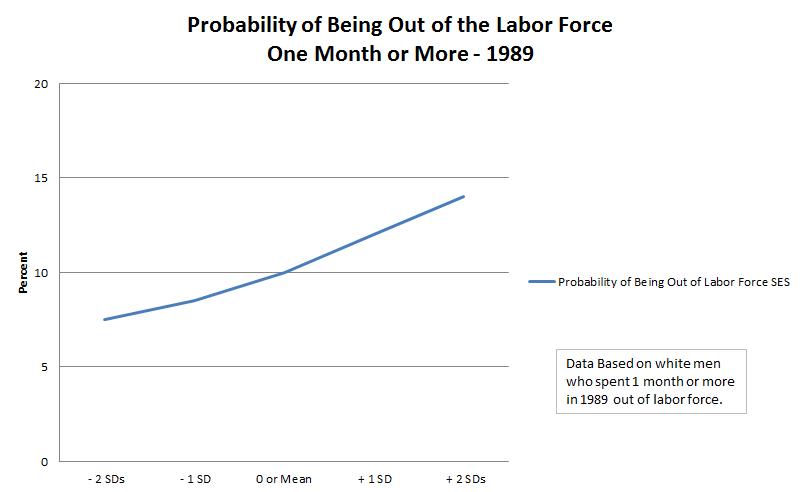
Back when I started this series, I demonstrated data that spoke to each topic using SES data only.  For example, looking at the probability of being out of the labor force for 1 month or more in 1989 bases on SES, the data showed this:

The data seems counter intuitive.  As the SES status of the family increased, the chance that a young man would drop out of the labor force increased as well.  This may be explained by the fact that wealthier families could afford to have their son’s not work for a time while those from poorer families felt a greater need to earn money.

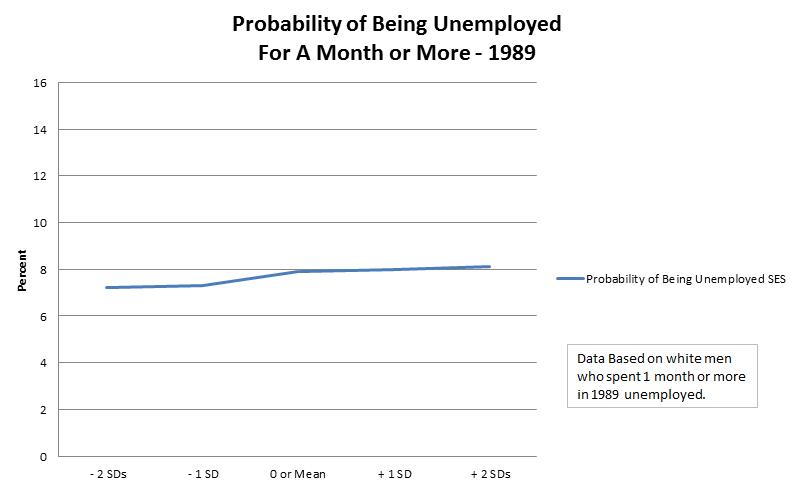
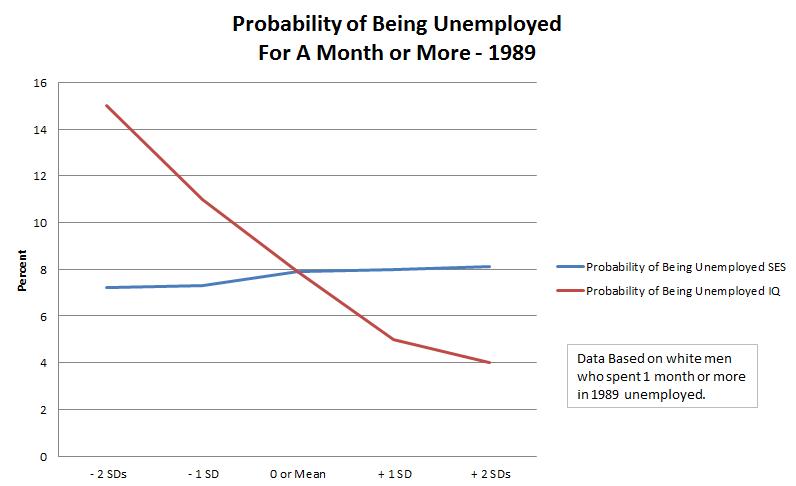
Next we looked at unemployment.  That is, still in the labor force but not working for a month or more in 1989.  Here is the impact of SES:

There is no impact.  The SES of the individual’s family doesn’t impact the unemployment of the young man.

Let’s compare SES and IQ.

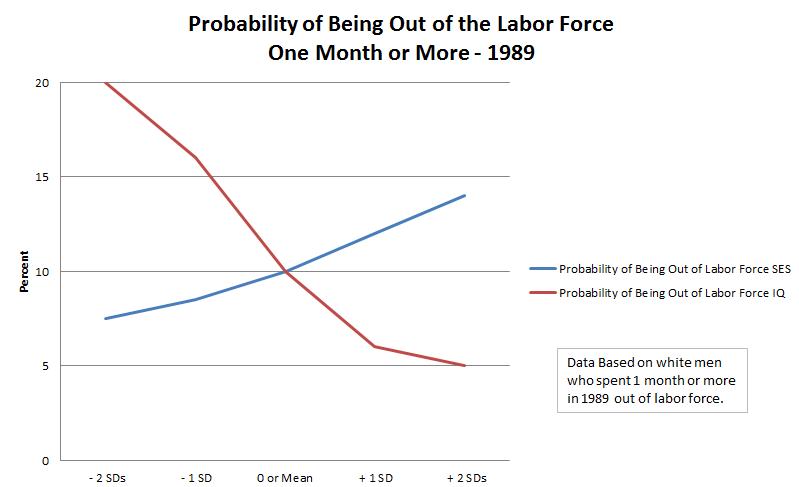
First, go back to labor force participation:

As man with very low IQ had a 4x percent chance of remaining out of the labor force compared to a man with very high IQ. Even moving in one standard deviation, the less intelligent man had more than twice the probability of staying out of the labor force than the more intelligent man.

Those men that are unemployed?


Again, not close.  While SES has non meaningful impact on the probability of unemployment, it’s clear that IQ does.  Mirroring labor force participation rate, the unemployment rate for the least intelligent is nearly 4x that of the most intelligent.

The idea that the SES of an individual or his family influences the fate of that person has significant influence in today’s debate.  And I’m sure that folks with money are more able to offset life’s unexpected challenges.  However, it may be that the intellectual ability of an individual has dramatically more impact on his or her success than the wealth, or lack thereof, of his or her family.

Bigger Government – Higher Taxes: A Liberals Charity

For a long time now we’ve know that religious belief, political affiliation and charity correlate.  Certainly correlation isn’t causation but it does provide for interesting conversations.  Which brings me this story:

BOSTON — A new study on the generosity of Americans suggests that states with the least religious residents are also the stingiest about giving money to charity.

Like I said, this is well known and not surprising.  I would like to say that freedom loving individuals intuitively know that we need to care for our neighbors, but that legalized theft is not the way to do it.  However, I don’t think most people think it through like that.

But it would be fin to try and explain this:

The study released Monday by the Chronicle of Philanthropy found that residents in states where religious participation is higher than the rest of the nation, particularly in the South, gave the greatest percentage of their discretionary income to charity.

The Northeast, with lower religious participation, was the least generous to charities, with the six New England states filling the last six slots among the 50 states.

The study also found that patterns of charitable giving are colored in political reds and blues.

Of the 10 least generous states, nine voted for Democrat Barack Obama for president in the last election. By contrast, of the 10 most generous states, eight voted for Republican John McCain.

Whatever the reason, I think it has to do with how the brain works.  For example, there are studies that show people who “be green” are then more likely to be rude or less moral; at least for a time.  Scientist feel that by contributing to the health of their plant, that “need” in their mind has been met and they are now free to act less charitable.

In fact, I’ve always felt that liberals aren’t less generous, they simply feel that government is their charity.  I honestly feel that when a liberal lawmaker is successful in voting for someone else to build a school for the poor with someone elses money, they feel the same sense of accomplishment that someone who volunteers for Habit for Humanity and actually swings the hammer that builds the school, or house.

Not surprisingly I’m often called out for this line of “garbage” and am told that I’m simply looking at it through too simply and too bias a lens.  Perhaps.  Tribalism is tough and resentment is an unattractive date.  Which is why I was surprised to see this:

Alan Wolfe, a political science professor at Boston College, said it’s wrong to link a state’s religious makeup with its generosity. People in less religious states are giving in a different way by being more willing to pay higher taxes so the government can equitably distribute superior benefits, Wolfe said. And the distribution is based purely on need, rather than religious affiliation or other variables, said Wolfe, also head of the college’s Boisi Center for Religion and Public Life.

Wolfe said people in less religious states “view the tax money they’re paying not as something that’s forced upon them, but as a recognition that they belong with everyone else, that they’re citizens in the common good. … I think people here believe that when they pay their taxes, they’re being altruistic.

I’ll differ with the good professor a little bit here.  I don’t think it’s the act of PAYING the taxes that causes democrats to be less charitable than others, I think it’s the act of VOTING for more spending that causes liberals to be less charitable.

No one likes to pay taxes and even democrats avoid it when they can.

Voter ID Laws: A Critique

Moe provides a critique I can resonate with:

VOTER ID: I have absolutely no problem with voter ID. My problem is with 1) making it difficult, and 2) rushing it. Voter ID? Not a bad idea. The way they’re doing it? That’s suppression.

I’m not sure what of the specific way and manner in which she objects, but I’m encouraged by the acknowledgement that proving you are who you say you are is not scandalous.

Obama: You Didn’t Build That

Obama’s words are now famous.   In context, out of context, fair not fair, it’s all out there.  The republicans are running with it and the president is denying it.  However, this much is true.

Obama was making reference to the fact that business owners did not get to where they are entirely on their own.  Much of their success is based on the fact that those who came before created an infrastructure, roads and bridges, teachers and firemen, who have made their success possible.

And because of this, Obama feels, the very wealthiest among us, should be willing to “give a little back.”  Now, it’s important to put this in context, as ironic as that might be.  Here Obama is talking about his desire to let the Bush tax cuts expire for the wealthiest Americans.  Those Bush tax cuts that he wants to keep are the federal income taxes for all Americans earning less than $250,000.

President Obama is creating the narrative.  Federal income taxes.  The wealthy.  Business owners.  Roads and bridges and teachers.

Obama.

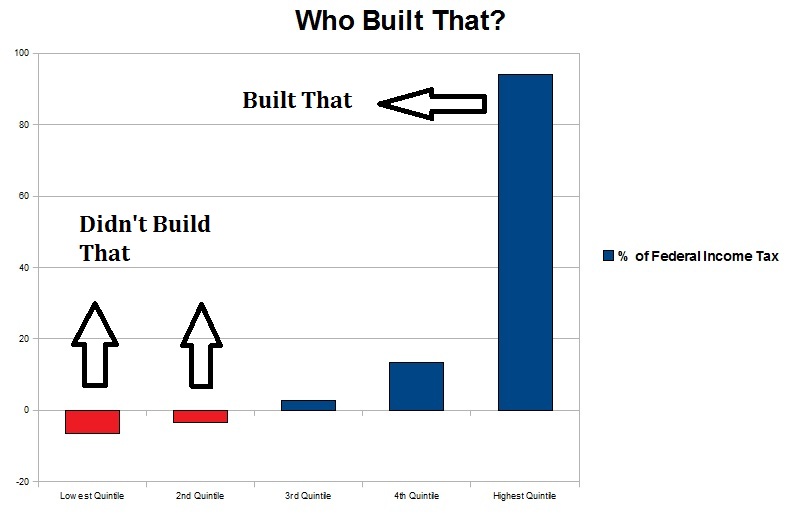
The conversation is federal income tax.  We’re not talking about sales tax.  No mention of property tax.  Not a whisper about social insurance taxes.  This conversation begins and ends with federal income tax.  Keeping the Bush rates for everyone but the wealthiest using the logic that those business owners didn’t build the infrastructure that allowed them to be successful.

In researching TPC’s critique of the Romney tax plan I found some numbers that will prove to be illustrative to Obama’s, his own logic, argument:

It turns out that the middle class didn’t build that.  The poorest among us didn’t build that.  Just as you would imagine, the wealthiest among us built that.  Those few wealthy who not only provide jobs for the rest of us but also provide for the roads and bridges to get us there.


That Didn’t Take Long: Obama Attacks Ryan

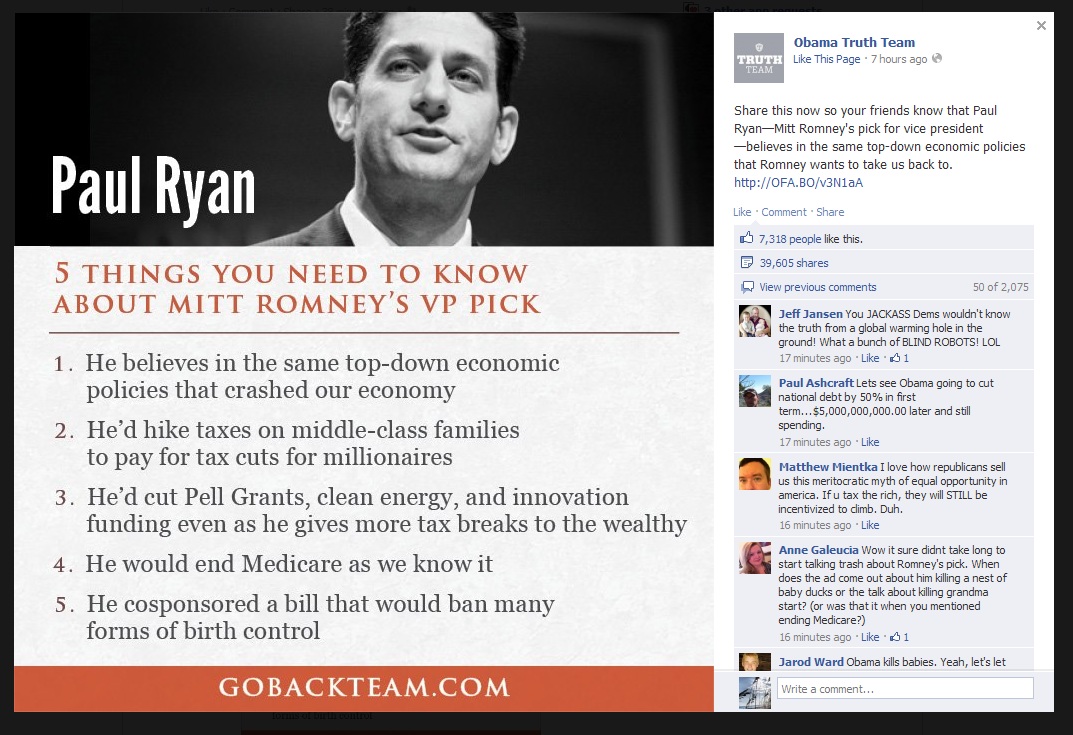
It took team Obama about 15 minutes to release the hounds.  However, to be fair, he probably had these ads lying in wait for each of the top choices.

Let’s take a look:

  1.  The economy crashed due to government policies that induced banks to lend money to people who had no hope of paying those loans back.
  2. BAM!  Class warfare at it’s finest.  I’ll have to look at the plan first though.  But if the analysis is anything like the TPC, there may be a bit of a partisan bias.
  3. We clearly don’t need more college graduates.  Or, at teh very least, we need fewer of the “soft” degrees and more of the “hard” degrees.  Clean energy – meh.  Clean energy should be given the same breaks as traditional energy.  But let’s not move to #4 without more class warfare.
  4. Yes.  Medicare as we know it is broken.
  5. I’ll have to check on that.  Not sure what he’s talking about.

Romney Picks Ryan And Other Stuff To Think About

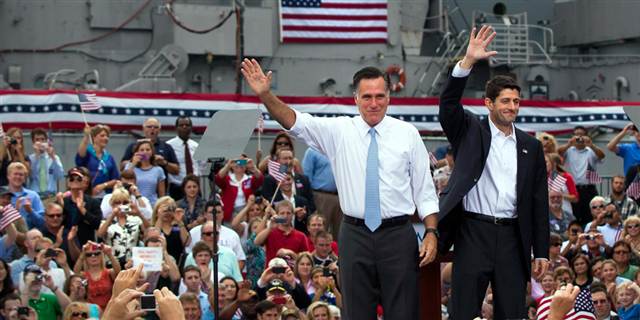
So he picked Ryan.  I think it’s a fine choice but maybe not the strongest one he could have made.  I’m glad that he didn’t pick Rubio.  Rick is too new, is only a Senator and really would have smacked to pandering.   The other pick I was afraid of was Rice.  I like her but she would have been a massive gamble.  She’s pro-choice -which is what it is- and that would have turned off a ton of the base.  Further, she could be seen a doubly pandering.

High gain high risk.

I would have preferred a governor.  Paulenty, Christie, Daniels, Jindal or McDonnell.  I think any of those 5 would be solid solid picks.  [If Obama wins the Republican primary is going to be an All Star team].

I think Ryan brings a conservative Tea Party rock and roll star, he brings youth and enthusiasm and brings a degree of expertise in matters financial.  However, he also brings the Ryan plan.  A plan that has been an easy target for democrats.  And a plan that may negatively sway indies and the elderly.

Will he make a difference?  Probably not.  But if his team can influence the Romney team that you have to be a little looser, a little more hip and a little bit more aggressive, then that would be a good thing.

Additionally, a few things are also clear.  In the coming days and for the rest of the campaign we’re gonna hear the democrats roll out all kinds of ads and speeches on the following themes:

  • War on the Middle Class – See also “Decline of the”
  • The gutting of Medicare and Medicaid
  • Tax breaks for the wealthy
  • Income disparity
  • The Ryan Plan itself

It should promise to be a great campaign!

Education: Socioeconomics vs IQ – The Bell Curve

The second installment of the comparison of socioeconomic status and IQ.  This post examines the impact of each on:

  1. Dropping out of school
  2. Obtaining a GED
  3. Graduating from college

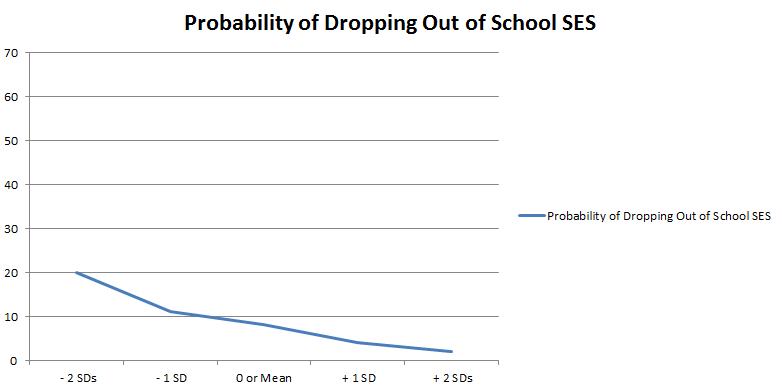
In a previous post, I showed various charts.  Among them is the probability of cropping out of school based on the SES of the family:

The pattern is clear, kids from wealthier families have a better chance of obtaining a high school education.

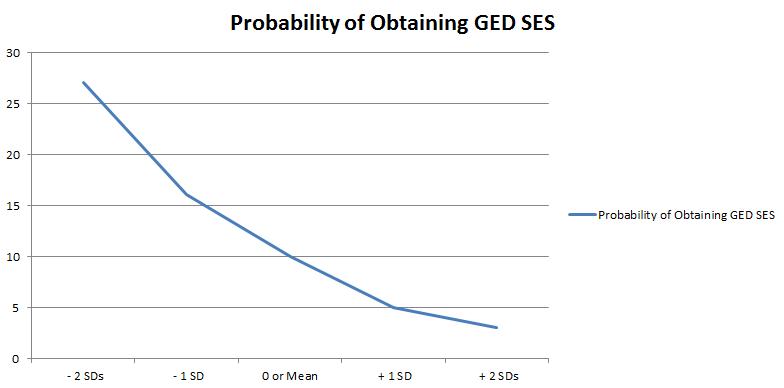
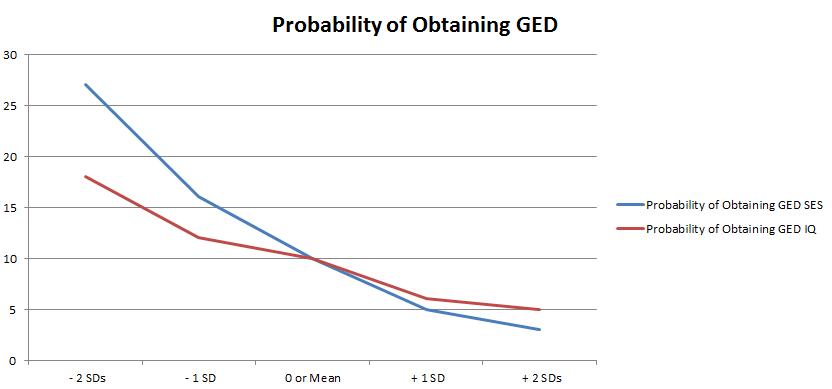
The came the data showing the probability of a kid, who has dropped out, obtaining a GED:

This is a tale that is counter-intuitive.  We expect the narrative to be that rich kids do better than poor kids.  But this data shows the opposite for folks who obtain a GED after dropping out of school.

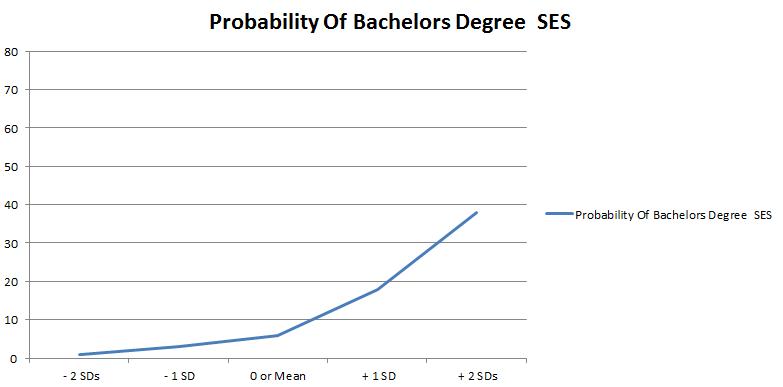
Finally we show data that speak to college degrees.  College is, arguably, a key factor to the success of an individual in today’s society.  Maybe.

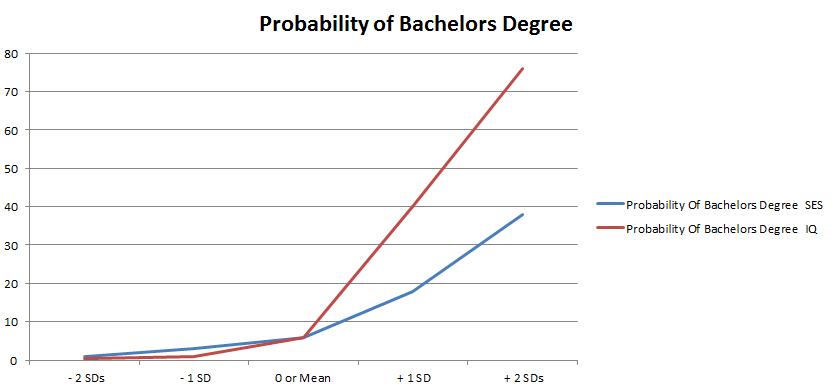
The data suggests a massive SES impact.  Very few kids from the poorest families are graduating college while nearly 40% of the wealthiest kids are achieving that milestone.

The data is somewhat mixed.  High school and college graduation rates seem highly dependent on the SES of the parents while attainment of a GED is the exact opposite.

Now, what if we add in the predictive value of IQ?

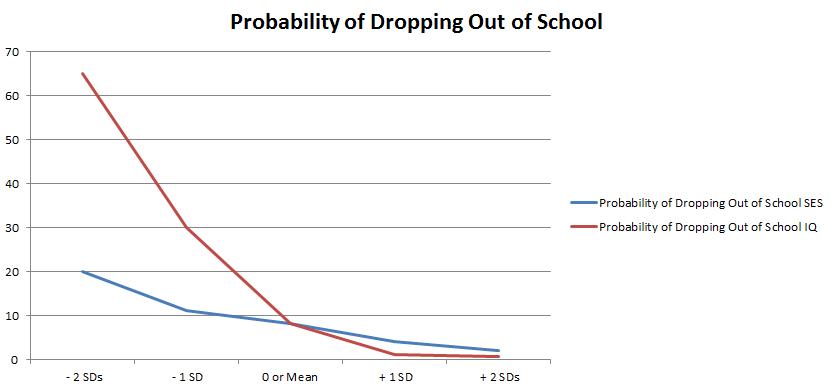
First, dropping out of school:

The first thing that should be apparent is that dropping out of school is rare for kids of either average SES or intelligence.  But dropout rates escalate dramatically for those of below average intelligence.  IQ is more than a 3x predictor than SES of the school dropout.

How does GED look?

The data including IQ doesn’t change the fact that obtaining a GED goes against the commonly held belief that kids from poorer households do worse than the rich kids.  Even accounting for IQ, the folks from the poorer families obtain a GED at higher rates than do kids from wealthier households.

Our last look into education is the college graduation rate:

Again, a dramatic difference.  With one exception; the data shows very little difference between low SES and low IQ.  But when it comes to highly intelligent kids, it doesn’t matter if they come from poorer families or wealthier families; the kids are graduating college at a better than 75% clip.

As with poverty, IQ plays a dominant role in the educational attainment of our children.  All else being equal, the smarter the kid, the better they will achieve educationally.


On Liberals, Tolerance, Speech and Hate

Liberty can be messy.  But God forbid we would have it any other way, an excerpt from Jack Chambless:

As usual, liberals tell us that we must be tolerant – even thought we have a right to be intolerant.  Liberals tell us that we should have freedom of speech.  But notice, when someone uses their freedom to speak in such a way that offends liberal theology (and there is a theological element to modern liberalism), they cry out that they have been victims of hate-speech or worse.

The true test of your support of Liberty is if you can accept someone else’ opinion.