
Category Archives: Middle Class

Poverty And Class In America

There’s been a lot of discussion surrounding the mobility between classes here in America.  At the same time, there’s been a lot of discussion surrounding the importance of education.  Not only getting a high school diploma but on getting a college one as well.  In fact, it’s gone so far as to have people calling for free college education for all Americans.  The argument is that the rich get richer while the poor get poorer.  That income mobility in America is restricted.  That attaining wealth is more and more becoming reserved for the pre-existing well to do’s.

For a long time I’ve fought this belief.  I’ve fought the idea that America is not the land of opportunity.  That we’ve somehow lost the idea that if you work hard enough you can do anything.

I’ve fought it.

And now I’m reading a book, The Bell Curve, and I’ve seen some interesting data.  For example, it seems to be important where you come from if you wanna avoid poverty:
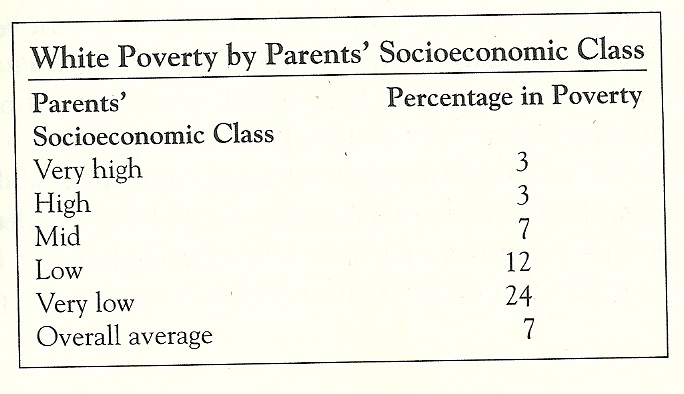
If you’re born to a family with very low socioeconomic class, you have an 8 times better chance to find yourself in poverty than if you were born to a family with a very high socioeconomic status.

It would seem that class matters.

Further, when it comes to wages, the data suggests that there is an education gap that would strengthen the argument that we need to increase college degrees to our kids:
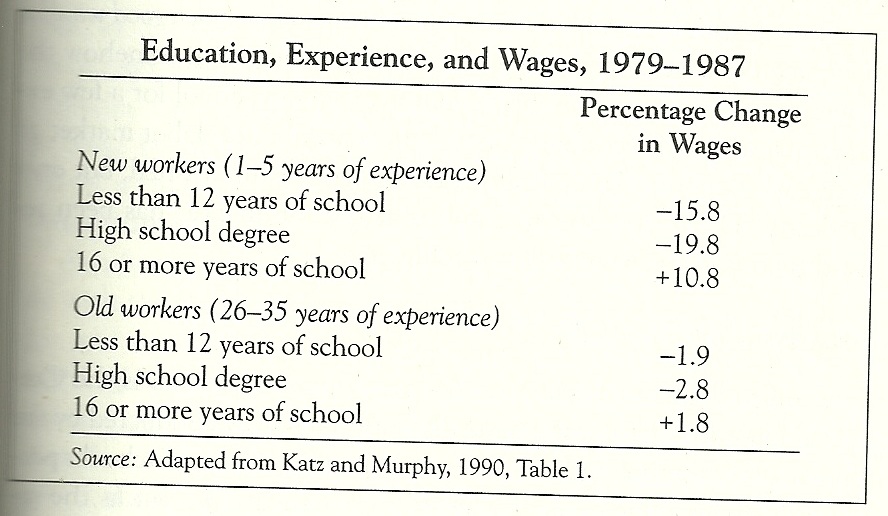
It’s hard to argue the numbers.  High school droop-outs are seeing their wages drop by double digits while college graduates are seeing double digit increases.

Interesting data to be sure.



People Who Are Bad At Money Don’t Have Money

Poverty in the United States is a problem.  When folks are poor they are less healthy, receive less education and are more likely to raise children who are poor themselves.  And there are a lot of noble efforts to curb poverty in the US.  Much of that effort is, of course, centered on taking money from people who have it and giving it to other people who don’t.

There are schools of thought that say, “The wealthy are able to give their children unfair advantages.  We need to remedy this unfairness by proxy; giving money to the children of the poor.”

Not surprisingly, I don’t agree with this.

Continue reading

Are You Smarter Than A Three Year Old: Inequality and fairness

It’s no secret Obama is going to bang the “It’s not fair” drum this election.  Hell, he’s been bangin’ it since LAST election.  He’s continually calling for the rich to “pay their fair share.”  He can’t rub two speeches together without mentioning that everyone should play by the same rules.  Even more, he continues to claim that the richest among us have been doing exceptionally well in the economy while the rest of us are seeing wages stagnate for the last 30 years.

Don’t forget that it isn’t true:

 The claim that the standard of living of middle Americans has stagnated over the past generation is common. An accompanying assertion is that virtually all income growth over the past three decades bypassed middle America and accrued almost entirely to the rich.

The findings reported here—and summarized in Chart 8—refute those claims.  Careful analysis shows that the incomes of most types of middle American households have increased substantially over the past three decades.

So if it isn’t true, why does Obama continue to bang this drum?

Because he thinks that we think it’s true.

Continue reading

Wherein The Economist Channels Pino

If I’ve said it once I’ve said it a thousand times, if you wanna sell more beer, lower the price.  The same concept exists for labor.  If you want people to buy more labor, lower the price of labor.

But even as we face unprecedented levels of unemployment, there are people in the world that wanna make it harder for people to hire people.  They suggest that the real value of the current minimum wage is low and that we should consider raising it match past level.

I don’t understand how pricing low margin workers out of the job market right now makes sense.  And the Economist agrees with me.

Continue reading

Wages, Middle Class And Stagnation

I’ve been aware, politically aware, since about 2006 or 2007.  That’s when an interesting tidbit caught my attention:

The 2008 Presidential election would be the first in a long time where neither a sitting President or Vice President would be running.

The race would be wide open.  I began to  pay attention, and I was hooked.  And since then I have heard a steady dull roar about the fading middle class.  I’ve heard that the richest among us have been getting richer while the rest of us have experienced wages that remain flat.

The world would have us believe that for most of us, wages have experienced stagnation.

Is it true?

Continue reading

Mitt Romney: I Don’t Care About Poor People

Recently Mitt Romney made a statement that many, on both sides, are using to against him.  From the Blue, Romney is being attacked on that comment by having it taken out of context.  The left is going to say that Romney said:

Former Massachusetts Gov. Mitt Romney said on Wednesday that he’s “not concerned about the very poor,”

When in fact he said:

“I’m in this race because I care about Americans. I’m not concerned about the very poor. We have a safety net there. If it needs repair, I’ll fix it,” the Republican front-runner said Wednesday on CNN, following his victory in the Florida primary.

Be that as it may, it’s election politics and the tactic is used by both the Red and the Blue.

But is the statement true?

Continue reading

The Liberal Lie: Buffet’s Secretary And Her Tax Rate

President Obama has enjoyed making a point the rich, the very rich, are making more out very well under the current tax code while the rest of us suffer.  His favorite example is his friend Warren Buffet.  In fact, Obama even mentioned it during his State of the Union Address:

When it comes to the deficit, we’ve already agreed to more than $2 trillion in cuts and savings.  But we need to do more, and that means making choices.  Right now, we’re poised to spend nearly $1 trillion more on what was supposed to be a temporary tax break for the wealthiest 2 percent of Americans.  Right now, because of loopholes and shelters in the tax code, a quarter of all millionaires pay lower tax rates than millions of middle-class households.  Right now, Warren Buffett pays a lower tax rate than his secretary.

I’ve been working this for a long time.  I’ve tried making the point that Buffet pays that SAME income tax rate as his secretary; tax on salary is straight forward and everyone uses the same schedule.  I’ve also tried to point out that Buffet pays much MUCH more in taxes than his secretary; he makes very much more.

All of this is ignored as only so much right-wing buffoonery.

So, let’s look, what does Warren Buffet’s secretary – Debbie Bosanek – pay?  Well, it’s reported that she pays a rate of 35.8%.  And Buffet?  What does he pay?  The same report says he pays 17.4%.

Buffett’s secretary since 1993, Debbie Bosanek, sat next to her boss just hours after being invited by the president to the State of the Union address, where the president made her the face of tax inequality in America.

Bosanek pays a tax rate of 35.8 percent of income, while Buffett pays a rate at 17.4 percent.

“I just feel like an average citizen. I represent the average citizen who needs a voice,” said Bosanek. “Everybody in our office is paying a higher tax rate than Warren.”

Interesting.  Interesting indeed.  The first thing I considered when reading this is why Buffet doesn’t compensate his staff in the same way he compensates himself; namely through assets that yield capital gains.  The second question I asked was, “Wait a moment, what IS the marginal rates exactly?”

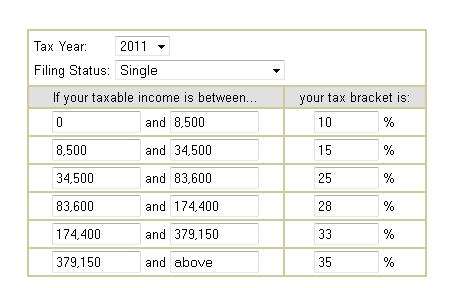
Let’s again, go look:

According to the above table, Ms. Bosanek can’t earn enough  income to set her tax rate at 35.8%.  In fact, the highest that any American can pay is 35%.  And even if Ms. Bosanek made $1,000,000 her rate would be 32.73%.  No where near the 35.8% the liberals report she pays.

This should not be surprising; liberals suffer from a degree of lack of understanding when comes to things economic:

It’s not even close.  The conservatives did better, MUCH better, than the Leftists.  And it tracks exactly with political affiliation.

So the next time that you are confronted with the argument that Mr. Buffet’s secretary pays more in taxes than her boss, challenge them.  Ask them questions.  Ask them if they mean total dollars or tax rate.  Then ask them to explain their answer.

They can’t.


Three Steps To Avoid Poverty

Income mobility.  Poverty.  How to create best results.

Topics that generate a lot of interest in the discussion of politics, government and the role of government.

I have discussed how marriage can impact the GINI coefficient measuring income disparity in populations and more recently had conversations regarding the impact of marriage on social mobility.  I feel that the more married we are, the more mobile we are:

I suspect that it [ social mobility] has to do with several things, but I feel that our declining marriage rate and the number of immigrants are leading reasons.

I came across an interesting piece of data from the Brookings Institute:

The Immediate Prerequisites to Success Are:

  1. Recieve a good education [graduate high school]
  2. Work full time
  3. Marry [And do it before having kids]

The results are staggering:

If an individual adheres to zero of those three social norms, he has a 76% chance of being poor.  Only a 7% chance of attaining the middle class.

On the other hand, if an individual adheres to all three of those social norms, an almost exact opposite picture is painted.  An individual stands a 74% chance of attaining middle class and only a 2% chance of being poor.


The “Attack” Of The Middle Class

In November I asked a simple question:

Would you be more or less likely to look for a new job if your current job no longer offered vacations and holidays?

I got a couple of answers and they confirmed the very obvious:  We would be more likely to look for a new job and certainly not LESS likely.

More recently I made an observation concerning teacher salaries:

…to receive the bonuses and raises, teachers must sign away some job security provisions outlined in their union contract. About 20 percent of the teachers eligible for the raises this year and 30 percent of those eligible for bonuses turned them down rather than give up those protections.

Teachers in Washington DC valued the clause in their contract that prevents them from being fired MORE than they valued $30,000 in bonus AND a $37,000 salary increase.

In both cases, the point is made, one theoretical and the other practical, that compensation comes in forms OTHER than strictly wages and salaries.  Vacation is one form of compensation.  Protection from having to actually DO your job is another.  It’s something that I’ve always suspected.  However, Dan Mitchell on his blog points out a couple of studies by CATO that demonstrates the lower earning deciles is growing more rapidly than the growth shown in the highest earning deciles:

While it is true that the cash explicitly paid to employees has become more unequal over the last generation, the…more benign explanation for the change in cash compensation over a generation is the dramatic increase in health insurance costs. …inequality in total compensation has not increased because the fixed costs of health insurance are a much larger percentage of the total compensation of lower-earnings workers. Burkhauser and Simon explore this explanation. They add the value of employer-provided health insurance as well as Medicaid and Medicare to the pre-tax, post-cash-transfer household income data and find that the bottom three income deciles actually exhibit higher growth than the top seven deciles from 1995 to 2008.

Compensation, in it’s many forms, grows more rapidly for the lower earning deciles.

Further:

Using unpublished BLS total compensation data, including employer health insurance expenditures, from 1999 to 2006, he finds that the growth in compensation by earnings decile (from the 30th to the 99th) averages 35 percent, with 41 percent growth at the 30th percentile (workers earning $10–$14 an hour) and only 35.8 percent growth at the 99th percentile (workers earning $59–$80 an hour).

We’re certainly going to h ear from Obama and the Democrats this election cycle that the Middle Class is under attack, perhaps true, but that attack takes the form of government dominated health care, not some form of class warfare engaged by the elite.  Obama is going to cast himself as the Middle Class warrior.  The media will produce study after study that shows the rich are getting richer while the poor are getting poorer.

Don’t buy it.  Do the work.  Get the data.


Minnesota Metro Transit Bus Drivers: Pay And Overtime

A recent analysis of bus drivers for the Minnesota Metro Transit system provided some interesting data:

  • Base pay for drivers is nearly $50,000 a year.
  • The top earner in the system made $120,000 a year.
    • He did this by working, on average, 74 hours a week.
  • Overtime in the system has jumped by 52 percent from 2008 to 2010.
  • A driver on overtime – paid at time and a half – saves Metro Transit $4 an hour on average.
    • This due to the fact that the agency would have to pay for training, additional benefits and pension.
  • A union agreement says that no more than 24 percent of Metro Transit’s workforce can be part time – prompting the agency to turn to overtime.
  • In October, 89 percent of weekday overtime assignments were during rush hour and lasted less than three hours.

The incentives are undeniable.  For a system that demands flexibility; traffic doesn’t occur in neat 8 hour blocks, the rules prohibit the proper response.  Further, regulations surrounding benefits, those benefits that include vacation, retirement and health care, make it more cost effective to work an already employed person than to hire someone else.  And lastly, being a Metro Transit driver isn’t all that bad; 50 large is a good deal of money.

Finally I’d like to point out that for at least one of these drivers, the overtime is a feature and not a bug.  And it’s a feature because of decisions HE’S made in HIS life:

Lance Wallace is happy to drive a few extra hours if it means his wife can stay home with their four children – all younger than 5.

The New Hope man is among the top 5 percent of overtime earners at Metro Transit. Picking up extra shifts and working nearly every day, he averages 60 to 70 hours a week. The $37,700 in overtime he earned last year pushed his total earnings to $86,400.

“I don’t really want to work overtime,” Wallace said. “But I do it to make up the income.”

The extra work doesn’t make him “overly tired,” Wallace said. In fact, after working two jobs before, he “feels good” to now work where he can dictate his own hours.

Mr. Wallace is a father.  A father of FOUR.  A father of FOUR in a family that has the mother stay home.  And of those FOUR kids, all are younger than 5.  And this father of four young children is happy that he’s able to work the hours he does in order to prevent having to carry two jobs.

My point?  Incentives matter.  Raising the cost of hiring means that you will see less hiring.  Wage earners will enjoy working more hours if it benefits them, not the other way around.  Government union work pays well.  People who have 4 kids in 4 years time have a more limited ability to dictate their time.