Category Archives: Health Care

Grocery Barons: If Medical Care Delivery Were Like Food Care Delivery

Just got back from the grocery store.  It was 11:10 PM here in North Carolina.  I just finished working out at the YMCA.  I stopped to have a bite to eat and a beer at the local tap room and then decided I needed to pick up some things from the food store.

It was open.  Would be until tomorrow; they sell food 7×24.

The place was well lit, air conditioned and pleasant.  Music even.

Imagine, a warehouse that sells virtually anything you could wanna eat.  7×24.  On your way home.

Then I saw this:

Biscuits and eggs.  Taters and juice.  This would last my family of 4 two whole breakfasts.  That means for $6.99 I feed 4 people twice.  Or, if you carry the 1, eight people for seven bucks.

That’s less than $1 a meal.

Can you imagine what it would be like if we could sell medical care like we sell food?

Life Expectancy In The United States: We’re Number 1

A little while ago I posted that health care in America may be getting a bad rap.  That perhaps we might have the BEST system in the world, not the abysmal system that is often reported in the reports today:

The fact that America can deliver this service is a miracle in and of itself.  And the fact that we are such a wealthy nation that we can afford it is yet another miracle.

Now, to be sure, my case here is that our system is advanced and can be expensive.  However, we are a very wealthy nation and can afford the care.  However, in the comments, shenanigans was called and we discussed how the United States might be ranked #1, not #19-#29 or #47.

Continue reading

We Spend More On Healthcare Than…..Bug or Feature?

The arguments have been going on as long as we’ve had modern healthcare.  On one side we have those that claim the United States spends more on healthcare, with worse results, than any other industrial nation on earth.  Therefore our system is broken.

The other side claims that the ability to spend more on healthcare may be an indicator than our system is the BEST in the world.

To be sure, no one wants to have to spend $550.00 a month on medication when we could craft a system that delivered the life saving pills at a tenth of the price.  Spending money for money’s sake is silly.  But our levels of expenditure are elevated because the medical care system is, quite simply and without debate, the best in the world.

Just ask Mr. and Mrs. Baker.

Continue reading

Health Care: Why We Are The Best In The World


All you have to do is Google “USA Healthcare Ranking” to see that most people thing we rank low; very low.  But I have been carrying the banner that this ranking isn’t an accurate portrayal of the health care system in America.  Rather, when appropriately measured, we rank #1, just as you would expect.

See, the organizations doing the ranking have a built in bias.  They rank health care systems lower that don’t meet their already stated goals.  That is, they punish the United States for not having medical facilities close to a certain segment of the population even though that certain segment of the population moved to rural Montana fully aware of the risks.

But most egregious is the failure of these organizations to normalize their data. For example, these statistics use life expectancy.  Yet they fail to account for the fact that the United States has a disproportionate number of deaths due to non-health care related causes.

No matter.

And I have been fighting an uphill battle.  Until now.

Continue reading

Government Adds To The Cost Of Medical Care

One of the for profit hospitals in the Raleigh area is Wake Med.

WakeMed Health and Hospitals is a 870-bed healthcare system with multiple facilities placed around the metropolitan Raleigh, North Carolina area.  WakeMed’s main campus is located on New Bern Avenue in Raleigh, North Carolina. WakeMed serves multiple counties throughout the state and specializes in a variety of services including cardiology, neurology, orthopedics, high-risk pregnancy, children’s care, trauma, physical rehabilitation and critical care transport.

In addition to providing the above services they also have emergency rooms.  And being a for profit entity Wake Med is looking for ways to improve the efficiency of medical care delivery.  And they have a solution.

Continue reading

Capitalist Pigs

If you listen even just a little, you can pick up on one of the main complaints against the medical care delivery system here i the United States.  That the whole system is doomed to fail because we allow greedy asshole pigs to profit off the medical needs of our citizens.  For some reason, the fact that this doesn’t apply to food or clothes is a point that’s missed by those that scream we must nationalize health care.

The fact is this, when exposed to market forces, blueberries and shoes become less expensive and come with higher and higher degrees of quality.

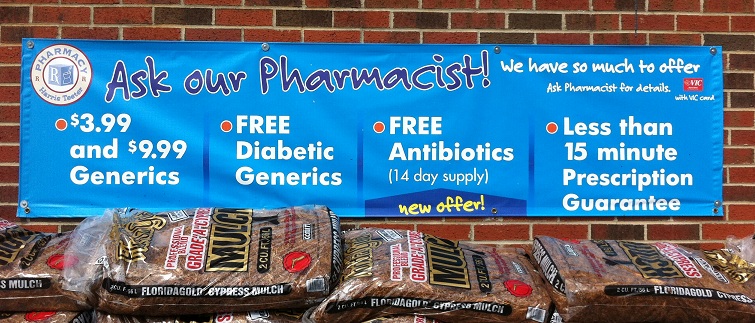
I stopped by my local “Grocery Barron” outlet and was amazed to see this new advertisement.

The grocery store market is offering drugs that “cures” high blood pressure.  The cost?  $3.99 a month.  By the way, hypertension is the single #1 killer in the United States.  Number one.  Cured, blammo, for the crazy cost of 4 bucks.

After that is the program for diabetes medication.  The cost?

Nothing.

That’s right; free.  Diabetes medication carries no cost to the consumer.  The greedy bastards are offering life saving medication for free in the hopes that you’ll just come in a shop.

But wait, there’s more!

For the low low price of NOTHING you can now get antibiotics as well.

Blink.  Blink.

All of this will be delivered to you in less than 15 minutes while you shop in  conditioned warehouse for berries from Chili, chocolate from Switzerland, wine from France and sushi fresh from the sea.

Bastards!

Obamacare’s Legacy

With the end of their careers near, several Democrats are opening up about the truths of Obamacare, what it cost them, the party and possibly Obama.

The elections are right around the corner and the campaign season is right on top of us.  Lot’s of people are gonna be out front and talking about the issues that might impact this season.  And Obamacare certainly will get it’s chance to shine.

Continue reading

Reducing The Cost of Health Insurance

One of the contributors to the price of medical care is the price of malpractice insurance.  And with a simple change in tort laws that price of malpractice has diminished:

RALEIGH – The state’s second largest medical malpractice insurer has cut its premiums in response to the effects of tort reform laws in North Carolina and other states as well as to put it on a more competitive footing.

Mag Mutual Insurance Co. has cut doctors’ premiums by an average of 7.4 percent for 2012, North Carolina Department of Insurance spokeswoman Kerry Hall says. The company calls 3 percentage points of that a “tort reform credit.”

There’s a whole bunch of ways top reduce the cost of medical care besides forcing young healthy people to buy a product they don’t want or even need.

How We Payed For Healthcare In The Past

There was a time when the government didn’t tend to the care of her citizens like we do now.  I was researching another post or comment or something and came across this:

While the health care community and academics searched for a single insurance plan for delivering health care, the absence of regulation left individual Americans free to solve the problem on their own. They proceeded to do so, aided in the effort by a number of medical entrepreneurs.

In spite of the price increases, most people still paid for medical care out of their own pockets.  Estimated health expenditures in 1929 were $3,649 million. Of that, consumers paid $2,937 million, public sources paid $495 million, and philanthropy paid $217 million.

Employer plans covered only a tiny minority of people. Most sickness insurance was provided by mutual benefit associations unrelated to work—fraternal societies like the Loyal Order of Moose, the Knights and Ladies of
Security, the Ladies of the Maccabees, and the Société Française de Bienfaisance Mutuelle, which built San Francisco’s French Hospital in 1852. According to Stewart, there were thousands of fraternal societies operating in New York’s Lower East Side at the beginning of the 1900s. Existing for the benefit of their members and offering benefits that were not contingent on employment, many of the societies “employed or contracted with physicians to care for dues-paying members for as little as $1 to $2 per year per member. In some eastern and southern cities, a third to a half of some ethnic groups depended on these organizations for medical care. In New Orleans 88% of the entire population was said to be covered by some form of prepaid ‘contract medicine,’ also known as ‘lodge medicine’ by 1888.”

Historian David Beito estimates that in 1910 at least one-third of adult males belonged to fraternal societies that provided nearly every service of the modern welfare state “including orphanages, hospitals, job exchanges, homes for the elderly, and scholarship programs.”  Fraternal societies had a number of competitors including “commercialgroup plans, government workmen’s compensation programs, trade unions and industrial unions, company-sponsored mutual benefit societies, and other fraternal orders that provided life insurance or non-stipulated (discretionary) relief.”

Before the government intervened to solve our healthcare crisis, we were doing it ourselves.  We banded together, formed our own organizations and took care of each other.

However, there was one thing going FOR those social organizations that is missing from the government run programs; accountability:

The fact is that the fraternal societies knew their members gave them an advantage in issuing disability and sickness insurance. Lodges had home visiting committees that helped uncover false claims and one or two week waiting periods requiring members applying for aid to shoulder some of the financial load. Unlike many of the public proposals, the societies also had behavioral requirements that made life less attractive while receiving payments. Emery
reports that fraternal groups could require that “members receiving benefits could not drink or gamble and in some cases were not allowed to be away from their residence after dark.”

The fraternal societies were made up of friends, neighbors and associates.  Further, they worked to prevent fraud and ensure that a life of leisure while accepting benefits wasn’t allowed.

A sad cry from where we are today.

 

Spy vs. Spy

I was researching data for another post and came across this fun fact:

President Nixon’s plan for national health insurance rejected by liberals & labor unions, but his “War on Cancer” centralizes research at the NIH.

Up is down and down is up.

Fascinating.