
I’m reading an article for an upcoming post when I came across this:
We have a shortage of every kind of doctor, except for plastic surgeons and dermatologists.
It strikes me that plastic surgery and dermatology are both examples of medical “care” not subject to insurance and the accompanying government regulation.
And the prices of plastic surgery?
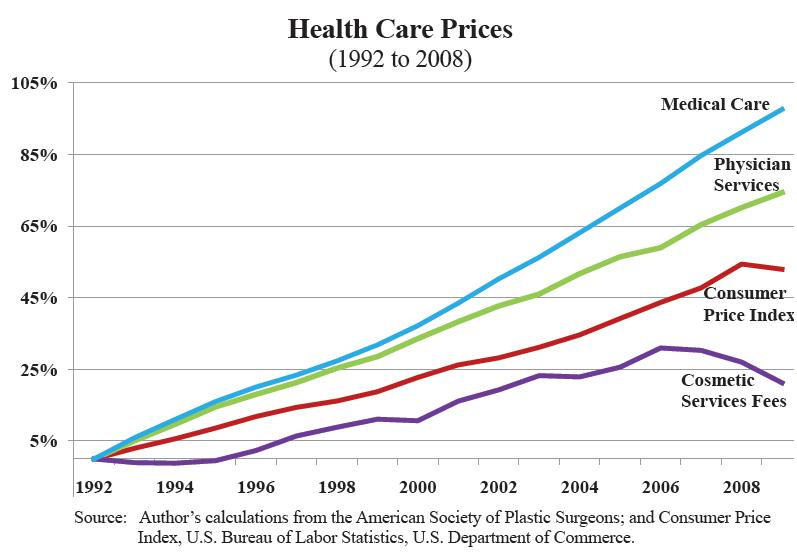
Cosmetic surgery is one of the few types of medical care for which consumers pay almost exclusively out of pocket. Even so, the demand for cosmetic surgery has exploded in recent years. According to the American Society of Plastic Surgeons, 1.7 million cosmetic surgical procedures were performed in 2008. That is more than 40 times the number performed two decades ago (for example, 413,208 in 1992).
Despite this huge increase, cosmetic surgeons’ fees have remained relatively stable. Since 1992, medical care prices have increased an average of 98 percent. The price of physician services rose by 74 percent. [See the figure.] The increase in the price of all goods, as measured by the consumer price index (CPI), was 53 percent. Yet, an index of cosmetic surgery prices only rose only about 21 percent. Thus, while the price of medical care generally rose almost twice as fast as the CPI, the price of cosmetic surgery went up less than half as much. Put another way, while the real price of health care paid for by third parties rose, the real price of self-pay medicine fell.
When exposed to the free market, commodities and services will respond with cheaper prices and higher quality.