
Tag Archives: North Carolina Politics

Econ 101: A Lesson in the Tender Mercies of Medical Care

So, it turns out that while you may be able to legislate price, you can not legislate costs:

For years, Mayo Clinic officials have complained that Medicare and Medicaid pay less than what it costs to treat patients.

Now they’re doing something about it.

In the past week, the Rochester-based clinic said it will stop caring for 50 Medicaid patients in Montana and Nebraska starting Jan. 1, unless they have a rare disease that can’t be treated elsewhere. Also on that date, a handful of Mayo’s primary care doctors in Arizona will opt out of Medicare, forcing some 3,200 patients to pay out-of-pocket or find new providers.

Really!?!

You mean that when government imposes price ceilings you get shortages?  Who would have thought that?

The difference between prices and costs is not just a fine distinction made by economists. Prices are what pay for costs — and if they do not pay enough to cover the costs, then centuries of history in countries around the world show that the supply is going to decline in quantity or quality, or both. In the case of medical care, the supply is a matter of life and death.

When politicians talk about “bringing down the cost of medical care,” they are not talking about reducing any of these costs by one cent. They are talking about forcing prices down through one scheme or another.

-Thomas Sowell

It is a law as sure as gravity; when you artificially reduce the price of something below what the market would otherwise demand, you will get less of it or worse of it.

Count on it.

Postscript:  For added fun, here is a foretaste of the feast to come:

“Both of these moves are very difficult for us to make,” said spokeswoman Shelly Plutowski. “Both point to the fact that we as a country need to change the way we pay for health care. Mayo Clinic and other providers lose money on every Medicare patient we see, and the same goes for Medicaid.”

Last year, it cost Mayo $840 million more to treat Medicare patients than it received in payments, Plutowski said. The clinic also lost $100 million treating Medicaid patients, she said.
The Mind of the Leftist

I am working on a project at the office with some colleagues that are not from the United States.  During lunch we had some time to chat and so I took the opportunity to ask them what “the world” thought of Obama’s Nobel.  They grinned, a bit more sheepishly than I thought they would, and admitted that it was, indeed, a little early for him to win.  So far so good.

With my toe firmly in the water, I decided to get their take on Universal Health Care.  I felt that their insights would be useful, one being from Italy and the other from Slovakia.  Before I go on, I should say that these guys are some of the most educated people I have worked with in a long time.  And while they have recently been at the Northeast Ivy; Harvard, they have degrees in the sciences as well.  In fact, the Italian has his PhD in physics.

So, imagine my surprise when these two highly educated scientists came down in favor of universal health care.  And more than that, they both felt it is a right as citizens to have this health care provided to them.

I am stunned.

Leftists are everywhere.

But I Voted For Him

And now I want me money.  Or so goes the general consensus if you read the Reuters article describing the Home Rescue Plan.

Obama, grappling with the worst U.S. housing crisis since the Great Depression, pledged to help as many as 9 million families keep their homes by reworking their mortgages.

Let’s not forget that the whole reason those 9 million families are struggling is because the government “pledged to help as many as 9 million families keep obtain their homes by reworking cheating* on their mortgages.

Eight months later, the plan is plagued by delays, red tape

delay and red tape?  A government program defined by delay and red tape?  Come on!

some critics say, a reluctance by banks to do their part.

Riiight.  Cause last time the banks “did their part” a housing bubble was created, then burst and we were plunged into this problem.  After which the banks were rewarded for “doing their part” by having themselves taken over, vilified, their CEO’s fired and then their pay limited.  Honestly, why wouldn’t the banks “do their part?”

Just 17 percent of eligible borrowers have had their loans modified and monthly payments cut. Hardly any have been given a cut in the amount they owe on homes which are now worth less.

Huh.  Weird.  It doesn’t seem that banks want to lend money to people who demonstrate that they can’t pay money back to banks that lend them money.  Bitches!  Oh, especially hard hit are the owners who have negative equity-who would have guessed?

For homeowners like Jeff Latta, there was no help at all.

Latta, a 53 year-old retiree, pays $1,600 in monthly home payments that eat up 93 percent of his pension and he struggles to make child support payments.

So, a 53-year-old man decides that he wants to quit working at 53 [at least] and discovers that he is having trouble paying the bills.  Unbelievable.

To help pay his mortgage, Latta has slashed his bills by hunting for food in the wooded hills around his town of Albany in southern Ohio, and growing his own vegetables.

Serious.  I wonder if “slashed” means the same thing in Reuters talk as it does in Pino talk?  However, to his credit, Mr. Latta is doing a lot more than many other folks in his condition.  But let’s be honest here, if $1600 is 93% of his pension, he has $120 left over.  No vegetable is going to cover that gap.

In March, Latta heard about Obama’s Home Affordable Modification Program, or HAMP, that allows mortgage payments to be reduced to 31 percent of a homeowner’s income.

Awesome.  Because you can just legislate away the annoying aspects concerning the laws of Economics.

Latta applied for a loan modification but was rejected. His bank said his income from selling pumpkins and firewood — a net of $906 in 2008 — was too high.

Serious.  Even HAMP must know on some level that this is just silly; it’s designed to fail.

That banks lent irresponsibly in the U.S. property boom is irrefutable. As San Diego-based realtor Steve Rodgers says: “If you could fog a mirror, they’d give you a mortgage.”

While this is true, it is also true that banks were forced to carry a required portion of their lending portfolio in this low income high risk demographics.   To say that they did this on their own is disingenuous.

Look, in the end I feel bad for Mr. Latta.  But check this out, if you make $1720 a month you can’t afford to live in a house.  Move to an apartment.  Or a smaller house.  Or something.  And more advice?  Give up on the pumpkins and firewood and move to Raleigh; they have work there.

Alan Colmes: Is a Capitalist

Saturday afternoon, Alan posted on the emerging news media; citizenry media.

With newspapers folding and many denizens in the old media not understanding the new media, the young entrepreneurs at metrojacksonville.com are on the edge of the curve.  Locals, including officials, can’t wait to post there, knowing their messages will be read by an engaged citizenry.  They are using the web the way it is meant to be used, incorporating a level of interactivity that most newspapers haven’t grabbed onto.

I couldn’t help but being impressed by Ayn Rand reaching to us from the past:

Creative destruction. Even as a reliable icon like the delivered print newspaper makes it’s way into the the same museum as the rotary telephone, VCR and horse drawn buggy, we see the beautiful effects of ingenuity, creativity and the capitalist way. More and more people are finding that the old way of receiving news is no longer meeting their needs, so they “vote” with their wallets. Given the fact that news print and printing presses and journalists and editors are “rationed by price” we are seeing the release of these resources due to people purchasing other forms of news delivery.

Certainly the impact of the loss of their jobs will be hard for those journalists, editors and print specialists, but society overall will benefit and become more productive. Net/net, everybody wins. We see a less efficient form of media fall away, we see competition in the new forms that we are allowed to choose from and, even better, they are cheaper than the $0.75 a day it costs to purchase the local fish wrapper. In short, life is good, even great.

Imagine the lack of progress if the government stepped in, stole your money right from your pocket and propped up an industry that no one wants to see succeed? I would think we would be upset that the progress of a nation would be halted in it’s steps. Impossible? Nope:

blogs.reuters.com/mediafile/2009/09/24/how-to-subsidize-news-without-feeling-dirty/

Posted by John Galt
October 10th, 2009 at 10:56 pm

Who knew that Ayn lives?

Changing of the Guard

Well, for better or for worse, it happened.  The folks in Wake County who have opposed the Diversity Plan won.  And they won big.  I can only imagine that this means they are going to try and break down the work that has been done to ensure that schools maintain a balance of economically challenged families and non-economically challenged folks.

I have been torn in the days leading up to this election.  I am almost totally Libertarian.  Therefore I mostly disagree with the folks on the left when it comes to the economy and those on the right when it comes to things related to the social issues.  Schools always get me.  Every time.  And so it was this time as well, though even harder.

See, the left always wants to throw more money at the problem and protect the teachers in a Union kinda way.  And that NEVER works.  Ever.  You always get the lowest common denominator and the “enterprise” suffers.  But jeez, this Diversity thing has legs.  I really think it makes better schools.  The kids are better off and they learn more and we just don’t end up failing as many kids as we otherwise would.  So I sided with the Dems on this one.  Not because I think more money is the answer; or teachers unions [I hate ’em], but because the diversity strategy is an awesome tool in the toolbox.

The Price of Free Health Care

See, that’s not fair.  Everyone knows there’s no such thing as free health care.  Heck, we know there isn’t free anything.  So, what has to happen for health care to be made available to every citizen in America?  Well, it has to be paid for.  And who would pay for it?  Well, we would simply raise taxes to cover the costs.  And could we do this?  Yes, almost for sure.  To be equally sure, we would have to raise the taxes so high that even Democrats would puke.  So instead we’ll raise them just some.  And what does this get us?  A system in debt.

We have all heard that America is ranked something like 37th in the world [based on the metrics used to determine this, I think that we are really ranked #1, but why quibble].  The club that we are beaten with is “If we spend all this money on health care, why do we only get a return that ranks us 37th?  The other club, my second favorite, is “We are the only industrial nation that doesn’t have some form of universal health care.”

Let’s look at the cost those other nations have to pay.  I like GDP PPP [that is purchasing power parity].  Basically, this is a measure of the “quality of economic life” in a given country or State.  Using this measure you can compare the purchasing power of people living in North Carolina and Minnesota for example.  Of of people living in Sweden and Germany.

So, these nations that are providing medical care to all of their citizens–how do they rank in GDP PPP?  Poorly.  Very poorly.  In fact, according to one study, if you took the nations of Spain, Portugal and Greece and granted them statehood in the United States, they would immediately become the 1st, 2nd and 3rd poorest states in the Union.

Italy, Finland, Denmark, France and the UK?  Make them states instead?  They would become the 5th, 6th, 7th, 8th and 9th poorest States in America.  In fact, you could take the whole of the European Union and make it a State.  It would be the 5th poorest State right behind Arkansas and Montana.

Why?

When we turn to consider the impact of economic policy on growth, it is hard not to
notice that one particular factor above all is essentially different in large parts of Europe
compared with the USA, namely the expansion of the political sphere in general and
taxes and the size of the public sector in particular.

Taxes.

So, if we simply worked at letting medical care exist like any other commodity, we would find that America would:

  1. Have more money than any other nation to spend on health care.
  2. See the real cost of that care go down.

WCPSS: Diversity

As my daughter started getting closer in age to going to school, I became interested in WCPSS.  I began to learn how kids are sent to school, ow they get there and why.  I also learned many many other things.  That Wake is the largest district in the State and one of the largest in the country.  That we are growing like crazy.  That we win awards for our schools and the job that we do.  And I learned that we use tests the rest of the country doesn’t use.

I come from an educator’s family; my dad taught for 33 years.  Heck, I went to school to be a teacher and spent a single year in the classroom before I realized this wasn’t for me.  An expert?  No, certainly not.  But an interested participant with not insignificant experience and training.

I also have a different take on education that most of my political flock.  I’m not pro-voucher, I’m pro public school with market solutions existing outside of that option.  See, I don’t so much see the taxes I pay going to MY children’s education as much as I see them going to a well educated public.  One of the reasons our nation is so prosperous is that we have an educated populace.  So, when I consider moving my kids into a private school, I don’t see the tax money I pay in something that I have claim to pull out.

With that said, the role of the public schools is to give an education.  They are not meant to be anything else.  And if there are tools that assist in that process, it is incumbent on the serious administrator to utilize those tools.  And I think that diverse schools are one of those tools.  I absolutely feel that parental involvement in the school contributes to the success of the students in those schools.  We volunteer and walk through the school.  I call the principle when I have concerns and am engaged with our teachers.  All of this is to say that someone other than no one is making sure that things are being done well in our school.  Further, our involvement affects other students in other ways.  When my wife and I are in the classroom, we are not only helping our child, but the other kids in class as well.  One more adult to pick up the slack and let the teacher teach just a titch more.

And so yes, when a school contains a mixture of economic diverse families, the involvement of the school’s parents exits at some level that keeps the school at least humming, if not over achieving.  Is it hard to pass a school near where you live?  Sure.  Should that be our concern when going about the business of educating a public?  Maybe, but not the top priority.  Is there more work to do?  Certainly.  Is more money the answer?  Almost certainly not.  There are many many things that can be done without adding more money; removing any represented workers for one and merit based pay for two.  But diversity works.

Leave it alone.

Robber Barons!

Those drug companies that we love to hate!  How dare they, how DARE they make money on our misfortunes!?!  Seems they ain’t so bad after all.

The Bridges to Access program will provide free drugs to single people with household income of less than $27,075; $36,425 for couples; and $55,125 for a family of four.

Last year, GSK gave away drugs worth about $438 million to nearly 415,000 patients through various assistance programs.

Just goes to show, when left to it’s own devices, the market works.

Why Would We Tax Chinese Tires?

When American’s are really struggling right now to make ends meet, why would the United States impose a tax on tires being shipped to the country?  I mean, if we are really trying to give our consumers the opportunity to save and spend money, why, why would we tax something that they need?

“China strongly condemns this grave act of trade protectionism by the U.S.,” the spokesman for China’s Ministry of Commerce, Yao Jian, said in a statement issued on the Ministry website (www.mofcom.gov.cn) Saturday.

“This step not only violates the rules of the World Trade Organization, it is also contrary to the relevant commitments that the United States government made at the G20 financial summit.”

I am having a hard time understanding why we would impose trade restrictions that would endanger our relationship with China; one of our largest trading partners.

I should re-read this thing–be right back.

Oh, I see now:

The United Steelworkers union, which represents workers at many U.S. tire production plants, filed a petition earlier this year asking for the protection.

It said a tripling of tire imports from China to about 46 million in 2008 from about 15 million in 2004 had cost more than 5,000 U.S. tire worker jobs.

Forget I asked.  These are not the droids you are looking for.

The Health Care Lottery

Much debate has been made about the uninsured in America.  I have tried and tried and tried to make the point in my personal conversations that you can not claim you can’t afford thing “A” when you voluntarily spend the money that could purchase thing “A” and instead buy thing “B”.  That is to say, if I have enough money to book, but instead purchase a DVD, I can not claim to be unable to buy the book.  I simply decided to prioritize the DVD higher than the book.

The same is true of health insurance.  If I have money to purchase health insurance but instead choose to buy thing “B”, I can not claim to be unable to afford health insurance.  I just decided not to buy it.  Now, I understand that there are things in life that seem to qualify as “must have”.  Shelter, food and clothing to name a few.  People even claim that an internet connection and phone service can qualify as required services.  So I tried to find an item that in no way could be classified as “required”.  I came up with lottery tickets.

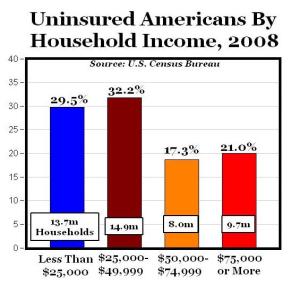
Now, looking at uninsured data found at Carpe Diem, there seem to be three rough categories of people:

uninsured by income

  1. Those that make less than $25,000 a year
  2. Those that make from $25,000 to $50,000 a year
  3. Those that make more than $50,000 a year

Those three breakdowns seem to describe the uninsured equally.  About 30% of the uninsured population are in each category.   Let’s see if my theory holds true for the lower income population.

Using data reported by 4 Professors at Duke University, we are able to see lottery participation rates as well as annual per capita amounts.

Lottery Play by Demographic

What it shows is remarkable.  Combining the players making less than $25,000 per year we see that just about HALF of the population plays the lottery.  Further, those people who play are spending near $600 a year!  This means that these players have near $600 of annual disposable income that they are choosing to spend on the lottery.  By going here, I can find a policy that covers a single 25-year-old man for $52 a month.  Or, $612 a year – almost exactly what is being played on the lottery.

Given that a group of people have disposable income of near $600 and that an insurance policy costs nearly $600, can you realistically say that those folks are unable to afford health insurance?

Me either.