Basic High School Math Fail

Again, I’m reading a bunch of stuff for an upcoming post and I see this:

Lucia Harkenreader’s check landed in her mailbox last week: a rebate of $456.15 from her health insurance company, with a letter dryly explaining that the money came courtesy of the federal health care law.

For Ms. Harkenreader, 53, who is putting a son through college, the rebate helps soothe the frustration she feels toward her insurer, Golden Rule, which is owned by UnitedHealthcare.

“It seems like the health insurance companies really just don’t have any consideration for the cost out here,” said Ms. Harkenreader, who pays about $480 a month for a high-deductible plan, up from $400 last year. “What costs have gone up to justify that rise in premium? I’d love to know. Did you give your people a raise? I guess your light bill went up?”

How is it possible that she can ask “What costs have gone up?” as she clutches a $456.00 check?  How can she ask “What costs have gone up?” as insurance companies are required to “insure” people who knock on the door with a broken arm?

People wonder why this country is in trouble.

Poverty: Socioeconomics vs IQ – The Bell Curve

About 6 weeks ago I started posting data from the book, “The Bell Curve.”  The first portion of the book deals with various conditions, poverty, education, crime and so on that take place in our society.  And more than just look and detail those conditions, the authors try and look at what might cause some of those conditions.  The point being that a vast majority of today’s commentators on such matters blame the socioeconomic conditions of families for the unfortunate plight many of our citizens find themselves in today.

Having problems graduating high school?  Check and see if the kid is from a poor family.

Mothers raising children in poverty?  Check and see of that mother herself came form a poor family.

Individuals in jail?  Check and see if those folks came from a poor family.

And the evidence is there that such an impact exists.  But is there another, stronger variable that impacts these conditions?  The author’s answer is, “Yes.  And that variable is IQ.”

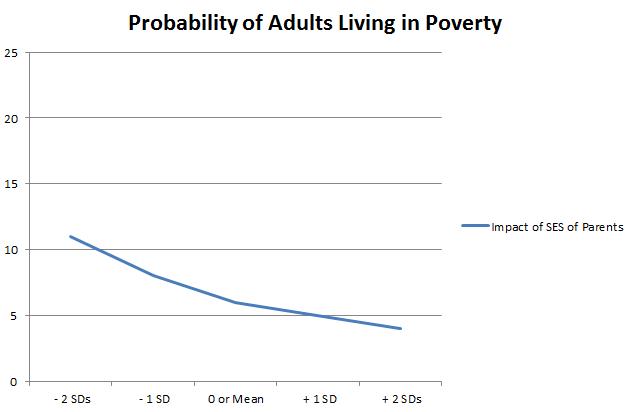
Let’s review the first set of data I showed back then.  The first set of data shows the probability that an individual will be living below the poverty line in 1989, the data the study used:

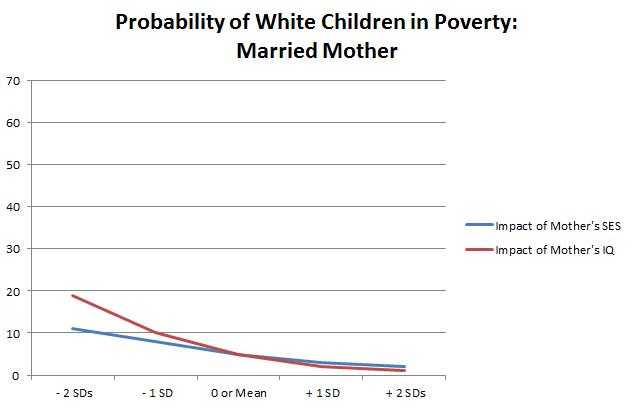
The next set of data shows the probability that a child will be living below the poverty line in 1989 when her mother is married:

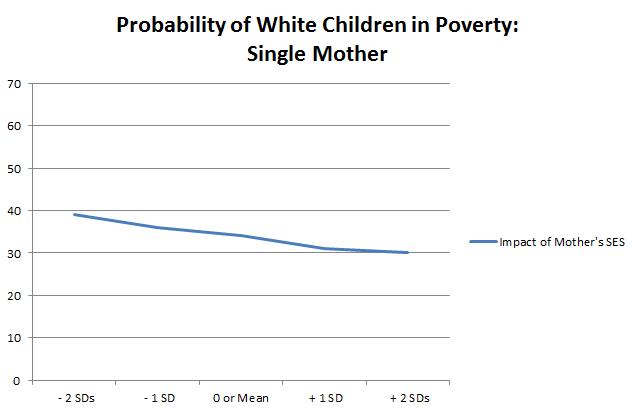
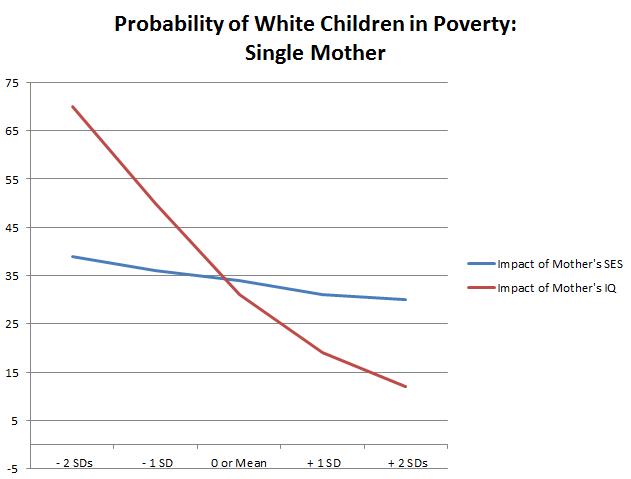
And the third set of data shows that same probability for that same child if her mother is single.

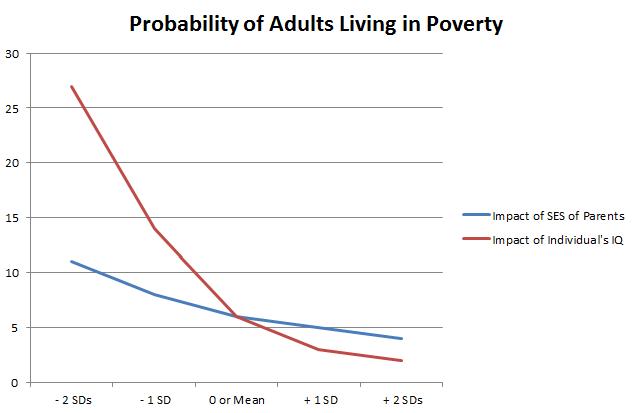
The data has an uncomfortable, but not surprising trend, to be born wealthy is better than being born in poverty.  However, here the authors, as I mentioned, looked for additional variables.  Specifically IQ.  Look at the data with the socioeconomic status AND the IQ included in the same graph.

Let’s go down the line starting with the probability of living in poverty:

The difference is dramatic.  Not only does having a very low IQ put you at significant risk of living in poverty compared to having a very low SES background, but being very intelligent is more important than being very wealthy.

Next we look at children of married mothers living in poverty and the impact that her SES and IQ have:

While the dramatic difference in the values isn’t the same, the pattern is.  A mother having everything else considered who is less intelligent has a higher probability of raising her children in poverty than an equally neutral mother of higher intelligence.

Finally, the probability of children of single mothers living in poverty and the impact that her SES and IQ have:

Right back to the dramatic difference.  What looked like an impacting variable before, SES clearly now has the appearance of having a minimal effect on raising children in poverty.  Rather IQ dominates this condition for children of single mothers.  Those children lucky enough to be born to the brightest of mothers have a 1/7th the chance of living in poverty compared to those children whose mothers score on the very lowest on IQ tests.

Clearly, as it relates to poverty and child poverty, IQ is the runaway variable when compared to SES.


More On The Laws Of Economics

I’m reading an article for an upcoming post when I came across this:

We have a shortage of every kind of doctor, except for plastic surgeons and dermatologists.

It strikes me that plastic surgery and dermatology are both examples of medical “care” not subject to insurance and the accompanying government regulation.

And the prices of plastic surgery?


From the report:

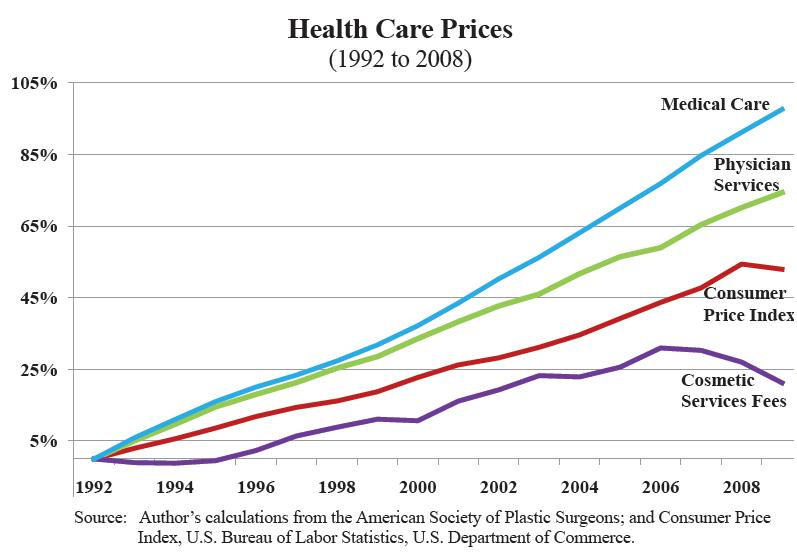
Cosmetic surgery is one of the few types of medical care for which consumers pay almost exclusively out of pocket.  Even so, the demand for cosmetic surgery has exploded in recent years.  According to the American Society of Plastic Surgeons, 1.7 million cosmetic surgical procedures were performed in 2008.  That is more than 40 times the number performed two decades ago (for example, 413,208 in 1992).

Despite this huge increase, cosmetic surgeons’ fees have remained relatively stable.  Since 1992, medical care prices have increased an average of 98 percent. The price of physician services rose by 74 percent.  [See the figure.] The increase in the price of all goods, as measured by the consumer price index (CPI), was 53 percent. Yet, an index of cosmetic surgery  prices only rose only about 21 percent. Thus, while the price of medical care  generally rose almost twice as fast as the CPI, the price of cosmetic surgery went up less than half as much. Put another way, while the real price of health care  paid for by third parties rose, the real price of self-pay medicine fell.

When exposed to the free market, commodities and services will respond with cheaper prices and higher quality.

The Art Of Politics

One of the reason I’ve never been high on Obama is that I don’t think he’s capable.  He’s certainly never demonstrated excellence at running an organization.  And by organization, I mean an organization of directors.  That is, a team of managers who themselves manage managers who AGAIN, have a team of people.

Obama has never been held responsible for meeting organizational milestones.  Of urging teams of people with competing priorities and views of success.  Obama hasn’t managed money, a bottom line or deadlines.

I manage people.  And I can’t imagine Barack Obama being  hired as a 2nd or 3rd level manager.  He simply doesn’t bring any experience to the table.

Romney, of course, has this in spades.

But THIS is frustrating:

Mitt Romney on Tuesday accused the media of looking to protect President Obama by focusing on the GOP candidate’s high-profile gaffes during his week-long foreign tour rather than more substantive policy issues he discussed.

“I realize that there will be some in the fourth estate or in whichever estate who are far more interested in finding something to write about that is unrelated to the economy, to geo-politics, to the threat of war, to the reality of conflict in Afghanistan today, to a nuclearization of Iran,” Romney told Fox News. “They’ll instead try to find anything else to divert from the fact that these last four years have been tough years for our country.”

Even if true, and I’m sympathetic to the claim, complaining about it is nonsensical.  It’s a tactic that doesn’t get anything done, weakens the candidate and takes away from the real message.

Victim Of The Feminist Revolution – School Children?

Am reading Super Freakonomics tonight after swimming at the “Y”.  Consider this:

In 1960, about 40% of female teachers scored in the top quintile of IQ and other aptitude test, with only 8% in the bottom.  Twenty years later, fewer than half as many were in the top quintile, while more than twice as many in the bottom.

Between 1967 and 1980, U.S. test scores fell by about 1.25 grade-level equivalents.

Jeepers.

It’s Jobs And The Economy Stupid

I’m not sure that Obama will be able to get from his time fighting inequality as a community organizer in the city of Chicago.  I’m not sure he knows HOW to get away from his time fighting inequality.

But America wants him to focus on fixing the economy and bringing more jobs:

Nearly every major poll indicates that the top issues for voters are jobs and the economy. Making the wealthy pay more in income taxes? Not so much, at least according to a new USA Today/Gallup poll.

An excerpt from Gallup:

“Creating good jobs, reducing corruption in the federal government, and reducing the federal budget deficit score highest when Americans rate 12 issues as priorities for the next president to address. Americans assign much less importance to increasing taxes on wealthy Americans and dealing with environmental concerns.”

In fact, higher taxes for the rich was given the lowest priority of the dozen issues, Gallup reports.

Respondents rated “extremely important” the following issues: “creating good jobs” (48 percent of respondents); “reducing corruption in the federal government” (45 percent); “reducing the federal budget deficit” (44 percent); “dealing with terrorism and other international threats” (42 percent).

After a number of other issues, it jumps down to “dealing with environmental concerns, such as global warming,” (21 percent). The same percentage — 21 percent — cited “increasing taxes on wealthy Americans” as an extremely important issue.

The poll would seem to indicate that the fairness arguments made by President Obama and his campaign aren’t top concerns for voters.

I think this is spot on for two reasons:

  1. People don’t think there is a fairness in taxation issue
  2. In so far as there is, no one really cares.  People compare their wealth to those around them and few see the excesses of the very wealthy.  But what they DO want is to regain some confidence in the job markets.

But that’s probably just me talking, not the folks who support our President:

What’s really striking about the poll results is that not only was this true of voters in the aggregate but of self-identified Obama voters, too.

Among Obama supporters, only 32 percent said raising taxes on the wealthy should be a top priority of the next president. That also put it dead last on the list of 12 issues among that demographic.

Well, maybe America HAS got it right.

Cost Of Raising A Child

For some reason as I was driving home yesterday, a thought occurred to me:

If one group of people paid $5.00 for a beer and another group of people paid $2.00 for a beer, would one group of people drink more beer than the other?

Or

If one group of people paid ~$200,000 to have a child and another group of people paid ~$0.00 to have a child, which group of people would have more children?

So, here I am looking at the data:

A middle-income family may spend $234,900 to raise a child born in 2011 to the age of 18, a 3.5 percent increase in a year, according to a government report.

That is a lot of money.  But the costs are not fixed:

The typical two-parent middle-income family spent $12,290 to $14,320 in 2011 on each child, the study found. Households that make less spend less, USDA researchers said. A family earning less than $59,410 a year will probably spend $169,080 in 2011 dollars to rear a child, while parents earning more than $102,870 may pay $389,670, according to the study.

And it can get worse than that.  According to this calculator the cost of raising a child can be as high as $434,180 if you earn more than $100k.

Earn less than $57,800 and you pay $133,710.  That’s $7,300 this year alone.

With government assistance to those poorest among us, that $7,300 can be completely covered reducing the real cost to near zero.

So, given the differences in the cost of raising children, I came to the conclusion that wealthy individuals have fewer children than do those less wealthy.

Was I right?  According to the Census I was:

The births per 1,000 women below 100% of the poverty line in 2008 was 96.3.  Births per 1,000 women above 200% of the poverty line that same year was almost exactly half : 47.7.

If income levels are pulled out, there is a steady climb in births per 1,000 from the wealthiest to the least wealthy.  A notable exception are the very poorest mothers:

Income Births Per 1,000
Less than $10,000. 33.7
$10,000 to $14,999. 103.8
$15,000 to $24,999. 86
$25,000 to $34,999. 80.3
$35,000 to $49,999. 72.3
$50,000 to $74,999. 64.4
$75,000 to $99,999. 57.4
$100,000 to $149,999. 51.8
$150,000 to $199,999. 49.3
$200,000 and over. 49.8

Certainly much more than the cost of raising a child goes into the decision of whether or not to have a baby.  Perhaps something as simple as the cost of contraception goes into the amount of pregnancies among the wealthy and the poor.  But it would be foolish to wave away the fact that the cost of raising a child is much higher for those who have more money and thus acts as a drag on the birthrate among that population.

Economists Ignore Laws Of Economics

It would appear that a set of economists are willing to ignore reality:

As the three-year mark since the federal minimum wage was last raised approaches, we urge you to once again raise the federal minimum wage. A three-step raise of 85 cents a year for three years—which would mean a minimum wage of $9.80 by 2014—and then indexing to protect against inflation (corresponding to the legislation proposed by Senator Tom Harkin and Representative George Miller) would be a reasonable approach. The increase to $9.80 would mean that minimum wage workers who work full-time, full-year would see a raise from their current salary of roughly $15,000 to roughly $20,000. These proposals also usefully raise the tipped minimum wage to 70% of the regular minimum.

This policy would directly provide higher wages for close to 20 million workers by 2014. Furthermore, another nearly 9 million workers whose wages are just above the new minimum would likely see a wage increase through “spillover” effects, as employers adjust their internal wage ladders. The vast majority of employees who would benefit are adults in working families, disproportionately women, who work at least 20 hours a week and depend on these earnings to make ends meet. At a time when persistent high unemployment is putting enormous downward pressure on wages, such a minimum wage increase would provide a much-needed boost to the earnings of low-wage workers.

These esteemed economists must have forgotten the negative repercussions of raising the minimum wage:

  1. Reduced employment for marginal workers
  2. Reduced hours for minimum wage earners
  3. Restriction of new job market entrants reducing valuable work place skills

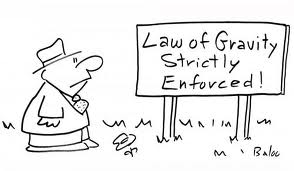
The laws of economics are incontrovertible.  You may no more pass legislation that says gravity is discretionary.

Crime: SES Impact – The Bell Curve

This post speaks to the eleventh chapter in the book, “The Bell Curve.”  It is here that the authors take a look at the impact of SES on crime and criminality in the NLSY study.  Again, in the early chapters of the book, the authors only look at white members of the NLSY.  Data pulled for the criminality is further restricted to men.  The data is presented below.

Data on crime can be hard to obtain.  Many times an individual can be “successful” at crime and not be caught.  This would reduce the instance of crime and present a challenge in reporting group patterns.  In an attempt to overcome this shortcoming, the book uses two classifications:

  1. Self reported crime
  2. Being interviewed in a correctional facility

The impact of SES on the first, self-reported crime is shown here:
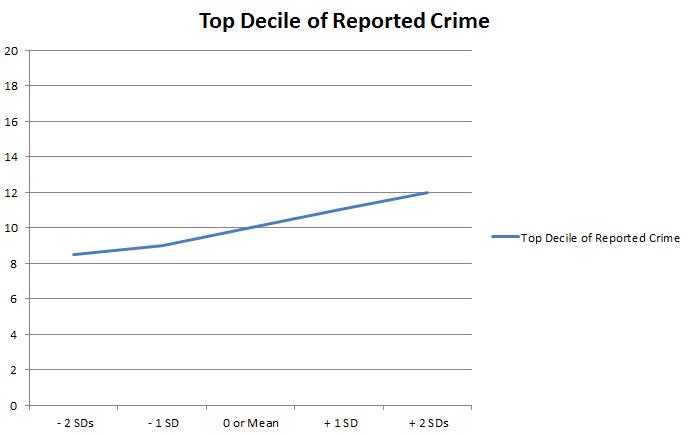
While the impact of the socioeconomic status of the parents of the men interviewed is low, less than 4 points, it’s interesting to note that the trend is reversed from what we might expect.  The lack of significant SES impact follows as demonstrated below.
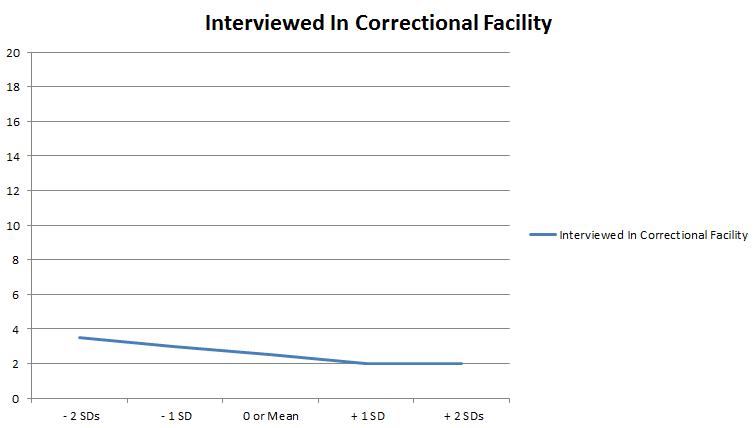
Here it shows that SES plays an even smaller role in determining criminality.

As I mentioned, this is the 11th chapter in the book.  Chapter 12 deals with civility and citizenship.  After reading the chapter, I was left with the feeling that I was reading a filler, one more chapter to fill a book.  As with crime before it, the data presented was sparse and, in my opinion, unfulfilling compared to the earlier chapters and data.

Then comes Chapter 13.

When I picked up the book I was looking for books on “How to Raise Chickens” as a result of a post of mine some time back.  I saw the book on the shelves and was taken by the title.  I bought it and it was immediately relegated to my stack.  Some time later, Boortz was speaking about the author and I decided I better begin the book.  At this time I was still unaware of the controversy of the book.  Then I posted on it.  I was then made aware of the controversy.

It’s chapter 13 where that controversy begins.  It’s here that the authors go into the subject of racial disparities, if they exist, between races.  In the book, the  authors explicitly put pen to  paper and ask, rhetorically for us, why should we explore this topic, one so painful and emotional?  They gave an answer, however, I was struck by the question.

As a result, I won’t go there.

Much of the talk I talk here at TarHeel is, or may be, emotional.  But it’s easy political kinda stuff.  Shit we can all agree is fun or enjoyable to debate.  But race is different.  I have neither the expertise, the knowledge or the education to be able to talk about this subject with anything resembling expertise.  And while I think it’s important to talk about the painful experiences of race, I feel it’s CRITICAL to bring an expert’s touch to the subject of race and IQ.

I don’t have that expertise.

With that said, I understand the controversy surrounding the book.  It IS controversial.  However, I need to point out that the first 13 chapters didn’t discuss race even one time.  And as a I read those first 12 chapters, I was struck by the straight forward and powerful arguments presented.

The next series of posts on this book will go back to Chapter 1 and revisit each until we get to the 11th chapter again.  At that point, I’ll stop.

The Upside To Obtructionist Congress

The upside to congress getting nothing done?  It’s obvious, the answer is that congress does nothing.  And in this case, I actually can’t fault the democrats for slowing down the republicans:

A second typo is slowing down House work on a bill aimed at limiting federal regulations.

Work stalled after Republicans made a typographical error in a measure that had been quickly developed to replace an earlier measure that included an embarrassing typo.

The bill, H.R. 4078, was intended to prevent new federal rules until the unemployment rate falls to 6 percent, but instead referred to the “employment” rate.

To fix that, the House Rules Committee approved a rule that, once passed by the House, would deem the bill to be corrected to say “unemployment.” But that rule incorrectly refers to the main rule for the bill as H.Res. 783, when it should have said H.Res. 738.

One typo is just that, a typo; fix it.  Two typos on the same bill, where the second one is in response to fixing the first?

Slow down.  Or better yet, stop.