Mitt Romney And The American Response To The Embassy Attacks


Like it or not, the campaign season is a time for candidates to differentiate themselves from their opponent.  Further, each candidate who is not the incumbent – in this case Romney – is going to posture himself as Presidential.  It might seem that each candidate is in a “damned if you do, damned if you don’t” position.
Mitt Romney Responds To Obama Administration

Mitt Romney’s Response To The Obama Administration

On Tuesday, September 11, two separate American embassies were attacked resulting in the deaths of 4 American’s including the American Ambassador to Libya.  Mitt Romney, attempting to demonstrate a difference between himself and Obama, used the developing situation as a foil.

At around 10:00 PM EDT Romney issues a statement:

I’m outraged by the attacks on American diplomatic missions in Libya and Egypt and by the death of an American consulate worker in Benghazi.  It’s disgraceful that the Obama Administration’s first response was not to condemn attacks on our diplomatic missions, but to sympathize with those who waged the attacks.

The response that Romney was referring to?

The Embassy of the United States in Cairo condemns the continuing efforts by misguided individuals to hurt the religious feelings of Muslims – as we condemn efforts to offend believers of all religions. Today, the 11th anniversary of the September 11, 2001 terrorist attacks on the United States, Americans are honoring our patriots and those who serve our nation as the fitting response to the enemies of democracy. Respect for religious beliefs is a cornerstone of American democracy. We firmly reject the actions by those who abuse the universal right of free speech to hurt the religious beliefs of others

Was Romney right?  Is this response appropriate or not?

The answer – It depends.

The Embassy Attack Timeline

It all depends on the timeline of events.  For example, I was off-line most of yesterday afternoon and only this morning woke up to the news of the attack.  Upon hearing of the Egyptian embassy release I had two thoughts:

  1. When protestors are attacking your location, you don’t issue statements that legitimatize those attacking you.
  2. Knowing that protestors had already murdered 4 embassy staff in Libya, the Egyptian staff may simply have been acting to save their lives.

Only later did I investigate the timeline and discovered that .  And it looks something like this:

  • 06:17 – The Cairo embassy issues their statement.
  • 10:00 – Crowds begin to form at the Cairo embassy.
  • 14:47 – Protesters in Cairo tear down the U.S. flag.
  • 14:00 – Crowds began to gather at Libyan embassy.
  • 18:00 – Protestors in Libya storm the embassy.
  • 19:17 – Reports of an American consulate staff shot dead.
  • 20:00 – Cairo embassy staff Tweets affirmation of morning’s statement.
  • 22:00 – Obama administration disavows Cairo statement.
  • 22:30 – Romney issues statement.

It’s clear that there is confusion surrounding the events of the situation in Egypt and that such confusion colored the context of the Cairo statement.  For example, if we believe that the embassy in Cairo released their statement long before the attack on the embassy, their message is better phrased.  However, if their statement is released AFTER the attacks on the Cairo embassy, their statements are grossly irresponsible.

And I think both Romney and Obama were confused by the timing of the statement.

The Politics of Cairo and Libya Attacks

It’s no secret that Romney has little if any foreign relations experience.  Obama is going to, he has to, use this in his critique of the governor.  However, most candidates for the office of President have that exact same knock against them.  This would include our sitting President Barack Obama when he was a contender just 4 years ago.  That being said, Romney is anxious to demonstrate that he has a firm grasp on matters foreign.  Enter the Mideastern violence.

To further complicate matters, Romney and Obama are not only working to manage the chaotic real time events overseas, but they are also keeping an eye on the “campaign ball.”  I feel that had both Romney and Obama been less concerned with that campaign and more concerned with providing leadership, remaining calm in a very charged circumstance and gathered all facts, neither the administration or the Romney camp issued their remarks. See, at 11:00 PM, the Obama administration distanced itself from the Cairo embassy remarks.  In fact, they mentioned that they do not represent the United States.   Here, Obama is making the same mistake Romney makes; they are confused by the timing of the statement.  Seen in the calm of day, the statement issued by Cairo are completely appropriate.  Further, adding that the statements don’t reflect the United States government only adds to the confusion coming from the United States.  If an embassy doesn’t represent the government, what is its role?

When the administration issued it’s statement on Cairo at 11:00 pm, I suspect that Romney felt more confident that the Cairo statement was issued AFTER the violence and not many hours before.  This mistake, now seen to be true, leads to his remarks that the administration is, in essence, apologizing.  I feel relatively confident that Romney was acting on facts as he thought they were and not twisting the timeline to his political favor.  However, the light of day indeed showed his statements to be inaccurate.

Mitt Romney Remarks on Libya and Cairo

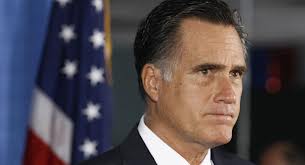
Notice Romney standing before a blue background framed by the American flags.  Clearly an attempt to appear Presidential.  Romney takes the tone of the gentle leader.  He’s reporting to America and is trying to show he’s present and managing the situation.

He speaks to the following:

  1. Issues condolences
  2. Issues statement on American’s stance on values
  3. Critiques the Obama administration on the handling of the events
  4. Embraces the Arab Spring and the potential it has
  5. Takes questions

My thoughts on his statements:

  1. He completes the reassuring leader role very well.
  2. At 3:25 he’s asked a question surrounding his statement from the night before.  I think he knows the facts now but doesn’t own up to the fact.  This is where he’s clearly weak and wrong.
  3. He doubles down on the mistake by referring to Cairo’s statement as an apology.
  4. When pushed further on this point, Romney acknowledges that the administration had the exact same reaction that he did.  In this, he’s right.  Both Obama and Romney were confused at the timing of Cairo’s statements and Tweets.
  5. At 4:50 Romney is pushed to explain that if both he and Obama took the exact same reaction, what did the White House do wrong.  Here is where Romney gathers steam.  He’s right when he claims that Cairo is part of Obama’s administration.  He’s right to say that a leader has to take responsibility for his administration.  It’s in this understand of “how things work” that Obama’s critic are correct in leveling the claim that Obama has no leadership experience.  That this is apparent to a 2nd level manager and not to the President of the United States is frightening.
  6. Again he mentions apology.  He slips and is weak by doing that.
  7. When asked if it’s appropriate to engage in politics when the events are ongoing.  His answer is powerful.
  8. He correctly brushes off the trap of hypothetical nonsense.
  9. He’s asked to define his foreign policy.  And does so very well.  The first “branch” as he calls it is to have “Confidence in our cause.”  I think that he hits a home run with this one.  Obama’s critics, e among them, distrust the President greatly.  We don’t believe that Obama appreciates the things that makes America great.  We think that he resents the abuses America has perpetuated around the world.  And if Romney can verbalize the feeling we have, put brackets around this mistrust, he’ll make significant inroads.

Romney made some mistakes, however, those mistakes were made by both Obama and Romney.  But his morning press interview went very well.

One last thing, Obama has a reputation for being a strong speaker.  I’ve never felt that.  I think he delivers a strong speech and can move audiences but his ability to speak succinctly in an ad hoc situation is horrible.  Notice that Romney never pauses, hhmms or haws or takes time to struggle with his next words.  He’s confident and clear in what he’s trying to say.
 

Thoughts On Chicago Teacher Strike

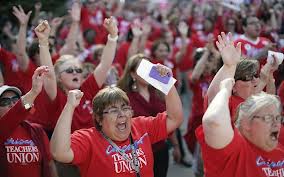
Teachers Walk Out On Strike!

The emotions of a strike are sure to supersede the rational negotiations.  However, this struck me as interesting:

Lewis said among the issues of concern was a new evaluation that she said would be unfair to teachers because it relied too heavily on students’ standardized test scores and does not take into account external factors that affect performance, including poverty, violence and homelessness.

I’ve often encountered this line of reasoning when discussing teacher evaluations.  First, I find it unfathomable that an educated group of experts who routinely adjudicate proficiency of very subjective materials find it completely out of the realm of possibility to measure the effectiveness of teachers themselves.  Second, if they are unwilling to allow themselves to be measured on their effectiveness based on poverty, violence and homelessness, can we expect them to adjust grades so that such impacts are taken into account?

For example, I’ve heard that teachers won’t accept performance based measurements because, “a dog may be barking during the test.”  Yet, are these same teachers willing to change the test scores of those kids subjected to the barking dog?

Utter nonsense.


These People Really Believe That We Need To Ban Profits

I was a political ignoramus just 6 years ago.  Certainly I could express my views on the big ones, capital punishment, immigration and abortion.  But the more nuanced perspectives would come later.

What surprises me is that at one time, I may actually have held views that I now hold in disdain.  I’m not sure I was ever this far left, but the views expressed by delegates at the Democrat Convention regarding corporate profits are without defense.

By the way, whats up with Van Jones not shaking hands with Peter Schiff?  I mean, not even shaking hands?

Employment: Socioeconomics vs IQ – The Bell Curve

The Impact Of IQ On Employment:

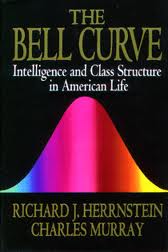
In previous posts I’ve explored the impact that socioeconomic status has on various measurements in society.  For example, we’ve seen that poverty, education and employment, among other measures, are influenced by the socioeconomic status of the family unit.  In fact, I’ve gone through the whole list of factors explored by the authors of the book, “The Bell Curve” and explored just that impact.

But is that the whole story?

The book presents a second half, another “look” if you will.  And that “other look” is the impact of IQ on these various outcomes.  This post will deal with the impact of IQ on employment.

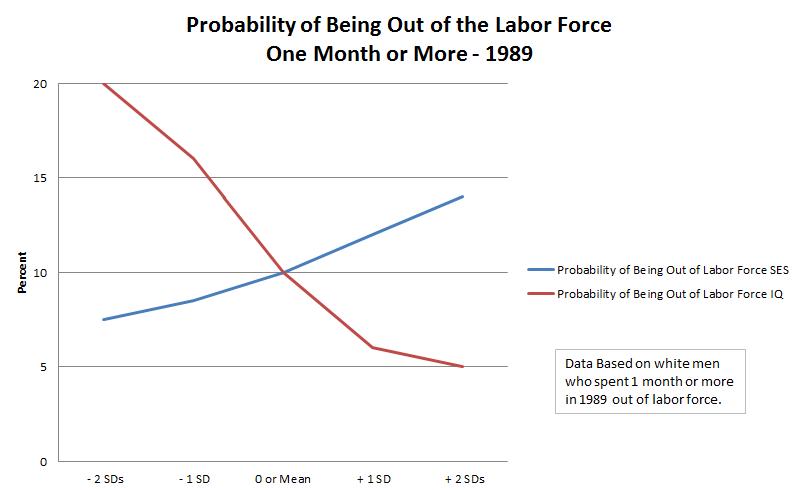
Probability of Being Out of the Labor Force

One of the measures of the employment prospects of an individual is being active in the labor force; are you looking for a job.  I’ve already presented the data that explains an unexpected result.  Namely, that as the socioeconomic status of the family increases, so does the probability that a white male in the study will leave the labor force for at least a month in 1989.

However, the authors asked another question, “What if age, socioeconomic status and race are held constant, what happens then?  What role does IQ play in labor force participation?

It’s pretty straightforward.  Those of us scoring the lowest on IQ tests are predicted to leave the labor force at a 20% clip.  Those of us scoring in the 2nd standard deviation?  We’re leaving the labor force at only a 5% rate.

Whereas socioeconomic status seems to play a “reversed role” here, IQ is a dramatic predictor in labor force participation.

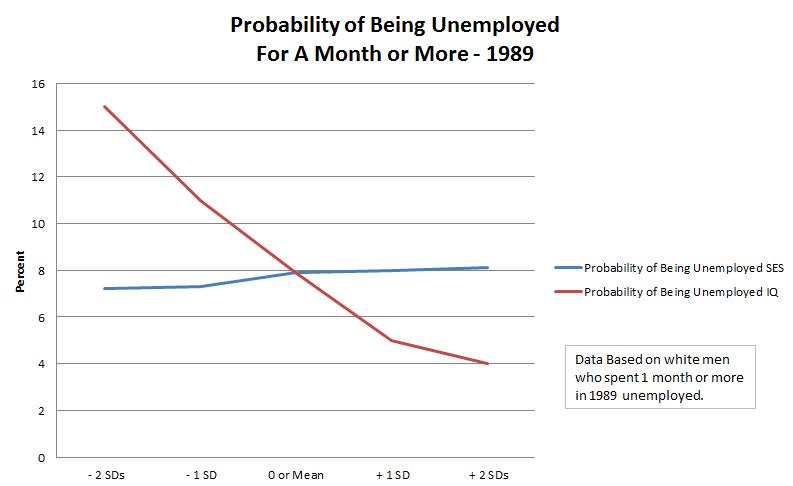
Probability of Being Unemployed

The second measurement of employment prospects is the rate at which folks find themselves unemployed.  Unemployed is different than being out of the labor force, of course, because being unemployed implicitly acknowledges that an individual is looking for work.

Again, I’ve peeked at the impact that the socioeconomic status of the family has on the unemployment prospects of an individual, and the results are in; almost none.  About 1% separates the poorest families from the wealthiest.

And the impact of IQ?

Again, powerful.

Those folks scoring lowest in IQ tests are predicted to have a 16% chance of being unemployed for a month or more in 1989.  Those scoring the highest?  4%.  In other words, those scoring low on IQ tests have a 400% better chance of being unemployed than those scoring on the high end on those same tests.

Being rich or poor has little impact.  Scoring well or not has a massive impact.


President Obama: The Only Thing Going Is His Personal Likability

Democrats at a 20 year low:

Democrat - Republican Favorable Views

Political Party Affiliation

I wonder how moderate people think they are.  I often wonder two things when I review where I’m at in politics.  Am I often right? And then, where do I fall in the political spectrum?

Where Do We Stand Politically

I enjoy political blogging and clearly not for the abundance of traffic that Tar Heel Red sees.  But rather for the dual purpose of getting out in plain sight some of the things I am thinking along with the really cool feature of engaging with differing viewpoints.  And if taken honestly there should be mostly mild evolutions of views and often dramatic “wake-up calls” that precede a dramatic change in belief.

For example, I’ve long identified that I’m a political conservative.  Further, I’ve long identified as a republican.  And those things are two very different things.  And worse, identifying with a party is tantamount to identifying with a “team.”  No amount of debate is ever going to convince me that the Green Bay Packers are a “cooler” or “better” team than the Minnesota Vikings.  However, a belief that a strong defense begins with a combination of strong defensive ends and a strong safety is a concept that transcends the tribe; the team.

You can have a conversation about what makes a good defense.  You can’t have a conversation about the coolest color that goes with gold.  HINT:  It’s purple.

So, a interested in those little games that try and tickle out where a guy stands based on his answers to questions.  I found one of those quick and easy political poll quizzes on line over at Pew Research.

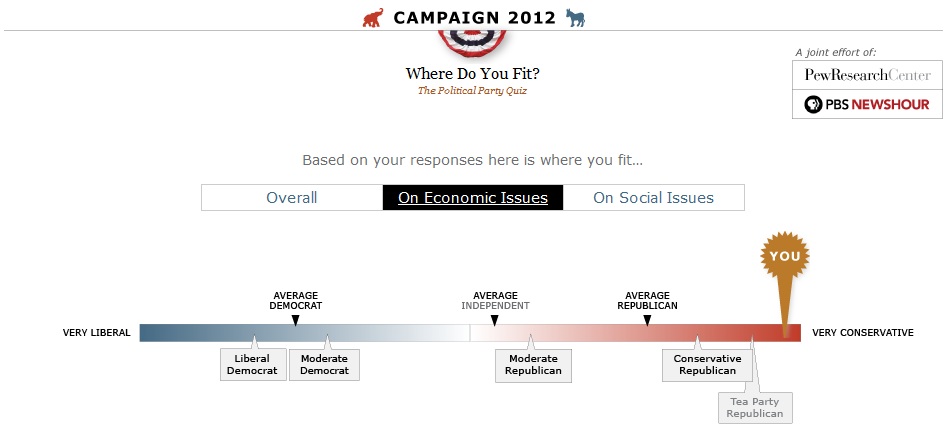
 Political Leaning: Economic Issues

It should surprise none of the dozen readers here that I trend strongly to the right on matters fiscal.  With a nod to the above acknowledgement of team, I have, at times, found myself struggling to defend republicans when they fail to live up to those views.  Perhaps fail to defend is too strong, perhaps it’s only a “yeah, they screwed up but not NEARLY as bad as the democrat next to him!”

So I fully expected the rank I was awarded on matters economic:

Party Affiliation: Economic Issues

I’m very conservative; right even of “Tea Party Republicans.”  I didn’t anticipate  THAT strong of an affiliation with a political party.

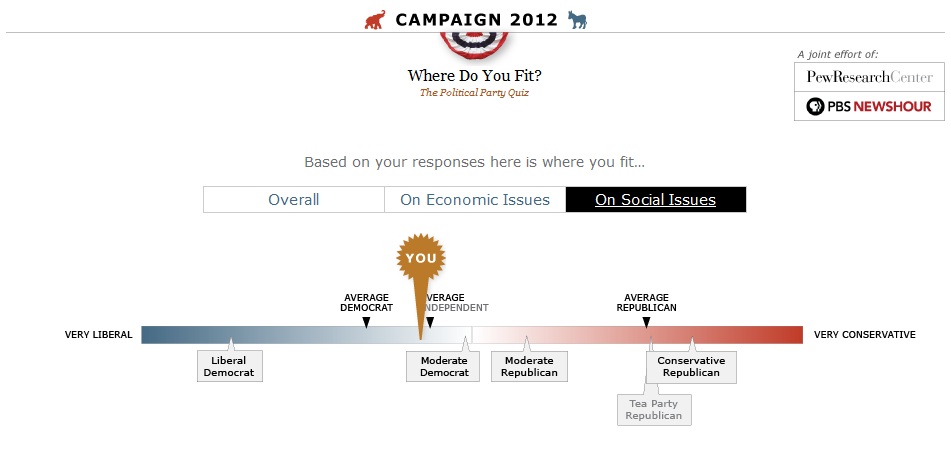
Political Leaning: Social Issues

I acknowledge a pretty strong libertarian streak that results in a predictable conservative economic.  However, the reverse of that libertarian view of life is one that should result in a relatively moderate to liberal stance on many social issues.  In exactly the same way that I feel the government should remove itself from the influence of contracts between two voluntary parties faithfully representing their goods and services, I feel the government should remove itself from the decisions that grown free adult make on a voluntary basis.

I am a strong advocate of gay marriage.  Similarly, I favor the legalization of many drugs with restrictions the same as exist for alcohol.  I trending more and more to the view that a strong national defense is required to defend the country, not impose our views on other nations.

I realize that abortion is a hot button issue and that my support for life is going to cost me, however, I thought that it was over emphasized by the lack of other questions  that would explore a more liberal social stance.

With all of that said, I thought that my political party affiliation was pretty decent on the social issues:

Party Affiliation: Social Issues


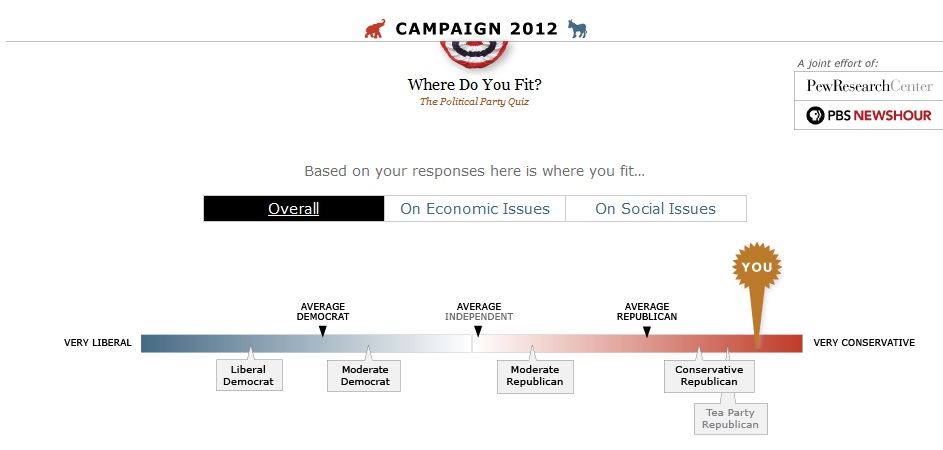
Political Leaning: Overall

While I don’t wanna run away from the conservative nature of myself on the fiscal side of the house, I do wanna point out that I scored a respectable “moderate democrat” on the social issues.  I suspect had more questions been asked about gun laws, education and children’s health services, I would have scored even more liberal perhaps surprising even me.

The kicker, however, is the overall score I received.  I would have thought that such a balance would have put me in the average republican range, but here is where I rank:

Political Party Affiliation: Overall

So there it is.  I’m ultra conservative when it comes to economic issues and then I rank to the left of a moderate democrat on social issues.  However, in aggregate, Pew puts me significantly to the right of the average republican and even to the right of the Tea Party republican.

Really?

It’s Okay, You Don’t Have To Vote For Him

I get the feeling that people like Barack Obama.  And while they like him, they know he’s failed.  And when they come to peace with the idea that they can like him AND not vote for him, it’s curtains.

A majority of voters believe the country is worse off today than it was four years ago and that President Obama does not deserve reelection, according to a new poll for The Hill.

Fifty-two percent of likely voters say the nation is in “worse condition” now than in September 2008, while 54 percent say Obama does not deserve reelection based solely on his job performance.

Only 31 percent of voters believe the nation is in “better condition,” while 15 percent say it is “about the same,” the poll found. Just 40 percent of voters said Obama deserves reelection.

The results highlight the depth of voter dissatisfaction confronting Obama as he makes his case for a second term at this week’s Democratic National Convention in Charlotte, N.C.

Breaking up is so hard to do.

The Tea Party vs. Occupy Wall Street

Very appropriate considering the convention in Charlotte.

Venezuela, Oil And Government

The fire in Venezuela is a perfect example of the dangers of the corporate state:

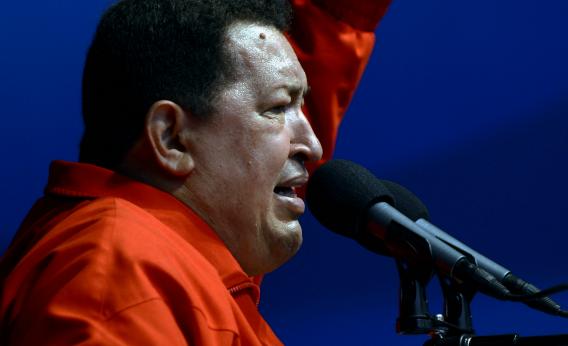
Venezuela’s Amuay refinery explosion is emblematic of the Hugo Chavez curse. The blast hobbled PDVSA’s largest oil processor – as well as killing 39 people. The Venezuelan leader’s policy of placing loyalty before commercial prowess may not have caused the accident. But it has warped the nation’s business ethos. The way he has meddled in the state-owned oil company offers an apt example.

A decade ago Chavez purged PDVSA of 19,000 employees he considered enemies and now rewards political allegiance over anything else. Employees must now devote as much time to political proselytizing as they do to pumping and refining oil. Top jobs typically go to true-blue Chavistas.

As a result, PDVSA is no stranger to maintenance issues from wellhead blowups to oil spills and unplanned shutdowns. And now, at some 2.7 million barrels a day, oil output is almost a fifth below the level when he took office in 1999.

A large part of why I don’t like the idea of too much Government meddling is that it provides too much opportunity for abuse.  I’m continually confused as to why those on our left would think that we’ll find angels in government but only devils in a free’er free market.

Recent moves make matters worse. Last week Chavez vowed to strip PDVSA of a seventh of its 70 percent stake in a key oil venture to hand it to another government-controlled enterprise -mining operation CVG. It’s a great deal for the latter. CVG companies consistently lose money, so getting a 10 percent share in 150,000-barrel-a-day Petropiar oil venture will bolster its finances. And it may also help win over CVG’s 9,940 steel workers ahead of the presidential election in October.

It’s explicit.  Chavez, and  he’s by no means unique, is using his power to buy votes.  Capitalism may be imperfect; businesses will fail and people will lose their job, but it’s simply superior to this.

It’s not the only recent example of mind-bending politicking, either. On August 22 Chavez approved a plan to finance unpaid benefits for government workers with petroleum-backed bonds. Workers cannot cash them in for a year, however, and the 18 percent coupon they pay is less than the 19.4 percent inflation rate. But after years of waiting, this transparent play for votes must seem better than nothing to thousands of active and retired public servants.

Where Are The People Of The Middle Class Going?

To the Upper Class.

There is no lack of reports demonstrating that the middle class is shrinking.  The unspoken conclusion?  That we’re all getting poorer and that somehow, we’re all under attack.

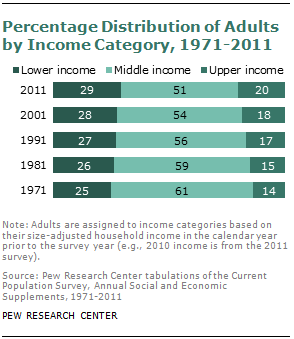
In fact, there is a Pew Report on just that topic:

Since 2000, the middle class has shrunk in size, fallen backward in income and wealth, and shed some—but by no means all—of its characteristic faith in the future.

But from Pew’s own report we find this:

In 1971 25% of us were in the “Lower Income” bracket.  Today there are 29% of us there.  The middle class shrunk even as the number of “lower income” folks grew in numbers.

But look.

As those of us in the “lower income” grew by 4% points, the number of us in the “upper income” group grew as well.  Grew by 6%.

We’re moving people from the middle to the top.  We’re getting richer, not poorer.