Category Archives: Economy

Sadly, This is What it Takes

Perhaps not so sad after all.  One of Tzun Tzu’s admonitions is that we should never want the current circumstances to be anything other than they are.  What is; IS.  So, we should waste no gnashing of teeth on the fact that the government can’t distribute well, but that the private sector can:

Raleigh, N.C. — Walmart stores in central North Carolina will offer the H1N1 vaccine in conjunction with Mollen Immunization between the hours of 11 a.m. and 3 p.m. Wednesday through Friday.

A total of 20 stores will be selling H1N1 shots.  What are the chances that Walmart runs out?  Or makes you stand in the cold rain to get your shot?

Adult Talk in the World

This assessment should shake up team Obama:

BEIJING — China’s top banking regulator issued a sharp critique of U.S. financial management only hours before President Barack Obama commenced his first visit to the Asian giant, highlighting economic and trade tensions that threaten to overshadow the trip.

Liu Mingkang, chairman of the China Banking Regulatory Commission, said that a weak U.S. dollar and low U.S. interest rates had led to “massive speculation” that was inflating asset bubbles around the world. It has created “unavoidable risks for the recovery of the global economy, especially emerging economies,” Liu said.

The situation is “seriously impacting global asset prices and encouraging speculation in stock and property markets.”

I LOVE getting schooled by China!

schools in session

Freddie and Fannie: Just the Beginning

I am convinced that Fannie and Freddie were the causes that led to the current recession.  I am sure that when incentives were created to give people money who had no or little ability to pay that money back, bad bad things were going to happen.

But somehow all of that got lost in all of the fall out.  What we heard was how evil those greedy corporations are.  What we heard was how Wall Street doesn’t look after Main Street.  What we heard was that it was Big Corporations that are somehow “Too Big To Fail” that brought this country to its knees.

What we didn’t hear was the story behind Fannie and Freddie:

NEW YORK (Reuters) – Freddie Mac, the second largest provider of U.S. residential mortgage funding, on Friday posted a loss of $5 billion in the third quarter and predicted it would need more government support amid a “prolonged deterioration” in housing.

And why is the company losing so much money?

delinquencies worsened on loans it guarantees.

Well, heck, what can ya expect?  The little brother of Fannie Mae is surly the runt of the litter and can only look on as big sister excels, right?  Right?

Its larger rival Fannie Mae on Thursday said it would need $15 billion from the U.S. Treasury after a whopping $18.9 billion third-quarter loss.

Whoops!  Didn’t see THAT one coming.

But hey, Fannie and Freddie–ya know, they are players but really, they aren’t THAT big; are they?  Or are they?

Results at Freddie Mac and Fannie Mae are widely watched as a barometer of the U.S. housing market since they own or back nearly half of outstanding mortgages.

Jeepers.  By golly, they ARE that of a player in the market!  And maybe, just maybe, when those two players begin to change the way in which they do business, the rest of the market attempts to adapt?

In other words,  I guess what I’m saying is that when Fannie and Freddie, backed by good Ol’ Unc [that’s the USofA to you and me], begin too incent market forces to provide mortgages to people who can’t afford mortgages, you end up with a bunch of:

horse.shit

But hey, what’s $51.7 billion between friends?  Or even $60.9 billion?  At least your good for it, right?

Starting in 2010, the company will begin accounting for $1.8 trillion in mortgage-backed securities it guarantees on its balance sheet to meet new guidelines. This will increase interest income and interest expenses, and could have a significant negative impact on net worth, it said.

Hmm, something smells in the State of Denmark.

Shares of Freddie Mac were flat at $1.23 in light after-hours trading following the results.

And if you’ll buy shares at a buck 23, I have some fertilizer for your garden…

Sleight of Hand

I have to admit I was suckered.  I bit.  Hook line and sinker.  DAMN it!  When I saw the headline I should have known:

Senate Dems Aim to Curb Fed’s Powers

But instead I clicked through.  And got suckered yet again:

WASHINGTON – Senate Democrats on Tuesday proposed stripping the Federal Reserve of its supervisory powers

WOW!  Virginia and New Jersey really got to these guys!

My excitement and wonderment lasted, ohh, about 14 words; and that’s counting “Washington”

and creating instead three new federal agencies to police banks, protect consumers and dismantle failing institutions.

Doh!  I should’ve known!  In fact, I’m pissed I missed it.  I mean, really?  A Democrat trying to reduce the size of government? Sheesh.

A Breeze – Not Wind – of Change

This can’t be good news for Obama.

AT FIRST sight, the idea that Europe has anything to teach America about tackling unemployment seems preposterous. America has some of the most flexible labour markets in the developed world, while continental Europe, in the popular imagination, is a sclerotic place with powerful unions, rigid labour markets and high entrenched joblessness. Over the past quarter-century America’s unemployment rate has averaged 5.8%, compared with 9.5% in France and 9.1% in Germany.

This picture may be changing. Although output in the euro area has fallen as much as in America, the unemployment rolls have not grown as much. The euro-wide jobless rate is up by less than a third, compared with a doubling across the Atlantic. At 9.7%, euro-area unemployment is high, but slightly lower than in America, where new figures due on November 6th were expected to show joblessness hitting double digits.

Unemployment Comparison

Well, then again it might.  I am convinced that our President is out to build a more left leaning European socialist state than the right leaning socialist state that we have now.  So really, it’s hard to tell.  But what I mean, really mean, is that The Economist is actually calling him out on it!

The United States has put in place a hefty fiscal stimulus, but relatively little of that money has gone into labour-market policies—schemes to slow firing, boost hiring or support the jobless.

Europe’s policymakers, in contrast, appear to have a more coherent strategy: one which uses government money to subsidise a shortened work week, cuts labour costs and, in a few cases, offers tax subsidies to support new jobs. The OECD says 22 out of 29 of its member countries have extended support for workers on furlough, and 16 have cut payroll taxes and other social contributions

Now, before we get all “crazy talk” here, I wanna point out that shortened work weeks and paid furloughs are NOT my ideas of economic good ideas.  And as I was reading my edition of The Economist at my favorite Thai place, I just about lost my belly.  See, I mostly think that The Economist calls itself The Economist because they wanna trick conservatives into reading leftist views.  Almost as if…. But then, in a last second Hail Mary, The Economist pulls off the improbable:

Consider the subsidising of shorter work weeks, continental Europe’s most dramatic innovation. By in effect paying firms to hoard workers, governments have slowed the rise in joblessness and helped prop up consumer confidence and demand. In a vicious temporary slump, driven by a credit crunch and the collapse of global spending, such subsidies make short-term sense. But they prop up demand by fossilising a country’s job structure and preventing the shift of workers from industries with excess capacity (like carmaking) to more promising ones. That ossification will surely come to haunt continental Europe. And in an economy like America’s, where the end of the debt-fuelled consumer-spending binge is forcing big structural shifts, it would be insane.

And the revolution over at The Economist continues:

That is why Europe’s governments are right to focus on waiving or reducing their high payroll taxes, especially for additional hires. And it is why American proposals to finance an extension of unemployment insurance with payroll taxes are misguided. Heavy labour taxes are one reason why Europe entered the downturn with far higher unemployment than America. Lightening that burden would do most to boost jobs—on both sides of the Atlantic.

Thai tasted a whole lot better today.  And it was just some more bad news for Obama.

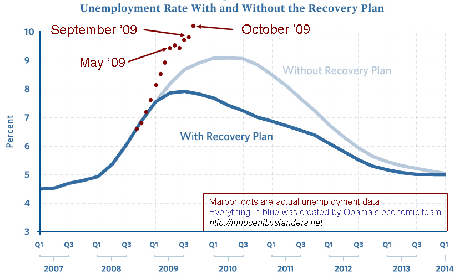
Change You Can Believe In

A picture is worth a thousand words:

stimulus-vs-unemployment-october-dots

From Innocent Bystanders via TJIC

Freakin’ Obama.

This Isn't Going To End Well

We know what happens when the government pressures banks to lend to people they wouldn’t otherwise lend to, right?

So, what does Obama wanna do when banks won’t lend to people they don’t want to?  He pressures ’em.

President Obama is prepared to take “every appropriate step” to pressure banks to lend more money to small businesses, he said Saturday, the latest in a week of salvos his administration has directed toward financial institutions.

Obama said banks should return the favor for a $700 billion taxpayer-financed financial bailout package by lending more money to small businesses, without specifying what steps he would be willing to take to mount pressure on the banks.

Too many small business owners remain unable to get credit, Obama said in his weekly radio address, despite his administration’s efforts to jump-start lending, which was virtually frozen when the financial crisis took hold last year.

“These are the very taxpayers who stood by America’s banks in a crisis, and now it’s time for our banks to stand by creditworthy small businesses and make the loans they need to open their doors, grow their operations and create new jobs,” Obama said.

“It’s time for those banks to fulfill their responsibility to help ensure a wider recovery, a more secure system and more broadly shared prosperity,” said Obama.

Because 9.8% unemployment just isn’t high enough.  You know what happens when you start a Rookie?  He gets beat.

Where Brad and Britt Are Wrong

The boys over at WZTK are at it again.  This morning they are talking about Obama reducing the pay of executives whose companies took money in the bailout program.

Responding to the growing furor over the paychecks of executives at companies that received billions of dollars in federal bailouts, the Obama administration will order the companies that received the most aid to deeply slash the compensation to their highest paid executives, an official involved in the decision said on Wednesday.

Under the plan, which will be announced in the next few days by the Treasury Department, the seven companies that received the most assistance will have to cut the annual salaries of their 25 best-paid executives by an average of about 90 percent from last year. The executive’s total compensation — including bonuses and retirement contributions — will drop, on average, by about 50 percent. The companies are Citigroup, Bank of America, the American International Group, General Motors, Chrysler and the financing arms of the two automakers.

The conversations mostly centered on the fact that it was these big companies executives fault that the economy has gone through this latest recession.  And, as such, these executives should “suffer”.  Or, at the very least, should not continue to reap the rewards of their position by continuing to make all of this money.

I completely resonate with the concept of reward by performance.  I think that bad teachers should be fired.  Bad lawyers not be allowed to pass the bar.  Bad soccer players not make the team etc etc.  But the idea that we somehow cede this normal working of things to the government to satisfy the political need of the day is very very dangerous.  Very.  Not to mention it may be illegal.

However, the part that really got me going was the inevitable conversation surrounding the cause of this whole mess; the housing bubble.  The boom and bust.  The left just SCREAMS when anyone suggests that government regulation is responsible.  That somehow, by passing laws and creating rules that force people to do what they normally would not do, isn’t going to disrupt the market, always in ways that are unforeseen and undesirable.

For example, if a friend or family member asked to borrow $100 I would enter into that arrangement.  And prolly for free.  That is, I would give them 5 twenties and if they gave me a hundred bucks later, we would be “even.”  No juice or interest.  Now, if I were in the business of selling money, I would want to see some reward to hand money out.  This comes in the form of interest.  Soo I begin to borrow money to people.  Sometimes I get all of my money back with interest.  Sometimes I get most or some of my money back and then sometimes I don’t get any money back.  I begin to try to figure out what characteristics trend to me getting paid back.  I really want to lend only to those people who are going to pay me back [crazy talk, I know!  Wanting my money back.]  However, I am not the only money seller out there so I have to compete, in terms of lower interest rates, with other firms.  This keeps my profits down.

Now, a guy walks into my office and says he would like to borrow $100.  I say nope, the 5% interest isn’t enough to overcome my doubts that you’ll repay.  He looks at me and says, well, how high of a rate do I need to agree to before your fears are overcome?  I say 8%.  He says okay.  And now I sell money to another group of people for 8%.  And so on.  However, there is a group of people who I will not sell money to under any condition.  Just won’t do it.  Will not.

Enter the Libtard.  They claim that it’s not “fair” for me to deny lending opportunities to those people.  And because they have the power of law and fiat, they create rules and laws that force me to make a set % of my loans to these people.  Because I enjoy paying my mortgage and feeding my family, I comply out of fear they will put me out of business.  And low and behold, these people begin to default and I start losing money.  No one is surprised.  I sure ain’t.

And this is the beginning of the crisis.

Shocker

Because buying money isn’t any different than buying plywood it is no surprise that banks are going to change the way in which they sell plywood.

On Friday, Rep. Barney Frank, chairman of the House Financial Services Committee, will join FDIC Vice Chairman Marty Gruenberg and others in a discussion of “new, safe and affordable credit options for America’s underbanked.”

The policy discussion on Capitol Hill comes as banks – reacting to new credit card rules imposed by Democrats – start pulling the plastic from current credit-card holders, a move that is sure to lead to even more “underbanked” Americans.

Press reports note that Citibank recently canceled a number of credit card accounts affiliated with the Shell, ExxonMobil, Citgo and Phillips 66-Conoco oil companies.

Citibank also has notified some customers that interest rates on unpaid balances are going up – to a whopping 29.99 percent APR, effective Nov. 30. As the new law requires, customers have been notified that they may reject the change to their accounts, in which case their accounts are closed immediately and they may continue paying off their balances at current rates over five years.

So, when people who have a track record of not paying back their loans no longer have to pay the price of not paying back their loans, banks are going to react by no longer loaning them money they have no hope of paying back, that’s news?

Stop.

But then again, maybe it is.

Dave seems to think that credit card companies are simply soaking the folks that use their cards and imposing new rules will not result in increased fees:

The new rules are likely to reduce some of those profits (that is, to the extent that companies don’t find new “gotcha” fees to replace the old ones). However, the rules are not likely to raise rates or fees for responsible card holders.

But that is not what we are seeing, in fact, it’s the opposite:

On Wednesday, USA Today noted that starting next year, Bank of America will charge a small number of customers an annual fee, ranging from $29 to $99 – an “experimental” move. Even card holders who have never carried a balance or paid late fees could be among those affected, the newspaper said. “You could be spanked for staying out of debt,” the article stated.

So once more, we see government stepping in and regulating where they have no business regulating.  The result?  Predictable.  Higher prices and reduced supply.

Go Obama!

The Rich Just Keep Getting….Poorer?

It’s a bar room brawl folks.  Target is getting into the fight over low priced books.

The Minneapolis-based discounter said Monday that it will offer some of this season’s most anticipated book titles at $8.99, in line with recent moves by Walmart.com and Amazon.com.

What is the goal of corporations?  To make money, of course.  How do you make more money?  By attracting more customers, of course.  And how do you increase the number of customers?  By reducing price or increasing quality.  And how do you raise the quality of a book already written?  You can’t.  So what is your only alternative?  Reduce the price.

And a million people across the United States will get quality books for a cheaper price.

Did Target do this willingly?

All three sellers are almost certainly taking a loss on the sales of these books in order to bring in customers.

I’m guessing no.  The power of capitalism baby.  Responsible for yanking hundreds of millions of people out of bone jarring poverty.

Know what I’m also guessing?  I’m guessing all we’d hear about from the left is:

But the price war, occurring as the critical holiday shopping season gets under way, is bad news for independent bookstores, as well as the large chain bookstores Borders Group Inc. and Barnes & Noble Inc. These chains have seen their sales and profits squeezed by discounting and a decline in their music business.

Analysts also note that the price wars also don’t bode well for the overall book industry, which may likely cut authors’ advances and editors’ salaries.

“I don’t see an end in sight,” said Michael Norris, a senior analyst with Simba Information. “There is going to be a longer-term cost to cheap books. This book war drives out chain stores and independent bookstores.” He noted that Amazon.com, Target and Walmart don’t “value books” in the same way.

“Bookstores are invested in the future of books, but the others are not,” he continued.

More crap from the Leftists.  Fake outrage for the benefit of just another capitalist evil corporation, Barnes and Noble or Borders.  Or maybe they’ll defend the independent booksellers.  You know, that group of people who price books so high that only the wealthy and privileged can afford them?  Or maybe that group of people who will only hire part-time employees at minimum wage without benefits.  Yeah, let’s defend them by all means.

But wait, the left could lash out and defend the poor authors and editors!  Yeah yeah, those poor poor authors!

  • John Grisham – $9 million in 2007
  • Stephen King – $45 million in 2007
  • Dean Koontz – $44.2 million in 2004

Oh, salary of an “editor” for a major author?  ‘Bout a hundred k.

The benefit of getting books into an affordable range at the cost of reducing Mr. King’s millions?  Easy call for the left.  But we’ll never hear it from them.