Category Archives: Economics

Unemployment Benefits: Incentives Matter

I’ve argued time and time again that incentives matter.  And why people think this wouldn’t apply to the incentive not to work is beyond me.  But now there is evidence of just how strong that incentive is: via Dan Mitchell

The extension of UI [unemployment insurance] is found to have a positive and significant impact on the national unemployment rate…. The UI benefit extensions that have occurred between the summer of 2008 and the end of 2010 are estimated to have had a cumulative effect of raising the unemployment rate by .77 to 1.54 percentage points.

That seems pretty significant to me.

Libertarianism in Hungary: Who Knew

How cool to find a sympathetic voice in Hungary:

I will only give you a job if:

  1. I can fire you, when and if I want to.
  2. If VAT goes down to at most 20%, but better yet 15%.
  3. If the state takes away “only” 30% of your money.
  4. If higher income is not exponentially punished.
  5. If the state punishes corruption instead of decent companies.

Until these things change, I won’t give a job. Until the state ferrets out corruption in every possible aspect, I won’t start a business, and I won’t create jobs.

There are things that contribute to people giving people jobs and then things that discourage such activity.

Continue reading

Wherein The Economist Channels Pino

If I’ve said it once I’ve said it a thousand times, if you wanna sell more beer, lower the price.  The same concept exists for labor.  If you want people to buy more labor, lower the price of labor.

But even as we face unprecedented levels of unemployment, there are people in the world that wanna make it harder for people to hire people.  They suggest that the real value of the current minimum wage is low and that we should consider raising it match past level.

I don’t understand how pricing low margin workers out of the job market right now makes sense.  And the Economist agrees with me.

Continue reading

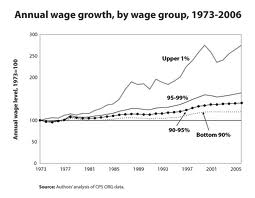
Wages, Middle Class And Stagnation

I’ve been aware, politically aware, since about 2006 or 2007.  That’s when an interesting tidbit caught my attention:

The 2008 Presidential election would be the first in a long time where neither a sitting President or Vice President would be running.

The race would be wide open.  I began to  pay attention, and I was hooked.  And since then I have heard a steady dull roar about the fading middle class.  I’ve heard that the richest among us have been getting richer while the rest of us have experienced wages that remain flat.

The world would have us believe that for most of us, wages have experienced stagnation.

Is it true?

Continue reading

Youth, Labor, Recessions and Minimum Wages

One of the most frustrating aspects of being conservative is that it’s too easy for the other side to fall back on a “you hate X” where X is any group that you are really, in fact, trying to assist.

An easy example to consider is a school child and her homework.

When I was a teacher I could very easily “give” the student an A on her blank homework.  However, I felt that it would do her more good in the short term, the long term and in other character building aspects if she actually worked for and earned that grade.

In today’s liberal dialogue, I would be said to “hate kids”.  Or, if the individual liberal were truly on his game he could claim that I “hate girls”.

Silly example?  Perhaps.  But consider modern day minimum wage laws.

Continue reading

How Rich Are You

With all the talk from Obama about the rich, the elite and the 1%, I often wonder, “Do we really have it that bad?”

What might we use as a measurement to gauge whether or not we really are better off.  The media is full of comparisons, we often hear the reports that the rich are getting richer while the poor are getting poorer.  That the middle class is under attack and is losing; indeed, shrinking.

But is it true?

Continue reading

Incentives Matter: The Power Of The Entitlement Society

Incentives matter.  Obvious when stated but almost always forgotten when policy is considered.

Give away money when an individual doesn’t have a job?  A perfectly valid idea; who doesn’t wanna help those facing unexpected difficulty?

Give away food to the individual who may not have enough?  Again, absolutely warranted for those in need.

But what does it do to a society that grows up learning that to work, or not to work, often times results in the same short term result?  When the concept of individual achievement is removed, squashed?  What happens then?

Continue reading

Main Stream Media: Where Is Journalism?

I like getting my news, or at least some of it, from Reuters.  Partly because they’re good at reporting the news and partly because they’re good to use as a source.  As much as I hate HuffPo or Kos, I suspect that liberals hate Fox, CATO or Heritage.

Reuters is safe.

But check out this headline:

“AT&T jacks up data plan prices as usage booms”

I mean jeepers.  Jacks up data plan prices and then followed by usage booms!  My gawd, the world is ending.  So I read the article.  And didn’t understand the outrage:

From January 22, AT&T customers will pay $20 for a 300-megabyte monthly data plan, up from $15 for 200-mb currently.

So, right now, AT&T charges $15 for 200 mb.  Or $0.075 per meg.  Right?  7.5 cents times 200 equals 15 American.  Then, after the 22nd, AT&T is going to charge WAY more than 7.5 cents per meg, they’re gonna charge $0.06 per meg.

Robber barons!

There’s more:

Users with higher requirements can also opt for $30 for 3 gigabytes — versus $25 for 2 GB previously

AT&T used to charge $25 for 2 GIG, or $12.5 per GIG.  Now, those greedy bastards are charging WAY more, they’re charging $30 for 3!  That comes out to $10 per GIG.

Wait, that doesn’t make sense.  But there’s more still:

or $50 for 5 GB, up from $45 for 4 GB.

For the larger plans, AT&T used to charge $11.25 per GIG.  And now what are those monopolistic capitalists charging?!?

$10 per GIG.  For those that attended the CLA, that is an 11% price REDUCTION!

“Jacks” up rates indeed.

We need WAY more journalists.  For sure!

For fun, I thought I’d check out the comments section of the Reuters piece.  The very first one, I shit thee not:

jscott418 wrote:

Normally demand reduces prices. What’s AT&T excuse? Seems to me they are just taking advantage of the popularity of data usage.

Normally.  Demand.  Reduces.  Prices.

Blink.  Blink.

You can NOT make this up.

Free Market: Microsoft Office

The latest iteration in the market delivering goods and services at the lowest price possible:

This week, Onlive Inc., in Palo Alto, Calif., is releasing an app that brings the full, genuine Windows versions of the key Office productivity apps—Word, Excel and PowerPoint—to the iPad. And it’s free. These are the real programs. They look and work just like they do on a real Windows PC. They let you create or edit genuine Word documents, Excel spreadsheets and PowerPoint presentations.

When allowed to roam free, the market will solve virtually any problem you can think of.


Government Mandates: Biofuel Additives

I’m a big believer in markets.  Which is another way of saying that I’m a big believer in incentives.  As the demand for lemonade goes up, the demand for sugar, waters and lemons go up.  As the demand for sugar, water and lemons go up, the price of those items goes up as well.  As the price f sugar, water and lemons go up, so do the price of the finished products that also contain those ingredients.  At this point there will be conflict.  Conflict as the rising price of two or more products compete in the market.  In time, over time, the demand of lemonade will level out as the cost hits a limiting level.

Even more fun is the impact that these higher costs of goods have down stream.  As the price of lemons goes up, farmers increase lemon  production.  They do this by engaging useful farmland into lemon trees.  By doing this, they stop the productive activity they WERE engaging in as they move to higher and higher lemon production.  Say, for example, peaches.  Lemon trees are planted in favor of peach trees and we see the ration of lemons to peaches increase.  This leads to price fluctuations between peaches and lemons.  As these forces are spread through geography and time, the price will reflect the demand of the society on both peaches and lemons.

And this will be natural.  This is what allows most people in a group, even a large group, to get what it wants.  Are there going to be winners?  Sure, there will be people who love lemons and hate peaches and will benefit by the increase production of lemons.  Losers?  You betcha!  Peach lovers but lemon haters may lament the rising prices and availability of peaches.  But on the whole, the demands and wants of the society are served.

Can you image the infrastructure required, the sheer magnitude of size required, if the government wanted to set up an office that measure and dictated the proper allocation of lemon and peach production?  For us in America it is relatively uncommon.  But in Soviet Russia, not so much.  In an effort to make sure the economy was controlled and the people fed, the State dictated means of production.  And no one was fed.

Point.  Sorry.

So, I get frustrated when I see the government mandate something.  Mandate health insurance.  Mandate light bulbs.  Mandate farm subsidies.  All of it.  All of it creates a ripple affect down the line resulting in unwanted consequences.   But I have to admit, when the state mandates a product that doesn’t exist, I am more amused than frustrated:

WASHINGTON — When the companies that supply motor fuel close the books on 2011, they will pay about $6.8 million in penalties to the Treasury because they failed to mix a special type of biofuel into their gasoline and diesel as required by law.

But there was none to be had. Outside a handful of laboratories and workshops, the ingredient, cellulosic biofuel, does not exist.

In 2012, the oil companies expect to pay even higher penalties for failing to blend in the fuel, which is made from wood chips or the inedible parts of plants like corncobs. Refiners were required to blend 6.6 million gallons into gasoline and diesel in 2011 and face a quota of 8.65 million gallons this year.

“It belies logic,” Charles T. Drevna, the president of the National Petrochemicals and Refiners Association, said of the 2011 quota. And raising the quota for 2012 when there is no production makes even less sense, he said.

The government is mandating a product that doesn’t exist.

Classic example of government heavy handedness.