
Category Archives: Government

Jack Lew Grilled Over Perfectly Legal Investment

Jack Lew

Jack Lew has been nominated to run the Treasury Department.  Last week he went before his congressional committee for intense questioning.  Among other things, Mr. Lew was forced to answer questions regarding a $56,000 investment:

 President Obama’s nominee to lead the Treasury Department defended his $56,000 investment in a Cayman Islands fund at his confirmation hearing on Wednesday, saying he was unaware it was based in a nation famous for having offshore tax havens.

“I always reported all income, I always paid all taxes,” he said. “I was aware that it was an international fund investing in emerging markets … I actually didn’t know [its location] at the time.”

Seriously.  Lew was forced to endure question regarding a 56k investment in a legal fund established in the Caymans.  This isn’t a case where the funds should have been taxed and Lew cheated to avoid paying money that he owed.  No.  This is the case of a man making intelligent decisions balancing risk with reward and diversifying his portfolio.

This is what people who have money, often why people HAVE money to begin with, do to make sure they will continue to have more money later.

Now, to be sure, the only reason -I’ll give ’em the benefit of the doubt- that the republicans went after Lew is because Obama demonized Mitt Romney during the campaign for the exact same reason; his off-shore Cayman investments.

And if THAT wasn’t enough, the republicans kept at it:

Lew also addressed a bonus of nearly $1 million he received as Citigroup was receiving billions in government support amid the financial crisis. Sen. Chuck Grassley (R-Iowa) questioned whether it was “morally acceptable” for Lew to accept a bonus at Citi briefly before the bank tapped the government for billions of dollars in bailout relief. Lew said his compensation was not out of the norm at the time, and that he disclosed everything as he should.

“I was compensated for my work,” he said, adding that he was aware that Citi was about to receive a large federal guarantee when he received the bonus.

“I do believe it was comparable for people in positions like mine in the industry,” he added. “I don’t think there’s anything that hasn’t been fully transparent both in what I did and what I earned.”

Surely I’m aware of the beautiful bitter irony, but just because a democrat NOW is speaking truth doesn’t mean that he’s wrong to say it.  Listen to what he’s saying, “I have a job maybe not 1,000 people in America could do as well as I do it.  And for that, I get compensated.  Of COURSE I feel justified in cashing that check.”

I don’t know, maybe politics demands that the questions be asked and answered.  While Lew played stupid on the Cayman island thing, and we can’t use stupid to defeat democrats, he did provide ammunition in the class-war that the left is waging.

Maybe it’s worth it, but I wish we governed in a way and manner in which we didn’t need that.

Entitlement Programs

I’m gonna step in the mind of a bigger state thinker for a second.

In this mind, the goal is to identify all individuals and/or families that are in some sort of need.  This need could be based on a scale of sorts; usually income based.  That is, if income is too low, programs should be created or funded in order that some definition of “basic needs” is met.

These basic needs could be supplemented by straight cash, tax breaks, food programs, rent programs, energy programs or any other such program.

Okay, I may disagree with that mindset, but for now, that’s the mindset I’m in.  Now, given this reality, the goal, as a criteria for success, would be to make sure that all qualified individuals and/or families, would be identified and enrolled.  We don’t want a shadow population of folks who are in need of assistance or care, to exist.

In this aspect, I get that the bigger state thinker would want to expand the rolls of these programs.  I get that, right?

To the point that we want to include all qualified individuals in the program, I understand why someone would want to make sure the program “grew”.  I can even see the logic behind expanding the criteria of “need” to include an ever growing population.  What I am NOT sure about, and what I really truly guard against, is, “Do our goals change when all qualified individuals are enrolled?”

In other words, when all the poor and less fortunate have been enrolled in these programs, is there any effort to get them UNqualified?  For example, give them what ever it is that is needed to be able to create a level of income that allows them to leave the program.

To me, there are two kinds of charitable giving, two kinds of programs that can be set up.  One is where resources are gathered and distributed just to make the ends meet.  Food to feed the hungry, coats to warm the cold.  Stuff like that.  I think of that as “give a man a fish” kinda program.

Me?  I’m interested in the “teach a man to fish” kinda programs.  And I just don’t see the rigor, the discipline, the will or, frankly, even the desire on part of the policy makers to craft such steps into their programs.  I don’t see a willingness to exhibit the tough love that even parents engage in with their own children.  A love that says, hell-demands, that by paying your rent and your heat and your car payment, I am not helping you in life, I am, in fact, hurting you.

Liberals often claim that the right cares more about the unborn than about the orphan or the single mom or the poor.  There may be something to that, maybe.  But given that it’s the conservative that is more charitable than the liberal, I don’t buy it.  Rather, I see it that the programs favored by the conservative more resemble the “programs” that they teach and enforce upon their own children.  Namely sacrifice, hard work, goal deferral and plain old “do the job right”.

I just don’t get how feeding and housing a person for years and years helps them.

Am I wrong?

The Cost of a Pencil

The other day my daughter and I were walking through the grocery store when she saw a pencil.  She asked me if she could have it.  Normally I like that kind of “toy” request; I can make the deal contingent on a poem, a math problem or a little story.

But this day I said “no”.

But daahhh-ad!  It’s only a dollar!  How long does it take you to earn a dollar.

So I bought her the pencil and when we got home I taught her about taxes.

It turns out that just accounting for my portion of the North Carolina sales tax, my federal income tax and then North Carolina income tax, the cost of that $1.00 pencil goes to $1.68.

I didn’t bother to go through the FICA, the gas tax, and the tax on the car that drove us to the grocery.  Just the three.

Think of that, 40.48% of my income, just accounting for those three taxes, are consumed to buy a simple pencil.

Laffer Curve: PGA Style

Imagine a curve.  On the left hand side the value is zero.  Then, as you move from left to right, the slope goes up peaking somewhere then slides down back to zero.  That’s the Laffer Curve.

If you tax income at 0%, you realize $0.00 of tax revenue.  If you tax income at 100% you will also realize $0.00 of tax revenue; no one works for free.  In between is the sweet spot.

And it appears that, for Lefty, a 63% take is just too much:

LA QUINTA, Calf. — Phil Mickelson started his 2013 PGA Tour season at the Humana Challenge in partnership with the Clinton Foundation with a tie for 37th place. But after a final-round 66, Mickelson did more than hint that the 2014 season may see some big changes for the World Golf Hall of Famer.

“Well, it’s been an interesting offseason. And I’m going to have to make some drastic changes,” Mickelson said at the Palmer Course at PGA West in La Quinta. “I’m not going to jump the gun and do it right away, but I will be making some drastic changes.”

And what changes might he be making?

PHIL MICKELSON: Well, it’s been an interesting offseason. And I’m going to have to make some drastic changes. I’m not going to jump the gun and do it right away, but I will be making some drastic changes.

Q. Meaning leaving from California?

PHIL MICKELSON: I’m not sure.

Q. Moving to Canada?

PHIL MICKELSON: I’m not sure what exactly, you know, I’m going to do yet. I’ll probably talk about it more in depth next week. I’m not going to jump the gun, but there are going to be some. There are going to be some drastic changes for me because I happen to be in that zone that has been targeted both federally and by the state and, you know, it doesn’t work for me right now. So I’m going to have to make some changes.

And why does he think he needs to make these changes?

PHIL MICKELSON: Yeah. I’ll probably go into it more next year or next week. But if you add up, if you add up all the federal and you look at the disability and the unemployment and the Social Security and the state, my tax rate’s 62, 63 percent. So I’ve got to make some decisions on what I’m going to do.

France learned it.  And now California is about to.  When you tax the living snot out of people they are going to react.  They’ll either move or quit.

And that results in $0.00 tax revenue.

United States Wire Tapping

I have a strong distrust of government over reach.  I think that we often times allow out government to go far too far in what we think are noble intentions.  But I have to admit that I am at a loss in this area.

Consider, an American citizen talking to another American citizen.  Clearly the government would be required to obtain a warrant.  However, what legal requirements would be needed in order for the government to listen to the communications of a foreign operative and ANOTHER foreign operative outside the US borders?

Probably none.

But now consider this.  A foreign terror suspect, on foreign soil.  Can we listen to his communications?  And what if those communications are between him and an American citizen?

This is what we’re talking about:

The FISA Amendments Act, (.pdf) which was expiring Friday at midnight, allows the government to electronically eavesdrop on Americans’ phone calls and e-mails without a probable-cause warrant so long as one of the parties to the communication is believed outside the United States. The communications may be intercepted “to acquire foreign intelligence information.”

I happen to agree with Obama’s administration on this one.  If we’re targeting a foreign suspect and happen to listen to American citizens, I don’t think that we have a legal requirement to obtain a warrant.  However, if we just listen to American citizens in the hopes of catching them talking to terrorists…..different story.

The Lunacy That Is Over Reaction

What’s next?

A 5-year-old Pennsylvania girl who told another girl she was going to shoot her with a pink toy gun that blows soapy bubbles has been suspended from kindergarten.

Her family has hired an attorney to fight the punishment, which initially was 10 days but was reduced to two.

Attorney Robin Ficker says Mount Carmel Area School District officials labeled the girl a “terrorist threat” for the bubble gun remark, made Jan. 10 as both girls waited for a school bus.

Ficker says the girl didn’t even have the bubble gun with her and has never fired a real gun. He says she’s “the least terroristic person in Pennsylvania.”

Thoughts, in no particular order:

  • Bubble gun
  • Terrorist Threat
  • 5 years old
  • Didn’t even HAVE the gun


The Cost of Entitlements

UPDATE:  Added link to the AE Ideas post.

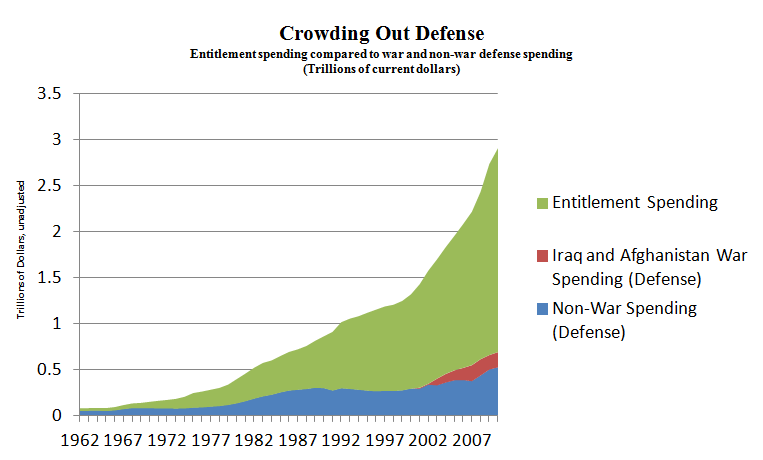
Browsing over at AE Ideas when I saw this chart:

Some things:

1.  Defense spending has been pretty constant since 1985.

2.  Spending on entitlement programs has not.

Deficits and Debts: Spending and Taxes

Money.  The spending of it.  The making of it.  Revenue and expenditure.

How to manage it all responsibly?

Recently, always[?], there has been a debate regarding the deficit and the debt.  How we as a nation spend vs how much we as a nation bring in.  The most recent event was the fiscal cliff.  The new event is the debt ceiling negotiations.  And yes, there will be negotiations regardless of what the President says or what he wants.

Leave aside the partisan bickering for a second and let’s just look at this in a way that people kinda get; real world.

Typically, a household has an idea on how much money they bring in.  And this amount of money dictates how much they spend, typically.  In college I brought in very little – I spent very little.  Out of college I brought in more and spent more.  And during these times, my spending would, indeed, fluctuate.  I could count on certain bills and expenditures but others would just come up.  A broken muffler, a wedding out of state.  Maybe dental work.

My budget would often shift.  But it was always thought of in relation to how much I could bring in.  I knew that I was taking a short term hit but long term gain by going to college.  Earnings would suffer but the long term outlook was positive.

But my debt was always defined in relation to MY reality.

Earlier this week, the fellas at Poison Your Mind posted on the fact that the United States is a low tax country:

Of course, one can have a political preference that the US maintain extremely low taxes and/or reduce the size of government, but neither political inclination is compelled by The Math.

I assume, with all the risks commensurate, that by referencing “The Math” RR is referring to the fact that republicans claim spending is to blame for our deficit, not taxes.  In fact, the chart accompanying the post shows that the United States is near the bottom in tax revenue indicating that tax revenue, and not necessarily spending, is the problem.

But to me, that doesn’t jive.

Back to younger me.  I existed in my own reality.  I went to school, church and lodge with members of my community that existed on a range of socioeconomic status.  Virtually ALL earned more than I did.  And now, flash forward to today, I exist in that same strata, many peers earn more, many less.  None of which have any bearing on defining the health of my financial status.

I must balance my spending with my revenue.

In some cases I earn less due to sheer ability.  They have it and I don’t.  In other cases it’s based on desire; they have it and I don’t.  In others, I earn more because I am the one with the desire or the ability.  And yet in others, people have decided that compensation takes forms other than money; time off, value to society and personal growth are examples.  Whatever the individual situation is, basing fiscal health on the experience of others is rather short sighted.  And in the end, not at all healthy.

For whatever reason, perhaps because we are an independent colony all grown up.  Maybe it’s because we have access to massive natural resources.  Or education, or – well, whatever.  Whatever the reason, America has decided that it only wants to generate “X” amount of revenue.  We don’t wanna work harder to earn more per hour, or take an second job.  We’re cool where we are.

Given that reality, our spending has to reflect that fiscal reality and adjust.  It just has to.  And if it doesn’t, then spending is the problem.

But back to the chart, it IS rather stark.  After all, we are the United States of America and certainly have reason to expect that we come in better than 4th from the bottom.  Am I missing something?

Well maybe.

See, we may only be taxing at a very low rate of GDP, but we are a very VERY rich nation. So, while a person may argue that a policy of higher tax revenue is desirable, the larger question may be ignored.  Namely, is the nation wealthier as a result of such taxation or less wealthy as a result.

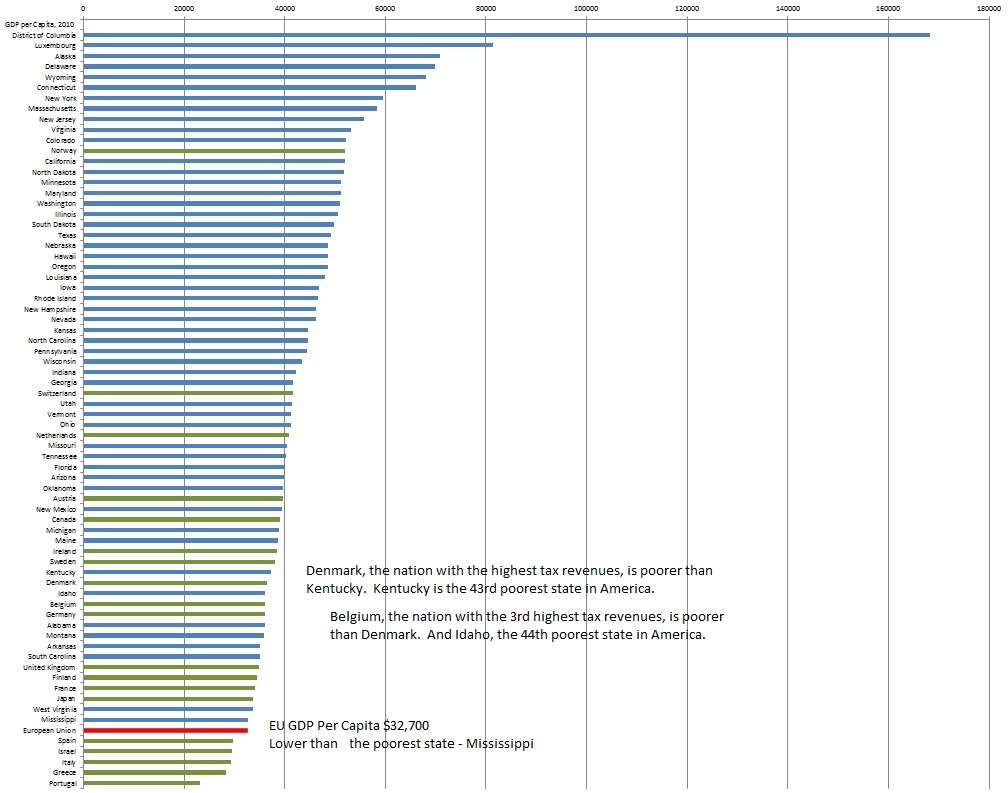
There is data:

It turns out that America does well compared to her high tax peers.  For example, Denmark, the nation with the highest revenues, is very poor compared ti the states of the United States.  In fact, if Denmark WERE a states, it would rank only as the 44th richest state in the Union.  Behind Kentucky.  And Belgium, the nation with the 3rd highest tax revenues?  Why, it would rank below even Denmark, poorer even than Idaho.

The EU as a whole, with Spain, Israel, Italy, Greece and Portugal all, ALL, rank lower than the poorest state in our nation; Mississippi.

This might mean that such high tax rates lead to less prosperous nations.  Or it might mean that such high tax rates are really an illusion of mathematics – revenues compared to a paltry GDP may seem higher than they really are.  Whatever the explanation, I doubt anyone would argue that we would wanna live in a nation that would rank among the poorest of our states.

Police State

I don’t generally buy into the “Black Helicopter” crowd regarding conspiracy of government.  For example, touching on the gun debate, I’m not sure it’s a given that if we register guns that one day the government will confiscate them.

However, I’ve always had a push me pull you relationship with law enforcement.  I distrust 22 year old men with a uniform and a gun.  I’m deeply indebted to the mature officer that puts limb and life on the line to defend me and mine.

But this doesn’t help the cause:

A Ramsey County man who videotaped a sheriff’s deputy in public is now fighting a citation for obstruction and disorderly conduct.

A St. Paul Pioneer Press report says the deputy was loading another man into an ambulance, and 28-year-old Andrew Henderson videotaped the action.

Sheriff’s deputy Jacqueline Muellner confiscated the camera, saying Henderson was violating the other man’s privacy rights. Henderson says when he got the camera back the next day the recording was gone.

Muellner cited Henderson for obstructing legal process. The American Civil Liberties Union has agreed to represent him for free.

Maybe there’s room for slack on the part of the cops.  They are, after all, the ones out there putting it all out there.  And having someone tape you may come across as trying to “entrap” you.  So I get it.

But still.

At least the force is saying the right things:

Ramsey County sheriff’s spokesman Randy Gustafson says it’s not the department’s policy to take people’s cameras. He says people are within their rights to record deputies’ activities.

It reminds me of the time I witnessed a DUI arrest in progress.  The entrance to my apartment building had a small flower median.  One lane in, one lane out.  And the officer was parked behind the community sign IN THE WRONG LANE.  The car drove in, not expecting a parked car with headlights on, and hit the brakes.

He was walked and arrested.

I watched the whole thing.  And the officers clearly didn’t like it at all.

Addressing Gun Violence

On Tuesday President Obama will receive a report from Joe Biden on gun violence and how to address it.  I admit that I’m torn on the whole issue.  Personally, I don’t care for guns at all.  I played with BB guns as a kid, to be sure, but that’s where it stopped.  I held my brother’s .22 and 16 gauge, but never owned my own weapon.  I once shot a friend’s hand gun, but didn’t like it.

I know that lot’s of people own guns to protect themselves.  Many more own guns because they like to collect them.  And even more because they life to hunt.  And I’m all good with that.  But I don’t want’em in my house.  I have young kids and believe the stats that say a gun owner’s family is more likely to be harmed by their own gun than that gun will be used in self defense.

But I feel its very important to defend the rights of those that DO wanna keep a gun.  I think that if an individual feels that, in balance, the risk of owning gun isn’t greater than the benefit provided by that gun, he should have the ability to purchase and keep that weapon.  He should be able to buy and use ammunition.

In short, a man has a right to buy guns.  And when I say guns, I mean any guns.

Part of the reason that the 2nd Amendment was written and codified was the belief that citizens be able to defend themselves.  From intruders AND their government.  In fact, Jefferson felt that an armed citizenry was a last resort to a tyrannical government.

So, what to be made of the world today?

I think the wrong questions will be asked in the report.  I think the wrong questions have been asked in the public discourse.  I think that people are seeing people committing atrocities with guns and are fixating on the guns; not the people.  I think that we need to look at data.  Data that suggests violence due to guns is on a downward trend.    I think that we need to look at data that would suggest that banning assault weapons increases violence, not decreases it.  And I think that we need to understand that being exposed to the inconveniences of too much liberty is preferable to the those attending too small a degree of it.

To those that would ban an assault rifle.  How much less of a tragedy would it be if an armed intruder, carrying a pistol, or 4, would take the lives of, say, 10 children rather than the number taken in Sandy Hook?  How will you be able to stand in front of the parents and claim that it could have been worse?

The answer?  You can’t.

A life taken too early due to violence is a tragedy.  And whether that life is taken by a hand gun or a rifle is not meaningful.

But the restriction of liberty is.  And THAT is what we need to guard against.

Now, are there things that we can do?  Happily, yes.

I think that we have a good opportunity to increase our background checks.  Both in number and in depth.  I think that we can do more to keep guns out of the hands of criminals and of the mentally unstable.

We should increase our databases regarding gun crimes.  And speaking of gun crimes, we need to focus on the characteristics of criminals with guns.  And then target them.  Instead of crafting laws that take guns out of the hands of law abiding citizens, we need to craft laws that take guns out of the hands of criminals.  Guilty of a gun crime?  Subject your property to an immediate search warrant.

And technology might be able to help us.  We should consider, at least consider, the technology that allows a gun to be fired based on a fingerprint profile.  Should a private sale occur, the gun could be taken to a dealer to swap that profile.  Have a family of 5?  Submit a profile for 5.

There is a lot of work to be done, to be sure.  But there is a lot of Liberty to be lost as well.  And we must remain ever vigilant that the sacrifices of those who came before us are not lost to fear.