Category Archives: Economy

United States Debt Higher Than United States GDP

Everyone knows that the problem America faces is a spending problem.  We simply are spending more money than we have a hope of bringing in.  Since the end of WWII, the United States has remained steady with tax receipts coming in around 18% of GDP.  More in the good years, less during recessionary periods.  The whole of that time our spending has been a little more.  Not now.  Now our spending has dramatically increased.

The result is a debt to GDP level that is unprecedented:

The nation’s debt has reached a symbolic milestone. With gross domestic product of roughly $15 trillion and total debt of $15.23 trillion, our total debt is now bigger than our economy, as USA Today noted Monday.

What’s more, the Obama administration’s projections put our debt at more than $23 trillion by 2020, well in excess of the projected $22.5 trillion GDP.

Indeed, this is bad news.  But how bad?  Let’s look at other nations in the debt club that we find ourselves in:

Zimbabwe 233.2
Japan 199.7
Saint Kitts and Nevis 185
Greece 142.7
Lebanon 133.8
Iceland 126.3
Jamaica 126.2
Italy 119.1
Singapore 105.8
Barbados 102.1
Belgium 100.7

Not very good company at all.  And it’s only going to get worse.

Some commentators are claiming that we are going to end up like Greece.  Our debt and our #Occupiers seem to indicate that we very well could.

Government Regulations: Costing Jobs

I have long held the position that incentives matter.  Further, I hold that government cannot completely control all reactions to incentives.  That is, when a government body imposes regulations upon a population with the desire to guide correct action, the government body cannot anticipate all reasonable reactions.

Incentives matter.

And so, in an effort to regulate mortgage originators, the government is forcing corporations to leave that segment of the business:

MetLife, the nation’s largest life insurer, announced Tuesday that it would close its home mortgage-origination operation, costing the company at least $90 million. Most of the 4,300 employees at the unit will lose their jobs.

“The majority will no longer have a position,” said John Calagna, a spokesman for MetLife. Most of the workers at the business are based in Irving, Tex., Mr. Calagna said.

MetLife said in October that it was seeking a buyer for its mortgage unit after announcing plans to sell deposit-gathering operations to reduce federal oversight. The company reached a deal last month to sell about $7.5 billion of its bank’s deposits to General Electric.

The Federal Reserve, which oversees MetLife because of its size and banking operations, rejected its plan last year to raise its dividend and resume share buybacks.

Because of the Federal Government and the regulations it imposes, MetLife will now shed 4,300 jobs.

To be clear:  Government regulations cost the economy 4,300 jobs.  No outsourcing.  No downsizing.  No automation.  No nothing.  Pure and simple regulation avoidance.

And for added enjoyment, the NYT article goes on to mention the dollar amount that this will cost MetLife:

MetLife will continue to service current home-loan clients and offer reverse mortgages, the company said. The wind-down may cost as much as $110 million, according to the statement.

In addition to shedding 4,300 jobs, MetLife is WILLINGLY taking an action that will cost it $110 million dollars.  The cost of the regulation is AT LEAST $110 million!  AT LEAST!

Is there any legitimate argument that can be made that this administration is building an environment conducive to business and the free market?


Income Inequality, The GINI and Marriage

I continue to question the GINI calculation comparison of nations in order to determine how well wealth is distributed within those nations.  For example, I have a specific problem with the fact that the United States has seen a significant rate of marriage decrease in its population over the last several decades.

As an example, I used a population of 4 and computed the GINI if they were all single:

24,000 – 30,000 – 50,000 – 75,000  The GINI came to .24162

If we marry 2 of those we might see:

24,000 – 50,000 – 105,000 This GINI is .301676

If we marry a different 2, we might see:

54,000 – 50,000 – 75,000 This GINI is .093110

Clearly the makeup of the population impacts the GINI coefficient.  In this analysis, I was called on small sample size.  Fair enough.  I did the data on a population of 10,000.

I took a random sampling of 10,000 salaries.  These salaries ranged from $0.00 to $250,000 and formed a near perfect bell curve with an average of $125,000.  Clearly this is not how wealth is distributed in real life, but I am simply making a point.

I then created 4 worlds.  Each world had a different marriage rate; 80-70-60-50%.  An acknowledge flaw in my data is that I do not randomize the single people each time.  That is, in the first world where 80% of the population is married, I take the first 2,000 and mark them single.  I then marry the 2001st individual to the 6,001st individual.  Then the 2002nd individual to the 6,002nd individual and so on.

My results:

  • 50% Marriage:  .3446
  • 60% Marriage:  .3353
  • 70% Marriage:  .3227
  • 80% Marriage:  .3015

As the marriage rate went up, the GINI went down.  In other words, as my population increased its marriage rate the inequality diminished.  In fact, by moving from a 50% marriage rate to an 80% rate, the GINI moved by 12%.

Let’s do it again.  10,000 new salaries, same constraints:

  • 50% Marriage:  .3471
  • 60% Marriage:  .3416
  • 70% Marriage:  .3248
  • 80% Marriage:  .3093

Again, a continuing trend toward equality.

Does my theory have legs in the real world?  I think it does:

Inequality is typically higher as the percentage of married people declines and as the correlation of of partner’s income increases.  Inequality also tends to be higher when low-income earners are disproportionately likely to remain unmarried.

In other words, the more people marry, the more equitable income is.  Especially when this trend is observed in low income individuals.

Further data suggests that poverty is addressed by marriage:

As expected, the results clearly show that married parents experience lower poverty rates and higher incomes not only than single mothers living without another adult, but also among those unmarried mothers with at least two potential earners. Poverty rates of cohabiting couple parents are double those of married parents; non-cohabiting single parents with at least a second adult had poverty rates three times as high as among married parents.  The apparent gains from marriage are particularly high among black households.

The gains from marriage extend to material hardship as well. About 30 percent of cohabiting couples and 33-35 percent of single parents stated that sometime in the past year they did not meet their essential expenses. These levels are twice the 15 percent rate experienced by married parents. Even among households with similar incomes, demographic and educational characteristics, married couples suffer fewer serious material 21 hardships. Moreover, despite their less promising marriage market, low-income and less educated mothers who are married experience significantly less material hardship than lowincome,
less-educated mothers not married.

In short, marriage matters.  And for whatever reason, the United States is becoming a less married nation.  If you wanna address poverty, inequality and hardship, focus on getting people, especially low-income people, married.  Failing that what you are doing is transferring wealth from one population to another in an attempt to “wish” you way out of reality.

 

Marriage In The United States Of America

Last month I made a claim that one of the reasons the GINI coefficient, a measure of the disparity in income, is not telling the whole picture in America is that it doesn’t reflect the true concept of households.  I made the case that:

For example, you could take 4 people with incomes described as:

  1. $24,000
  2. $30,000
  3. $50,000
  4. $75,000

The Gini coefficient for the above data is .24162

Now, marry two of those wage earners:

  1. $24,000
  2. $50,000
  3. $105,000

The Gini coefficient for THAT data is .301676.  Without ANY income changing at all, the Gini increases by 25%.  In other words, the same number of people are working the same number of jobs and earning the same number of dollars.  The only difference is the method by which they calculate the Gini.

Nickgb over at Poison Your Mind called shenanigans.

You are taking a nation-wide economic statistic, applying it to a population of four, then three, and drawing conclusions as to its usefulness?

Certainly my math was simple.  It consisted of a population of 4 individuals.  Clearly this was just a demonstration of what could or might occur in a larger group.

However, since then, we have learned that a record number of Americans are unmarried:

Barely half of all adults in the United States—a record low—are currently married, and the median age at first marriage has never been higher for brides (26.5 years) and grooms (28.7), according to a new Pew Research Center analysis of U.S. Census data.

In 1960, 72% of all adults ages 18 and older were married; today just 51% are. If current trends continue, the share of adults who are currently married will drop to below half within a few years. Other adult living arrangements—including cohabitation, single-person households and single parenthood—have all grown more prevalent in recent decades.

Certainly there is nothing wrong with people deciding that they would rather enjoy life’s treasures as a single person rather than a married person, but it is also true that when measuring household income using the GINI coefficient, a drop in marriage rate of 33% will impact the results.


Measuring History And Economic Productivity

Over the holiday break, the Economist ran a bunch of really cool little snippets of articles.  One of them caught my eye:

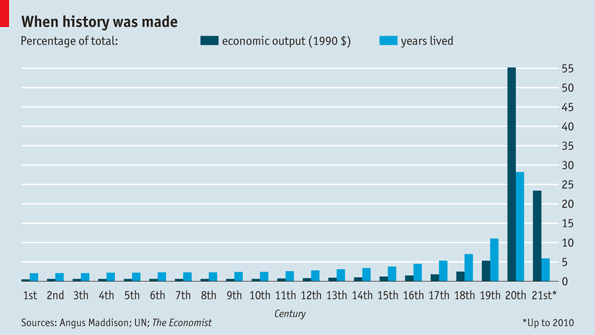
The chart below shows a population-weighted history of the past two millennia. By this reckoning, over 28% of all the history made since the birth of Christ was made in the 20th century. Measured in years lived, the present century, which is only ten years old, is already “longer” than the whole of the 17th century. This century has made an even bigger contribution to economic history. Over 23% of all the goods and services made since 1AD were produced from 2001 to 2010, according to an updated version of Angus Maddison’s figures.

What this is saying is that of all the economic history since the birth of Christ, 23% of it has been made in this decade alone.

And the chart.

Fascinating.  Considering that 55% of all economic history was made in the last full century, we are almost half way there and we’re only 11 years in.

Public vs Private Regulations

As part of legislation, Congress made it illegal for banks to charge a certain percentage to merchants when a debit card was swiped.  As a result, the merchant was able to retain more of the purchase price, but the bank lost a segment of its revenue; profits were threatened.

Because banks don’t enjoy profit margins significantly above the average, they have to work to retain whatever margin they DO have.  This means that the lost revenue from debit card swipes paid via the merchant would have to be made up elsewhere.

Banks began to end free checking.  They even began to add $5.00 fees for using a debit card for purchases.  The banks changed the way and manner in which they billed individuals based on indiscriminate legislation.

Now consider Verizon.  The telecommunications giant introduced a $2.00 fee for electronic billing to certain customers.  There was o regulation that forced this move, no change in laws.  Verizon simply felt that they need to move revenue in a specific segment.

Customers were enraged.  And Verizon changed course and ended the charge:

Verizon Wireless bowed to a torrent of criticism on Friday and reversed a day-old plan to impose a $2 bill-paying fee that would have applied to only some customers.

The consumer vitriol, which cascaded across Twitter and onto blogs and petitions all around the Web, struck a chord with a company that was clearly not expecting it.

“The company made the decision in response to customer feedback about the plan, which was designed to improve the efficiency of those transactions,” Verizon Wireless said in a statement referring to the reversal.

Companies risk capital in an effort to produce a product or service that the consumer wants.  In return for this risk, investors desire a return on capital.  If they fail to obtain this return, they move their capital somewhere else.  Therefore, it is incumbent for a company to look to improve revenues in any way they can.  And if those methods fail in the market place, shrewd companies will adapt.  Inefficient companies will fail.

And all of this is achieved through the free market.  Not one of government control.

The Economy Set To Improve

Every year the Associated Press interviews top economists and asks them for their thoughts on the coming year.  This year we have good news:

The three dozen private, corporate and academic economists expect the economy to grow 2.4 percent next year. In 2011, it likely grew less than 2 percent.

The year is ending on an upswing. The economy has generated at least 100,000 new jobs for five months in a row — the longest such streak since 2006.

The number of people applying for unemployment benefits has dropped to the lowest level since April 2008. The trend suggests that layoffs have all but stopped and hiring could pick up.

While a 2.4% growth rate isn’t as large as we would like to see, it does represent a better than 20% increase over last year’s numbers.  As long as we continue to grow, every little bit helps.  However, the employment picture doesn’t seem to look ay brighter for next year that for this year:

Unemployment will barely fall from the current 8.6 percent rate, though, by the time President Barack Obama runs for re-election in November, the economists say.

Not only has this economic crisis been deep but it’s been wide.  We’re gonna be looking at elevated unemployment for years to come.

Homeless: Contributing Factors

Disclaimer:

This is a topic that earns conservatives a bad name.  Or rather, this is a topic that liberals are easily able to use in order to give conservatives a bad name.  This is an unfortunate reality, for IN reality, it is the conservative that gives more to charity than the liberal:

The fact is that self-described “conservatives” in America are more likely to give—and give more money—than self-described “liberals.” In the year 2000, households headed by a conservative gave, on average, 30 percent more dollars to charity than households headed by a liberal. And this discrepancy in monetary donations is not simply an artifact of income differences. On the contrary, liberal families in these data earned an average of 6 percent more per year than conservative families.

So, with that said, let me make it clear that what I describe as policy in no way or manner represents my individual and specific view of the actual person, their plight, human spirit and personal tragedy.

Okay, now, onward.

I caught a Reuters article recently.  Specifically detailing the impact of the recession on our children; our homeless children:

In a report issued earlier this month, the National Center on Family Homelessness, based in Needham, Massachusetts, said 1.6 million children were living on the streets of the United States last year or in shelters, motels and doubled-up with other families.

That marked a 38 percent jump in child homelessness since 2007 and Ellen Bassuk, the center’s president, attributes the increase to fallout from the U.S. recession and a surge in the number of extremely poor households headed by women.

To be sure, we have work to do.  The problems surrounding kids who don’t have hoes is bad.  And getting worse.  I don’t think there’s a soul alive who who disagree that something, anything, has to be done.  But it’s important to acknowledge that the thing, the “anything, is going to come in two forms:

  1. Direct assistance to the displaced families right now.
  2. Actions that will prevent the homeless condition from occurring in the first place.

While noble, I am less interested in the first, as a matter of policy, than I am in the second.  Consider this:

As her mother sat in a homeless shelter in downtown Miami, talking about her economic struggles and loss of faith in the U.S. political system, 3-year-old Aeisha Touray blurted out what sounded like a new slogan for the Occupy Wall Street protest movement.

“How dare you!” the girl said abruptly as she nudged a toy car across a conference room table at the Chapman Partnership shelter in Miami’s tough and predominantly black Overtown neighborhood.

There was no telling what Aeisha was thinking as her 32-year-old mother, Nairkahe Touray, spoke of how she burned through her savings and wound up living in a car with five of her eight children earlier this year.

Think of that.  This woman is trying to care for a family of 9 on her own.  Ms. Touray is 32 years old and has 8 children.  In comparison, I had yet to be married at 32.  And now, as a professional married to another professional I have two children.  Without making any judgements as to decisions or life circumstances, as a 32 year old professional, I’m certain that I would have struggled caring for 8 kids.  Even making it to work would be difficult if not impossible.

Again, my interest in the conditions of the poor and homeless in America are more focused on preventing single 32 year-old women from having 8 children.  To put this in perspective, if you were to take ALL families in 2011, the percent of them that have 7 or more members is 2.6%.  When you look at only female householder, the percentage of families with 6 members is 2.8%.  In a perverse fact of life, the problem gets worse as women find themselves raising the family alone.

Certainly I can’t know the journey that Ms. Touray has taken to get to where she is.  Her life could be one of immeasurable bad luck and unbelievable twists of fate that have led her to where she is.  However, I suggest that another theme exists.  One that we can change.

That is, there is a significant portion of our population that makes misinformed and bad decisions that ted to put them in cohort groupings that lead to poor outcomes.  Is it perfectly allowable that a single woman would want to make it on her own and raise a family of 8 children?  Sure, without a doubt.  However, if a trusted friend or sister were to seek your advice on her decision to embark on this path, what might your counsel look like?  Would you caution her?  Might you recommend that she obtain an education?  Perhaps secure income?

Something.

What would you counsel your own daughter to do?

And if THAT answer is different than, “I’d do nothing.  However, I would continue to lavish untold amounts of mine and my neighbor’s money in order to support her.”, then I ask you:

Why aren’t we making YOUR answer policy?  Why aren’t we telling our Ms. Tourays of the world that it’s generally not accepted wisdom to create a condition where you are single with 8 kids?  In fact, why is it so “insulting and disparaging” even to merely suggest such advice?

Minimum Wage

Got a bunch of baseball cards in the attic?  Beanie Babies maybe?  How about some old CD’s?

Now, say ya wanna sell ’em.  Everyone knows that if you start the bidding to high you won’t get any takers.  Bring the price down and you can sell almost anything.

Simple:  More expensive, fewer people buy.  Less expensive, more people buy.

Which makes this so mind boggling:

Eight states will ring in the New Year with a higher minimum wage, under state laws that require wage floors to keep apace with inflation. San Francisco, one of the few cities that sets its own minimum wage above the federal level, is also raising wages for the lowest-paid workers in the new year. It will become the first big city in the country to require companies to pay their workers more than $10 an hour.

The minimum wage increases in Arizona, Colorado, Florida, Montana, Ohio, Oregon, Vermont and Washington will be 28 cents to 37 cents an hour, according to the National Employment Law Project. That is an extra $582 to $770 a year for a full-time minimum wage worker, and resets these states’ minimum wages to $7.64 to $9.04 an hour.

At that higher end is Washington State, which will become the first state in the nation to set its minimum wage above $9 an hour. For reference, the federal wage floor for most workers is $7.25 an hour.

I get it, I do.  No one’s time should be worth so little.  However, by forcing businesses to pay more for labor than they otherwise should, they will buy less labor.  And lastly, should an individual be free to bargain for the value of his time?


The 12 Days Of Christmas

Christmas is more expensive this year.  3.5% more expensive:

Giving the holiday presents of a French hen, a milking maid, a leaping lord or even a partridge in a pear tree is rather unlikely in this day and age. But the gifts from the favorite holiday carol “The 12 Days of Christmas” are lighthearted clues to how the economy is faring.

Over all, prices are fairly stable and not rising precipitously for even the quirkier gifts, according to the Christmas Price Index released for the 28th year by PNC Wealth Management, part of the PNC Financial Services Group. On the down side, the price tag for the eye-popping 364 items and services in each of the song’s verses breaks $100,000 for the first time this year.

Gold, for example — as in the five golden rings — has fallen in price. Those rings (fairly lightweight ones, one would think) come to $645, down from $649.95 last year. Even though gold commodities, an investor haven, have been hovering at record highs recently, the demand for gold at retail has been weakening.

Unsurprisingly, labor costs remained fairly flat. The nine ladies dancing, for example, remained static, at $6,294, the same as last year, according to figures from Philadanco, a dance company in Philadelphia. The 11 pipers piping, at a price of $2,427.60, and 12 drummers drumming, for $2,629.90, were up modestly, about 3 percent. The only unskilled laborers in the verses are the eight maids-a-milking, who are calculated as earning the $7.25 minimum hourly wage. That wage did not rise in 2011 for the second straight year, so their cost stayed the same.

The price tag for one round of gifts is $24,263.18 this year, up $823.80 from last year. Repeating the gifts totaled slightly more than $101,000, a gain of 4.4 percent, also close to the federal price index.

It would be fun to “gift” the 12 days of Christmas one year.