Category Archives: Economics

The Slow Decline Of GM

The whole of the rust belt went for Obama.  The auto states have long been democratic strong holds and no matter what happened to GM they likely would have supported Obama.  However, Ohio has a history of swinging and was in play November 5th, 2008.

And Obama knew this.

So, when faced with the dilemma that was the failing corporations, GM and Chrysler, he made the political play to bail the companies out with government money giving a huge gift to his political allies; the auto unions.

After this move, the companies failed anyway and they both went through bankruptcy where Obama continued his assault of reasonableness and simply ignored well established bankruptcy law.  He paid the unsecured creditors first which benefited the very voters he would need later in 2012.

It paid off.

But Romney, back in 2008, wrote an Op Ed for the NY Times where he called for the managed bankruptcy of the two companies , not a bailout.  Here’s what he said:

IF General Motors, Ford and Chrysler get the bailout that their chief executives asked for yesterday, you can kiss the American automotive industry goodbye. It won’t go overnight, but its demise will be virtually guaranteed.

Without that bailout, Detroit will need to drastically restructure itself. With it, the automakers will stay the course — the suicidal course of declining market shares, insurmountable labor and retiree burdens, technology atrophy, product inferiority and never-ending job losses. Detroit needs a turnaround, not a check.

Fast forward to today:

(Reuters) – Ford Motor Co, which clung to the road with a timely swerve before the 2009 crisis that bankrupted General Motors Co, may now be pulling a similar stunt in Europe.

The Dearborn, Michigan-based automaker is scrapping three European plants and thousands of jobs while its rival appears to be stuck on the starting grid. The speed of Ford’s restructuring plan – and the comparatively slow pace of GM’s – has become more important during a protracted slump in Europe’s auto market, with sales down another 7.2 percent so far this year.

Both companies unveiled hefty third-quarter losses in the region and warned they could lose a combined $6 billion or more in Europe in 2012-13.

The bad news weighs heavily on GM’s troubled Opel unit, which has lost billions of dollars over the past decade, has a long history of ill will with its labor unions, has seen its products and brand image pummeled in the media and has shown the door to all but a handful of its top executives.

More than anything, however, the cost of making cars is simply too high, with too many workers still on the payroll given sagging demand in most of western Europe.

Ford, quick and nimble – able to respond to changing needs – is outpacing the “saved” company that Obama “saved.”

Ford adjust.  GM didn’t.  And they’re paying.

By 2009, the company was solid enough to stay afloat as GM took a government bailout and Chrysler was sold to Fiat – both through Chapter 11 bankruptcy proceedings.

Beyond the disposals, Ford seeks more gains by building future cars and trucks from just five basic platforms, compared with nine distinct vehicle architectures currently deployed.

The push to consolidate underlying technologies – led by rivals VW and Hyundai – is already lifting earnings at home. Ford’s North American operating profit amounted to 12 percent of third-quarter sales, pulling further ahead of GM’s 7.8 percent margin.

“We track how we’re performing versus Ford very closely and we’ve got a good understanding of the gap,” GM’s U.S. finance chief Chuck Stephens told reporters and analysts this week. “Obviously it’s widened thus far this year. Ford is about two years ahead of us (in) getting scale on global architectures.”

Ford’s lead over GM is closer to four years in the European restructuring stakes. And even then, Bochum’s 2017 closure should not be taken for granted, some observers warn.

Ouch.
 

Welfare: Socio-Economic vs IQ – The Bell Curve

We’re moving from “The Family” to “Welfare” in the latest installment on “The Bell Curve.”

The series has been focusing on various snapshots of impact that the wealth of an individual or family may have and then at the impact that IQ may have.  Long has the argument been made that much of the disparity in America is due to the fact that the rich get richer while the poor get poorer.

Perhaps it has less to do with the wealth of the family and more to do with the IQ of the family.

So, moving towards welfare.

Previously I posted on the probability of going on welfare, within one year, after the birth of the first child.  I posted on this probability using only the socioeconomic status of the family.  Here I show both the SES and the IQ of the mother:

The impact is significant.  Even more so after accounting for the fact that a woman with higher IQ would be able to avoid the condition that would result in welfare.  Yet, after accounting for age, poverty, marital status and SES, we see that IQ plays a massive role in the probability of welfare reliance.

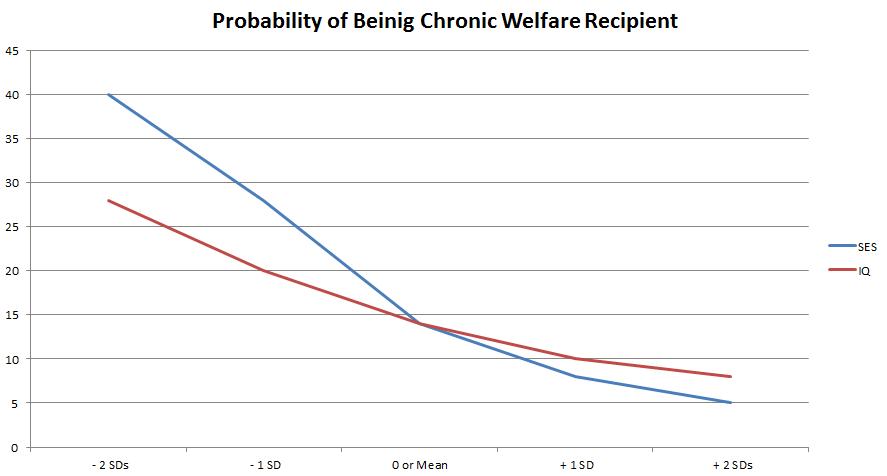
Next, the topic of chronic welfare dependency.  The data suggests see below, that SES plays at least as important a role as IQ does.  However, the data is restricted to the point that makes it important to point out a note.  Of the women in the study that were long term recipients of welfare, none scored in the quintile of cognitive ability; only 5 were in the second quintile.

With that caveat, here is the data:

Both the economic background of the mother AND the IQ play a part.  As I mentioned in the original post, education may be the relevant influence on this topic.

Beer And Taxes

A friend of mine posted this on Facebook.  I’ve posted here before but I think every now and then it’s important to take time and understand what taxes are really meant to do:

Raise funds to pay for the proper role of government.

And. because we uses a system of taxation that is progressive, when we reduce taxes, that reduction will also reflect the nature of that progressive tax system.

THE TAX SYSTEM EXPLAINED IN BEER
Suppose that every day, ten men go out for beer and the bill for all ten comes to $100…
If they paid their bill the way we pay our taxes, it would go something like this…
The first four men (the poorest) would pay nothing.
The fifth would pay $1.
The sixth would pay $3.
The seventh would pay $7..
The eighth would pay $12.
The ninth would pay $18.
The tenth man (the richest) would pay $59.
So, that’s what they decided to do..

The ten men drank in the bar every day and seemed quite happy with the arrangement, until one day, the owner threw them a curve ball. “Since you are all such good customers,” he said, “I’m going to reduce the cost of your daily beer by $20”. Drinks for the ten men would now cost just $80.

The group still wanted to pay their bill the way we pay our taxes. So the first four men were unaffected. They would still drink for free. But what about the other six men ? How could they divide the $20 windfall so that everyone would get his fair share?

They realized that $20 divided by six is $3.33. But if they subtracted that from every body’s share, then the fifth man and the sixth man would each end up being paid to drink his beer.

So, the bar owner suggested that it would be fair to reduce each man’s bill by a higher percentage the poorer he was, to follow the principle of the tax system they had been using, and he proceeded to work out the amounts he suggested that each should now pay.

And so the fifth man, like the first four, now paid nothing (100% saving).
The sixth now paid $2 instead of $3 (33% saving).
The seventh now paid $5 instead of $7 (28% saving).
The eighth now paid $9 instead of $12 (25% saving).
The ninth now paid $14 instead of $18 (22% saving).
The tenth now paid $49 instead of $59 (16% saving).

Each of the six was better off than before. And the first four continued to drink for free. But, once outside the bar, the men began to compare their savings.

“I only got a dollar out of the $20 saving,” declared the sixth man. He pointed to the tenth man, “but he got $10!”

“Yeah, that’s right,” exclaimed the fifth man. “I only saved a dollar too. It’s unfair that he got ten times more benefit than me!”

“That’s true!” shouted the seventh man. “Why should he get $10 back, when I got only $2? The wealthy get all the breaks!”

“Wait a minute,” yelled the first four men in unison, “we didn’t get anything at all. This new tax system exploits the poor!”
The nine men surrounded the tenth and beat him up.

The next night the tenth man didn’t show up for drinks, so the nine sat down and had their beers without him. But when it came time to pay the bill, they discovered something important. They didn’t have enough money between all of them for even half of the bill!

And that, boys and girls, journalists and government ministers, is how our tax system works. The people who already pay the highest taxes will naturally get the most benefit from a tax reduction. Tax them too much, attack them for being wealthy, and they just may not show up anymore. In fact, they might start drinking overseas, where the atmosphere is somewhat friendlier.

The “tax cut” above resulted in the rich man saving more dollars.  But he was paying more dollars to begin with.  Remember this when the left screams, “The tax cuts unfairly benefit the rich!”

Why I Don’t Trust Politicians – Bustin’ Republican’s Chops

One of the reasons I have so much scorn for democrats is that they embrace the big government statism power that I despise.  Republicans at least SAY* they’re against it but then eventually break my heart by giving in to the temptation that is “power.”

To be sure, the devastation that is “Sandy” is, in some areas, complete.  Any human with a drip of a spirit and decency would weep at the scene.  But the reason we elect people is that we expect leadership.

And courage.

And with one stroke of a pen, Christie failed BIG time:

Trenton, NJ – Taking action to save homeowners money following Hurricane Sandy, Governor Chris Christie signed Executive Order 107, prohibiting insurance companies from imposing costly hurricane deductibles on New Jersey homeowners. An important part of the recovery of New Jersey will be the influx of funds that occurs when insurers settle claims by New Jersey homeowners. This action will increase the total size of the payments made by the insurance industry, helping residents rebuild their homes and speed New Jersey’s path to recovery.

“We need to ensure that homeowners are not forced to pay higher out of pocket costs than required as they begin the rebuilding and repair process,” said Governor Christie. “While Hurricane Sandy was a devastating storm, it did not meet the regulatory threshold to trigger the application of hurricane deductibles by insurance companies in New Jersey. This executive order makes it clear that consumers do not have to pay these unusually large and often unexpected amounts.”

Now, did the storm meet the threshold to trigger deductible?  Maybe, maybe not.  But THAT isn’t up to the governor of a state.  That’s to be determined by the normal and regular and well understood relationship between the private entities that entered into a legally binding contract.

Governor Christie would be wise to remember that if he legislates away the right to collect deductibles, if indeed they are entitles, he may very well find out that the polices issued to his residents are dramatically more expensive if offered at all.

* Except, of course, things like gay marriage and extreme abortion views.  THOSE state powers they are just fine with.

You Can Pick

Would you rather have all the gas you wanna buy at 15 bucks a gallon?

Craigslist users started offering gasoline for as much as $15 a gallon to motorists and homeowners not wishing to brave the lines.

Or would you rather have no gas at $3.90 a gallon?

To me, the choice is easy.

We All Want Equal Pay

There’s a lot of discussion surrounding equal.  Specifically as it relates to pay between women and men.

I came across this study on monnkeys and equal pay.

Aside from being funny,what does the video tell us about pay equity?

The Power Of A Word

From The Economist - True Progressivism

I was going through my edition of The Economist the other day.  It was a treat really, in the “old days” I used have lunch across from the Barnes and Noble, buy the print edition and read it over Thai food.  I’ve long given that ritual up in favor of a subscription and electronic reading but hey….

So, anyway, there I was with my Phad Thai and the print version of the Economist.  I flipped to the “Leaders” section and just shook my head when I say this title:

True Progressivism

I’ve come to see The Economist as a more moderate magazine than I used to, but every now and then I hit an article that makes me wonder.  I nearly just turned the page and walked away.

But I read on.  And boy am I glad that I did!

To be sure they came out of the gate pretty slowly:

BY THE end of the 19th century, the first age of globalisation and a spate of new inventions had transformed the world economy. But the “Gilded Age” was also a famously unequal one, with America’s robber barons and Europe’s “Downton Abbey” classes amassing huge wealth: the concept of “conspicuous consumption” dates back to 1899. The rising gap between rich and poor (and the fear of socialist revolution) spawned a wave of reforms, from Theodore Roosevelt’s trust-busting to Lloyd George’s People’s Budget. Governments promoted competition, introduced progressive taxation and wove the first threads of a social safety net. The aim of this new “Progressive era”, as it was known in America, was to make society fairer without reducing its entrepreneurial vim.

Ugh.

But the plot improves quickly:

Thus, on America’s campaign trail, the left attacks Mitt Romney as a robber baron and the right derides Barack Obama as a class warrior. In some European countries politicians have simply given in to the mob: witness François Hollande’s proposed 75% income-tax rate.

I’m willing to trade a whole bunch of ideology to someone who’s willing to admit that the left is nothing more than class warriors.  So anyway, the article moves along and then comes some true gems:

In the rich world the cronyism is better-hidden. One reason why Wall Street accounts for a disproportionate share of the wealthy is the implicit subsidy given to too-big-to-fail banks. From doctors to lawyers, many high-paying professions are full of unnecessary restrictive practices. And then there is the most unfair transfer of all—misdirected welfare spending. Social spending is often less about helping the poor than giving goodies to the relatively wealthy. In America the housing subsidy to the richest fifth (through mortgage-interest relief) is four times the amount spent on public housing for the poorest fifth.

WOW!

The Economist is calling out the label, “Too Big To Fail.”  And then the truly Libertarian line of logic that begins to pin back the lawyers and the docs.  Who WOULDN’T love the racket that allows barristers and snake oil salesmen to restrict competition?  And how about that fact regarding the mortgage-interest?

So, ideas?

Compete, target and reform

The priority should be a Rooseveltian attack on monopolies and vested interests, be they state-owned enterprises in China or big banks on Wall Street. The emerging world, in particular, needs to introduce greater transparency in government contracts and effective anti-trust law. It is no coincidence that the world’s richest man, Carlos Slim, made his money in Mexican telecoms, an industry where competitive pressures were low and prices were sky-high. In the rich world there is also plenty of opening up to do. Only a fraction of the European Union’s economy is a genuine single market. School reform and introducing choice is crucial: no Wall Street financier has done as much damage to American social mobility as the teachers’ unions have. Getting rid of distortions, such as labour laws in Europe or the remnants of China’s hukou system of household registration, would also make a huge difference.

Next, target government spending on the poor and the young. In the emerging world too much cash goes to universal fuel subsidies that disproportionately favour the wealthy (in Asia) and unaffordable pensions that favour the relatively affluent (in Latin America). But the biggest target for reform is the welfare states of the rich world. Given their ageing societies, governments cannot hope to spend less on the elderly, but they can reduce the pace of increase—for instance, by raising retirement ages more dramatically and means-testing the goodies on offer. Some of the cash could go into education. The first Progressive era led to the introduction of publicly financed secondary schools; this time round the target should be pre-school education, as well as more retraining for the jobless.

Last, reform taxes: not to punish the rich but to raise money more efficiently and progressively. In poorer economies, where tax avoidance is rife, the focus should be on lower rates and better enforcement. In rich ones the main gains should come from eliminating deductions that particularly benefit the wealthy (such as America’s mortgage-interest deduction); narrowing the gap between tax rates on wages and capital income; and relying more on efficient taxes that are paid disproportionately by the rich, such as some property taxes.

Thoughts on paragraphs 1, 2 and 3:

1- A gigantic FU to the teacher’s unions and labor laws!  What I wouldn’t do to compromise if the deal included teacher’s union destruction and the loosening of labor laws.  I mean, holy shit – “No Wall Street financier has done as much damage to American social mobility as the teacher’s unions!”

2- Welfare reform.  We can only hope to slow the increase, but we should!   Though they do slip on early education; there isn’t any data that suggests the gains last beyond 3rd grade.

3-  This sounds exactly like Romney’s tax plan.

And to think, I almost passed this by because of the word Progressivism.

The Rich Will Be Poorer – But The Poor Will Also Be Poorer

His words:

America’s wealth comes from the efforts of people striving for success.  Take away their incentive with badmouthing success and you take away the wealth that helps us take are of the needy.


The Family: Socioeconomics vs IQ – The Bell Curve

The election, work and a jammed family schedule have impacted not only the amount of recent blogging but the subject matter as well.  It’s been over a month since my last installment of the impact of IQ on the conditions of all of us.

The Impact of IQ on Family Matters

I’ve gone over subjects such as poverty, education and employment.  I’ve taken an approach that first shows the impact of the socioeconomic status of the folks involved; sometimes the parents or family and sometimes the individual himself.  Then I’ve come back to show what the circumstances look like when the population has been described in terms of IQ.  So far, to me, the differences are stunning.

Today I look to continue this by checking out the family.

Marriage

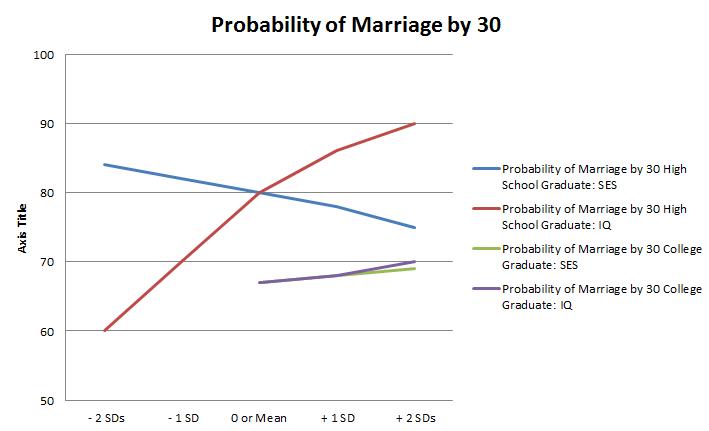
Because of the massive positive impact that being married has on society, it’s important to track who is getting married, when and why.  Earlier I showed a chart that described the state of folks at 30.  And because of the natural tendency of education to suppress marriage, both high school only and college graduates were displayed.  The chart below now includes taking IQ into account:

Most likely due to the fact that college is highly tracked to IQ, the differences don’t really matter.  But looking at the IQ of individuals without college education the impact i s large.  Of those with average IQs, 80% are married by 30.  Compare this with those of very low cognitive ability and their rate of 60%.

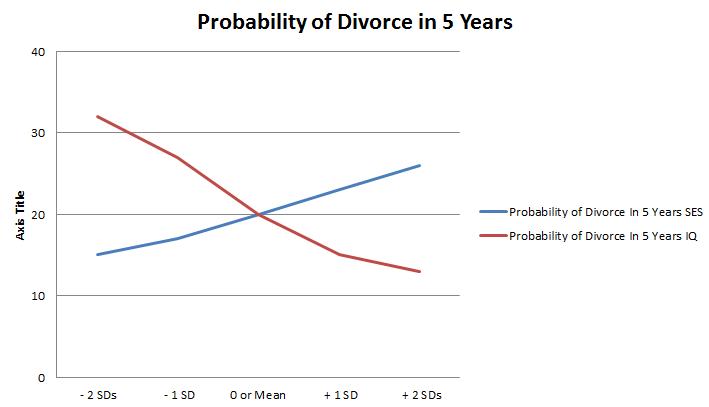
As I mentioned before, if marriage is important, then so is divorce.  And what does the comparison show?  Look:

The trends are interesting.  As individuals become wealthier, they are more likely to end their marriages in divorce.  But in a completely opposite way and manner, as the IQ of the folks increases, their likelihood of divorce decreases.

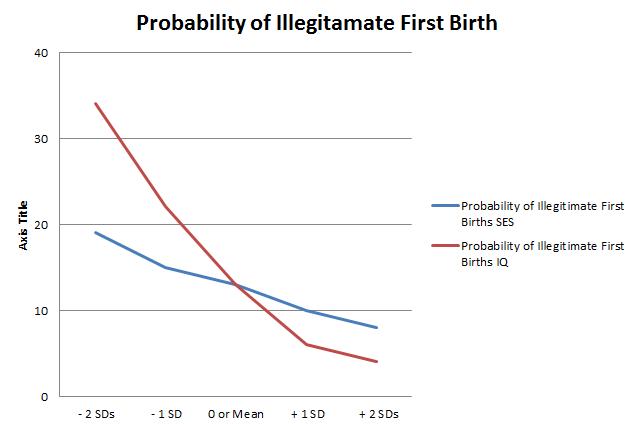
The subject of marriage is important because of the impact to the lives of the children of those families.  Because of this importance, it is required to look at the circumstances of birth.  Specifically illegitimate births.

The data are clear.  While the impact of the SES status is important, the top to bottom difference is 10 points, the impact of the IQ is even higher.  Where SES can show a 2 to 1 ratio, IQ shows a 7 to 1 ratio.

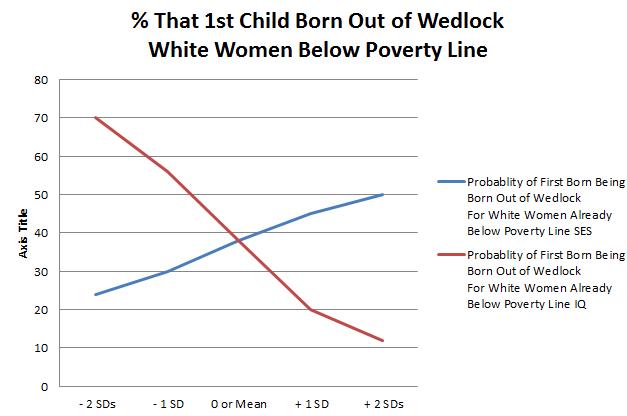
The last comparison is that of illegitimate births to white women already below the poverty line.  The data shows that as SES status increases so does the probability that a child is born out of wedlock.  If we include IQ?

Massive.

In perhaps the most glaring demonstration of the impact of IQ, this metric shows that women with higher cognitive ability avoid births out of wedlock at remarkable levels while women with lower cognitive ability are much less likely to avoid this condition.

In each of the 4 comparisons, IQ is shown to have a positive impact on the favorable conditions expected.  In some cases moderate, in others dramatic.

Next up – we look at the impact of IQ compared to SES and welfare.

Lilly Ledbetter And Fair Pay

During the second Presidential debate a question came up that spoke to equal pay for women in the work place.  Specifically the fact that women earn a fraction of what men earn.

In that back and forth, Mitt Romney mentioned that “they brought us whole binders of women…”

This has upset the left.  I suspect that this will play out like Big Bird.  But tonight I saw an interview of Ms. Ledbetter:

Watching the interview it struck me that she most likely deserved to get paid less than an average employee doing the same job that she performed.  Listen to her bullshit at 3:05:

It’s a fundamental American right to be paid and compensated …

It’s clear that this woman has no earthly clue about what she is talking about.  She is implying in her statement that pay and compensation must be equal independent of proficiency.  To be paid the same amount of another individual most certainly is NOT a fundamental American right.