Tag Archives: Unemployment

Change You Can Believe In

A picture is worth a thousand words:
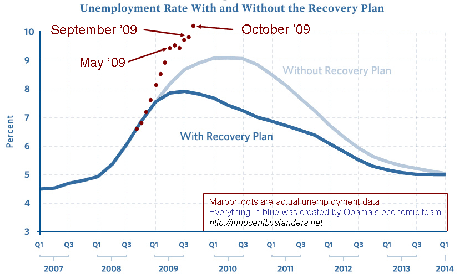
stimulus-vs-unemployment-october-dots

From Innocent Bystanders via TJIC

Freakin’ Obama.

12,000 Jobs Created

Minnesota is reporting that they have saved or created nearly 12,000 jobs due to the stimulus package. That’s more than 1 per lake, and Minnesota has a lot of lakes!

So, how much stimulus money did Minnesota get? About $4.7 billion.
How much has Minnesota spent? About $1.6 billion.
So, at this rate, how many jobs is Minnesota predicting? 35,000.
And the White House, how many did THEY predict? 66,000.

So, even using their own numbers, the White House and Minnesota is falling short by 47% of the predicted total, or 31,000 jobs.

And the jobs that WERE created? Let’s see:

  • $16.6 million to put 5,800 youth to work over the summer.

So, let’s see.  The state spent $16.6 million to hire a bunch of kids for the summer?  And that counts as a job saved or created?  So, really, what Minnesota is saying is that they saved or created 6,200 jobs.  5,800 high school kids having summer jobs doesn’t count.

Way to go Minnesota!

Poor Democrats: Responsibility

As we are beginning quarter 4, 2009, it is becoming clear that what we already knew was going to happen is, ahem, going to happen. That is, we are most certainly going to see the end of the recession between April and September of this year. Further, the unemployment rate is going to continue to rise and rise for quite some time.

As I mentioned, this is not surprising or new information.  What IS surprising, however, is that there is a group of people who find themselves in an uncomfortable position; the Democrats.

Job losses are expected to continue at least into the middle of next year, likely driving the unemployment rate above 10 percent from 9.8 percent last month. It could take three or four more years for it to fall to normal levels.

The longest and deepest downturn since the Great Depression has claimed 7.2 million jobs since it began in December 2007. Analysts figure 750,000 more jobs could disappear over the next six months.

And why is this?  It’s a perfect storm of sorts for the Democrats.  They are dealing with both long term and short term trends.  On the one hand, we are now paying the piper for the incentives given to banks, lenders and individuals to buy/sell houses to people who couldn’t afford them.  That’s the long term.  The short term?  The whole stimulus package including, to be fair, the Republican led TARP disaster.  And the medium term?  The rise of the minimum wage, which, by the way, is coinciding with a very bad labor market.  Right when we should be trying to incent people to hire other people, we instead are raising the cost of labor; even beyond what that labor is worth.

And what are the Democrats going to do to try to help us through this period of adjustment?  Why, a second stimulus perhaps?  Some are even considering raising that minimum wage even higher.  And the doubly whammy?  Cap and Trade along with Universal Health Care.

If you wanna implement policies that promise to rise the people up but in reality strip those same people of economic health and vibrancy?  Hire a Democrat; just remember that when their policies fail, it’ll get harder and harder to hire them in the next election.

Goodyear: Bad Policy

The United Steelworkers Union won one the other day. In the deal, the Union was able to win a number of concession from Goodyear:

  1. Minimum staffing levels
  2. Prevention of shifting production to any facility not represented by the Steelworkers Union
  3. $600 million in updates to the plants to keep them modern
  4. Wage and benefit increases
  5. Continuation of cost of living increases.
  6. A plant in Tennessee that was closed will have it’s employees to receive a buy out

So lemme get this straight.  Companies across the country, world in fact, are trying to cut back to minimize the impact of the global recession [which has most certainly ended by the way].  We are seeing staff reductions, we are seeing wage freezes and even in some cases wage roll backs.  All of this in order to keep companies from having to close.  But Goodyear?  What are they doing?  Why, of course, they are promising that they will keep a minimum number of workers on the job; not a maximum.  They are promising that they won’t move work to any plant not in America represented by the SWA.  Yeah, did ya notice that?  The Union didn’t say that they couldn’t move the jobs out of city or out-of-state or country, they simply said that the couldn’t move them where the union didn’t have representation.  So, if Goodyear wanted, they couldn’t move the plant to a Right to Work State and avoid a represented racket work force.  Nice.

Further, the Union was able to provide raises on top of cost of living increases to its membership.  All the while forcing Goodyear to spend $600 million in the plants so that they would be anchored to this ship wreck for the next several years.  Awesome.  Simply awesome.

Meanwhile,the only mention of why  these plants are in need of protection comes when the article mentions:

The Tennessee factory has been severely hurt by the economic downturn and an influx of cheap tires from China

Let’s ignore the fact that all of the tire buying American’s enjoy the “cheap tires from China.”  We like to have things provided to us at a price that is less expensive than we could otherwise find in the market.  So, while the American tire makers may see a decline in their sales, or at least in their profits, the rest of America see more money in their pockets.  This could be anyone from the single mother trying to make it to work to the florist that has to rely on tires to deliver her flowers on time.  All of this means added productivity.

Allocation of scare resources with multiple uses.

What we have now is an artificial allocation.  Or, people spending money on things that they wouldn’t otherwise spend that money on.  Which is almost always not optimal.  And somehow the press and the world rejoices at the fact that some Union jobs are saved at the expense of jobs elsewhere in the economy.  Jobs that have long ago ceased to be meaningful means of employment here in the US.  Here, you see, we are known for innovation and for services.  We need to free resources from the manual labor of tire making in order to free those minds to invent new kinds of tires.  Or news kinds of rubber.  Or any other of a long list of things yet to be invented but now prevented from being discovered.  All because of a racket.

But how, may you ask, can Goodyear continue to survive in this system where it is forced to pay fees and services to a work force that isn’t worth those fees and services?  Because, Mr. Obama has allowed Goodyear to charge an extra 35% for its tires adding directly to that companies bottom line.

Two Parallels in One Article

I’ve admitted before that I am no economist.  Fact is, I haven’t even ever taken a class in economics.  However, I did major in mathematics and work significantly with statistics at my current job.  As I tell my boss, “I’m nifty with numbers”.

So, as I wax poetic on all of these economic issues I do so with a bit of trepidation.  See, really, from an “expert’s” point of view, I don’t know what I’m talking about.

Which makes seeing two of my most often repeated mantras in text at one time very exciting.  This article from Mises.org just made my morning:

Mandating benefits for employees imposes costs on employment. The would-be worker bears the cost. It makes the worker more expensive to hire. The employer has to pay not only a salary but also a benefit. If you make it more expensive to hire people, fewer people will be hired.

It is no different from eggs at the supermarket. If they are $2 each, you will purchase fewer of them — you will economize. This is nothing but the law of demand: consumers will demand less of a good at a higher price than of a good at a lower price. A salary plus benefits amounts to a price that the employer must pay to purchase the work of a laborer. At a higher price, less work will be purchased by the employer.

You should read the whole article; it’s fantastically simple.  And for once, I see in print, what I seem to intuit.  And furthermore, it is verbalized with economic expertize that I simply can’t claim:

There is no real reason to prove these assertions empirically since they flow from the logic of economics.

The article is entitled  “The Jobs Program” and deals with health care:

Sadly, there is no way that free health care can be granted to all living things with the stroke of a pen. Broadening availability will require that the entire sector be turned over to the private sector, so that it can be controlled through the price system like everything else.

But while Mr. Rockwell is speaking about the current health care bill, his article could easily be speaking about the new minimum wage increase slated this month.

How to Raise Unemployment

Raise the cost of labor.

See, labor, like copper or plastic, oil or stamps, is a commodity.  Businesses need commodities to operate.  Businesses see how much a thing costs, calculates value analysis and then buys some.  How much depends on that analysis.  For example, if copper becomes too expensive, business will try to find a way to use less of it.  Perhaps substituting for something else; a batter value.  Stamps too high?  Go to bulk mailing, or e-mail services.  So it goes with labor.

Why people don’t see this is beyond me.  For example, if we are interested in reducing unemployment, why don’t we mandate that all McDonalds have twice the current number of workers on each shift?  If one McDdude is good, certainly two McDudes is better?  Yes?

No.

See, at some point, more labor doesn’t mean more revenue or profits.  Now, at some point it does.  If I have to wait 20 McMinutes for my McBurger, I am going to walk out the McDoor.  Here, more labor would be worth it to the store.  However, once McDonalds has reached the point that it is servicing the clientele adding more labor doesn’t add up.  The cost doesn’t justify the return.  The simple truth is that the amount of labor someone buys is limited to the business model.  Raising the unit cost of labor reduces the units.  Or, increases the price of the widget.?

So, does raising the minimum wage increase or decrease employment?  In an article from the Wall Street Journal, it seems that studies show jobs will be lost:

There’s been a long and spirited debate among economists about who gets hurt and who benefits when the minimum wage rises. But in a 2006 National Bureau of Economic Research paper, economists David Neumark of the University of California, Irvine, and William Wascher of the Federal Reserve Bank reviewed the voluminous literature over the past 30 years and came to two almost universally acknowledged conclusions.

First, “a sizable majority of the studies give a relatively consistent (though not always statistically significant) indication of negative employment effects.” Second, “studies that focus on the least-skilled groups [i.e., teens, and welfare moms] provide relatively overwhelming evidence of stronger disemployment effects.”

Now, let’s continue to pretend that we don’t know, for sure, that raising the minimum wage will result in job loss.  Let’s instead use the Global Warming argument.  What if it’s just possible that it does?  Why raise it?  What is the upside?  And there, gentle reader, is the rub.  As far as I can see, there is no upside.  Very very few people actually make the minimum wage or less.  Almost none of them will be making the minimum wage in a year.  Most of them are from families with annual family incomes well well above poverty.  The fact is, there just aren’t that many people making the minimum wage.  And for those that do, they would rather make that amount than make the true minimum wage: $0.00.

Strange Numbers

This past Thursday, workers at a Smithfield Foods went to work covered by a Union contract.  And from all accounts, they are very very happy to finally be so covered.   For example, the article mentions as benefits:

  • Guaranteed sick leave
  • Time-and-a-half holiday pay
  • $1.50 an hour raise over the next four years

“We really did accomplish something with this union,” said Mattie Fulcher.  “We might not have gotten the raise that we wanted, but that will come in time. This is our first contract, and it is a start.”

Now, it’s hard to gauge “success” of this contract for the members.  Among the most glaring omissions of the article are the pre-contract benefits.  For example, what have the pay increases for the average worker been for the past 4 years?  Or, what was the pay multiplier for holidays and overtime before the Union came in to “save the day”?  We do get an idea of what pre-contract life might have been in respect to sick leave:

Fulcher said that on Thursday she got a 40-cent-per-hour raise…and she began earning sick time for the first time since going to work for Smithfield. The sick time is unpaid, but in the past workers earned disciplinary points that could lead to firing if they stayed home sick.

Okay, so lemme get this straight.  The new Union contract says that Ms Fulcher is able to begin to accumulate sick time.  Sick time that is unpaid.  And this is different than in the past when the worker was afforded unpaid sick time but could, if abused, be fired for taking too much sick time?  Now, the article doesn’t mention this specifically, it does point out that employees were given “discipline points”; whatever that means.  Look, I work in corporate America and my sick leave policy is pretty straight forward and generous.  If you are sick, stay home.  As often as you are sick.  And guess what?  few of us ever really call in sick.  But when we do, our bosses mark it down and track us.  Cause, ya know, far be it from an employee to take every other Friday off and claim to be sick.  Sheesh.

Next on the hit list, guaranteed hours:

The contract will also guarantee workers at least 30 hours of work each week…

Awesome.  Really awesome for peope who wanna work more than 29 hours a week.  Really REALLY bad for folks who don’t.  Cause guess what?  Those people get fired.  No company in their right mind is going to pay someone 30 hours of pay for 15 hours of work.  Nice.

And the last piece of good news:

Union members will begin paying dues of about $7 a week…

So, Ms Fulcher gets a $0.40 per hour raise AND gets to pay $7 bucks a week.  Let’s say, just for fun, that she works 40 hours a week.  40 hours at $0.40 is $16.  Assume a 15% tax burden and that 16 bucks goes to $13.60.  Of which $7 goes to the Union.  In the end, she gets $6.60 a week, or about $26.40 a month.  The Union’s take?  7 bucks.  7 bucks or $28 a month.  Guess who makes out better here?  The worker or the Union?  In this specific case, even considering that Ms. Fulcher kept her job, the Union made more money than she did.  But let’s not forget the folks that lost their job as a result of this.  In the end, they have lost the most.

Minimum Wage Going Up – If You’re Lucky

So, the next phase for the minimum wage hike is set for July 2009.  Right around the corner.  And this might seem like good news, heck, even in my own household I’m told this is a good idea.  To which I reply “The real minimum wage is $0.00.”  See, if you don’t have a job, you don’t get paid.  Which brings me to the point of it all I guess.  Or, rather, what should be the point.  See, government is really really bad at setting expectations, conducting data driven analysis, implementing a solution and then tracking that solution for results.  Heck, even private industry is generally bad at this, but really, government is horrible.  The reason?  It’s easier to manufacture spin than it is to demonstrate results.  Spin is easy.  Results are hard.  One gets you elected, the other gets the other guy elected.

So, let’s take minimum wage.  Let’s see if we can’t try to:

  1. Identify what we are trying to accomplish.
    1. Or, perhaps, more specifically WHO were are trying to help or assist.
  2. Identify some metrics that we can use to study data and later, measure results.
  3. Get some data, run some analysis.
  4. Since we have already implemented this policy, we’ll skip the whole “should we implement it” phase.
  5. Go back and see if the policy has worked.

Alright, so, let’s see if we can work to identify what we are trying to accomplish with a minimum wage law.  In my search, I found this, a study entitled “The Who and Why of the Minimum Wage” from The Economic Policy Institute.  The EPI is a liberal economic think tank; imagine Cato or Heritage for the Democrats. Right away we are given a hint of a possible metric:

Raising the wage floor is an essential part of a strategy to support working families.

Now, I’m going to clarify here.  All families, ALL of them, are working families.  While I don’t make the minimum wage, nor does my wife, I would take umbrage with anyone who tried to claim that ours is not a working family.  Yet, somehow, I understand from this study that mine is not the family we are trying to “support”.  The author is trying to support the poor or near poor, working family.  So, alright, we have a start.   We want to increase the income of the families, or people, who make the minimum wage.

To be clear, the authors do devote a significant portion of the study to those making more than the minimum wage, they do claim that the minimum wage is only a start.

Moving on to bullet #2 we need to see if we can identify a metric that we can use.  That would be something that would be able to give us an idea as to where we are now and then compare it to after we have implemented our change.  For me, one metric that jumps right out is the Annual Income of the target population.  So, we have as a metric “Annual income of people who made minimum wage before the increases of that minimum wage went into affect”.  If the law works, that metric should go up.  If it didn’t work, that metric would go down.

The third bullet point is what they always skip, and since they did, we can’t recreate it here.

So now we move on to number 5.  Let’s see if the policy worked.  Here we go!

First task, who earns the minimum wage?  Let’s check.

  • 2.2 million workers with wages at or below the minimum made up 3.0 percent of all hourly-paid workers.
  • Workers under age 25 represented only about one-fifth of hourly-paid workers, they made up half of those paid the Federal minimum wage or less.
  • About 7 in 10 workers earning the minimum wage or less in 2008 were employed in service occupations, mostly in food preparation and serving related jobs.
  • The industry with the highest proportion of workers with hourly wages at or below the Federal minimum wage was leisure and hospitality (about 14 percent). About three-fifths of all workers paid at or below the Federal minimum wage were employed in this industry, primarily in the food services and drinking places component. For many of these workers, tips and commissions supplement the hourly wages received.

Do you know what this means?  This means that A). Very very few people make the minimum wage. B). Those that do are young.  And C). A large portion of minimum wage or less earners are bringing in tips.

As an aside, I used to tend bar, at one point I did it for a living.  When I did, I would calculate an annual “salary” based on wage and tips adjusting for taxes [that I didn’t pay on tips].  Every year I brought in more than 40K.  Often I was making better than 44k.  And this did not include the added benefit of eating most meals at the restaurant as well as a significant discount on my “liquid” needs.  While I didn’t have health insurance provided, I was young and in good health; though I did smoke and did work in a smoky environment.

Needless to say, in 2008, the vast vast majority of workers in America did not make the minimum wage.  While the numbers above reflect the 2008 year, as recently as 2005, 67% of teens and young adult making the minimum wage:

  • Worked part time jobs – Again, I worked a part time job in school, high school and college.  In each case, I was paid the minimum wage at the time.
  • Had average family incomes of 64k.

Folks, I get the fact that we wanna help people who are struggling, but the facts is the facts; almost everyone makes more than the minimum wage.

Not the End, but The Beginning of Worse

I was reading the News and Observer this morning and saw that Smithfield Packing finally succumbed to the kudzu that is Unions.

Smithfield Packing, union agree on NC contract

TAR HEEL, N.C. — Smithfield Packing Co. and a union that worked for years to organize a huge North Carolina slaughterhouse say they have agreed on their first contract for the plant.

I have not yet taken the time to check and see if Smithfield Packing is a publicly traded company or not, but I am sure that the value of this company just took a 10% hit.  Not only that, but employment in the company went down today as well.

I repeat, there is nothing, not ONE thing that is good about unionization within a company.  Unless, of course, you are a Union official.

Unions effectively tax …  [company] investments by negotiating higher wages for their members, thus lowering profits. Unionized companies respond to this union tax by reducing investment. Less investment makes unionized companies less competitive.

And a less competetive company is a company that is not as valuable as a more competitive compant.  If you need further proof that Unionization is a bad thing, take a look at the States with the highest unemployment rates and see how many of them are Union states and how many are right to work.

Heck, I’ll save ya the time:

1 Nebraska Right to Work
2 North Dakota Right to Work
3 South Dakota Right to Work
4 Wyoming Right to Work
5 Utah Right to Work
6 Iowa Right to Work
7 Montana Forced Union
8 Oklahoma Right to Work
9 New Hampshire Forced Union
10 New Mexico Forced Union
41 Kentucky Forced Union
42 DC Forced Union
43 Tennessee Right to Work
44 Ohio Forced Union
45 North Carolina Right to Work
46 Nevada Right to Work
47 California Forced Union
48 South Carolina Right to Work
49 Oregon Forced Union
50 Michigan Forced Union

Interesting list, huh?

Mandatory Sick Leave, Vacation and Minimum Wage

So, recently over at Applied Rationality we have been discussing legislating Mandatory Sick Leave.  Dave seems to be of the opinion that we should mandate paid sick leave to all employees while I maintain that such a benefit more resembles increased pay and would reduce the incidence of labor.  Minimum wage has long been a favorite of mine and this new legislation seems to be another version of the same.

I think it’s exactly this type of legislation where we as conservatives fall down and really fail to serve the public.  As champions of this type of legislation, it is the Left that is doing the PR job of getting out there and shaping the message.  They are in front of the cameras talk about laws that will help the “Average American”, the “Working Man” and “America’s Middle Class”.  They are getting the message out in the nightly newscasts, newspapers and magazines.  And they are doing it well.  They have been able to successfully shape the public opinion to the point that most of the nations feels that it is the Liberal Left and the Democrats who are standing up for the rights and well being of the average guy.

And we are letting them.

We don’t have anyone that is able to go out and change the shape of the conversation.  We don’t have anyone that is willing to take this law, conduct the research and bring the message into the homes of all people everywhere that this tpe of legislation HURTS the very people it is aimed at helping.  By mandating such demonstrably bad policies, what we are doing is legislating those of us who can least afford to be out of a job–out of a job.  We are building a scenario where employers are going to reduce the number of employees on their payroll.  And they are going to begin with the least skilled most marginal among their employees.  Rather than helping people, this law and others like it is destructive.

And we are letting them.

Now, I’m not willing to give the Democrats enough credit to come up with one of these Black Helicopter theories that says they are doing this on purpose in order to create a dependent Nation.  I really really don’t think they are that, umm, well, thoughtful.  I really do think that they are trying to actually help people.  I do.  But they are wrong.  They are taking the easy way out and, it just so happens, that this easy way out plays very well in the court of public opinion.  But the facts remain, this is horrible legislation and we know it.  Or should.  And we should be singing and shouting it out from rooftops all across America.  And we should be changing the tone of the conversation that it is Conservatives who are championing policies that actually DO help people.

Of course, we should then actually enact that policies…but thats another post for another day.