Tag Archives: Politics

I am My Neighbor’s Keeper

North Carolina is somewhat unique in the region, heck, the country, as it relates to annexation laws.  North Carolina allows it’s cities to annex neighborhoods and developments without having to obtain the permission of those residents.  Further, there are no guidelines that the city must adhere to that could possibly allow this practice to help those folks who could really use it.  For example, when the city looks out over it’s borders and sees a new development being built, it can–and does–look into the nature of that development.  What is the mean value of the property?  What type of infrastructure facilities are being built into the development?  The roads and street that serve the development; are they being built in such a manner that would allow the city to assume them without additional cost?

And so it goes, each development has next to it’s name a score, or value.  If and when the city feels that it requores to expand it’s tax base, it just opens that dirty little black book and find the best fit.  And this best fit is the one that brings the most money into the city with the lowest political cost.  How do we know this is true?  Just look at the types of properties and neighborhoods that get annexed, and then look at those who don’t.  In fact, it’s these low value neighborhoods that aren’t brought into the fold even when they WANT to be annexed.

Proponents of this type of annexation will claim that the State’s cities are free of blight, that the services offered by the cities can expand and that, in general, the cities are much more “healthy”.  While it’s certainly true that more programs can be initiated when the tax base is in growth, it’s also true that many of those programs are unnecessary and grossly inefficient.  It’s always better to have less government than government thinks it needs.  So, if that government looks to increase it’s tax revenue, either through tax rate hikes or just more people paying taxes…beware.

The Two Best Laughs of the Day

And both are right here:

This has to be the best URL ever!

www.financialstability.gov

LOL.  Serious.  LOL.

I mean, really.  If someone sent that to me in email, I would think it was a hoax.  But the URL is only the second best laugh of the day.  The top laugh of the day is the page display when you actually go looking for financialstability.gov:

financialstability

What 400 Bucks Is Gonna Do

Recently I was part of a small conversation regarding a portion of the tax cuts in the new Stimulus Package.  The subject that got us all going was, well, the headline you see at the top of this very post; what 400 bucks is gonna do….  Now, to be clear, I think that what we were talking about was the portion of the tax cuts that President Obama refers to as tax cuts to 95% of working men and women; $500 for an individual, a $1000 for a family.  At least that’s what I think the reference is, though, to be fair, I’m not sure.  For example, I don’t know where 400 came from, as I mentioned, I though the Obama tax cut was $500…anyway, I digress.  The point is, we had a good conversation.

Here is my case.

The Federal government levies taxes on individuals in the form of individual income tax.  As far as I know, there are no other taxes on individuals that the Feds have claim to.  Sales tax is a state tax, state income tax is, well, levied by the state.  Vehicle, property, city and county taxes…all non-Federal.  FICA and Medicare, not taxes.  These are with holdings that fund programs or specific funds.  They can not be used for other purposes, and if those programs or funds went away, so too, would the withholding.  FICA , after all, is is really just shorthand for Federal Insurance Contribution Act.  In this specific case, Social Security is really just an insurance program.  Anyway, point is–not a tax.

That would mean, for the Federal government to say that it is giving a tax cut to 95% of working Americans, he would have to reduce the rate of the tax.  For example, if an individual is being taxed at 28%, to realize a tax cut, she would have to see her rate go down, say..to 27% or 20%. That’s a tax cut.  What is not a tax cut is when an individual who currently pays no amount of money to the Federal government gets a check from Uncle Sam.  It is something.  And if it’s a grand, it’s not insignificant.  But what it’s not, is a tax cut.

And this is why it’s important.  It’s important because it has clear and critical ramifications, when dealing with a struggling economy.  It is NOT important because of the partisan bickering going on.  We have all heard the arguments going back to the election from the Democrats that Obama was offering a tax cut and The Republicans claiming it was just income redistribution.  That’s not why it’s important.  Where it really really matters is in how the recipients SEE, or perceive, the additional money.

You see, when I am chugging along in my normal economic way, I do just that–chug along.  I buy near the same kinds of groceries at near the same amounts.  I drive about the same kind of car and get it washed at about the as often as I always do.  I go out about the same number of nights and have about the same number of beers.  But now, let’s say that something changes.  Let’s say that I get a check back from my insurance company; my rates went down and they have overcharged me for two consecutive 6-month periods.  I get $500.  How do I spend that money?  It has been shown that the typical person spends it in one of two ways – They pay down debt OR they go on a 1 time splurge shopping spree.  So, VISA gets it or Best Buy gets it.  And then whamo, right back to the normal way of spending money.  Point is, there is no sustainable economic jolt in either paying off VISA or buying that flat screen TV.

Now, let’s say that instead of a windfall [the insurance overcharge check], I get a raise.  This presents me with a new way of looking at the money coming into me.  I view this a sustainable income, an item that I can budget for and count on.  I know it’s going to be there next paycheck and the paycheck after it.  This affects my spending in a much different way.  It sustains it.  I am more willing to up what I buy and/or how often I buy it.  I may not ration myself to a 6-pak.  Perhaps I can up how often I get a new car, or new jeans or new whatever.  Further, because it is not presented to me in a lump sum significant amount, the chances that I sink it into debt reduction is less; I actually spend it.  In this case, the economy is better off.

Now, for the whammy.  If, instead of giving me, a worker bee who concerns himself with just me and mine, a $500 bump, what if 20 people like me DIDN’T get the money but it went to a small business owner who was just thhhhiiiiiiisss close to obtaining the money to hire one more guy.  Or buy that new processor in his assembly line.  What if that 10k went to someone who GREW the money, who took it and turned it into 15k, or 20k AND gave someone a job because of it?

It is because of these reasons that fiscal conservatives don’t like the tax cut language in the stimulus package.  Not because Obama thought of it, or because Pelosi pushed it.  Or because no republican voted for it.  It’s because it’s moving money around in a way that does not grow said money, and it denies the recipient the critical perception that it’s sustained.  And further more, if you want to grow the economy, it’s not putting it into the hands of people who grow money.

The Recession – How Bad Is It: part 3

Okay, back to the recession and the economic numbers.  CPI is widely considered one of the indicators of how well -or poorly- the economy is performing.  So, if you are like me, you may ask:

What is the Consumer Price Index (CPI)?

The consumer price index (CPI) is the most widely used measure of consumer price inflation. The CPI measures the average change over time in the prices paid by urban consumers for goods and services. The Bureau of Labor Statistics (BLS) of the U.S. Department of Labor collects the CPI price information and calculates the CPI statistics.

Thanks to the Seattle Government

So, basically, the CPI is a value showing how inflation is impacting the cost of stuff that you and I buy.  So, let’s take a look:

Year Jan Feb Mar Apr May Jun Jul Aug Sep Oct Nov Dec
2008 0.4 0 0.3 0.2 0.6 1.1 0.8 -0.1 0 -1 -1.7 -0.7

Or, graphically, it looks like this:

cpi-2008Notice that I have changed the graphical representation some.  Most graphs of the CPI show the % change from the month prior, in that case, the graph looks like this:
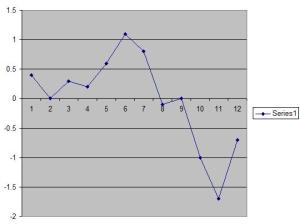
cpi-raw-2008

Now, the reason that I shifted the data is to show that while the CPI seems to be rising from November to December, what it really is doing is shrinking by a smaller number.  Further, unless you take the data and put it into real world terms, it’s hard to understand.  For example, CPI measure the cost to us of stuff that we buy.  So, if I was in the market for a Digital Picture Frame that cost $100 at the beginning of the year, I could roughly expect the price of that frame to fluctuate according to the top graph.  That is, it would cost more than $103 dollars in the summer, but, then in December, it would be just under $100.

So, in terms of how much stuff costs, right now -latest numbers go to December 08- the cost of goods and services that consumers buy is just under what it was in January 08.  Not bad.

An interesting comparison.  Anyone care to guess what the below graph is tracking?

price-of-gas-2008

If you said the price of gas, you are right.  The above is the cost of gas in cents, and notice just the shape of the graph.  Gentle rise followed by a steeper increase ending with a cliff at the end of the year.  Further, the height of the gas crisis, according to this data, is July.  Yet the height of the costof my picture frame was in August.  I am guessing the price of goods is going to track very closly the cost of getting it from where it was to where you are; shipping costs.

The larger point is this:  The CPI is not showing this current recession to be any worse than any of the data we have seen in the last 60 years.  In fact, just looking at the data we are seeing that the price of “stuff” is getting cheaper!  And that’s pretty good news these days.

Obama: I Inherited This Crisis

How many times do we have to hear The Blessed Leader report to the fainting masses that the financial crisis we find ourselves in was given to him by the previous administration?  I have been listening, and so far as I can tell, it’s every time he’s in front of a camera.  Now, I get it.  He wants to separate his time; Pre – Blessed Leader and then, well, you know, just Blessed Leader.

The problem that I have with this is not so much that he says it, after all, they have all said it. Dubya said it when he took over the recession from Bubba.  Bubba from 41 and Reagan from the Peanut Vendor.  They all say it.

However, in this case, Obama has it wrong.  You see, another disadvantage of being a Senator turned President is that you can actually be called on your record.  I mean, Obama was part of the organization that CREATED the mess that his current President self inherited.

And as it concerns Fannie Mae and Freddie Mac, he was warned and woo’d, to the tune of ranking #3 on the Active Leader Board.  Does that register?  Senator Obama, he of 4 short years, ranked 3rd on the currently serving members of the Senate.  John Kerry, who has been serving since forever, has only taken 6 large more than Obama.

And he has the stone to say that he inherited this.  He created it.

The Recession – How Bad Is It

About three weeks ago, I posted a bit on the status of the economy.  I wanna go back to that and review again.

I have a friend who, like  me, is a political news junkie.  I think that we use each other as our own personal foils.  Anyway, the topic of economic indicators came up, and this list came up:

  1. Unemployment
  2. Housing Starts
  3. Consumer Price Index
  4. Inflation
  5. Industrial Production
  6. Bankruptcies
  7. GDP
  8. Broadband Internet Penetration – I don’t agree with this one as a historical reference.
  9. Retail Sales
  10. Stock Market
  11. Money Supply

Let’s review some.

From the top.  Let’s take a look.

Unemployment

Right now, with the January numbers in, we are looking at a 7.6% unemployment rate.  To be sure, that is a historical high; a RECENT historical high.  In fact, you would have to go all the way back to September of 1992 to find a rate higher than where we are now.  And that’s a long way back, really is.  But–it’s no where near, not even close, to as bad as it’s ever been, or even as bad as it’s been since the Great Depression.  Now, the thing about that September 1992 value is that it was in the middle of a run of 21 straight months of 7.0% or higher; 21 MONTHS!  For referance, we are in the middle of, ummm, 2.  Only two!

Way Back MachineIf you dial the Way Back Machine to the year 1980, specifically May of 1980, you will be looking 68 straight months of unemployment higher than 7.0%.  Imagine!  Imagine having to go through the last two months for most of 6 years!  In fact, there were 78 months above 7.0% missing only one which came in at 6.7%  And to make it even worse, at the height of it, the rate stood at 10.8%.  Almost 11%.

Is 7.8 high?  Recent history suggests that it is.  Is it the worst since the Great Depression?  Hardly.  In fact, so far, it’s not even as bad as it was in 1992.  And the run in 1992 really had lasted from 1990 through 1994.  Now, clearly we are not sure where, or how high, we are going with these numbers.  But that’s not the use of this statistic.  These numbers represent what is going on in the nation today.  [Or last month as it were.]

Housing Starts

Without even looking, I think that this one is going to be bad.  In fact, this could be as bad as we have seen it.  And there is a reason for that; the whole reason we are in the place we are in is due to the burst of the housing bubble.  So, while I think that it is worth taking a look at the housing market [if only to act as a guide when we begin to turn], I hesitate to use this as any significant historical model.

And now that I have taken a look, I was right.  This indicator isn’t in good shape.  With data that I have going back to 1969, we are at the lowest level on record.  We reported only 550,000 new homes in December, 2008.  For an annual perspective, from Dec 2007 to Dec 2008, we saw a 45% decline.  This is the highest such decline on record.  To be sure, there have been other periods where we saw declines in the high 30’s, but this level is unprecedented.

Now, as I mentioned above, it is my feeling that it is the housing market that has us in this dilemma to begin with.  That is, there was a housing bubble and we are now contracting that bubble.  I am not surprised to see that we are reducing our output of new homes at just the same time that we are trying to move through our excess supply.  In fact, given our past spending on homes, I would be concerned if housing starts were NOT contracting.  With all of that said, however, we will not truely be able to say that we have come through the other side until this metric turns.

NOTE:

Foreclosure rates, on the rise for some time, have dropped sharply in January, with California rates at their lowest in nearly 14 months.  Further, pre-floreclosure filings also dropped, indicating that the falling rate may be sustainable.  Lastly, one of the most interesting aspect of a liberal media bias is that while rising oil prices are reported as horrible news for consumers, the price of housing is reported exactly opposite.  Why is it bad news when the affordability of housing is trending positive.  Right now, the affordability of housing is about 35-40% below the histroic rate.  All of this points to an ending of the housing correction.

Wake County Schools

So, North Carolina has two very large school districts.  The way it works in Carolina, see, is that our schools districts are made up along the county lines; not by the cities.  This forces allows districts to be very very large.  For example, Raleigh is about the 48th largest city in the nation, and yet Wake County Public School  [WCPSS] is one of the top 10 in terms of student population.

The other thing that makes WCPSS unique is that it is one of the nation’s leading districts in how it is handling it’s student assignment.  Unlike many, if not most, districts across the country, WCPSS assigns students by financial status.  In this case, the district is using F&R [free and reduced lunches] as a proxy for income.  As a result, the policy that has been in place for a number of years is that the district planners are trying to keep all schools at no more than 40% F&R population.

The idea, according to district officials, is that as the ratio of low income students at a specific school increases, achievement decreases;for all students.   Therefore,  assignment by income, taccdording to the theory, increases achievement for all students as well as minimizing the chance that a school degenerates into an inner city horror show so prevalent among many of the nation’s districts.

Anyway, I was reading this weekend.  One story chronicled the difference in the assignment approach in Raleigh and Charlotte.  The other describes one local Charlotte school that has changed dramatically since that district abandoned busing in favor of local or neighborhood schools.

I am a big believer in education.  I firmly believe that the higher the education of the individual, the higher the income, the lower rate of incarceration and in general, the higher return to society.  Further, I am a strong supporter of public education.  While I typically am not in favor of entitlement programs, I find that educating our youth is not only helping them, but, from a national perspective, investing in ourselves.  Unlike perpetual welfare or the minimum wage, I find that our society is actually improved by providing public education to all children.

However, in time, I do come back to my data driven roots.  And in this case, I am finding that the studies showing the increase achievement not only to be sound, but compelling.  I do not claim that a poor child sitting next to a rich child will help both of them learn.  But what I am saying is this.  Schools in affluent neighborhoods are going to have parents that are involved in the school.  They are going to volunteer.  They are going to donate to the PTA.  They are going to make sure that the computer lab has, you know, computers.  Further, these parents are not going to accept that when there is violence in the halls, nothing be done.  They will demand action, and, because they have a demonstrable successful trajectory in life, they will get that action.  In short, the schools will be safer, cleaner and better equipped.  The exact thing, by the way, that will bring in the best teachers, or at least not have them running for the doors.

Folks on the other side, well, they see it another way.  They claim that busing takes away from the neighborhood feel.  They claim that busing takes away time for a child to study.  They claim that they moved into a certain neighborhood to go to a certain school.  In some ways, I empathize.  In most, I don’t.  My take, is that when data and studies show that a particular method works, and integration of economic societies helps, you go with the data.  Every time.

Just look again at that Charlotte school.  Its only been 7-8 years and the schools has fell back to old times and ways.  Sure the Charlotte district will say that they are keeping up with Wake, but, I don’t think they are.  The schools themselves certainly are not.  And, as older sentimental teachers retire or just give up, the scores will show it too….

State Run Health Care

Was reading an article last night regarding North Carolina’s State Health Care system.  This is a program that offers employees health insurance.  What caught my eye was the headline:

State health plan wants the young, healthy

That’s awesome.  Another way of reading that headline would be this way:

State health plan wants the people who don’t have health problems to pay for health care.

I get where the State is coming from, I really do.  They have found that they are $138 million short in their fiscal planning.  And that’s a lot of money.  But the problem I have with this really became apparent to me as I was reading the article and mentally comparing it to my life in corporate America.  You see, I have a wife and some kiddos, so I can relate to the manipulation of pricing when trying to cover the family.

The problem, you see, is that the State was $138 million short in their goals.  That is, they are losing about $138 million.  In other words, the plan that they operate is not profiting.  What?  How can that be?  Is it possible that a business, run by the government, competing directly with private corporations is losing money?  Are you KIDDING me?  And then it REALLY came home and began to sink in.  Why in the world is the government in the business of selling health insurance?

The rest of the article talks about ways that the government is going to have to manipulate their model to become profitable.  The problem with this, however, is that the hard decisions required to do that will not be allowed to be made.  You see, it would require that some people won’t be able to afford the care that the government thinks that they need.  And the reason government thinks that certain people need certain coverage is because, well, because they were voted in by those people.  In short, it is NOT the goal of this government to run a profitable health insurance company, or even to provide the care they think they should.  The goal of these government folks is to stay in government.  There is no way the government can turn a profit here.

Now, I work for a Big Ugly Company [BUC] and I have health insurance through that BUC.  But guess what?  The insurance that I have through the BUC is not BUC’s Health Insurance.  Rather, BUC has negotiated with several different  other health insurance providers and found, what I hope, to be the best deal for me, or at least for the BUC.

Why can’t the State of North Carolina do the same thing?  Why is it that the State feels that they have to offer their own insurance?  If they would contract with a private firm, they would be able to set up SLA’s, minimums and yes, perhaps maximums as well.  There would be contractual expectations that would need to be met, and if they weren’t, the State could take their business elsewhere.  And in this economy, even the mean insurance companies don’t want that!

Now, the State could even offer to pay 100% of the cost if they wanted to.  This isn’t to say that they should, but they could.  If they want to feel that they are competitive in the field, attract and retain the best employees, it may very well be in the State’s interest to do this.  If, on the other hand, the State finds that they can obtain very skilled labor, say 85% of the best while only paying half the premium, they should do that.  It’s called open market.  And it works.

The State of North Carolina should be getting back to the business of the State.  After all, the State doesn’t manufacture their own paper clips, right?


This Should Suprise No One

Word is that the Bush administration overpaid for bank assets as part of their TARP program.

The Bush administration overpaid tens of billions of dollars for stocks and other assets in its massive bailout last year of Wall Street banks and financial institutions, a new study by a government watchdog says.

The Congressional Oversight Panel, in a report released Friday, said last year’s overpayments amounted to a taxpayer-financed $78 billion subsidy of the firms.

While it hurts, and at $78 billion it really really  hurts, this is no small thing.  $78 billion  is enough money to send each man woman and child in America $260 bucks.  Now, don’t get me wrong, sending each person in America $260 is not my idea of a stimulus, but the point has to be taken.

What makes this especially hard to swallow is the fact that this money was mean to prop up our financial institutions.  To be honest, when TARP was first announced, I was a critic and spoke out against it [to be fair, I am still hesitant].  However, after reading and taking a look at the facts I came around.  After all, our economy is based on capital; that is the selling of money from one institution to another.  When that process stops, when people are no longer able to obtain money for investment, that’s when we stop doing what we do best:  PRODUCE.

And so it came to pass that I begrudgingly began to warm to the idea of helping these guys out.  But that was when help was targeted to the very place that was perhaps ground zero; the bad paper caused as a result of number of bankruptcies.  When these loans were bundled by the hundreds and sold off, in essence they were chopped and split and dispersed to every investor who purchased a share.  Because of that it became very difficult to “know” the value of those shares.  nd so the market dried up, you couldn’t sell these things anymore.  This isn’t to say that they weren’t worth anything, clearly a majority of the loans were still, and even to this day are, viable.  But no one knew what their value was, and so they couldn’t be sold.

So the idea was that Paulson would buy up these assets, or bad paper, freeing the banks and lending institutions of them.  See, ya can’t lend money when you are over extended.  And in essence, this paper was worth Zilch and so all banks were forced to freeze lending.  But, Paulson changed his mind, bought up shares in banks and ended up over paying for them.

And this gentle reader, is a lesson in the tender mercies of Government Administration.  The fact is, when the government acts, it is almost ALWAYS for reasons other than for what is good and healthy.  There is always an eye out for the powerful, the political and the electability.  And because of this, decisions are almost always bad.

All government sucks.  The liberal and the conservative.  The answer is to reduce and remove.  Put the power in the hands of the people.

The Chairman’s Weekly Radio Address: February 7, 2009

Barack Obama’s Weekly Radio Address

February 7, 2009

Yesterday began with some devastating news with regard to our economic crisis.  But I’m pleased to say it ended on a more positive note.

This must be speech writing 101.  I think that you started out last week’s address exactly the same way.

In the morning, we received yet another round of alarming employment figures – the worst in more than 30 years.

Okay, okay; I’ll give this one to ya.  At least you didn’t bring up the whole “worst since the Great Depression” thang.  So, while this may be as bad as the 90’s, it’s close.  And yes, the last time we saw numbers this bad was in the early 80’s.  About 28 years; so, okay, let’s go with 30.

Another 600,000 jobs were lost in January.  We’ve now lost more than 3.6 million jobs since this recession began.

Right, and 3.6 million sounds like a lot, heck, it IS a lot.  But, let’s take a look.  Since 1981, the last BIG recession, the labor force has grown some 50%.  So, while 3.6 million remains a lot of people, lets put this into perspective.

But by the evening, Democrats and Republicans came together in the Senate and responded appropriately to the urgency this moment demands.

Let’s be honest here sparky.  Every single Democrat – ALL of them– and just THREE Republicans came together.  This is not the partisan promise you sold me.  Actually, I personally didn’t buy ANY of your snake oil, but you know what I mean.

In the midst of our greatest economic crisis since the Great Depression,

I knew it.  I JUST KNEW you couldn’t make it through one of these infomercials with out a worst since the Great Depression reference.  You do know that this just makes you sound stupid.  I guess now I understand how the left felt about listening to Dubya.  Change……

the American people were hoping that Congress would begin to confront the great challenges we face.  That was, after all, what last November’s election was all about.

Legislation of such magnitude deserves the scrutiny that it’s received over the last month, and it will receive more in the days to come.  But we can’t afford to make perfect the enemy of the absolutely necessary.

Month?  What’choo talkin ‘about Willis?  This ain’t been no month!  You have been in office shy three week.  You know and I know that you are pushing this through before the American people support it less than they supported Dubya!

The scale and scope of this plan is right.  And the time for action is now.

If by right you mean horribly horribly wrong, then yeah, I’m with ya.  Action schmaction.  If you do nothing, just NOTHING, we are out of this in less than 6 months.

Because if we don’t move swiftly to put this plan in motion, our economic crisis could become a national catastrophe.  Millions of Americans will lose their jobs,

Pssst, over here.  Check it out….when Americans bring down debt -and they should bring down debt-it’s a recessionary action.  We knew this going in.  Okay, back to you.

their homes,

Pssst, over here.  Check it out…..[wait wait wait–do I really have to be the guy to tell you this?] It was those poepl GETTING their homes that caused this whole freaking mess to begin with?  What are doin?  Hey man, don’t walk away from me…..

and their health care.  Millions more will have to put their dreams on hold.

Let’s be clear:

Okay, okay.  Being clear time!  Let’s go.

We can’t expect relief from the tired old theories that, in eight short years,

Clear–being clear.  This is all George W. Bush’s fault.  Got it.  Not even three weeks in and I am tired of you!  Clear my ass.

doubled the national debt, threw our economy into a tailspin, and led us into this mess in the first place.

Whoo sparky.  “into this mess in the first place.”  Do you read or study?  I mean, you must have, right?  Double Ivy?  I mean, how in the HELL did you make it through?  Let’s review:

  1. Democrats initiated a program that sold people homes they couldn’t afford.  Bad bad bad.
  2. Democrats allowed Fannie and Freddie to go unchecked.  This not only perpetuated the lending money to people who couldn’t afford it, but in fact, accelerated it by creating a market for OTHER banks to do the same thing.
  3. Democrats came in and INCREASED regulation changing basic as well as tried and true accounting principals.
    1. Google Mark to Market

We can’t rely on a losing formula that offers only tax cuts as the answer to all our problems while ignoring our fundamental economic challenges

Things like borrowing and printing money to spend our way out of debt.  Anyone know the rat race that is cash advance from VISA to pay Mastercard?  Would you consul your daughters to do that?  No, then why are you telling me to do that?

– the crushing cost of health care or the inadequate state of so many schools; our addiction to foreign oil or our crumbling roads, bridges, and levees.

Look, we’re with ya on the whole schools, energy and infrastructure thing.  Really, we are.  But we are also not so fookin stupid as to think that they are the same thing as a stimulus bill.  If you want money for schools, get out your Abe Lincoln oil lamp and craft such a bill.  You should remember how to do it from your days in the Senate, right?  I mean, hell, you were responsible for huge and important legislation while you were—oh my, how embarrassing for you.  You weren’t were you?  Huh, well, maybe that explains why you don’t know how this whole thing works.

The American people know that our challenges are great.  They don’t expect Democratic solutions or Republican solutions – they expect American solutions.

From the beginning, this recovery plan has had at its core a simple idea:  Let’s put Americans to work doing the work America needs done.

Except it’s not the Government’s role to create jobs.  Just allow proper conditions to exist and we’ll take care of the rest.

It will save or create more than 3 million jobs over the next two years,

Umm, gosh, this is getting old, but you may wanna, you  know, research this.  Even your own peeps are not so much thinking 3 million

all across the country – 16,000 in Maine, nearly 80,000 in Indiana – almost all of them in the private sector, and all of them jobs that help us recover today, and prosper tomorrow.

Jobs that upgrade classrooms and laboratories in 10,000 schools nationwide – at least 485 in Florida alone – and train an army of teachers in math and science.

Jobs that modernize our health care system, not only saving us billions of dollars, but countless lives.

Jobs that construct a smart electric grid, connect every corner of the country to the information superhighway, double our capacity to generate renewable energy, and grow the economy of tomorrow.

Jobs that rebuild our crumbling roads, bridges and levees and dams, so that the tragedies of New Orleans and Minneapolis never happen again.

It includes immediate tax relief for our struggling middle class in places like Ohio,

We’ve been over this before as well.  When you take steal money from me and GIVE it to someone else, that is neither a tax cut or a relief.  All it does is PISS me off without benefiting anyone.

where 4.5 million workers will receive a tax cut of up to $1,000.

Okay, okay, you win.  I agree, Uncle.  Let’s give these people that $1,000.  Just DO it already.  In fact, if you PROMISE to just not talk anymore, I’ll double it.  That’s 9 billion dollars.  Just saved ya about 850 billion.

It protects health insurance and provides unemployment insurance for those who’ve lost their jobs.  And it helps our states and communities avoid painful tax hikes or layoffs

Dude, DUDE!  You SAID you studied Constitutional Law.  It is not YOUR job to reduce State and City taxes.

for our teachers, nurses, and first responders.

Stop it!  Shameless emotional garbage!

That’s what is at stake with this plan:  putting Americans back to work, creating transformative economic change, and making a down payment

What?  Down payment?  A down payment is money that you ALREADY have placed down for money you are going to borrow.  This, THIS is a lot of things.  But isn’t most certainly NOT a down payment!

on the American Dream that serves our children and our children’s children for generations to come.

Americans across this country are struggling, and they are watching to see if we’re equal to the task before us.  Let’s show them that we are.  And let’s do whatever it takes to keep the promise of America alive in our time.

If only you would!

Thank you.