
Category Archives: Health Care

The Problem With Obamacare

Health Care

Or at least two of them.

Cost and need.

First, consider cost:

For 2014, the penalty is either $95 per adult or 1% of family income, whichever results in a larger fine. (Income is defined as total income above the filing threshold, which is $10,000 for an individual and $20,000 for a family in 2013.) That’s still a lot less than premiums, which are generally $200 to $300 a month on average for a silver plan.

So a person making $50,000 would not be eligible for a subsidy and would pay full price — typically around $2,400 to $3,600 a year in premiums — for a plan. If he declined to get insurance, he would only be subject to a $400 penalty for the year.

A couple earning that amount would receive a roughly $1,300 subsidy, leaving them to pay about $4,750 in premiums for the year. But that compares to a $300 penalty.

For some folks, the economics just doesn’t make sense.    The penalty is the better way out.

Then there is the case of the need.  Young people generally don’t need the insurance.  Why?  Because they aren’t sick:

For some folks, health insurance just isn’t a good deal. Take Jessica Birge, 29, who is studying nursing and works as a medical assistant. Her job gives her $100 a month for medical expenses, though she does have dental and vision coverage through her employer. But she doesn’t have a lot of medical expenses since she rarely goes to the doctor, opting instead to go to a local clinic for her annual exams.

Though she knows she needs insurance in case she gets into an accident, she doesn’t think Obamacare is very affordable.

“I don’t really want to pay a penalty, but it’s more economical for me to pay $300 a year [in fines] than $200 to $300 a month for insurance I don’t use,” said Birge.

Now, you can argue that the young folks should contribute to the system in order that the elderly and the sick may obtain coverage.  And  I would argue that such a ideal is a noble one indeed.  But we’ve now moved away from an insurance conversation to one more properly defined as an entitlement conversation.

The fact is, Ms. Birge and millions like her are simply making the choice to self insure.  A choice that I myself made when I was that age as well.  Lookig back I wish that I had taken a catastrophe policy and matched it with an HSA.  Not that ever was sick or hurt, but it’s a curse of being older to look back on the mistakes of youth and shake your head.

Plus I would now have an HSA account that would have grown tax free over the last 22 years.
ObamaCare: The Price Of A Policy

There has been much joy and excitement over the recently released report declaring that policies are coming in lower than projected:

The report also gives an overview of pricing and the number of coverage options across the nation.  It finds that the average premium nationally for the second lowest cost silver plan will be $328 before tax credits, or 16 percent below projections based off of Congressional Budget Office estimates.

Now, to be sure, had the report come out and reported that the premiums were going to be 16 percent above, HHS would be hammered, so a 16 percent below expectation is positive news.  But in truth, this report is only comparing what the policies will cost compared to what people THOUGHT they would cost.  It mentions nothing without being able to compare costs to existing costs.

AEI makes the point very well:

In short, HHS is not saying that people will be paying lower premiums on the exchanges than they’re paying now. HHS is just saying that people will be paying less than HHS thought people would be paying. They’re trying to sell this as good news—people will not have to spend as much as HHS originally thought they would. However, when determining what’s affordable, what really matters is what people think they should be spending.

When we’re trying to figure out if the new premium estimates will be affordable for people, then, we can’t just set a federal standard—which is how the Affordable Care Act defines affordability. We should compare what people (to a large extent, in this case, the uninsured) think they should pay and what HHS says they’ll be paying.

I think that the administration knows that this roll out is going to go very poorly and this report is nothing but an attempt to spin some good news.

Unintended Consequences

UPS

I’m sure this is exactly what Obama had in mind when he urged Americans to support him in passing Obamacare:

United Parcel Service Inc. plans to remove thousands of spouses from its medical plan because they are eligible for coverage elsewhere. The Atlanta-based logistics company points to the Affordable Care Act, or Obamacare, as a big reason for the decision, reports Kaiser Health News.

The decision comes as many analysts are downplaying the Affordable Care Act’s effect on companies such as UPS, noting that the move reflects a long-term trend of shrinking corporate medical benefits, Kaiser Health News reports. But UPS repeatedly cites Obamacare to explain the decision, adding fuel to the debate over whether it erodes traditional employer coverage, Kaiser says.

Rising medical costs, “combined with the costs associated with the Affordable Care Act, have made it increasingly difficult to continue providing the same level of health care benefits to our employees at an affordable cost,” UPS said in a memo to employees.

This is exactly what Pelosi meant when she mentioned that we should pass this bill so that we can see what’s in it.

Obamacare And Setbacks

Setback

In shocking news this morning we learn that the Obama administration is going to miss another deadline:

(Reuters) – The Obama administration has delayed a step crucial to the launch of the new healthcare law, the signing of final agreements with insurance plans to be sold on federal health insurance exchanges starting October 1.

Needless to say this does NOT come as a surprise but rather as an expectation from this administration.  What does it mean?

Coming at a time when state and federal officials are still working to overcome challenges to the information technology systems necessary to make the exchanges work, some experts say that even a small delay could jeopardize the start of the six-month open enrollment period.

U.S. officials have said repeatedly that the marketplaces, which are the centerpiece of President Barack Obama’s signature healthcare reform law, would begin on time.

But the October 1 deadline has already begun to falter at the state level, with Oregon announcing plans to scale back the launch of its own marketplace and California saying it would consider a similar move.

I’m betting January 1 is already dead in the water.  But don’t worry:

But having everything ready on October 1 is not a critical issue.

Well, what IS the critical issue:

What matters to people is January 1, which is when the coverage is supposed to start. If that were delayed, it would be a substantive setback.

Strap in for a substantive setback.

Health Care Markets

Healthcare

Health Care.

It’s all the rage these days.  How are we going to implement it?  Will the republicans defund it?  Can Obama legally just change the law as he sees fit?

Fascinating stuff.

But underneath it all is the assumptions that go into it.  For example, take Ezra Klein over at Bloomberg:

Health care and education pose the same basic threat to the economy: How do you keep costs down for a product that consumers must purchase?

Saying “no,” after all, is how consumers typically restrain costs. If Best Buy Co. wants to charge you too much for a television, you can walk out. You might want a television, but you don’t actually need one. That gives you the upper hand. When push comes to shove, producers need to meet the demands of consumers.

But you can’t walk out on medical care for your spouse or education for your child. In the case of medical care, your spouse might die. In the case of college, you’re just throwing away your kid’s future (or so goes the conventional wisdom). Consequently, medical care and higher education are the two purchases that families will mortgage everything to make. They need to find a way to say “yes.” In these markets, when push comes to shove, consumers meet the demands of producers.

So, first off, education is nothing like health care.  You  may or may not purchase it.  Sure, purchasing some of it is a great idea, more of it may be a good idea and too much can be a bad thing – look at all the freakin’ Fine Arts and English Literature students out there.  Sheesh.

Second, Ezra misses a critical parallel – food.  After all, even more basic a need than health care is food.  And we aren’t facing a food cost crisis.  Nor is there a food shortage.  In fact, hunger is defeated here in America and on the ropes globally.

So what gives on medical care?

One answer, beloved on the right, is that government is the problem and less government is the solution. Both medical costs and education costs are highly subsidized. Those subsidies, some contend, are the cause of rising prices. If people were paying full freight, they’d be acting more like typical consumers and demanding a better deal.

That gets causality backward. The subsidies exist because consumers — also known as “voters” — are desperate to get medical care when they need it and secure quality educations for their kids. As prices rise, they appeal to the government for help. They find a way to say “yes.”

Indeed.  Let people pay full freight.  And this should be accomplished in two ways:

  1. Let people purchase insurance on their own outside of the confines of their job.
  2. Create an environment where people shop for their own medical care.

In the first, it’s a perverse system that takes away an individual’s insurance when they loose their job.  In the second, shopping for services reduces costs and can even reduce services that are duplicates or are not needed.

But what of subjecting medical care to the market, how are we to explain emergency care?  Easy, there isn’t much of it:

Health care is a big business in the United States, representing more than 16 percent of U.S. Gross Domestic Product. Yet there are misconceptions about the costs and efficiencies of emergency rooms and “unnecessary” care. According to U.S. government statistics, emergency care represents less than 2 percent (1.9 percent)1 of the $2.4 trillion spent on health care.

Two percent on emergency care.  The rest, fully 98% of the health care spend…that money is spent on procedures and items that, while certainly not discretionary, are able to be planned and most importantly, shopped.

No one feels that food is discretionary – that we can choose to go without food for long.  But when opened up to a freer market, food has become ubiquitous.

Two simple changes to the way we deliver health care would dramatically reduce prices – okay 3, I just thought of another:

  1. Separate health insurance from employment – end the tax break for insurance as compensation.
  2. Buy plans that carry large deductibles and pair them with HSA’s.
  3. End the concept that routine maintenance be covered by insurance – this is not insurance, it is a prepaid medical plan.

Problem solved.


Scientists Turn To Gamers

While I have long ago given up my gaming habits, I like to see geeks ruling the world:

This Is Obama’s Economy

Barack Obama

The United States is experiencing job growth, to be sure.  But look at the kinds of jobs being created:

(Reuters) – U.S. businesses are hiring at a robust rate. The only problem is that three out of four of the nearly 1 million hires this year are part-time and many of the jobs are low-paid.

Executives at several staffing firms told Reuters that the law, which requires employers with 50 or more full-time workers to provide healthcare coverage or incur penalties, was a frequently cited factor in requests for part-time workers. A decision to delay the mandate until 2015 has not made much of a difference in hiring decisions, they added.

“Us and other people are hiring part-time because we don’t know what the costs are going to be to hire full-time,” said Steven Raz, founder of Cornerstone Search Group, a staffing firm in Parsippany, New Jersey. “We are being cautious.”

Raz said his company started seeing a rise in part-time positions in late 2012 and the trend gathered steam early this year. He estimates his firm has seen an increase of between 10 percent and 15 percent compared with last year.

Other staffing firms have also noted a shift.

“They have put some of the full-time positions on hold and are hiring part-time employees so they won’t have to pay out the benefits,” said Client Staffing Solutions’ Darin Hovendick. “There is so much uncertainty. It’s really tough to design a budget when you don’t know the final cost involved.”

Watch the word from the Left as they mention “anecdotal”

A Mile Away

Obvious

Truly shocking news, but at least it’s being reported:

(Reuters) – U.S. businesses are hiring at a robust rate. The only problem is that three out of four of the nearly 1 million hires this year are part-time and many of the jobs are low-paid.

Employers say part-timers offer them flexibility. If the economy picks up, they can quickly offer full-time work. If orders dry up, they know costs are under control. It also helps them to curb costs they might face under the Affordable Care Act, also known as Obamacare.

People are responding to incentives.

Executives at several staffing firms told Reuters that the law, which requires employers with 50 or more full-time workers to provide healthcare coverage or incur penalties, was a frequently cited factor in requests for part-time workers. A decision to delay the mandate until 2015 has not made much of a difference in hiring decisions, they added.

“Us and other people are hiring part-time because we don’t know what the costs are going to be to hire full-time,” said Steven Raz, founder of Cornerstone Search Group, a staffing firm in Parsippany, New Jersey. “We are being cautious.”

Raz said his company started seeing a rise in part-time positions in late 2012 and the trend gathered steam early this year. He estimates his firm has seen an increase of between 10 percent and 15 percent compared with last year.

Other staffing firms have also noted a shift.

“They have put some of the full-time positions on hold and are hiring part-time employees so they won’t have to pay out the benefits,” said Client Staffing Solutions’ Darin Hovendick. “There is so much uncertainty. It’s really tough to design a budget when you don’t know the final cost involved.”

One hundred percent the result of an administration that has never had to “do” anything but win votes.

Obama will point to the fact that he’s delayed the mandate:

The delay in the Obamacare employer mandate “confused people even further,” said Bill Peppler, managing partner at Kavaliro, a technology staffing firm in Orlando, Florida. “When we talk to customers, I still don’t think anyone has a handle on this.”

But this will HELP employees:

Some businesses are holding their headcount below 50 and others are cutting back the work week to under 30 hours to avoid providing health insurance for employees, according to the staffing and payroll executives.

Under Obamacare, any employee working 30 hours or more is considered full-time. An effort to trim hours might have helped push the average work week down to a six-month low in July.

“As organizations and companies reduce the hours of part-time workers, they still have to replace the capacity, so they go out and hire additional part-time workers,” said Philip Noftsinger, president of CBIZ Payroll in Roanoke, Virginia, which manages payroll for more than 5,000 small businesses.

This is a train wreck.  And we’re all in for the ride.

Those In Charge Of Obamacare Want Nothing To Do With Obama Care

Can’t blame them really:

“Mr. Werfel, last week your employees who are a member of the National Treasury Employee’s Union sent a form letter for union members to send in to ask they be exempt from the exchanges,” a congressman asked. “Why are your employees trying to exempt themselves from the very law that you’re tasked to enforce?”

“I don’t want to speak for the NTEU, but I’ll offer a perspective as a federal employee myself and a federal employee at the IRS,” said the IRS chief. “And that is, we have right now as employees of the government, of the IRS, affordable health care coverage. I think the ACA was designed to provide an option or an alternative for individuals that do not. And all else being equal, I think if you’re an individual who is satisfied with your health care coverage, you’re probably in a better position to stick with that coverage than go through the change of moving into a different environment and going through that process. So I think for a federal employee, I think more likely, and I would — can speak for myself, I would prefer to stay with the current policy that I’m pleased with rather than go through a change if I don’t need to go through that change.”

Awesome.

Medical Intervention

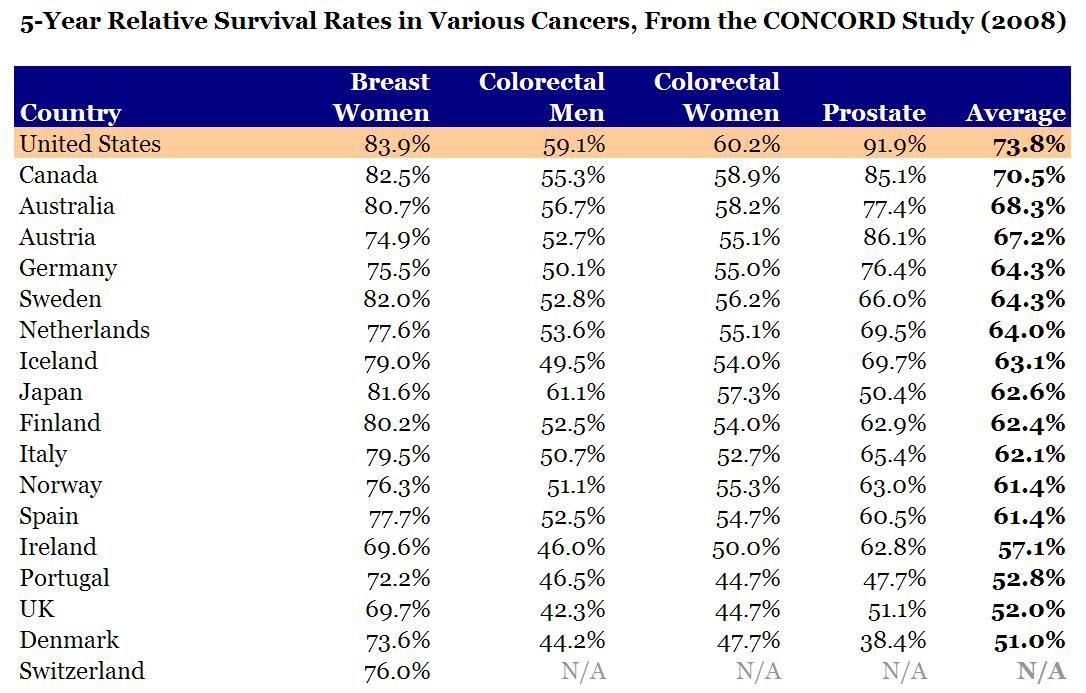
When we measure a health care system, are we measuring the right things?  For example, consider heart attacks.  Is the best measure of a medical care delivery system one where we measure how many people survive a heart attack once it’s happened or is it one where we measure how many people have heart attacks?

I suggest that one measure is a reflection of societal norms.  The other medical care delivery.

With that said, do we measure the US system fairly?

Cancer Survival Rate

It’s not even very close, really.  And this plays out to what we know to be true – the world comes to America for medical care, not the other way around.

Sure – move to the ranch in Montana and you have less access to medical care.  But is tat the fault of the system or a feature?

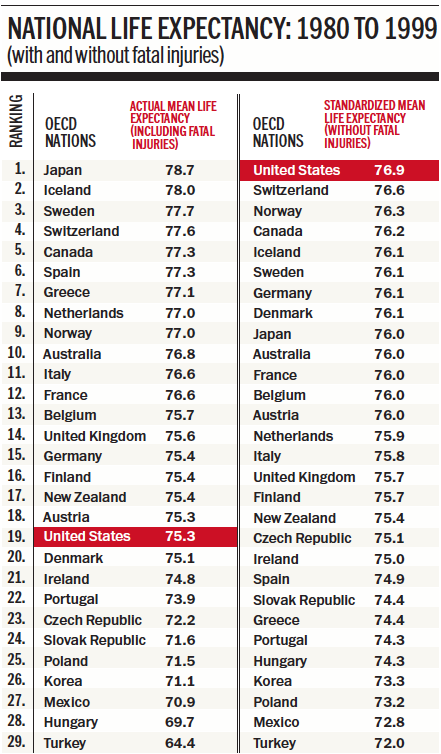
But what about life expectancy?

Life Expectency

When fatal injuries are removed, which occur before medical care can be applied, the US moves from 19 to [ahem] 1.