
Category Archives: Health Care

How To Afford Health Care

I’m reaching into the “Way Back Machine” and pulling out a post from a long time ago:

Much debate has been made about the uninsured in America. I have tried and tried and tried to make the point in my personal conversations that you can not claim you can’t afford thing “A” when you voluntarily spend the money that could purchase thing “A” and instead buy thing “B”. That is to say, if I have enough money to book, but instead purchase a DVD, I can not claim to be unable to buy the book. I simply decided to prioritize the DVD higher than the book.

The same is true of health insurance. If I have money to purchase health insurance but instead choose to buy thing “B”, I can not claim to be unable to afford health insurance. I just decided not to buy it. Now, I understand that there are things in life that seem to qualify as “must have”. Shelter, food and clothing to name a few. People even claim that an internet connection and phone service can qualify as required services. So I tried to find an item that in no way could be classified as “required”. I came up with lottery tickets.

Now, looking at uninsured data found at Carpe Diem, there seem to be three rough categories of people:
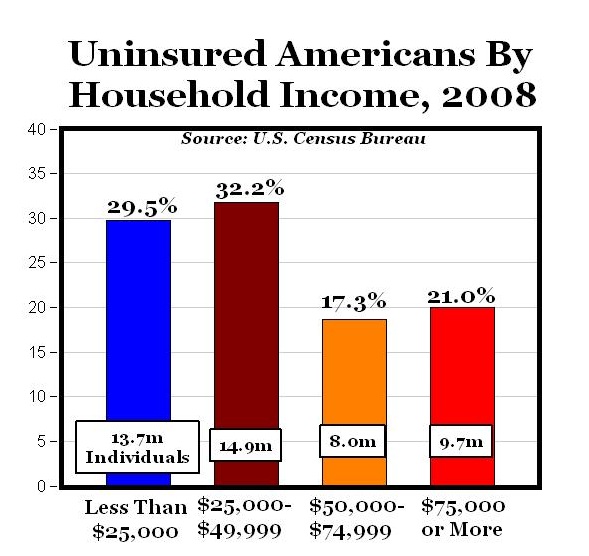
  1. Those that make less than $25,000 a year
  2. Those that make from $25,000 to $50,000 a year
  3. Those that make more than $50,000 a year

Those three breakdowns seem to describe the uninsured equally. About 30% of the uninsured population are in each category. Let’s see if my theory holds true for the lower income population.

Using data reported by 4 Professors at Duke University, we are able to see lottery participation rates as well as annual per capita amounts.

What it shows is remarkable. Combining the players making less than $25,000 per year we see that just about HALF of the population plays the lottery. Further, those people who play are spending near $600 a year! This means that these players have near $600 of annual disposable income that they are choosing to spend on the lottery. By going here, I can find a policy that covers a single 25-year-old man for $52 a month. Or, $612 a year – almost exactly what is being played on the lottery.

Given that a group of people have disposable income of near $600 and that an insurance policy costs nearly $600, can you realistically say that those folks are unable to afford health insurance?

Me either.

United States Ranks 37 in Health Care

Just look and see:

1  France
2  Italy
3  San Marino
4  Andorra
5  Malta
6  Singapore
7  Spain
8  Oman
9  Austria
10 Japan
11 Norway
12 Portugal
13 Monaco
14 Greece
15 Iceland
16 Luxembourg
17 Netherlands
18 United Kingdom
19 Ireland
20 Switzerland
21 Belgium
22 Colombia
23 Sweden
24 Cyprus
25 Germany
26 Saudi Arabia
27 United Arab Emirates
28 Israel
29 Morocco
30 Canada
31 Finland
32 Australia
33 Chile
34 Denmark
35 Dominica
36 Costa Rica
37 United States of America

It’s plain as day.

The United States sucks.

But I’d like to see even ONE of those other 36 nations do this:

Makayla Clary, of South Hill, Va., was a passenger on an ATV that suddenly tipped over.

“I initially found her at the accident and had to lift the ATV off of her,” her mother, Cheri Clay, said.

A helicopter carried Makayla to Duke hospital.

Catch that?  In order to provide treatment, a helicopter was employed.  And she was carried to Duke Hospital.  One of the world’s TOP facilities.

Okay, back to the news:

There, doctors said her legs were crushed and had severe cuts and swelling. It looked as if her right leg might need to be amputated, but her surgical team recommended waiting four more weeks, Duke plastic surgeon Dr. Detlev Erdman said.

During that time, Makayla underwent additional therapy, including hyperbaric oxygen treatments. In those, a person breathes pure oxygen in a sealed chamber with a pressure 1½ to three times greater than the normal atmosphere.

“With hyperbaric oxygen, we can actually decrease the swelling while simultaneously providing oxygen for those tissues which are not getting an adequate supply of oxygen,” said Dr. Bret Stolp, with Duke Hyperbaric Medicine.

Makayla spent two hours a day for two weeks in a hyperbaric chamber in pressure equivalent to diving 33 feet below sea level. A head tent fed her 100 percent oxygen.

The treatment accelerated Makayla’s treatment and helped save both her legs.

Recently, she was able to drop her crutches and take a few steps on her own.

“She took three steps towards me, and we just hugged and cried,” Clay said. “To go from an injury where half her leg is basically missing to having almost a complete limb now, it’s amazing.”

Makayla said her big motivation to get better is to return to the softball field, where she plays catcher on her school and recreation center teams.

From amputation to catcher on the softball team.

Not one other medical system on the list could have provided that treatment.  Expensive?  You betcha.  A feature or a bug?

Feature.

‘Nuff said.

Why Does Health Care Cost So Much?

The United States consistently ranks as one of the lowest advanced nations when it comes to health care.  To add further to the poor ranking of the US is the fact that we spend so much more money on our medical care than do other nations.  In terms of GDP, we outpace most, if not all, nations in the world.  We simply spend too much money.

The cost of medical care is one of the driving forces behind the call for this reform.  And for the most part, I’m all for that.  Generally speaking, reducing the amount of money we spend for a service or product is a good thing.  A good thing with one caveat:  Unless spending more on that thing is reported incorrectly.

For instance, suppose I enjoy minor league baseball.  And I spend $200 this year but will end up spending $400 next.  That can sound like a bad thing.  Unless, of course, it really means I went to twice as many games, in which case it’s a GREAT thing!

So, what are we spending all this money on and how can we fix it?

Continue reading

How Much Does Health Insurance Cost?

I haven’t posted this in awhile.  How much does health insurance cost?

In my ZIP code, a 30 year old man with no wife or kids can get coverage for $66.05 a month.

Are the uninsured really uninsured because they CAN’T be insured or because they CHOSE not to be insured?

Infant Mortality Rate: Numbers Matter

I think it’s important.

Plus, as we get closer and closer to election time, we’re gonna be discussing this more and more.

Plus, the debate is raging over at Poison Your Mind concerning it.

What is it?  What are we debating and how can there be a debate?

Well, it is Infant Mortality rates and how they can be used to measure a nation’s health care system.  Rightly or wrongly.

Continue reading

Rand Paul, Right To Health Care And Slavery

What does it mean to have a Right?  What is Liberty?

The answer to that question is fundamental to our nation; to how we see ourselves not only in this world, but in this creation.

What is it that we have a Right to?  What thing, what state of being, do we own simply by being alive?  What is it that is ours BEFORE the state? What is that thing, or group of things, that belongs to us not because of the state, but in spite of the state?

For me, that answer is simple.  It’s me.  My own self.  THAT is mine before the state.

And who would argue that defending myself, legally or forcefully, is not my right?

I am sovereign to myself.  I belong to me and my labor belongs to me.

Men erect governments not to reduce this natural or divine state of being, but to protect it.  We create relationships to assist in that protection.  We do not enter into a bond to reduce those things, but to enhance those things.  In short, it is the role of the state to maximize my sovereign right to myself; my Liberty.

In that context, I do NOT have a right to running water.  Rather, I have the right to expect water to be provided in the event I enter into a legally binding contract to procure that water for an agreed upon price.

So, know that we know what the state Ought do, does this make better sense?

Continue reading

Teacher Insurance Rates: Teachers Pay Their Own Premium

North Carolina is broke.  Ba-Roe-K.

Hear it people.  We have no more money and things are gonna have to change.  And one of those things is that people who used to have the State pay for things are now going to have to pay for those things themselves!

Some will say that this is a pay cut, but I disagree.  It’s not a pay cut.  After all, it can’t be a pay cut if you didn’t count it as pay to begin with!

Continue reading

It’s Hard Not To Be A Leftist

Or, Republicans Can Be Leftists Too!

We all want to what we think is the best for the folks under our care; at least I HOPE that’s what we wanna do.  Now, I understand that at the margin, there are politicians that do enter the system and play the game for the sole purpose of enriching themselves, either with power or money–or both.

By and large, however, I think they play the game in an effort to serve well.

And often times serving well means, or can mean, parenting.

Continue reading

United States and Medical Care: We’re #1

Of course we are.  No one really REALLY thinks that we’re not.

Some people, like those crazy guys that just moved in down the block, they DO think other parts of the world rank better.

Well, given the peculiarity of the health care market, and the fact that all other industrialized countries have a much less expensive, much more effective, it seems that too much government involvement is not the problem with our current health care system.

The problem is, of course, that it’s just not true.

Now, to be sure, there ARE studies that show the United States coming in some other place than first, but I don’t think the measurement system is really one that can be trusted to measure medical care delivery.  Afterall, they’re measuring things not really associated with medical care:

Mean Minimum Maximum
Health 25 20 40
Health Inequalities 30 20 30
Responsiveness Level 12.5 5 15
Responsiveness Distribution 12.5 5
Fair Financing 25 15 35

To be sure, some of these are fair measurements.  Others, however, not so much.  For example, Fair Financing.  This metric doesn’t speak to the quality of care, simply the amount of income to purchase it.  Others again, fail to measure the qualify of care given.  They simply measure distribution of said care.  Without a doubt the inclusion of such characteristics may be acceptable from your POLITICAL position, but it in no way measures the quality of care being delivered.

But really, the point I wanna make is this.  The world comes here for care.  We don’t go there.

In the past five years, would-be parents from as far as Istanbul and Uruguay have turned to healthy, young American mothers to serve as surrogates, according to the Detroit Free Press.

The babies are born U.S. citizens, but surrogacy agency officials say that’s not a primary motivation for the parents, who typically come from European and Latin American countries where surrogacy is illegal or socially unacceptable. The parents have exhausted other options and are willing to pay about $50,000 to $100,000 — part of which goes to the surrogate — to have biological children.

The world, having exhausted all other options, are willing t pay money to come to America to take advantage of our medical delivery services.

So, is the fact that people are willing, and ABLE mind you, to pay $50-$100k for a procedure, impacting the amount of money spent in American health care costs by the way, a good thing or a dirty rotten example of how America just sucks at all things medical care related?

Yeah.  That’s what I thought too.

Brad and Britt: Pre-existing Conditions

I was listening to the Brad and Britt Show last week and they were discussing the proposed changes to North Carolina public employee’s health insurance payments. Currently the State pays 100% of the health care premiums for its employees.  The new proposal would require employees to contribute $11 per month this year and then $22 per month next year.

Further, premiums would be subject to individual conditions as it relates to weight and smoking habits of those employees.  For example, if an individual was over weight, they may find that their premium would be higher than their svelte co-worker.  Similar to that concept is the idea of determining the premium based upon  smoking habits.  A smoker would face a higher premium than a non-smoker.

Given the Left-leaning tendancies of our hosts, I felt for sure that they would be against such discrimination.

I was pleasantly surprised.

Continue reading