
Category Archives: Government

Employment: Socioeconomics vs IQ – The Bell Curve

This post continues the comparison of the impact of the socioeconomic status of individuals and the IQ of those same individuals.  I’m going off the book “The Bell Curve” written by Herrnstein and Murray.  So far I’ve covered the comparison with respect to poverty and education.  This post will deal with employment, keeping it and looking for it.

Back when I started this series, I demonstrated data that spoke to each topic using SES data only.  For example, looking at the probability of being out of the labor force for 1 month or more in 1989 bases on SES, the data showed this:
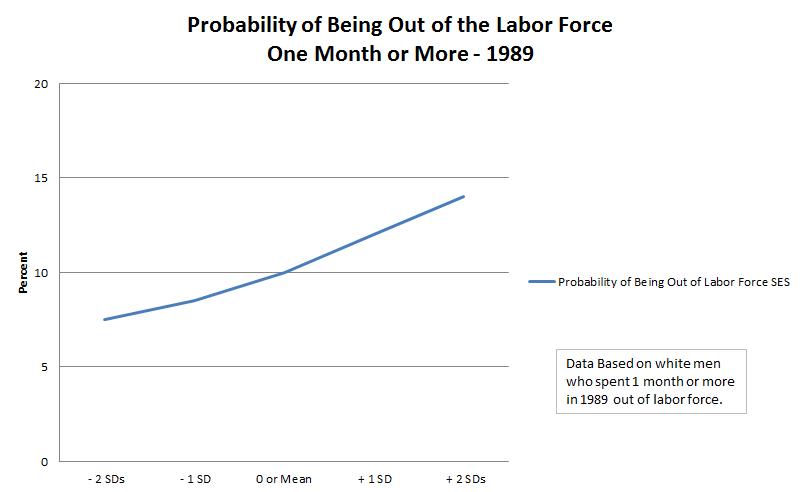
The data seems counter intuitive.  As the SES status of the family increased, the chance that a young man would drop out of the labor force increased as well.  This may be explained by the fact that wealthier families could afford to have their son’s not work for a time while those from poorer families felt a greater need to earn money.

Next we looked at unemployment.  That is, still in the labor force but not working for a month or more in 1989.  Here is the impact of SES:
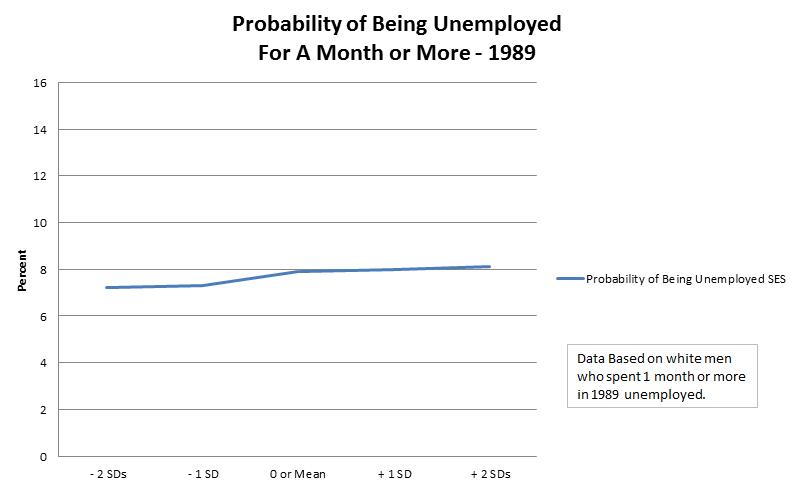
There is no impact.  The SES of the individual’s family doesn’t impact the unemployment of the young man.

Let’s compare SES and IQ.

First, go back to labor force participation:
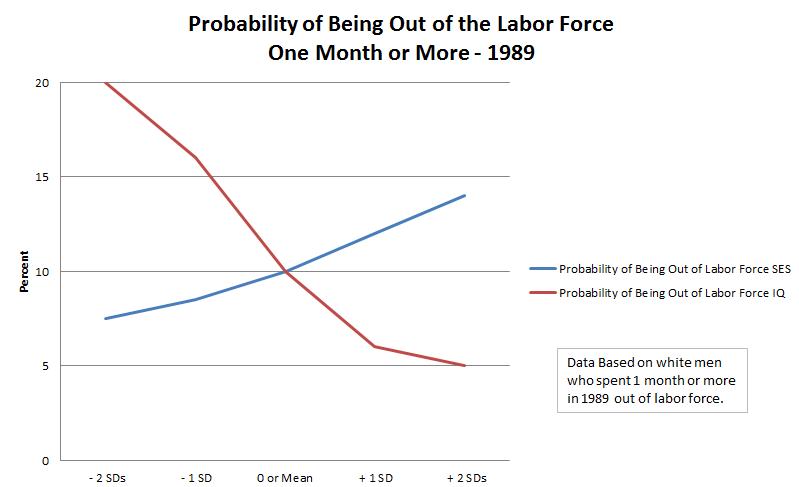
As man with very low IQ had a 4x percent chance of remaining out of the labor force compared to a man with very high IQ. Even moving in one standard deviation, the less intelligent man had more than twice the probability of staying out of the labor force than the more intelligent man.

Those men that are unemployed?
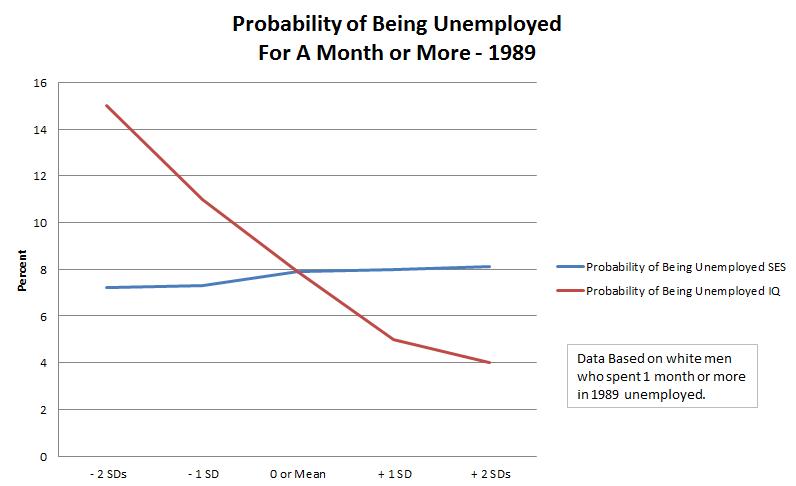
 

Again, not close.  While SES has non meaningful impact on the probability of unemployment, it’s clear that IQ does.  Mirroring labor force participation rate, the unemployment rate for the least intelligent is nearly 4x that of the most intelligent.

The idea that the SES of an individual or his family influences the fate of that person has significant influence in today’s debate.  And I’m sure that folks with money are more able to offset life’s unexpected challenges.  However, it may be that the intellectual ability of an individual has dramatically more impact on his or her success than the wealth, or lack thereof, of his or her family.

Human Rights

I was reading through the “About” section of “A Voice From the Foothills.”  Basically a mission statement, very well stated, thought out and rather impressive.   However, when I hit #2 I verbally sighed:

We Believe in basic human rights that are the right of any individual as a result of being born. These are the right to sufficient nourishing food, clothing, and shelter. People have a right to good education for their children. They have a right to health care of equal quality as of any that can be paid for. We believe in meaningful employment at decent wages and under safe working conditions. People have a right to reasonable time to recreate and rest.

I bump into this concept often enough that I thought it worth a full post rather than just a comment over at Sherry’s place.   So here goes.

I think that a very large number of people confuse “human rights” with “doing the right thing” kinda stuff.  When I mention liberty, individual rights or basic human rights, I’m talking about those concepts that are “endowed” by nature or by God.  Such things as the right of speech, the right to pursue happiness the right to individual property.  These are things that belong to individuals a priori of the concept of government or society.  That is, my right to speech is the same if I am prehistoric man living a life of isolation [speech in this case might be freedom of expression] as it is if I’m a nomadic hunter as it is if I’m a citizen of Rome, Greece or the United States.

That is, the right to these things is not given to me by the state.  Indeed, it is the unfortunate fact that it is often the state that restricts these rights over the history of man.  Further, these rights require nothing else from any other living person.  My right to the pursuit of happiness is mine without assistance from anyone.  In fact, if I did try to claim that another man enable my right to happiness, I am infringing upon HIS right to his happiness.  I have no claim over another individual.

Natural rights aside, there are things that we as moral beings Capital “O” Ought to do.  We Ought look out for each other.  We Ought care for those of us in need.  We Ought say thank you and please.  We Ought do many many things.  But those Oughts are not the same things as Human Rights in the way that I mean them.  They may be things that a decent and caring person does for another, but they do not exist in a manner that one person can claim them of another person.

Finally there are legal rights.  For example, in some nations in Europe, there exists the right to high speed bandwidth.  Here in America there is the legal right to a cell phone.  Again, here in America, I have the legal right to exempt some of my income that is used to pay the mortgage on my home.  These are legislated rights that are neither endowed OR things that would be reasonably considered an Ought.  Legal rights.

I think that if we seriously considered the difference in the three we would be better off.  For example, the most recent and obvious example is healthcare.  When taken in the context of the three examples I’ve described, there is no human right to healthcare.  A living individual has no right of compulsion to force another individual to labor for her health.  And this compulsion can either be the literal forcing of a doctor to perform medical care for the patient or the compulsion of someone to pay the willing doctor to do the same.

Healthcare may be, and I would argue it is, an Ought.  We as a civilized humanity Ought to care for our neighbors, our friends and our citizens.  But we cannot coerce each other in the name of human rights.  The same logic applies to such concepts as food.  As unemployment benefits.  And many of the other things that we want to have other people do for the less fortunate.

So no, I do not accept the concept that healthcare is a human right.  And debate we have after that is going to devolve due to the fact that we’re discussing different things.

The Law

100 days left until my daughter will get her copy of “The Law” by Frederic Bastiat

Existence, faculties, assimilation—in other words, personality, liberty, property—this is man.

It is of these three things that it may be said, apart from all demagogic subtlety, that they are anterior and superior to all human legislation.

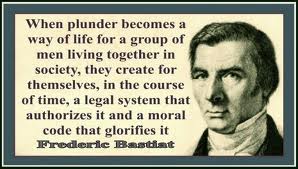
It is not because men have made laws, that personality, liberty, and property exist. On the contrary, it is because personality, liberty, and property exist beforehand, that men make laws. What, then, is law? As I have said elsewhere, it is the collective organization of the individual right to lawful defense.

Nature, or rather God, has bestowed upon every one of us the right to defend his person, his liberty, and his property, since these are the three constituent or preserving elements of life; elements, each of which is rendered complete by the others, and that cannot be understood without them. For what are our faculties, but the extension of our personality? and what is property, but an extension of our faculties?

If every man has the right of defending, even by force, his person, his liberty, and his property, a number of men have the right to combine together to extend, to organize a common force to provide regularly for this defense.

This then, is the proper role of government.  There is no right to life at the expense of another man’s labor.

Question On Taxes And Revenues

If an individual is a net Federal Income Tax receiver, is a reduction in the amount of money he receives from the Federal Government a tax hike for him?

I suspect that the answer is “yes.”  Exemptions that are removed seem to be treated as tax hikes.

For illustration, I own a home.  If the mortgage interest deduction would go away I would pay more taxes.  I can see me arguing that would be equal to a tax increase.   And since there is no income level that carries a negative tax bracket, any change in tax policy that would diminish a payment or reduce a deduction would be seen as a tax hike.

I’m only thinking this through right now.  I’m reading the report from the Tax Policy Center on how the plan offered by Romney would impact the tax picture for all of us.

I have two thoughts besides the one above:

  1. Why do we need to be revenue neutral?  Why can’t we cut taxes and just quit spending so much money?
  2. This sentence from the same organization bothers me: “An estimated 42 percent of the 76 million nontaxable tax units will have negative liability in 2011.”

A tax is an amount of money that an individual PAYS to the government.  Reducing the amount of money that someone GETS from the government might not be labelled a tax INCREASE.  In fact, I happen to think that labeling government entitlement programs as “tax cuts” has been a method to get those programs passed.  And this is long before Obama stepped into the White House [DUBYA!]

Serious.  42% of 76 million is a lot of people who are takers.  And 76 million out of 300 million is a  lot of non-payers!

Are You Smarter Than A Six Year Old?

This evening I was with my kid and we stopped at the bank.  I had a check to deposit and then I needed some cash.

As we drove away from the drive through ATM the young lad asked me, “Daddy, how much money did you get?”  I replied, “One hundred dollars.”

He scrunched his little face and asked if that was 2 bills?  When I told  him that it wasn’t, rather five bills; $20 bills each.

He then asked if he could have one.  When I answered that, indeed, he couldn’t, he grew a little frustrated.  “But daddy, I don’t have ANY money and you would STILL have 80 bucks!  You would STILL have more money than I would.”

It struck me how parallel his argument is with the liberals in government.

The Upside To Obtructionist Congress

The upside to congress getting nothing done?  It’s obvious, the answer is that congress does nothing.  And in this case, I actually can’t fault the democrats for slowing down the republicans:

A second typo is slowing down House work on a bill aimed at limiting federal regulations.

Work stalled after Republicans made a typographical error in a measure that had been quickly developed to replace an earlier measure that included an embarrassing typo.

The bill, H.R. 4078, was intended to prevent new federal rules until the unemployment rate falls to 6 percent, but instead referred to the “employment” rate.

To fix that, the House Rules Committee approved a rule that, once passed by the House, would deem the bill to be corrected to say “unemployment.” But that rule incorrectly refers to the main rule for the bill as H.Res. 783, when it should have said H.Res. 738.

One typo is just that, a typo; fix it.  Two typos on the same bill, where the second one is in response to fixing the first?

Slow down.  Or better yet, stop.

Obamacare’s Taxes And The Impact On Jobs

Romney says that he knows why jobs come and why jobs go.  Obama doesn’t.

Barack Obama feels a sense of charity.  And he thinks that government should act on that charity.

Are there people who get sick or hurt and can’t afford their care?  Well, by golly, the government should step in and perform that charity.

But when he realizes that people respond in rational ways, he becomes confused and then angry.  “Why won’t people just DO the right thing?  Why won’t they accept the added burden of Barack’s charity and continue to hire?”

An Indiana-based medical equipment manufacturer says it’s scrapping plans to open five new plants in the coming years because of a looming tax tied to President Obama’s health care overhaul law.

Cook Medical claims the tax on medical devices, set to take effect next year, will cost the company roughly $20 million a year, cutting into money that would otherwise go toward expanding into new facilities over the next five years.

“This is the equivalent of about a plant a year that we’re not going to be able to build,” a company spokesman told FoxNews.com.

He said the original plan was to build factories in “hard-pressed” Midwestern communities, each employing up to 300 people. But those factories cost roughly the same amount as the projected cost of the new tax.

“In reality, we’re not looking at the U.S. to build factories anymore as long as this tax is in place. We can’t, to be competitive,” he said.

This is why companies move jobs overseas.  The government forces the price of labor to the point that such labor isn’t competitive.

By the way, to answer the question above, “Why won’t they accept the added burden of Barack’s charity and continue to hire?”  I suspect that he would say that they are greedy.

Romney: I know Why Jobs Come And Why They Go

Without a doubt the main focus on the election so far has been the economy and the lack of jobs.  On one hand you have Romney claiming that he knows how business works, how the economy works.  On the other hand, you have Obama claiming that Romney simply guts American jobs while making himself wealthy.

I think it’s important to note that Obama never runs any ads claiming that HE knows how to grow jobs.

Anyway, I was going through some Obama commercials and found this one:

The point of the ad is that Romney took companies here in America and sent their jobs to other countries, countries like China and India.  The impression being that Romney doesn’t grow jobs, rather, he outsources American jobs.

It’s effective ’till you think it through, which I grant you, isn’t likely to happen considering the American electorate.

Romney claims, “I know how business works.  I know why jobs come and why they go.”  That claim is entirely truthful as it relates to his owning Bain, his restructuring companies and his sending jobs overseas.  When businessmen look at the state of the company before them, one of the things they look at is labor.  And they make a value based decision on where that labor might be better obtained.  Many many things are considered; ease of transition, cost of shipping, risk of client dissatisfaction due to hard accents, time zone difficulties and education of labor force.  And yes, included in that calculation is the tax and wage burden of the companies.

Romney knows why he sent those jobs overseas.  Because regulations and restrictions here in America make it more expensive than it has to be.  Moving work to another country is a painful and difficult decision to come by.  Making that transition is very difficult.  But no one does it because they WANT to.  They do it because business demands it.

Romney doesn’t say that he’s going to outsource jobs.  Not at all.  What he says is that he knows why people do it.  And that he’s going to change those reasons and incent businesses to keep labor here.

And THAT is something that Obama hasn’t clue one about.

Obstructionist Congress – Only They And Never Me

Obama has been lashing out at congress.  In fact, democrats in general blame congress for failing to pass his legislation referring to them as a “Do-Nothing Congress.”

President Obama and his supporters are well aware that Friday’s jobs report is an ugly mess. But they’re trying to gain the high ground by shifting attention to Congress, highlighting a number of White House jobs proposals that have languished under the GOP-controlled House of Representatives.

In a trip to a Honeywell factory in Minnesota Friday, Obama responded to the dismal news with a speech demanding Congress take action on a variety of measures, including infrastructure investments and aid to state and local governments to prevent teachers, firefighters and police from being laid off, that Republicans have thus far opposed. He also announced a new initiative to encourage private employers to hire returning veterans.

“We’ve got responsibilities that are bigger than an election,” Obama said. “We’ve got responsibilities to you. So my message to Congress is: Now is not the time to play politics, now is not the time to sit on your hands, the American people expect their leaders to work hard no matter what year it is.”

I wonder what the President would say regarding the latest shenanigans taking place in the lower chamber:

Republicans and Democrats got snippy on the House floor Wednesday over a typo in a GOP deregulation bill, which Democrats have so far refused to let Republicans fix quickly on the floor by unanimous consent.

The bill, H.R. 4078, is meant to prohibit major federal regulations until the unemployment rate falls to 6 percent, but instead says no new regulations can be issued until the employment rate falls to 6 percent.

Earlier in the day, Minority Whip Steny Hoyer (D-Md.) said he would not grant unanimous consent to add “un” to the word “employment” and thus fix the bill on the floor. And Wednesday afternoon, Rep. Gerry Connolly (D-Va.) indicated that Democrats were not willing yet to allow the quick fix.

House Oversight and Government Affairs Committee Chairman Darrell Issa (R-Calif.) asked Connolly if he would object to a unanimous consent request to make the correction. Issa cast the error as a mistake made by professional staff.

But in reply, Connolly said, “This member will reserve the right to object at the appropriate time.”

“Nothing could be more insincere than to pick on professional staff on a typographical error,” Issa shot back. “If we have to… go to the Rules Committee, I guess we will, but I’m really sorry to see that kind of an attitude on what the gentleman and all of us know was simply a typographical error.”

Connolly then took umbrage with Issa’s remark, and asked the presiding officer, “Did this member hear… the distinguished chairman of the Oversight and Government Reform Committee characterize a member as insincere?”

Truly doing the people’s will.

Now, to be fair, the more we can restrain Washington from passing laws, the better off we are, so, I must find myself congratulating the Do-Nothing Democrats of the House!!

Barack Obama: Government Invented The Internet

For the record, I said this first:

Contrary to what Obama would have you believe, it wasn’t the government that created the internet, it was individuals engaging in business that invented the internet.

Now, from the Wall Street Journal:

It’s an urban legend that the government launched the Internet. The myth is that the Pentagon created the Internet to keep its communications lines up even in a nuclear strike. The truth is a more interesting story about how innovation happens—and about how hard it is to build successful technology companies even once the government gets out of the way.

For many technologists, the idea of the Internet traces to Vannevar Bush, the presidential science adviser during World War II who oversaw the development of radar and the Manhattan Project. In a 1946 article in The Atlantic titled “As We May Think,” Bush defined an ambitious peacetime goal for technologists: Build what he called a “memex” through which “wholly new forms of encyclopedias will appear, ready made with a mesh of associative trails running through them, ready to be dropped into the memex and there amplified.”

That fired imaginations, and by the 1960s technologists were trying to connect separate physical communications networks into one global network—a “world-wide web.” The federal government was involved, modestly, via the Pentagon’s Advanced Research Projects Agency Network. Its goal was not maintaining communications during a nuclear attack, and it didn’t build the Internet. Robert Taylor, who ran the ARPA program in the 1960s, sent an email to fellow technologists in 2004 setting the record straight: “The creation of the Arpanet was not motivated by considerations of war. The Arpanet was not an Internet. An Internet is a connection between two or more computer networks.”

If the government didn’t invent the Internet, who did? Vinton Cerf developed the TCP/IP protocol, the Internet’s backbone, and Tim Berners-Lee gets credit for hyperlinks.

But full credit goes to the company where Mr. Taylor worked after leaving ARPA: Xerox. It was at the Xerox PARC labs in Silicon Valley in the 1970s that the Ethernet was developed to link different computer networks. Researchers there also developed the first personal computer (the Xerox Alto) and the graphical user interface that still drives computer usage today.

But, did the government impact the creation of the Internet in any way?

As for the government’s role, the Internet was fully privatized in 1995, when a remaining piece of the network run by the National Science Foundation was closed—just as the commercial Web began to boom. Blogger Brian Carnell wrote in 1999: “The Internet, in fact, reaffirms the basic free market critique of large government. Here for 30 years the government had an immensely useful protocol for transferring information, TCP/IP, but it languished. . . . In less than a decade, private concerns have taken that protocol and created one of the most important technological revolutions of the millennia.”

Other than delaying the innovation for 30 years, the government seems to have done not a thing.