Tag Archives: Barack Obama

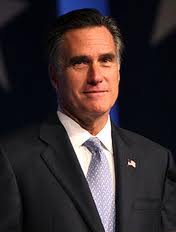
Romney: I know Why Jobs Come And Why They Go

Without a doubt the main focus on the election so far has been the economy and the lack of jobs.  On one hand you have Romney claiming that he knows how business works, how the economy works.  On the other hand, you have Obama claiming that Romney simply guts American jobs while making himself wealthy.

I think it’s important to note that Obama never runs any ads claiming that HE knows how to grow jobs.

Anyway, I was going through some Obama commercials and found this one:

The point of the ad is that Romney took companies here in America and sent their jobs to other countries, countries like China and India.  The impression being that Romney doesn’t grow jobs, rather, he outsources American jobs.

It’s effective ’till you think it through, which I grant you, isn’t likely to happen considering the American electorate.

Romney claims, “I know how business works.  I know why jobs come and why they go.”  That claim is entirely truthful as it relates to his owning Bain, his restructuring companies and his sending jobs overseas.  When businessmen look at the state of the company before them, one of the things they look at is labor.  And they make a value based decision on where that labor might be better obtained.  Many many things are considered; ease of transition, cost of shipping, risk of client dissatisfaction due to hard accents, time zone difficulties and education of labor force.  And yes, included in that calculation is the tax and wage burden of the companies.

Romney knows why he sent those jobs overseas.  Because regulations and restrictions here in America make it more expensive than it has to be.  Moving work to another country is a painful and difficult decision to come by.  Making that transition is very difficult.  But no one does it because they WANT to.  They do it because business demands it.

Romney doesn’t say that he’s going to outsource jobs.  Not at all.  What he says is that he knows why people do it.  And that he’s going to change those reasons and incent businesses to keep labor here.

And THAT is something that Obama hasn’t clue one about.

Obstructionist Congress – Only They And Never Me

Obama has been lashing out at congress.  In fact, democrats in general blame congress for failing to pass his legislation referring to them as a “Do-Nothing Congress.”

President Obama and his supporters are well aware that Friday’s jobs report is an ugly mess. But they’re trying to gain the high ground by shifting attention to Congress, highlighting a number of White House jobs proposals that have languished under the GOP-controlled House of Representatives.

In a trip to a Honeywell factory in Minnesota Friday, Obama responded to the dismal news with a speech demanding Congress take action on a variety of measures, including infrastructure investments and aid to state and local governments to prevent teachers, firefighters and police from being laid off, that Republicans have thus far opposed. He also announced a new initiative to encourage private employers to hire returning veterans.

“We’ve got responsibilities that are bigger than an election,” Obama said. “We’ve got responsibilities to you. So my message to Congress is: Now is not the time to play politics, now is not the time to sit on your hands, the American people expect their leaders to work hard no matter what year it is.”

I wonder what the President would say regarding the latest shenanigans taking place in the lower chamber:

Republicans and Democrats got snippy on the House floor Wednesday over a typo in a GOP deregulation bill, which Democrats have so far refused to let Republicans fix quickly on the floor by unanimous consent.

The bill, H.R. 4078, is meant to prohibit major federal regulations until the unemployment rate falls to 6 percent, but instead says no new regulations can be issued until the employment rate falls to 6 percent.

Earlier in the day, Minority Whip Steny Hoyer (D-Md.) said he would not grant unanimous consent to add “un” to the word “employment” and thus fix the bill on the floor. And Wednesday afternoon, Rep. Gerry Connolly (D-Va.) indicated that Democrats were not willing yet to allow the quick fix.

House Oversight and Government Affairs Committee Chairman Darrell Issa (R-Calif.) asked Connolly if he would object to a unanimous consent request to make the correction. Issa cast the error as a mistake made by professional staff.

But in reply, Connolly said, “This member will reserve the right to object at the appropriate time.”

“Nothing could be more insincere than to pick on professional staff on a typographical error,” Issa shot back. “If we have to… go to the Rules Committee, I guess we will, but I’m really sorry to see that kind of an attitude on what the gentleman and all of us know was simply a typographical error.”

Connolly then took umbrage with Issa’s remark, and asked the presiding officer, “Did this member hear… the distinguished chairman of the Oversight and Government Reform Committee characterize a member as insincere?”

Truly doing the people’s will.

Now, to be fair, the more we can restrain Washington from passing laws, the better off we are, so, I must find myself congratulating the Do-Nothing Democrats of the House!!

Barack Obama: Giving Something Back

At that small little firehouse in Virginia, Mr. Obama gave us a very real look into his philosophy.  Key among that is how success is built.  Let’s look at his words more carefully:

There are a lot of wealthy, successful Americans who agree with me — because they want to give something back.  They know they didn’t — look, if you’ve been successful, you didn’t get there on your own.  You didn’t get there on your own.  I’m always struck by people who think, well, it must be because I was just so smart.  There are a lot of smart people out there.  It must be because I worked harder than everybody else.  Let me tell you something — there are a whole bunch of hardworking people out there.  (Applause.)

If you were successful, somebody along the line gave you some help.  There was a great teacher somewhere in your life.  Somebody helped to create this unbelievable American system that we have that allowed you to thrive.  Somebody invested in roads and bridges.  If you’ve got a business — you didn’t build that.  Somebody else made that happen.  The Internet didn’t get invented on its own.  Government research created the Internet so that all the companies could make money off the Internet.

So, from his words we see that Obama feels that our success is not ours alone:

They know they didn’t — look, if you’ve been successful, you didn’t get there on your own.  You didn’t get there on your own.

So, why are we successful?

If you were successful, somebody along the line gave you some help.

And that help was?

There was a great teacher somewhere in your life.  Somebody helped to create this unbelievable American system that we have that allowed you to thrive.  Somebody invested in roads and bridges.

And because of all this help, what are we expecting the successful among us to do?

There are a lot of wealthy, successful Americans who agree with me — because they want to give something back.

But I’m struck….how did all that help get there in the first place?  I’ll leave that to Thomas Sowell via Mark Perry:

All the high-flown talk about how people who are successful in business should “give back” to the community that created the things that facilitated their success is, again, something that sounds plausible to people who do not stop and think through what is being said. After years of dumbed-down education, that apparently includes a lot of people.

Take Obama’s example of the business that benefits from being able to ship their products on roads that the government built. How does that create a need to “give back”? Did the taxpayers, including business taxpayers, not pay for that road when it was built? Why should they have to pay for it twice?

What about the workers that businesses hire, whose education is usually created in government-financed schools? The government doesn’t have any wealth of its own, except what it takes from taxpayers, whether individuals or businesses. They have already paid for that education. It is not a gift that they have to “give back” by letting politicians take more of their money and freedom.

When businesses hire highly educated people, such as chemists or engineers, competition in the labor market forces them to pay higher salaries for people with longer years of valuable education. That education is not a government gift to the employers. It is paid for while it is being created in schools and universities, and it is paid for in higher salaries when highly educated people are hired.

One of the tricks of professional magicians is to distract the audience’s attention from what they are doing while they are creating an illusion of magic. Pious talk about “giving back” distracts our attention from the cold fact that politicians are taking away more and more of our money and our freedom.

Why should they have to pay for it twice?  Indeed.

Barack Obama: Government Invented The Internet

For the record, I said this first:

Contrary to what Obama would have you believe, it wasn’t the government that created the internet, it was individuals engaging in business that invented the internet.

Now, from the Wall Street Journal:

It’s an urban legend that the government launched the Internet. The myth is that the Pentagon created the Internet to keep its communications lines up even in a nuclear strike. The truth is a more interesting story about how innovation happens—and about how hard it is to build successful technology companies even once the government gets out of the way.

For many technologists, the idea of the Internet traces to Vannevar Bush, the presidential science adviser during World War II who oversaw the development of radar and the Manhattan Project. In a 1946 article in The Atlantic titled “As We May Think,” Bush defined an ambitious peacetime goal for technologists: Build what he called a “memex” through which “wholly new forms of encyclopedias will appear, ready made with a mesh of associative trails running through them, ready to be dropped into the memex and there amplified.”

That fired imaginations, and by the 1960s technologists were trying to connect separate physical communications networks into one global network—a “world-wide web.” The federal government was involved, modestly, via the Pentagon’s Advanced Research Projects Agency Network. Its goal was not maintaining communications during a nuclear attack, and it didn’t build the Internet. Robert Taylor, who ran the ARPA program in the 1960s, sent an email to fellow technologists in 2004 setting the record straight: “The creation of the Arpanet was not motivated by considerations of war. The Arpanet was not an Internet. An Internet is a connection between two or more computer networks.”

If the government didn’t invent the Internet, who did? Vinton Cerf developed the TCP/IP protocol, the Internet’s backbone, and Tim Berners-Lee gets credit for hyperlinks.

But full credit goes to the company where Mr. Taylor worked after leaving ARPA: Xerox. It was at the Xerox PARC labs in Silicon Valley in the 1970s that the Ethernet was developed to link different computer networks. Researchers there also developed the first personal computer (the Xerox Alto) and the graphical user interface that still drives computer usage today.

But, did the government impact the creation of the Internet in any way?

As for the government’s role, the Internet was fully privatized in 1995, when a remaining piece of the network run by the National Science Foundation was closed—just as the commercial Web began to boom. Blogger Brian Carnell wrote in 1999: “The Internet, in fact, reaffirms the basic free market critique of large government. Here for 30 years the government had an immensely useful protocol for transferring information, TCP/IP, but it languished. . . . In less than a decade, private concerns have taken that protocol and created one of the most important technological revolutions of the millennia.”

Other than delaying the innovation for 30 years, the government seems to have done not a thing.

“You Didn’t Build That” – Out Of Context

Obama is taking a lot of heat for his comments in Virgina.  It was in that speech that he made the now infamous, “If you have a business, you didn’t build that.”  The republicans are going crazy with the clip, using it in every ad they can put on TV or the radio.  They’ve got it on Facebook and Twitter.  Obama saying that business owners didn’t build “that.”

And the left is going nuts over context.

First, I’ve always said that the remark IS out of context.  The president clearly was referring to roads and bridges when he mentioned “that.”

Second, this is politics.  These same people who are now fainting over context were no where to be seen when Romney was quoted as saying, “I like to fire people.”  No one was complaining about context when Romney’s comments on self-check out lines was doctored.  It is what it is.

Third, and this is the biggie for me, Obama BELIEVES the message that the republicans are pushing in the out of context quote.  Two months ago, if you were to ask Obama if he felt that businesses were built by their owners or with help from the government, he’d tell you that of COURSE it was built with the help of the government.  Heck, he’s saying that in the speech.

So, here are his remarks:

THE PRESIDENT:  Well, first of all, like I said, the only way you can pay for that — if you’re actually saying you’re bringing down the deficit — is to cut transportation, cut education, cut basic research, voucherize Medicare, and you’re still going to end up having to raise taxes on middle-class families to pay for this $5 trillion tax cut.  That’s not a deficit reduction plan.  That’s a deficit expansion plan.

I’ve got a different idea.  I do believe we can cut — we’ve already made a trillion dollars’ worth of cuts.  We can make some more cuts in programs that don’t work, and make government work more efficiently.  (Applause.)  Not every government program works the way it’s supposed to.  And frankly, government can’t solve every problem.  If somebody doesn’t want to be helped, government can’t always help them.  Parents — we can put more money into schools, but if your kids don’t want to learn it’s hard to teach them.  (Applause.)

But you know what, I’m not going to see us gut the investments that grow our economy to give tax breaks to me or Mr. Romney or folks who don’t need them.  So I’m going to reduce the deficit in a balanced way.  We’ve already made a trillion dollars’ worth of cuts.  We can make another trillion or trillion-two, and what we then do is ask for the wealthy to pay a little bit more.  (Applause.)  And, by the way, we’ve tried that before — a guy named Bill Clinton did it.  We created 23 million new jobs, turned a deficit into a surplus, and rich people did just fine.  We created a lot of millionaires.

There are a lot of wealthy, successful Americans who agree with me — because they want to give something back.  They know they didn’t — look, if you’ve been successful, you didn’t get there on your own.  You didn’t get there on your own.  I’m always struck by people who think, well, it must be because I was just so smart.  There are a lot of smart people out there.  It must be because I worked harder than everybody else.  Let me tell you something — there are a whole bunch of hardworking people out there.  (Applause.)

If you were successful, somebody along the line gave you some help.  There was a great teacher somewhere in your life.  Somebody helped to create this unbelievable American system that we have that allowed you to thrive.  Somebody invested in roads and bridges.  If you’ve got a business — you didn’t build that.  Somebody else made that happen.  The Internet didn’t get invented on its own.  Government research created the Internet so that all the companies could make money off the Internet.

And now, finally, the press is getting around to going after Romney over the context of the quote that he’s using.  And his response?  Just like I’ve been saying.

LARRY KUDLOW: “Why do you think President Obama, what did he mean, if you’ve got a business, you didn’t build it, someone else made that happen? He claims it’s being taken out of context. What do you think it means? Do you think this is Obama anti-business, anti-entrepreneur? Or do you think maybe he has been treated unfairly?”

GOV. ROMNEY: “Well, just read the whole speech. I found the speech even more disconcerting than just that particular line. The context is worse than the quote. The context, he says, you know, you think you’ve been successful because you’re smart, but he says a lot of people are smart. You think you’ve been successful because you work hard, a lot of people work hard. This is an ideology which says hey, we’re all the same here, we ought to take from all and give to one another and that achievement, individual initiative and risk-taking and success are not to be rewarded as they have in the past. It’s a very strange and in some respects foreign to the American experience type of philosophy. We have always been a nation that has celebrated success of various kinds. The kid that gets the honor roll, the individual worker that gets a promotion, the person that gets a better job. And in fact, the person that builds a business. And by the way, if you have a business and you started it, you did build it. And you deserve credit for that. It was not built for you by government. And by the way, we pay for government. Government doesn’t come free. The people who begin enterprises, the people who work in enterprises, they’re the ones paying for government. So his whole philosophy is an upside-down philosophy that does not comport with the American experience. And if we want to get people working again–and that’s my priority–if we want to get people working again, we have to celebrate success and achievement and not demonize it and denigrate the people who have worked hard, who are smart, who have made the kinds of investments to build a brighter future.”

The context of the quote is worse than the quote.  Obama’s using the success of the business owner as a lever to force him to pay more taxes.  And he hides behind “they wanna give something back.”

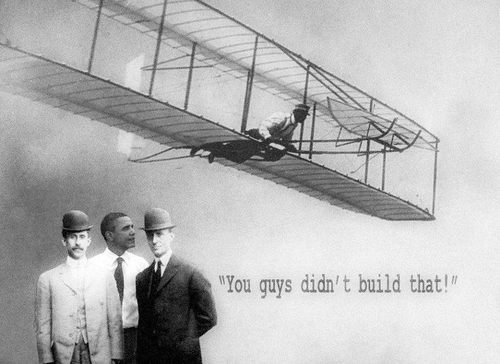
You Didn’t Build That

More and more Americans are waking up to the core beliefs this man has.  He’s a big government statist.  He thinks he can spend your money better than you.  And he believes, honest to God believes, that government builds people and not the other way around.

Each one of these people represents a qualification of leadership and accomplishment that he doesn’t.

Obstructionist Congress

Congress is having a hard time getting anything done.  This is true in general but has been especially true with this specific session.  The common complain from the left is that the minority won’t even let votes come to the floor and live by a simple majority.  Everything requires 60 vote to pass.

The republicans are just blocking everything Obama wants to do.  For example:

Senate Republicans on Thursday blocked an “insourcing” bill from Democrats that would have ended tax breaks for companies that move jobs overseas.

The Bring Jobs Home Act also would have given a tax incentives to companies that bring jobs back to the United States. The measure failed to advance on a 56-42 vote, with 60 votes needed to end debate on the bill.

Earlier in the week, Republicans also blocked the Disclose Act, which would have required the disclosure of campaign contributions of more than $10,000.

Seemingly another example of the republicans abusing the power of the minority.  However, might there be another side to the story?

Republicans were considering supporting the insourcing bill until Senate Majority Leader Harry Reid (D-Nev.) said he wouldn’t include any GOP amendments.

The democrats have “ruled” as the majority since Obama took office.  He even referred to his unwillingness to consider republican ideas when has said, “I won.”  There may be fewer bills being passed, there certainly is debate on whether that’s a feature or a bug.  But f blame is going to be cast, it needs to be cast where it belongs.

The Rich Don’t Pay Their Fair Share

Obama’s now famous quote out of Virgina, ” If you’ve got a business — you didn’t build that.  Somebody else made that happen. ” is surprising not because he believes that.  No, it’s surprising because he actually said it out loud.

Everybody knows that Obama is a big government guy.  We all know that he sees the world through the lens of unequal results rather than unequal opportunities.  But one has to wonder if Obama himself hasn’t channeled the villains in Atlas Shrugged:

“He didn’t invent iron ore and blast furnaces, did he?”

“Who?”

“Rearden. He didn’t invent smelting and chemistry and air compression. He couldn’t have invented his Metal but for thousands and thousands of other people. His Metal! Why does he think it’s his? Why does he think it’s his invention? Everybody uses the work of everybody else. Nobody ever invents anything.”

She said, puzzled, “But the iron ore and all those other things were there all the time. Why didn’t anybody else make that Metal, but Mr. Rearden did?”

If it were as easy as picking mangos that had dropped from the tree, everyone would be a mango seller.*

But the context of Obama’s speech wasn’t about government building out infrastructure, it was about the rich paying more taxes; paying their fair share.  But what is that fair share?  Ask a liberal and you’ll get a look that’s either:

  1. Glassy and confused
  2. Arrogantly silent – as if the question is beneath them to answer

But tell them that the rich already pay their fair share and they’ll start to object.  Tell them that they pay MORE than their fair share and you’ll see real denial.

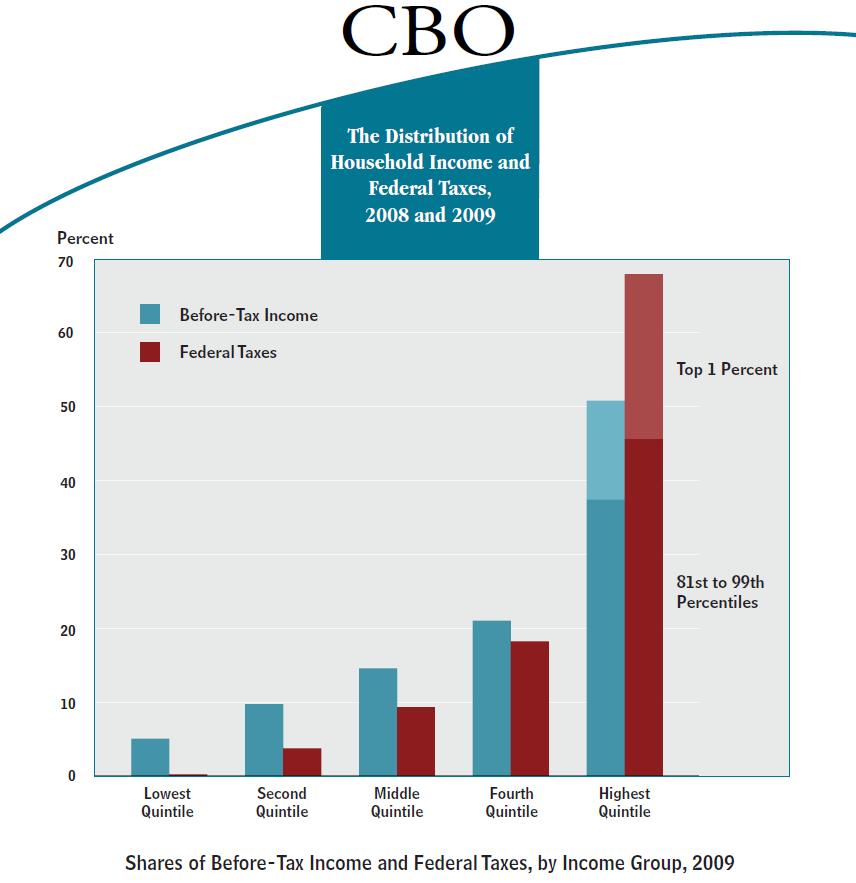
Take the above chart.

Every single income group earns more share of the income than they pay share of taxes.  Everyone, that is, except the wealthy.

Fair indeed.

* My wife’s family is Puerto Rican; I visit often.  Every time I visit when the mangos are in season, there are people with bags gathering them from the little rural roads.  It’s dangerous enough to drive those narrow winding roads, but with the folks on the roads to boot?  Anyway, these people then lug the mangos 1/8 of a mile to the main road and sell them to people driving by.  Mangos literally lying in the ditch are picked by some people and sold to to others.  This makes me think of liberals every time.

You Didn’t Build That

Obama: Government Invented The Internet

You might have heard by now that Obama gave a speech in Virgina.  And in that speech he made a statement.  He made a statement that individuals can’t claim credit for their successes.  Rather, they must acknowledge that what they have labored to craft is the result of the collective.  And, more importantly, that leading the way is the government.  After all, it invented the internet.

Right?

Maybe not.

Most people give credit to the invention of the internet to ARPANet, a DOD agency.

The Advanced Research Projects Agency Network (ARPANET) was the world’s first operational packet switching network and the core network of a set that came to compose the global Internet. The network was funded by the Defense Advanced Research Projects Agency (DARPA) of the United States Department of Defense for use by its projects at universities and research laboratories in the US. The packet switching of the ARPANET was based on designs by Lawrence Roberts of the Lincoln Laboratory.

But did ARPANet really invent the internet?  Not so fast say some:

In February of 1966 I initiated the ARPAnet project. I was Director of ARPA’s Information Processing Techniques Office (IPTO) from late ’65 to late ’69. There were only two people involved in the decision to launch the ARPAnet: my boss, the Director of ARPA Charles Herzfeld, and me.

Numerous untruths have been disseminated about events surrounding the origins of the ARPAnet. Here are some facts.

The creation of the ARPAnet was not motivated by considerations of war. The ARPAnet was not an internet. An internet is a connection between two or more computer networks.

-Bob Taylor

Interesting.

But if ARPANet didn’t create the internet, who, or what, did?

On further analysis we come up with at least five distinct theories, each of which can be credibly discussed. We state from the beginning that we do not personally see the theories as mutually exclusive – we have for many years believed in a multiple origins theory rather than a single point of invention one.

But the theories which need to be examined are:

1. Packet switching represents the origins of the Internet
2. The TCP/IP protocol represents the origins of the Internet
3. A range of telco-led activities from the 1960s represents the true origins
4. The birth of the Internet is best explained through a history of applications rather than the protocols
5. The range of inventions and activities emanating from Xerox Palo Alto laboratories, including Ethernet, represent the true beginnings.

All five theories are interesting.  Personally, I find theory 1 and 3 the most compelling with theory 3 possibly encompassing theory 3 almost completely.  Digital transmission and switching was accomplished in 1962, seven years before ARPANet claimed that accomplishment.    Further, the languages of the internet, C and Unix, were developed not by ARPANet but by AT&T.

Who knew?

In any event, what we CAN conclude is this:

So then, where and when did the Internet begin? The only thing historians seem to agree on is that it was not 1969, or the Pentagon, (or for that matter Al Gore). From there on, there is a wide divergence of views as to when, where, and by whom the Internet may have been invented.

Contrary to what Obama would have you believe, it wasn’t the government that created the internet, it was individuals engaging in business that invented the internet.