There Is No End To Political Correctness

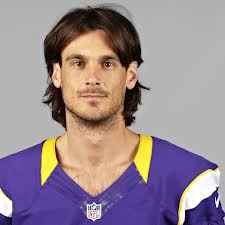
Chris Kluwe

For the record, Kluwe and I share the same position on gay marriage.  We both feel that folks of any sexual preference ought to enter into marriage as far as the state is concerned.  Further, Kluwe and I advocate our positions in social media; me on Facebook, this blog and sometimes Twitter.  Kluwe too.

Our primary difference, aside form the fact that his influence is significantly higher than mine, is that he is engaged in a profession that has a fantastically low career life-span and one that is over the top performance based.  To further tip the scales in my favor, my company faces no arbitrary salary cap or limit to “active employees”.

This week, Chris Kluwe was released from the Minnesota Vikings.  And the PC world is going nuts, including the governor of Minnesota:

ST. PAUL, Minn. – Gov. Mark Dayton thinks sports teams, like politicians, should be honest about decisions that are being made.

“Yeah, I don’t feel good about it,” said Dayton when asked about the Minnesota Vikings decision to release outspoken punter Chris Kluwe on Monday.

“I’m not in a position to evaluate the relative punting abilities, but it seems to me the general manager said, right after the draft, they were going to have competition,” Dayton recalled. “Well, they bring the one guy in, he kicks for a weekend and that’s competition?”

Serious.

The governor feels the need to weigh in on the personal moves of a professional sports team.  I can’t imagine many things less concerning to a governor than that.  However, in true liberal form, he makes his point and then “covers himself” at the same time:

“That’s their decision to make,” Dayton concluded. “They don’t give political advice. I don’t give them coaching advice.”

Yeah, perhaps you should have taken your own advice before you opened your mouth.
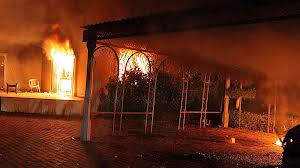
Benghazi Hearings: May 8, 2013

Catching up on the hearings today, there are several things that are clear:

  1. The United States government, at all levels, knew that what was happening in Benghazi was a terrorist action.  No one thought that this was the result of a protest gone bad.
  2. There were multiple stand-down orders given.  Perhaps they were legitimate, however, they were given.
  3. The talking points as delivered by the Obama administration regarding the reason for the attacks were manipulated and were never true as it pertained to the YouTube video.

An interesting note on news coverage:

This slideshow requires JavaScript.

Not surprising, only Fox News features the hearings.  All three main news outlets, ABC, CBS and NBC have only minimal attention to those hearings.   NBC has a link to the story but it isn’t prominent.  CBS and NBC do display a link to watch the hearings live but ABC has no mention.

This despite that CBS’ most popular story is the one regarding Benghazi.  Yet no where to be seen.

Benghazi – Enough To Damage Obama, Keep Hillary Out Of 2016?

Benghazi

Something Wicked This Way Comes

It’s clear now that the Obama administration misled America regarding the events that transpired that day in September.  There is no longer any doubt:

 Mark I. Thompson, the acting deputy assistant for operations in the State Department’s counterterrorism bureau, will testify on Wednesday that then-Secretary of State Hillary Clinton willfully blocked out his department’s involvement on the night of the September 11 Benghazi attacks — and that he has been threatened and intimidated by unnamed State Department officials about saying as much in public, and that al-Qaeda was involved all along. The scoop comes from — where else? — sources close to the congressional investigation speaking to Fox News, two days ahead of testimony by Thompson and two other whistleblower witnesses before Rep. Darrell Issa’s House Oversight and Government Reform Committee. Fox’s sources characterize Thompson has having “concluded on Sept. 11 that Clinton and Kennedy tried to cut the counterterrorism bureau out of the loop as they and other Obama administration officials weighed how to respond to — and characterize — the Benghazi attacks.”

That charge would seem to suggest that the State Department’s actions that night last summer came straight from the top and allegedly without input from Thompson’s Counterterrorism Security Group at Foggy Bottom. As CBS News reports, we know that the Obama administration “did not convene its top interagency counterterrorism resource, the Counterterrorism Security Group.” And since a certain segment of Issa’s Washington is (still) looking back and (still) trying to figure out what went wrong when the American diplomatic mission was attacked, one of the big questions heading into Wednesday’s hearing is whether or not CSG involvement would have made a difference. As The Washington Post‘s Jennifer Rubin insists, the two other witnesses — a regional State Department security officer in Libya and a former department deputy chair of the mission — could send the affair “into a whole different level of scandal.”

Not only did the administration fail to handle the situation appropriately the night of the attacks, they covered up that failure.  Additionally, in order to prevent Obama from being embraced in an election year, they administration attempted, and largely succeeded, in mis-characterizing what happened that night:

After a briefing on Capitol Hill by CIA director David Petraeus, Democrat Dutch Ruppersburger, the ranking member of the House Intelligence Committee, asked the intelligence community for unclassified guidance on what members of Congress could say in their public comments on the attacks. The CIA’s Office of Terrorism Analysis prepared the first draft of a response to the congressman, which was distributed internally for comment at 11:15 a.m. on Friday, September 14 (Version 1 at right). This initial CIA draft included the assertion that the U.S. government “know[s] that Islamic extremists with ties to al Qaeda participated in the attack.” That draft also noted that press reports “linked the attack to Ansar al Sharia. The group has since released a statement that its leadership did not order the attacks, but did not deny that some of its members were involved.” Ansar al Sharia, the CIA draft continued, aims to spread sharia law in Libya and “emphasizes the need for jihad.” The agency draft also raised the prospect that the facilities had been the subject of jihadist surveillance and offered a reminder that in the previous six months there had been “at least five other attacks against foreign interests in Benghazi by unidentified assailants, including the June attack against the British Ambassador’s convoy.”

After the internal distribution, CIA officials amended that draft to include more information about the jihadist threat in both Egypt and Libya. “On 10 September we warned of social media reports calling for a demonstration in front of the [Cairo] Embassy and that jihadists were threatening to break into the Embassy,” the agency had added by late afternoon. And: “The Agency has produced numerous pieces on the threat of extremists linked to al Qaeda in Benghazi and Libya.” But elsewhere, CIA officials pulled back. The reference to “Islamic extremists” no longer specified “Islamic extremists with ties to al Qaeda,” and the initial reference to “attacks” in Benghazi was changed to “demonstrations.”

The talking points were first distributed to officials in the interagency vetting process at 6:52 p.m. on Friday. Less than an hour later, at 7:39 p.m., an individual identified in the House report only as a “senior State Department official” responded to raise “serious concerns” about the draft. That official, whom The Weekly Standard has confirmed was State Department spokesman Victoria Nuland, worried that members of Congress would use the talking points to criticize the State Department for “not paying attention to Agency warnings.”

In an attempt to address those concerns, CIA officials cut all references to Ansar al Sharia and made minor tweaks. But in a follow-up email at 9:24 p.m., Nuland wrote that the problem remained and that her superiors—she did not say which ones—were unhappy. The changes, she wrote, did not “resolve all my issues or those of my building leadership,” and State Department leadership was contacting National Security Council officials directly. Moments later, according to the House report, “White House officials responded by stating that the State Department’s concerns would have to be taken into account.” One official—Ben Rhodes, The Weekly Standard is told, a top adviser to President Obama on national security and foreign policy—further advised the group that the issues would be resolved in a meeting of top administration officials the following morning at the White House.

The only question remaining is how long the administration can contain the damage.

Oh yeah, and if this prevents a Hillary 2016 run.

Best Headling Of The Day

Union

This made me smile:

Union rights dealt a blow again by appeals court 

The National Labor Relations Board violated the law when it required U.S. businesses to put notices in their workplaces and on their websites informing employees of their right to unionize, a federal appeals court ruled on Tuesday.

A unanimous three-judge panel of the U.S. Court of Appeals for the District of Columbia Circuit struck down the rule, finding that federal law prohibits the labor board from punishing a business for speech, or lack of it, as long as the business does not issue threats.

Freedom of speech “necessarily protects … the right of employers (and unions) not to speak,” Judge Raymond Randolph wrote for the appeals court.

When the power of trade unions grow, the liberty of individuals is diminished.

Gun Control In America – A Solution Looking For A Problem

Gun

I like to think that I fix a lot of problems.  In my job I’m responsible for fixing things that are broken.  And, when all broken things are fixed and I’m waiting for t them to break again, I try and look for patterns, trends and other data that will help me in future situations.

Normally, when we see a trend in a specific condition getting worse, we investigate it, see if the trend is legit, and if so, work to mitigate it.  Understand it.  Fix it.

And then, after we think that we have put in place corrections, we watch it to make sure that what we did is really working.

And if it is…we leave it alone and just let it keep getting better:

Gun violence in America has fallen dramatically over the past two decades, and the number of murders committed with a firearm is down too, though guns are still by far the leading type of crime weapon, according to a new report from the Justice Department.

Gun violence is down.

As for where crime guns came from, the study notes that less than two percent of convicted inmates reported buying their weapons at gun shows or flea markets.

Any talk of this mythical “Gun Show Loophole” is bullshit.

Murders committed with a gun dropped 39 percent to 11,101 in 2011, from a high of 18,253 in 1993, according to the report.

Other crimes committed with guns were down even more sharply — from 1.53 million in 1993 to 467,300 in 2011, a drop of 70 percent, according to the Bureau of Justice Statistics.

What we’re doing is working.  There may be no need to take any further action.

News And Observer Editorial – May 6, 2013

News And Observer

Critique of a selected News and Observer Editorial:

They’re poor, so they must be on drugs, right? There’s the not-so-subtle implication of a bill passed by the North Carolina Senate this week that would require those who apply for North Carolina’s good Work First program, which offers case and worker training for the poor who are trying to find jobs, to take a drug screening test for which they have to pay.

So, the dull minded might read that to be the thought process of the republicans – They’re poor, so they must be on drugs, right?

When in fact, the opposite is what I think is true – They’re on drugs, so they are more likely to be poor, right?

We should be clear where the insult is coming from.

The other detail?  They only pay if they fail.

Basically, Republicans claim they’re just trying to keep people who need money for their families from spending it on drugs. That’s very close to basically implying that everyone getting public assistance is on drugs. What a horrible implication.

I don’t think that’s what they’re saying at all.  I think that they are saying that if you have discretionary income that can pay for illicit drugs, you are not in need of assistance.

Is there no restrictions that a liberal would place on public assistance?

So what’s the purpose, then, of the GOP-backed drug testing requirement? It’s just another chance to beat up for purposes of political grandstanding some people who can’t defend themselves very well.

The purpose, of course, is to restrict public money to those that are in need of public money.


Prom Spending

Money

From all the Facebook posts I’ve been seeing, Prom Season is here.

It’s always fun to read the Visa Prom Report:

FOSTER CITY, Calif., April 24, 2013 /PRNewswire/ — Spending on the annual high school ritual of the prom continues to outpace inflation and grew for the second straight year, hitting an average of $1,139 per family in 2013, results from a new survey released today by Visa Inc. show. That represents an increase of 5% from the $1,078 that American families who have a teenager attending a prom spent on all aspects of the dance in 2012.

Full Disclosure:  I didn’t go to either my Jr. Prom or my Sr. Prom.  I’m a geek and I know it.

That said, $1,139 is an ENORMOUS amount of money to spend on one night.  And that’s only each HAL of the date.  I’m assuming the other half spends the same!  That makes the one night date a $2,278 affair.

Jeepers.

But this is what caught my eye:

One troubling statistic is that parents surveyed who fell in the lower income brackets (less than $50,000 a year) plan to spend more than the national average, $1,245, while parents who make over $50,000 will spend an average of $1,129.

What the what?

But that’s not all:

Additionally, single parents plan to spend $1,563, almost double the amount that married parents plan to spend at $770.

Why would single parents spend more on a Prom than married parents?  And given that single parent households are disproportionately less wealthy, what does that say about the decision making of single parent households?

Housing Bubble – Government Creation Part III

Housing Bubble

Setting the stage.

My argument is that government policies created an environment that encouraged loans to individuals that had an elevated risk of defaulting on those loans.  In many cases the government sponsored enterprise directly encouraged the loans and in others, the actions of those GSEs encouraged others in the market to make riskier and riskier loans themselves.

First, how did Fannie and Freddie define loans:

To better understand how this accumulation of weak mortgages came about, a description of the loan classification system used by Fannie and Freddie (the GSEs) and followed by others is in order. Fannie and Freddie did not classify subprime and Alt-A loans based on objective risk characteristics but on the basis of how the lender or securities issuer classified a loan. Thus a loan was only subprime or Alt-A if a lender or issuer denominated it as such.

Fannie and Freddie didn’t perform any due diligence on their own.  When did Fannie and Freddie acknowledge this?

“We have classified mortgage loans as Alt-A if the lender that delivered the mortgage loans to us had classified the loans as Alt-A based on documentation or other features. We have classified mortgage loans as subprime if the mortgage loan was originated by a lender specializing in the subprime business or by subprime divisions of large lenders. We apply these classification criteria in order to determine our Alt-A and subprime loan exposures; however, we have other loans with some features that are similar to Alt-A and subprime loans that we have not classified as Alt-A or subprime because they do not meet our classification criteria.” P. 182 of Fannie’s Q.3:2008 10-Q

What does this mean?

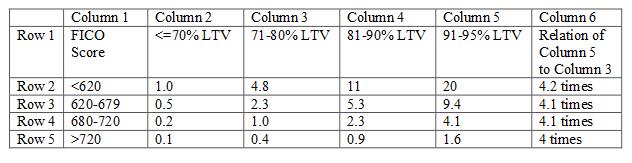
…one of the key triggers of the Financial Crisis was a policy decision to promote the widespread use of high LTV (highly leveraged) lending in the early 1990s. The risk inherent in high LTV lending was well known.  When Fannie decided to proceed with a 97% LTV program in 1994, objections were made – pointing out the poor experience on 95% LTV lending just a dozen years before…

And that risk?

Pinto.1

The risk in proceeding with a 95% LTV loan is about 4 times the risk compared to a conventional 20% down loan.  The table above demonstrates.

Consider an individual taking out a loan; credit score between 680 and 720.  Further, they are putting down between 20 and 30%.  Their risk is assigned a value of “1”.  The same individual taking out a loan but only putting down between 5 and 9%?  The risk moves to a rating of 4.1.  Four times the previous rate.

These were the types of loans that Fannie and Freddie, indeed, other government agencies, would be encouraging.

The beginning.

Why It’s Hard Admit To Global Warming

Global Warming.Polar Bear

It’s hard to debate Global Warming.  Or climate change.  Or whatever the word.

It’s hard because you can’t discuss the science any longer without also really find yourself talking about the alarmist’ “cure.”

You wanna talk about the fact that greenhouse gases can increase the temperature?

Wanna discuss the fact that CO2 is a greenhouse gas?  Or that we’ve released more of it than would otherwise have been released?

How about positive feedback and the fact that assumptions regarding them are most likely overstated?

Let’s do that.

But instead we get this:

A Democratic video says 240 House members “voted in 2011 that climate change was a ‘hoax.’ ” Not exactly. The 2011 vote was ultimately a referendum on who should set climate change policy — the Environmental Protection Agency or Congress. It was not a vote on whether climate change is a “hoax.”

Organizing for Action, a nonprofit political group that advocates for President Obama’s policies, unveiled the climate change video on April 25. It is a compilation, for the most part, of Republicans talking dismissively about climate change. One clip shows Rep. John Boehner, who was minority leader at the time, downplaying the environmental harm caused by carbon dioxide — noting that it is emitted by humans exhaling and cows “doing what they do.” We corrected some of the misstatements Boehner made in that 2009 TV interview in a piece titled “Hot Air on ‘This Week.’ ”

But the Democratic video goes too far in its text and images when it says, “Number of House members who voted in 2011 that climate change was a ‘hoax’: 240.” That is immediately followed by a video clip of GOP Rep. Paul Broun calling climate change a “hoax” in a floor speech — which implies that Broun was speaking on the 2011 legislation mentioned in the video.

We asked OFA about that 2011 vote. We were referred to an April 6, 2011, vote on a Democratic amendment to a GOP-backed bill that would have prohibited the EPA from regulating greenhouse gases. The amendment, which was defeated 184-240, did not use the word “hoax.” Broun did not speak on the amendment during the debate, and, in fact, none of the Republicans who spoke against it called climate change a “hoax.”

Also, not all of the 240 who voted against it were Republicans; three were Democrats.

The full text of the amendment, which was sponsored by Rep. Henry Waxman of California, reads: “Congress accepts the scientific findings of the Environmental Protection Agency that climate change is occurring, is caused largely by human activities, and poses significant risks for public health and welfare.”

We’re not going to have a serious debate on this topic anytime soon.  And we certainly aren’t going to see any meaningful legislation as long as this kinda nonsense continues to continue.

Florida: Drug Testing Welfare

Drug Test Welfare

Much ado has been made of Florida’s attempt to drug test welfare applicants.  Florida’s idea is that if an individual has enough discretionary income to afford drugs, that person has enough income to be disqualified from a need based program.

Lately, the left has been trying to make the case that conservatives should be against the initiative based on fiscal calculations:

From July through October in Florida — the four months when testing took place before Judge Scriven’s order — 2.6 percent of the state’s cash assistance applicants failed the drug test, or 108 of 4,086, according to the figures from the state obtained by the group. The most common reason was marijuana use. An additional 40 people canceled the tests without taking them.

Because the Florida law requires that applicants who pass the test be reimbursed for the cost, an average of $30, the cost to the state was $118,140. This is more than would have been paid out in benefits to the people who failed the test, Mr. Newton said.

So, I did my own math.  And what I found was interesting.

The Times article above uses the number of failures at 2.6%, however, other sources I’ve read use a number more like 2%.  Because that number helps the liberal cause, I’ll use 2%.  Because Florida has a 6.7% drug use rate, the 2% failure rate is indicative  of a self-selecting population.  That is, drug users are not applying for benefits knowing they will fail, and have to p ay for, a test.

Further, once an individual fails a test, he is ineligible for benefits for 12 months.  A savings not taken into account.  With all of that said, here is my data:

Drug Test Welfare data

Assuming a constant rate of applications and a conservative 2% failure rate the data shows that 25 people fail each month.  Because Florida hums along at a 6.7% drug use rate, I calculated that a certain number of people would simply not even try to test.  Again, to be conservative, I used a 6% rate and found that 50 people each month did not apply.  Finally, I begin to sum the failure and count the benefits that they WOULD have been given as savings.  I do this on a rolling 12 month period.  Additionally, I assume that this month’s drug users will not be using next month and only count 50 Missing Failure each month; I don’t sum them.

To be fair, the short term cost to the state is negative.  For the first 8 months of this system, the state loses money.  However, by September of the of the first year, or month 9, the state begins to realize savings and finally is in the black12 months after that.

The numbers would be even great if we used a normal 6.7% drug use on the welfare population and didn’t make the assumption that this months drug users will not continue to use next month.

As much as I like it when people use numbers and data to make their point, it’s important that such numbers reflect reality.