I like to think that I fix a lot of problems. In my job I’m responsible for fixing things that are broken. And, when all broken things are fixed and I’m waiting for t them to break again, I try and look for patterns, trends and other data that will help me in future situations.
Normally, when we see a trend in a specific condition getting worse, we investigate it, see if the trend is legit, and if so, work to mitigate it. Understand it. Fix it.
And then, after we think that we have put in place corrections, we watch it to make sure that what we did is really working.
Gun violence in America has fallen dramatically over the past two decades, and the number of murders committed with a firearm is down too, though guns are still by far the leading type of crime weapon, according to a new report from the Justice Department.
Gun violence is down.
As for where crime guns came from, the study notes that less than two percent of convicted inmates reported buying their weapons at gun shows or flea markets.
Any talk of this mythical “Gun Show Loophole” is bullshit.
Murders committed with a gun dropped 39 percent to 11,101 in 2011, from a high of 18,253 in 1993, according to the report.
Other crimes committed with guns were down even more sharply — from 1.53 million in 1993 to 467,300 in 2011, a drop of 70 percent, according to the Bureau of Justice Statistics.
What we’re doing is working. There may be no need to take any further action.
My argument is that government policies created an environment that encouraged loans to individuals that had an elevated risk of defaulting on those loans. In many cases the government sponsored enterprise directly encouraged the loans and in others, the actions of those GSEs encouraged others in the market to make riskier and riskier loans themselves.
To better understand how this accumulation of weak mortgages came about, a description of the loan classification system used by Fannie and Freddie (the GSEs) and followed by others is in order. Fannie and Freddie did not classify subprime and Alt-A loans based on objective risk characteristics but on the basis of how the lender or securities issuer classified a loan. Thus a loan was only subprime or Alt-A if a lender or issuer denominated it as such.
Fannie and Freddie didn’t perform any due diligence on their own. When did Fannie and Freddie acknowledge this?
“We have classified mortgage loans as Alt-A if the lender that delivered the mortgage loans to us had classified the loans as Alt-A based on documentation or other features. We have classified mortgage loans as subprime if the mortgage loan was originated by a lender specializing in the subprime business or by subprime divisions of large lenders. We apply these classification criteria in order to determine our Alt-A and subprime loan exposures; however, we have other loans with some features that are similar to Alt-A and subprime loans that we have not classified as Alt-A or subprime because they do not meet our classification criteria.” P. 182 of Fannie’s Q.3:2008 10-Q
What does this mean?
…one of the key triggers of the Financial Crisis was a policy decision to promote the widespread use of high LTV (highly leveraged) lending in the early 1990s. The risk inherent in high LTV lending was well known. When Fannie decided to proceed with a 97% LTV program in 1994, objections were made – pointing out the poor experience on 95% LTV lending just a dozen years before…
And that risk?
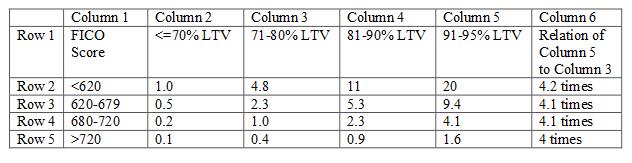
The risk in proceeding with a 95% LTV loan is about 4 times the risk compared to a conventional 20% down loan. The table above demonstrates.
Consider an individual taking out a loan; credit score between 680 and 720. Further, they are putting down between 20 and 30%. Their risk is assigned a value of “1”. The same individual taking out a loan but only putting down between 5 and 9%? The risk moves to a rating of 4.1. Four times the previous rate.
These were the types of loans that Fannie and Freddie, indeed, other government agencies, would be encouraging.
A Democratic video says 240 House members “voted in 2011 that climate change was a ‘hoax.’ ” Not exactly. The 2011 vote was ultimately a referendum on who should set climate change policy — the Environmental Protection Agency or Congress. It was not a vote on whether climate change is a “hoax.”
Organizing for Action, a nonprofit political group that advocates for President Obama’s policies, unveiled the climate change video on April 25. It is a compilation, for the most part, of Republicans talking dismissively about climate change. One clip shows Rep. John Boehner, who was minority leader at the time, downplaying the environmental harm caused by carbon dioxide — noting that it is emitted by humans exhaling and cows “doing what they do.” We corrected some of the misstatements Boehner made in that 2009 TV interview in a piece titled “Hot Air on ‘This Week.’ ”
But the Democratic video goes too far in its text and images when it says, “Number of House members who voted in 2011 that climate change was a ‘hoax’: 240.” That is immediately followed by a video clip of GOP Rep. Paul Broun calling climate change a “hoax” in a floor speech — which implies that Broun was speaking on the 2011 legislation mentioned in the video.
We asked OFA about that 2011 vote. We were referred to an April 6, 2011, vote on a Democratic amendment to a GOP-backed bill that would have prohibited the EPA from regulating greenhouse gases. The amendment, which was defeated 184-240, did not use the word “hoax.” Broun did not speak on the amendment during the debate, and, in fact, none of the Republicans who spoke against it called climate change a “hoax.”
Also, not all of the 240 who voted against it were Republicans; three were Democrats.
The full text of the amendment, which was sponsored by Rep. Henry Waxman of California, reads: “Congress accepts the scientific findings of the Environmental Protection Agency that climate change is occurring, is caused largely by human activities, and poses significant risks for public health and welfare.”
We’re not going to have a serious debate on this topic anytime soon. And we certainly aren’t going to see any meaningful legislation as long as this kinda nonsense continues to continue.
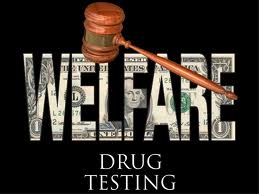
Much ado has been made of Florida’s attempt to drug test welfare applicants. Florida’s idea is that if an individual has enough discretionary income to afford drugs, that person has enough income to be disqualified from a need based program.
From July through October in Florida — the four months when testing took place before Judge Scriven’s order — 2.6 percent of the state’s cash assistance applicants failed the drug test, or 108 of 4,086, according to the figures from the state obtained by the group. The most common reason was marijuana use. An additional 40 people canceled the tests without taking them.
Because the Florida law requires that applicants who pass the test be reimbursed for the cost, an average of $30, the cost to the state was $118,140. This is more than would have been paid out in benefits to the people who failed the test, Mr. Newton said.
So, I did my own math. And what I found was interesting.
The Times article above uses the number of failures at 2.6%, however, other sources I’ve read use a number more like 2%. Because that number helps the liberal cause, I’ll use 2%. Because Florida has a 6.7% drug use rate, the 2% failure rate is indicative of a self-selecting population. That is, drug users are not applying for benefits knowing they will fail, and have to p ay for, a test.
Further, once an individual fails a test, he is ineligible for benefits for 12 months. A savings not taken into account. With all of that said, here is my data:
Assuming a constant rate of applications and a conservative 2% failure rate the data shows that 25 people fail each month. Because Florida hums along at a 6.7% drug use rate, I calculated that a certain number of people would simply not even try to test. Again, to be conservative, I used a 6% rate and found that 50 people each month did not apply. Finally, I begin to sum the failure and count the benefits that they WOULD have been given as savings. I do this on a rolling 12 month period. Additionally, I assume that this month’s drug users will not be using next month and only count 50 Missing Failure each month; I don’t sum them.
To be fair, the short term cost to the state is negative. For the first 8 months of this system, the state loses money. However, by September of the of the first year, or month 9, the state begins to realize savings and finally is in the black12 months after that.
The numbers would be even great if we used a normal 6.7% drug use on the welfare population and didn’t make the assumption that this months drug users will not continue to use next month.
As much as I like it when people use numbers and data to make their point, it’s important that such numbers reflect reality.
Former president Bill Clinton said it best in 2008. “I think the responsibility the Democrats have may rest more in resisting any efforts by Republicans in the Congress or by me when I was president to put some standards and tighten up a little on Fannie Mae and Freddie Mac.”
“Like a lot of my Democratic colleagues I was too slow to appreciate the recklessness of Fannie and Freddie. I defended their efforts to encourage affordable homeownership when in retrospect I should have heeded the concerns raised by their regulator in 2004. Frankly, I wish my Democratic colleagues would admit when it comes to Fannie and Freddie, we were wrong.
Obama lost the gun debate recently. Now, there is some discussion as to whether he was playing politics or really trying to pass new regulations concerning the purchase of guns.
In either case, it’s hard to argue that he won or scored points.
And yeah, Obama smarted. He was visibly upset and even took offense to the notion that he used the Newtown families as props. “As if” he claimed.
But he did:
If you believe that politics were at play, that the plan was to pass the bill in the senate and then have it fail in house only to pin the republicans as killers, he failed. The senate is under democrat control and he couldn’t even get all of THEM to vote with him.
However, if you are less cynical and think that Obama was really trying to pass legislation that would impact guns and how they are bought and sold, well, again, he failed. Not one new regulation even moved out of the upper chamber for consideration by the house.
A word, first, about that Senate “minority.” Majority Leader Harry Reid was free to bring the deal struck by West Virginia Democrat Joe Manchin and Pennsylvania Republican Pat Toomey to the floor for an up-or-down vote, and this background-checks amendment might have passed. It did convince 54 Senators, including four Republicans.
But under Senate rules, a simple majority vote would have opened the measure to up to 30 hours of debate, which would have meant inspecting the details. The White House demanded, and Mr. Reid agreed, that Congress should try to pass the amendment without such a debate.
No debate – no up-or-down vote.
Oh yeah, there is a ton of talk about the filibuster being used to defeat any gun legislation, but every time democrats bring that argument into play, it’s important to point out that Reid doesn’t allow amendments to bills he DOES bring to the floor:
Majority rules would have also opened the bill to pro-gun amendments that were likely to pass. That would have boxed Mr. Reid into the embarrassing spectacle of having to later scotch a final bill because it also contained provisions that the White House loathes. So Mr. Reid moved under “unanimous consent” to allow nine amendments, each with a 60-vote threshold.
The White House was right to worry. An amendment from John Cornyn of Texas that would have required all states to recognize every other state’s concealed-carry permits earned 57 votes, 13 Democrats among them. The nearby table has the list. On Thursday, Wyoming’s John Barrasso offered an amendment to protect gun ownership privacy that passed 67-30.
Obama didn’t want amendments.
And while the bill has language that prohibits the creation of a national registration, there was language that didn’t demonstrate intent:
Manchin-Toomey was rushed together on a political timetable, and a thorough scrub would have revealed that its finer legal points aren’t as modest as liberals claim. Tellingly, the White House blew up earlier negotiations with Tom Coburn on background checks. The Oklahoma Republican favored more and better checks across secondary firearms markets like gun shows and online, but liberals insisted that federally licensed dealers had to keep records.
But did the GOP do nothing but resist?
The Senate GOP offered an alternative background-checks amendment that failed 52-48. Nine Democrats were in favor, but their colleagues voted en masse to block it from moving forward. How’s that for incoherent?
Hardly.
Whatever Obama’s agenda was, political brinksmanship or honest to goodness legislating, he failed. And gun regulation is a biggie. Or was.
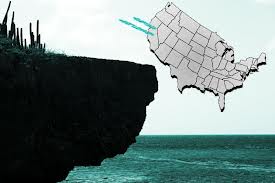
The cuts are becoming more pronounced now. The mandatory budget cuts are kicking in and the public is starting to feel the impact. Perhaps the most visible example are the flight delays:
WASHINGTON (CNNMoney)
Air travelers headed into New York’s LaGuardia Airport were facing two hour delays on Tuesday morning. By Tuesday afternoon La Guardia’s delays had improved by as much as an hour for some flights.
With fewer air traffic controllers showing up to work, the government has warned of problems at several large airports including those in the New York area, Los Angeles, Dallas-Ft. Worth and Las Vegas. The Department of Transportation warned that those airports are facing “staffing challenges” on Tuesday.
(Reuters) – The government’s effort at cutting spending across the board is hurting a population once considered among the most financially stable – dual income families where both partners are government employees.
Starting on Monday, employees at agencies such as the Federal Aviation Administration and the Office of Management and Budget will be required to take unpaid days off – a consequence of the U.S. government’s sequestration budget cuts. These forced furloughs come on top of the first round of cuts that began on March 1, and they will reduce some workers pay by as much as 12 percent a month.
Twelve percent is a sizable amount, to be sure. And it’s ballpark correct. I mean, if folks are being given 1 day off every other week, that’s 2 days a month, maybe a little more over time. And with about 4 weeks per month, that comes to about 20 working days per month, add 1 for love and ya get 21. 2 out of 21 is about 10%, a little less. So yeah, maybe 12% is high, but not by much.
However, the specific example cited by Reuters struck me as strange:
The cuts, which include decreased work hours for federal employees, hiring and pay freezes and layoffs, hit hard couples like Laurie and Jack Swensen, FAA employees in Kansas City, Missouri. When they both start furloughs next week, the couple will earn $1,900 less every month. The cuts come just as they were making moves to buy a house, said Laurie Swensen.
So, if the Swensens are among the hardest hit, taking 12% of their salary, that means they normally bring home $15,833. A MONTH! That’s an annual take home of $190,000. I’m not sure that using a couple in the top 5% of American take home pay is the subject for such sorrow.
But it continues:
With six family members, including their eldest son and his pregnant wife, living in a two-bedroom rental home, the Swensens were eager to move. But the furloughs and subsequent pay freezes have forced the family to reconsider.
We have 4, FOUR, working age adults living in a single 2-bedroom home. We know that the two parents bring home near 200k a year and who knows how much the kids make. And we’re somehow supposed to feel a tug?
At least I’m not the only one who noticed, the article is getting hammered in the comments.
Gov. Pat McCrory is among the nation’s more conservative Republican governors, according to Nate Silver, the political blogger and prognosticator for The New York Times.
In an article about the nation’s 30 Republican governors, Silver attempts to measure them on their conservatism – no easy task since they don’t have a voting record like members of Congress do. But Silver measures them based on public statements, the identity of their donors, and where applicable, their congressional voting record.
He rates McCrory as the ninth most conservative Republican. He is more conservative than Texas Gov. Rick Perry, Kansas Gov. Sam Brownback, Louisiana Gov. Bobby Jindal, South Carolina Gov. Nikki Haley, Florida Gov. Rick Scott, Ohio Gov John Kasich, Tennessee Gov. Bill Haslam, Michigan Gov. Rick Snyder and Alabama Gov. Robert Bentley, among others.
To McCrory’s right are Virginia Gov. Bob McDonnell, South Dakota Gov. Dennis Daugaard, Iowa Gov. Terry Branstad, Mississippi Gov. Phil Bryant, Georgia Gov. Nathan Deal, Wisconsin Gov. Scott Walker, Indiana Gov. Mike Pence and Idaho Gov. Butch Otter.
I surprised by some of the names. For example, I would have thought that Rick Perry and Bobby Jindal would have been to his right. Same for Kasich and Rick Scott. On the other side, I would have guessed McDonnell, Branstad and maybe Pence to be more liberal.
Not sure what it means, especially since McCrory has only been in office for less than 4 months, but….Nate says so.
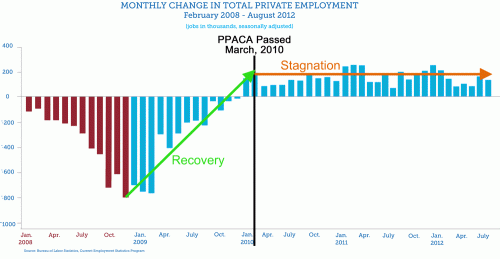
The immediate impact of the legislation is due to the fact that it wasn’t until Christmas eve in the middle of a snowstorm that the democrats wheeled a dying 117 year old man to vote that this was a done deal.
Let’s hope the Boston Marathon bomber is a white American
In a way and manner, I guess I’m glad he’s honest enough to admit what the collective is feeling. However, why does he think this?
Likewise, in the context of terrorist attacks, such privilege means white non-Islamic terrorists are typically portrayed not as representative of whole groups or ideologies, but as “lone wolf” threats to be dealt with as isolated law enforcement matters. Meanwhile, non-white or developing-world terrorism suspects are often reflexively portrayed as representative of larger conspiracies, ideologies and religions that must be dealt with as systemic threats — the kind potentially requiring everything from law enforcement action to military operations to civil liberties legislation to foreign policy shifts.
This is utter bullshit.
The reason that the United States treats different groups who engage in terrorism differently is not because of where the person comes from or what religion they are, it’s because of how that society deals with the terrorist. Here in America we kill them. In other nations, they harbor them and give them asylum. THAT is the difference.
And if you’re not convinced of that, consider how the United States has treated these two guys:
And then this guy:
In one case, the guy is executed. In the other, the guys isn’t even accused of terrorism.