
Category Archives: Economy

Mandatory Sick Leave, Vacation and Minimum Wage

So, recently over at Applied Rationality we have been discussing legislating Mandatory Sick Leave.  Dave seems to be of the opinion that we should mandate paid sick leave to all employees while I maintain that such a benefit more resembles increased pay and would reduce the incidence of labor.  Minimum wage has long been a favorite of mine and this new legislation seems to be another version of the same.

I think it’s exactly this type of legislation where we as conservatives fall down and really fail to serve the public.  As champions of this type of legislation, it is the Left that is doing the PR job of getting out there and shaping the message.  They are in front of the cameras talk about laws that will help the “Average American”, the “Working Man” and “America’s Middle Class”.  They are getting the message out in the nightly newscasts, newspapers and magazines.  And they are doing it well.  They have been able to successfully shape the public opinion to the point that most of the nations feels that it is the Liberal Left and the Democrats who are standing up for the rights and well being of the average guy.

And we are letting them.

We don’t have anyone that is able to go out and change the shape of the conversation.  We don’t have anyone that is willing to take this law, conduct the research and bring the message into the homes of all people everywhere that this tpe of legislation HURTS the very people it is aimed at helping.  By mandating such demonstrably bad policies, what we are doing is legislating those of us who can least afford to be out of a job–out of a job.  We are building a scenario where employers are going to reduce the number of employees on their payroll.  And they are going to begin with the least skilled most marginal among their employees.  Rather than helping people, this law and others like it is destructive.

And we are letting them.

Now, I’m not willing to give the Democrats enough credit to come up with one of these Black Helicopter theories that says they are doing this on purpose in order to create a dependent Nation.  I really really don’t think they are that, umm, well, thoughtful.  I really do think that they are trying to actually help people.  I do.  But they are wrong.  They are taking the easy way out and, it just so happens, that this easy way out plays very well in the court of public opinion.  But the facts remain, this is horrible legislation and we know it.  Or should.  And we should be singing and shouting it out from rooftops all across America.  And we should be changing the tone of the conversation that it is Conservatives who are championing policies that actually DO help people.

Of course, we should then actually enact that policies…but thats another post for another day.

We Are In Trouble

I will try to be as simple as I can be:

Economics: The study of the distribution of scarce resources with alternate uses.

So, I am sitting reading the Internet today and come across this gem.

Some highlights:

  1. Allow the Governor to ration gas in similar situations.
  2. Allow the Governor to freeze fuel prices.

Look, this is simple.  Gas is a thing that if people were able to obtain for free, would soon run out; we wouldn’t have enough to go around.  So we have to ration it.  Today, we do this using money; as the price goes up, yuou may trend to use less, as the price goes down, you will tend to use more.  Now, what the government wants to do is end the normal market method of rationing it and put it into the hands of elected officials who have almost zero ability to have a complete understanding of the market forces.

The result will be predictable:  Lines.

Why We Have to Fight the Unions

Certainly this last election was troubling for me here in Carolina.  We saw all the obvious, no need to rehash that here and now.  However, upon further reflection, I am perhaps most troubled by the increased influence of the labor movement here in North Carolina.  As a transplant, my history of struggles between the state and the unions is incomplete, but I understand that it has been brutal at times and even bloody.

Be that as it may, the impact of labor unions on the economic health of a state is dramatic and obvious.  And as the economic health goes, so goes the health of that state in general.  This includes the ability to create jobs, to keep those jobs, to balancing the budget and creating an environment that allows general and overall growth of that state.

This afternoon I came across this entry from Carpe Diem.  In it, Perry is showing that the highest ranking states in the “Economic Outlook Rankings” are almost all Right to Work states while the lowest are not.  Further, the net migration numbers are showing that people are leaving those Union Friendly states in droves.  And where are they moving to?  You got, Right to Work states.

But this is not news, it is just demonstrating what we really, already know.  That unions destroy economic progress.  And people, knowingly or not, vote with their feet and simply leave.  And typically, those that CAN leave are the ones that DO leave resulting in a continued downward spiral.  For example, see California:

California, which once lured Americans from near and far, is now driving out millions of the most productive residents – including high percentages of the most affluent.

“When California faced a Mount Everest-sized $14 billion deficit in 2003, one of the major causes for the red ink was the stampede of millionaire households from the state,” says a report called “Rich States, Poor States” by economists Arthur Laffer and Stephen Moore. “Out of the 25,000 or so seven-figure-income families, more than 5,000 left in the early 2000s, and the loss of their tax payments accounted for about half the budget hole.”

So this is what has me concerned about this past year’s election; the increased influence of the labor movement.  And here is why:

Big Labor’s Top Ten Special Privileges

1.  Exemption from prosecution for union violence.
2.  Exemption from anti-monopoly laws.
3.  Power to force employees to accept unwanted union representation.
4.  Power to collect forced union dues.
5.  Unlimited, undisclosed electioneering.
6.  Ability to strong-arm employers into negotiations.
7.  Right to trespass on an employer’s private property.
8.  Ability of strikers to keep jobs despite refusing to work.
9.  Union-only cartels on construction projects.
10. Government funding of forced unionism.

Just take a look at this list.  While I always have had a good healthy distrust and dislike for Unions, I have never seen it laid out bare like this.  Not ONE of these things even passes the basic sniff test.  Now don’t get me wrong, I fully support the right of worker or workers to “unite” in their common goal to approach management and offer a bargaining position.  What I do not support, is this legal mandate that exists that offers this kind of protection to a single organization.

And this is what scares me.

Money as a Signal

I run another blog that is basically a conversation between a real good friend of mine.  We end up talking lot’s of politics.  And my latest entry kinda sums up on how I feel about money.

I thought it would be good to double post that entry here today.

The Cost of Money

I Wish We Had a Cool Governor

Now, don’t get me wrong.  I don’t have the same feel for the Good Gov’na Purdue that I have for Obama; not even close.  But how nice it is to listen to some of the best conservatives in the country talk about the stimulus package:?

http://www.wral.com/

Louisiana Gov. Bobby Jindal, a likely 2012 presidential contender, has said he would reject a portion of the money aimed at expanding state unemployment insurance.

Notice the level of detail intimated by Jindal.  He is not rejecting all of the money, just that money that speaks to unemployment insurance.

Gov. Haley Barbour, R-Miss., said he was considering a similar move. Taking the unemployment dollars, he said, would force his state to eventually raise taxes when the stimulus money runs out, putting in place what he called an unfair tax on employers.

“There is some (money) we will not take in Mississippi. … We want more jobs. You don’t get more jobs by putting an extra tax on creating jobs,” Barbour told CNN’s “State of the Union’ on Sunday.

Again, very detailed analysis of the package.  These guys know the good from the bad; almost as if they–you know, READ the bill.

Michigan’s Democratic Gov. Jennifer Granholm said there are other states that want and need the new money: “We’ll take it. We’ll take your money.”

States with unemployment rates significantly differ- ent from that of the U.S

States with unemployment rates significantly differ- ent from that of the U.S

Guess who’s state is that highest bar, just left of center?  Yeah, that’s right.  The Great State belonging to Gov. Jennifer Granholm.  That, by the way, is not an accident.

At issue for Jindal and Barbour is a provision in the stimulus bill that could allow people ineligible for unemployment benefits to receive them anyway. That could eventually force a tax increase on employers, both governors have said.

Nice.  So even if the state doesn’t want the money, the Federal Government forces them to take it anyway.  And they have to raise taxes as a result.  How is this legal?

Some Democrats took a harder line at a press conference arranged by the Democratic Governors Association to praise Obama for his leadership on the stimulus. DGA Chairman Brian Schweitzer of Montana and Maryland Gov. Martin O’Malley dismissed GOP detractors as “fringe” Republicans eager to score political points.

“All of us are committed to working with President Obama to pull our nation’s economy out of the ditch that George W. Bush ran it into,” O’Malley said. “If some of the fringe governors don’t want to do that, they need to step aside and not stand in the way of the nation’s interests.”

Sorry, but when you complain of “fringe” Republicans and then say “pull our nation’s economy out of the ditch that George W. Bush ran it into” you lose some all credibility in my book.

The line drew a rebuke from Sanford, the Republican Governors Association chairman.

“I think in this instance I would humbly suggest that the real fringe are those that are supporting the stimulus,” Sanford said. “It is not at all in keeping with the principles that made this country great, not at all in keeping with economic reality, not in keeping with a stable dollar and not in keeping with the sentiments of most of this country.

Finally, Republicans acting like Republicans.

They Will Never Learn

Okay, okay.  So I get it, I mean, who doesn’t?  In fact, who could miss it?  The whole world, literally, is in some form of economic downturn or another.  Much, if not all, of this can be laid at the feet of the real estate or housing bubble here in the United States.  It was, after all, the inflation of homes that caused banks and other lending institutions to over extend themselves and take on some really really bad investments.

Now, if you wanna get into any form of political blame game, you can.  Either it is the republicans for “de-regulation” or it’s the democrats for the Community Reinvestment Act.  Maybe it’s democrat ssenators refusing to reign in Frannie and Freddie.  Heck, maybe it’s republican senators failing to reign those guys in.  Whatever, the point is, some form of government “tampering” led the housing markets down the path they have taken.  And the result is, well, the result is where we are today.

So, the lesson?  The lesson, of course, is to just let stuff be.  Especially the housing markets!  Just don’t touch ’em right now!  For gawd’s sake, don’t touch ’em.

Right?

Anyone listening?

Cricket.  Cricket cricket.

Nope, they aren’t.  And here is the proof:

http://www.wral.com…

Paragraphs rendered:

A report being considered by Chatham County commissioners says that recent development trends have divided the county and priced people out of some areas.  In recent years, the eastern half of the county has seen a housing boom, with development springing up close to areas such as Cary and Chapel Hill. Meanwhile, experts say, the western portion of Chatham hasn’t seen that same growth.

This happens all the time.  Certain land areas experience higher growth than others.  As the demand for those land areas increases, that land becomes more expensive.  The county needed top study this?

“The homes that were being created were for people who were in a higher-income category,” Commissioner Carl Thompson said.

Ahh, well, maybe not.  Seems that that intuit what’s going on.  Good.

Real-estate broker Katy O’Leary said that weekly, she has to tell some customers that they can’t afford a home in the eastern part of the county. Home prices there run from $350,000 and up, she said.

I suspect the same is true of Jaguar dealers.  Some people can afford homes in expensive neighborhoods  Others can’t.

O’Leary said the disparity of housing prices has an easy explanation: “The dirt’s too expensive.”

High lot prices force developers to build mostly only higher-end homes, she said.

Amen sista’!  End lesson on Econ101.  Wait, what?  They aren’t happy with this?

We could “actually require developers, maybe, to set aside certain portions of their development as lots for moderate-income homes,” Thompson said.

So, here we are.  In the middle of an economic housing bust, one we are trying to fix by ridding ourselves of a housing glut, and we are going to ADD to the complexity by mandating builders build homes on property they otherwise wouldn’t.  The result?  Somewhere, someone will be paying more for a home than it’s worth.  Sound familiar?

Jeez.

The Two Best Laughs of the Day

And both are right here:

This has to be the best URL ever!

www.financialstability.gov

LOL.  Serious.  LOL.

I mean, really.  If someone sent that to me in email, I would think it was a hoax.  But the URL is only the second best laugh of the day.  The top laugh of the day is the page display when you actually go looking for financialstability.gov:

financialstability

In Related News

This is just the kind of reporting that makes me upset.  How are people to understand what is really going on when our press and our broadcasters continue to deliver this type of information to people.  I have quoted the entire article below:

New jobs part of stimulus package for N.C.

North Carolina could gain 105,000 new jobs as a result of the economic stimulus package, according to a White House estimate released this morning.

The White House said the figure for each state was compiled by analyzing “detailed estimates of the working age population, employment, and industrial composition of each state.”

The release does not provide any details on what sort of jobs would be created.

And in related news, I plan to date Britney Spears.

What 400 Bucks Is Gonna Do

Recently I was part of a small conversation regarding a portion of the tax cuts in the new Stimulus Package.  The subject that got us all going was, well, the headline you see at the top of this very post; what 400 bucks is gonna do….  Now, to be clear, I think that what we were talking about was the portion of the tax cuts that President Obama refers to as tax cuts to 95% of working men and women; $500 for an individual, a $1000 for a family.  At least that’s what I think the reference is, though, to be fair, I’m not sure.  For example, I don’t know where 400 came from, as I mentioned, I though the Obama tax cut was $500…anyway, I digress.  The point is, we had a good conversation.

Here is my case.

The Federal government levies taxes on individuals in the form of individual income tax.  As far as I know, there are no other taxes on individuals that the Feds have claim to.  Sales tax is a state tax, state income tax is, well, levied by the state.  Vehicle, property, city and county taxes…all non-Federal.  FICA and Medicare, not taxes.  These are with holdings that fund programs or specific funds.  They can not be used for other purposes, and if those programs or funds went away, so too, would the withholding.  FICA , after all, is is really just shorthand for Federal Insurance Contribution Act.  In this specific case, Social Security is really just an insurance program.  Anyway, point is–not a tax.

That would mean, for the Federal government to say that it is giving a tax cut to 95% of working Americans, he would have to reduce the rate of the tax.  For example, if an individual is being taxed at 28%, to realize a tax cut, she would have to see her rate go down, say..to 27% or 20%. That’s a tax cut.  What is not a tax cut is when an individual who currently pays no amount of money to the Federal government gets a check from Uncle Sam.  It is something.  And if it’s a grand, it’s not insignificant.  But what it’s not, is a tax cut.

And this is why it’s important.  It’s important because it has clear and critical ramifications, when dealing with a struggling economy.  It is NOT important because of the partisan bickering going on.  We have all heard the arguments going back to the election from the Democrats that Obama was offering a tax cut and The Republicans claiming it was just income redistribution.  That’s not why it’s important.  Where it really really matters is in how the recipients SEE, or perceive, the additional money.

You see, when I am chugging along in my normal economic way, I do just that–chug along.  I buy near the same kinds of groceries at near the same amounts.  I drive about the same kind of car and get it washed at about the as often as I always do.  I go out about the same number of nights and have about the same number of beers.  But now, let’s say that something changes.  Let’s say that I get a check back from my insurance company; my rates went down and they have overcharged me for two consecutive 6-month periods.  I get $500.  How do I spend that money?  It has been shown that the typical person spends it in one of two ways – They pay down debt OR they go on a 1 time splurge shopping spree.  So, VISA gets it or Best Buy gets it.  And then whamo, right back to the normal way of spending money.  Point is, there is no sustainable economic jolt in either paying off VISA or buying that flat screen TV.

Now, let’s say that instead of a windfall [the insurance overcharge check], I get a raise.  This presents me with a new way of looking at the money coming into me.  I view this a sustainable income, an item that I can budget for and count on.  I know it’s going to be there next paycheck and the paycheck after it.  This affects my spending in a much different way.  It sustains it.  I am more willing to up what I buy and/or how often I buy it.  I may not ration myself to a 6-pak.  Perhaps I can up how often I get a new car, or new jeans or new whatever.  Further, because it is not presented to me in a lump sum significant amount, the chances that I sink it into debt reduction is less; I actually spend it.  In this case, the economy is better off.

Now, for the whammy.  If, instead of giving me, a worker bee who concerns himself with just me and mine, a $500 bump, what if 20 people like me DIDN’T get the money but it went to a small business owner who was just thhhhiiiiiiisss close to obtaining the money to hire one more guy.  Or buy that new processor in his assembly line.  What if that 10k went to someone who GREW the money, who took it and turned it into 15k, or 20k AND gave someone a job because of it?

It is because of these reasons that fiscal conservatives don’t like the tax cut language in the stimulus package.  Not because Obama thought of it, or because Pelosi pushed it.  Or because no republican voted for it.  It’s because it’s moving money around in a way that does not grow said money, and it denies the recipient the critical perception that it’s sustained.  And further more, if you want to grow the economy, it’s not putting it into the hands of people who grow money.

The Recession – How Bad Is It: part 3

Okay, back to the recession and the economic numbers.  CPI is widely considered one of the indicators of how well -or poorly- the economy is performing.  So, if you are like me, you may ask:

What is the Consumer Price Index (CPI)?

The consumer price index (CPI) is the most widely used measure of consumer price inflation. The CPI measures the average change over time in the prices paid by urban consumers for goods and services. The Bureau of Labor Statistics (BLS) of the U.S. Department of Labor collects the CPI price information and calculates the CPI statistics.

Thanks to the Seattle Government

So, basically, the CPI is a value showing how inflation is impacting the cost of stuff that you and I buy.  So, let’s take a look:

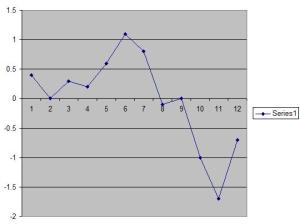
Year Jan Feb Mar Apr May Jun Jul Aug Sep Oct Nov Dec
2008 0.4 0 0.3 0.2 0.6 1.1 0.8 -0.1 0 -1 -1.7 -0.7

Or, graphically, it looks like this:

cpi-2008Notice that I have changed the graphical representation some.  Most graphs of the CPI show the % change from the month prior, in that case, the graph looks like this:
cpi-raw-2008

Now, the reason that I shifted the data is to show that while the CPI seems to be rising from November to December, what it really is doing is shrinking by a smaller number.  Further, unless you take the data and put it into real world terms, it’s hard to understand.  For example, CPI measure the cost to us of stuff that we buy.  So, if I was in the market for a Digital Picture Frame that cost $100 at the beginning of the year, I could roughly expect the price of that frame to fluctuate according to the top graph.  That is, it would cost more than $103 dollars in the summer, but, then in December, it would be just under $100.

So, in terms of how much stuff costs, right now -latest numbers go to December 08- the cost of goods and services that consumers buy is just under what it was in January 08.  Not bad.

An interesting comparison.  Anyone care to guess what the below graph is tracking?

price-of-gas-2008

If you said the price of gas, you are right.  The above is the cost of gas in cents, and notice just the shape of the graph.  Gentle rise followed by a steeper increase ending with a cliff at the end of the year.  Further, the height of the gas crisis, according to this data, is July.  Yet the height of the costof my picture frame was in August.  I am guessing the price of goods is going to track very closly the cost of getting it from where it was to where you are; shipping costs.

The larger point is this:  The CPI is not showing this current recession to be any worse than any of the data we have seen in the last 60 years.  In fact, just looking at the data we are seeing that the price of “stuff” is getting cheaper!  And that’s pretty good news these days.