Category Archives: Liberty

Drones In America

Eric Holder

For the record, I’m a hawk on enhanced interrogation techniques and am supportive of drone strikes in the prosecution of terrorist abroad.  So I certainly CAN imagine a time when the President could authorize a drone attack on American soil used against Americans.

For example, if Timothy McVeigh had left a note on the kitchen table describing what he was planning to do and we had him en route to the target; take him out.  Same for the scenario that Senator Feinstein described:

Senator Dianne Feinstein, the California Democrat who is the chairwoman of the Intelligence Committee, said one such situation would be the shooting down of a plane hijacked by terrorists.

Clearly where traditional methods would be allowed, a drone ought be allowed.  In fact, often time preferred.

But for the life of me I don’t understand why Obama, Holder and the whole of the administration won’t admit that the United States can’t use drones to strike American citizens “sitting in a cafe”:

Senator Ted Cruz, Republican of Texas, suggested a hypothetical situation in which a terrorism suspect was not presenting an immediate threat — like “sitting in a cafe” rather than “pointing a bazooka at the Pentagon” — and asked whether it would be unconstitutional for the military to simply kill that citizen.

How can the answer to that question not be an immediate “no”?

The politics are baffling to me.  This isn’t a President who would have to worry about his base being upset with the answer.  The reaction from the opposition wouldn’t be any worse than it currently is by hedging.

The answer and the “play” are so obvious that it’s mind blowing watching this play out.

Outside Federal Jurisdiction

Government Control

The powers not delegated to the United States by the Constitution, nor prohibited by it to the States, are reserved to the States respectively, or to the people.

We’re seeing more and more of this:

With gun rights coming under fire across the border in New York State, the Susquehanna County commissioners spoke out by resolution Wednesday in favor of the Second Amendment.

Republican Commissioner Michael Giangrieco said the issues in New York prompted him to address the matter on a county level.

He proposed a resolution stating that “any federal act, bill, law, rule or executive order that in any way infringes on our Second Amendment rights by attempting to reduce the private ownership of any firearm, magazine or ammunition shall be unenforceable in Susquehanna County.”

So, it occurred to me, “Can the federal government regulate guns at all?  And if so, how does it derive that power?”

I couldn’t find anything that expressly authorized the federal government to regulate guns but had a sneaking suspicion I would find the authority somewhere else.  And then I found this:

Congress derives its power to regulate firearms in the Commerce Clause, in Article I, Section 8, Clause 3, of the U.S. Constitution. Under the Commerce Clause, Congress may regulate commercial activity between the states and commerce with foreign countries. In reviewing federal legislation enacted pursuant to the Commerce Clause, the U.S. Supreme Court has given Congress tremendous leeway. Congress may enact criminal statutes regarding firearms if the activity at issue relates to interstate transactions, affects interstate commerce, or is such that control is necessary and proper to carry out the intent of the Commerce Clause.

Ahh yes, the Commerce Clause.  The Clause that effectively ended state’s rights and allowed the federal government massive power over those states.  In fact, the landmark case establishing such leeway seems to make Montana’s effort to try and skirt federal gun regulations by manufacturing and selling guns within the state outside federal control.  Remember, that case found that a farmer didn’t have the right to grow and use wheat on his own farm as he saw fit.

My feel is that it was never meant that the federal government could regulate firearms in general, that it be left to the states.  But that the states and local governments COULD regulate those weapons as THEY saw fit.

Unions: Legalized Racketeering

Unions

I have no issue whatsoever with the McWorker, along side his McFriend, walking into the McBoss’s office and asking for a raise.  And if denied, threatening that the two of them, in hopes they are valuable, will walk off the job and go to work somewhere else.

In this case, the McBoss can call the McBluff and say, “No raise for you!” and hope the McWorkers get back to McWork.  Or, perhaps the McBoss, seeing the value of the McWorkers, will relent and approve the raise and everyone is happy.

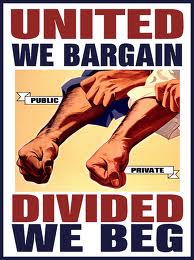
In other words, uniting in the pursuit of self interests is fine.  As long as the rules are fair for everyone.  And when it comes to unions, the rules are most certainly not fair:

“The most glaring examples of union favoritism under state laws,” notes a 2012 U.S. Chamber of Commerce report, “tend to occur in criminal statutes and allow individuals who engage in truly objectionable behavior to avoid prosecution solely because they are participating in some form of labor activity.”

Pennsylvania unions now enjoy a loophole that the state’s anti-stalking law “shall not apply to conduct by a party to a labor dispute.” In Illinois, anti-stalking laws exempt “any controversy concerning wages, salaries, hours, working conditions or benefits … the making of collective bargaining agreements.”

These exemptions prove that organizing tactics used by unions can have something in common with those of stalkers – and can perhaps inflict similar emotional distress.

While a number of states have exemptions that have allowed union members to intimidate and harass, California is by far the worst actor. As in other states, it is a crime in California to interfere with a lawful business through physical obstruction or intimidation of workers or customers.

Yet California has exempted unions from this law. The negative effects were clear in 2008, when United Food and Commercial Workers Union members picketed a new Ralph’s grocery store in Fresno. They went beyond traditional picketing, harassing customers and instigating confrontations with employees on store property. When store workers finally called the police, authorities refused to come and put a stop to the union’s disruptive behavior.

The police refused to even dispatch to the site.

But it gets even worse:

California also has a host of exemptions that allow union members to violate the property rights of private citizens. The 2008 Researcher Protection Act makes entering the residences of academic researchers to interfere with their work a crime. Sounds reasonable. Yet this doesn’t apply to union members. They can invade a professor’s home in California and it’s not a crime – so long as the invader is “engaged in labor union activities.”

And even worser:

Labor bosses have even deemed it necessary to get legislators to grant unions exemptions from laws against sabotage. Wisconsin’s state law against sabotage exempts unions, so as to not curtail their organizing activities. The fact that anti-sabotage laws might be construed as an impediment to union organizing says more about union organizing efforts than anything else.

Yet, in 2011, union members were alleged to have sabotaged equipment belonging to supporters of Governor Scott Walker’s labor reforms. In New York and New Jersey, during a labor dispute between Verizon and the Communications Workers of America, the telephone company contacted the FBI to investigate allegations of sabotage. The company reported equipment being stolen, fiber-optic lines cut and an office heating system tampered with.

During a union organizing effort in Ohio, the owner of one non-union electrical services company had his tires slashed and rocks thrown at his windows. One of his employees was assaulted. The owner was himself shot in the arm while confronting a person who was vandalizing his car on his property. Other owners of non-union shops experienced similar harassment and intimidation. When the Associated Builders and Contractors called on unions to halt such odious behavior, the unions responded that their actions were perfectly legal.

We all should have the right to bargain for our services and our compensation.  We should be able to grieve our differences when they occur.  But we should all be safe from threats, violence, theft and assault.

Monsanto, Seeds and Patents

David and Goliath

And David put his hand in his bag and took out a stone and slung it and struck the Philistine on his forehead.

I have to believe that anyone whose heard of the story of the farmer in Indiana that has been sued by Monsanto has, in some way, resonated with the story of David vs. Goliath.  The simple old farmer vs. the giant corporation.

The story:

For years, Bowman has purchased the seeds from Monsanto for his first crop and he has abided by the technology agreement.

But like some other farmers, he sometimes plants a second crop of soybeans in a practice called “late season planting.” Because the late season planting is risky due to a short growing time and the threat of drought, Bowman didn’t want to invest in the expensive soy bean seed for the second planting.

He had an idea: He would save money and buy a mix of unlabeled seed from a grain elevator, hoping that most of it would be Roundup resistant. After harvesting that crop he would save the progeny and replant it.

“I didn’t look at it as a loophole,” Bowman said outside court today. He said the Monsanto patent was abandoned once the soybean reached the grain elevator.

To his credit, Bowman did what farmers have been doing for years; purchasing grain from an elevator to plant.  On top of that, farmers have also held back some of their harvest themselves for planting later.  Both of which are illegal under Monsanto’s licensing.  The other step Mr. Bowman took?  He asked Monsanto for legal guidance.

At first blush I sided with the farmer.  After all, how crazy is it that a man can’t plant the harvest of his own field?  And how long, exactly, does a company have claim to the seed that originated in their laboratory?

I wondered if there were any other such examples in all of history?

The answer?  Yes, of course there are many.

  • Stories
  • Songs
  • Sketches
  • Paintings
  • Pictures
  • Poems
  • Computer programs
  • Movies

All of these products carry with them the inability of the purchaser to reproduce without the permission of the creator of the piece.  Can you imagine the consequences if an author lost ownership of her story just because she sold it to a bookstore?  Why, that bookstore could copy and resell that story as often as they wanted.

An artist who created a song or an album?  It’s illegal to copy that art and then resell it.

And yes, in those cases it can be argued that the artist or author DID sell it to a clearing house and allow that clearing house the ability to reproduce.  But consider a photographer.  After a sitting that photographer owns the pictures and sells a subset to the client.  And that client does not have the legal right to reproduce that photo, of herself that she paid for.

Legal questions aside, what are the ramifications to the industry is David slays Goliath?  Why, Goliath will stop innovating new seeds that generate larger and larger harvests, are more resistant to disease and blight and allow an easier time to grow and harvest.

Innovation will surely slow down if not cease.

That, or innovation will INCREASE in the form of seeds that are modified in such a way that their progeny will not sprout when planted.

In the end, Monsanto owns the license to that feed and can sell it under any contract it desires.  We can not expect a seed company to allow its customers to copy and reproduce its work anymore than we would expect a young artist to sell her painting and allow the purchaser to print it by the thousands.

The NAACP – Racists

The definition of the word “racist” has changed.  Today, its use has been co-opted by the left to instill a form of faux outrage against groups, or more accurately, policies that they don’t like.

To be sure, given any group of people and any sufficiently random problem to be solved, there will be disagreement.  And, in my opinion, in that disagreement lies the secret to America’s success; what a horrible horrible world it would be if it worked exactly like I wanted it to.

Or if it worked exactly like YOU wanted it to.

However, some of us engage in an especially caustic form of objection.  See, it’s one thing to disagree on merit, to debate rationally, emotionally even, but in a realm of reality.  But that doesn’t always win elections, it doesn’t always move people to act, to anger or to vote.

To do that, you have to make it that your opponent is “against” something.  And one of the most often used targets for that is race.

See, if I can make it look like your position on an issue is racist, I win.  Not because my position is stronger or more valid, not at all.  It’s because I have successfully cast you as a racist.  And who is for racism?

No one.

And this is how the left, liberals and democrats operate.  They ignore the merits of the policy and instead, and effectively, manipulate race.

And here in North Carolina we have an elected official going after the source:

Raleigh, N.C. — A Republican House freshman will be in the spotlight Friday at an NAACP press conference for an email he sent to the state organization, calling the group and its leader “racist” and “race-opportunists.”

Rep. Michael Speciale, R-Craven, along with all other state lawmakers, received an emailed version of a statement last week by NAACP state president William Barber on proposed voter ID legislation.

In the statement, Barber calls voter ID initiatives “national propaganda efforts by the far-right to justify the obvious tactic to suppress the votes of minorities, youth, disabled and the elderly,” and urges Republican legislative leaders to abandon their push for such a law in North Carolina.

Sing it brother!

The e-mail in full:

Dr. Barber,

This is as insulting a diatribe as I have seen in years. The NAACP has a proud history of working on behalf of black Americans to address the problems of society directed at them. You tarnish that with your racist diatribes and your race-baiting attitude. The photo requirement to vote is to prove that one is who they say they are. Nowhere in anyone’s minds but yours and your fellow race-opportunists is race, ethnic background, or color of one’s skin mentioned, insinuated or inferred regarding the proposed voter ID laws.

You do minorities and the elderly a disservice when you assume that they are incapable or incompetent to the point that they cannot provide a photo ID to vote. Photo ID’s are required in nearly every aspect of American life, and most Americans over the age of 16 have some form of photo ID. Your talking points make no sense, as you ramble on with Constitutional phrases to give an impression that you know what you are talking about, and it is apparent that you are grasping at straws. Your attempts to make minorities and the elderly believe that they are victims in this effort is contrary to common sense but apparently necessary to your economic survival

Your comments, both today and in the past are racist and inappropriate, therefore, I request that you remove me from your email list.
Michael Speciale

The new definition of racism, the “urban-dictionary” version of racism, calls out anyone that would use race as a reason to promote a policy.  Anything from immigration to voter-id to pre-k education to unemployment reform to you name it, if you don’t agree with it you can defend your position best by calling racism.

And it’s about time that someone called the left on it.

When someone uses “racism” as a lever to push an agenda that they disagree with, they are as guilty of this “urban dictionary” version of the definition as those they themselves accuse.  In this case it’s voter-id.  The North Carolina chapter of the NAACP is calling out state officials for engaging in racist policy as it pertains to voter requirements.  Yet they are silent on ID requirements for alcohol, cigarettes, the lottery, sudafed, and -as I learned today- mailing packages in a box through the mail.

Is it true that voter fraud is a problem in North Carolina?  Probably not.  Is it true that we want people who are casting votes to be able to prove who they are?  Probably so.  Given the economic circumstances is it the best policy to pursue at this time?  Debatable.

But is it racist?

If you ask that question, think that question, in those words, you don’t know what you are talking about.

Team vs. Policy

I’ve mentioned before that I’m a relative new comer to following politics.  And certainly, this is the first time that I’ve followed and paid attention to politics real time.  So I’ve never been in the circumstance of having to critique a republican president.

To be sure, at the end of Dubya’s term, I was aware and didn’t appreciate the lack of end-game concerning the two wars, I didn’t like the fact that we were detaining suspects with no real intention of trying them and I didn’t like the stimulus.

However, now we’re into Obama’s 2nd term and I’ve noticed a definite lack of prosecution regarding the subject of drones, drone strikes and the use of such as it concerns targets; foreign and domestic.

I would have guessed at such silence.  After all, politics is, in many ways, a zero-sum game; the other guy wins when you lose.  So  liberal to take Obama to task for such abuse of power is counter-productive to their “cause”.  I get that.

But this?

“We trust the president,” former Gov. Jennifer Granholm of Michigan said on Current TV. “And if this was Bush, I think that we would all be more up in arms because we wouldn’t trust that he would strike in a very targeted way and try to minimize damage rather than contain collateral damage.”

This isn’t a critique of policy where one side “attacks” the other guy and silently disagrees with our guy.  This is a case where the policy is okay in the hands of our guy but wrong in the hands of the other.

In other words, the act of killing Americans, foreign suspects and innocent civilians isn’t wrong a priori, it’s only wrong in the hands of President Bush.

The only thing more surprising than thinking this?

Saying this.


Decay

Life.

Life happens and then we have to deal with it.  Often times it’s messy but sometimes it’s breathtaking.

However, when tragedy comes, and it will, we need to begin to re-evaluate our response.  For me, the tragedy is a time to reflect on the love we have for one another, how delicate our lives are in the balance.  Have we done good?

Can we do more?

But what we cannot do is legislate away the boogieman.

No matter how badly I want to, I can’t make it against the law for the brain tumor to take my dad.

And you can’t legislate fun:

LOVELAND, Colo. — A 2nd grader has been suspended from school in Loveland for a make believe game he was playing.

The 7-year-old says he was trying to save the world. But school administrators say he broke a key rule during his pretend play.

“I was trying to save people and I just can’t believe I got dispended,” says Alex Evans, who doesn’t understand his suspension any better than he can pronounce it.

“It’s called ‘rescue the world,’” he says.

He was playing a game during recess at Loveland’s Mary Blair Elementary School and threw an imaginary grenade into a box with pretend evil forces inside.

“I pretended the box, there’s something shaking in it, and I go ‘pshhh.’”

The boy didn’t throw anything real or make any threats against anyone. He explains he was pretending to be the hero. “So nothing can get out and destroy the world.”

But his imaginary play broke the school’s real rules. The school lists “absolutes” designed to keep a safe environment. The list includes absolutely no fighting, real or imaginary; no weapons, real or imaginary.

That is insane.  We’ve gone too far.

Don’t like people shooting people with guns?  Make shooting people with guns illegal.  Then, make the penalty as harsh as required to drive down the incidence of people shooting people with guns.

But let the boys play “Rescue the world.”

The Opposite of Banning Guns

The debate surrounding guns brings out a bunch of interesting stories.  But this one is pretty interesting:

No town in the U.S. has been as public about its support for guns as Kennesaw, population about 30,000, where city leaders for 30 years have required that every household have at least one gun. The Dec. 14 killings of 20 children and six adults, the second-deadliest school shooting in U.S. history, has done little to change that, residents say in interviews.

The state of Georgia allows citizens to carry guns openly as long as they hold permits, in a region where guns have long been prized and firearms are part of the culture, Crowe said.

“It’s ingrained in us,” he said. “It’s about responsibility as much as anything and I am passing that on to my kids.”

Kennesaw, about 30 miles northwest of Atlanta, had about 5,000 people when its City Council adopted an ordinance requiring heads of households to own a gun and enough ammunition to use it, said police Lieutenant Craig Graydon, 47, who’s fielded questions about the law for 26 years.

An interesting take indeed.


R v. Wade – 40 Years On

I’m a little late on this.  I meant to post on this last week, closer to the anniversary of the monumental decision, but alas, the technical wizardry required to bring you the clips below were beyond my meager ability.  It took a bit of time to accomplish.

Anyway, I still feel the same about this debate as I did 6 months ago, 6 years ago and as a Sr. in college.  I really, honestly feel that America is much more in agreement than disagreement on the topic of abortion. For example, Gallup had a poll in 2011:

I’m afraid the debate has been taken over and dominated by the extremes.  The extremes of both sides.

Heh.  Sound familiar?

As a conservative and a Christian, I can understand where “my guys” are coming from and it’s easy to identify the crazy and disregard them.  But for the life of me, I just don’t get the far left and their position on the defense of every single aspect of the abortion debate.

Anyway, when it comes up, I always think of these two scenes in an episode from “Boston Legal”.

The context, of course, is a liberal law firm in Boston.  One of the named partners however, Denny Crane, is a staunch republican and often caricatured as such.  The show is a sounding board for liberal issues, when the show is about issues.  However, it’s more often than not funny and entertaining.

Anyway, in this episode, the two main liberal attorneys are faced with a dilemma; a 15 year old girl is seeking a court override of the parental consent required for an abortion.  The attorneys, normally in favor of such laws, take the case.  However, the scene turns complicated when the intent of the girl is not so much that she doesn’t wanna have a child, it’s that she doesn’t wanna have a daughter.

This creates a moral dilemma played out here:

In my experience, it’s spot on.  To the extreme supporter of Roe, it’s not so much the support of what’s going on, as it is the absolute critical nature of the ruling itself.

Finally, the bourbon scene:

Notice the hint at the “beginning of life” thing.

The Gun Debate Just Got Interesting

An big city sheriff in liberal Wisconsin just upped the ante in the gun debate:

The sheriff’s advice is sure to flame the debate on both sides.  To be sure, it already has:

Jodie Tabak, Mayor Tom Barrett’s spokeswoman, released this statement:

“Apparently, Sheriff David Clarke is auditioning for the next Dirty Harry movie.”

And there’s more:

Jeri Bonavia, executive director of Wisconsin Anti-Violence Effort, said she hears “over and over” from most law enforcement officials that the community should work to “take more guns off the streets, not add more.”

“What (Clarke’s) talking about is this amped up version of vigilantism,” Bonavia said. “I don’t know what his motivations are for doing this. But I do know what he’s calling for is dangerous and irresponsible and he should be out there saying this is a mistake.”

However, the sheriff is not without his supporters:

Asked about Clarke’s assessment of 911, James Fendry, director of the Wisconsin Pro Gun Movement, said, “It’s never been a great option (calling 911). Unless you can take care of yourself, you’re kind of SOL.”

Fendry, a former police officer, said that he tells citizens, “You’re not armed to be law enforcement. You’re armed to protect your own life and the lives of your family until law enforcement arrives. Do not go on search and destroy missions in your home.”

I tend to agree with the folks who are calling on Clarke to show restraint.  The debate is amped up as it is; folks are already looking for any and all reasons to buy a gun.  Heck, in many cases they’re looking for reason NOT to buy a gun.  And when a cop comes out and says that the white hats can’t get there in time; well, it only serves to embolden the guys in the black hats.

County Executive Chris Abele said Clarke is sending the wrong message.

“I think it’s irresponsible and it doesn’t help public safety to tell the public there’s some kind of imminent danger that they need to go buy guns,” Abele said. “Essentially, you’ve got a (public service announcement) that’s recommending people need to go buy guns because they can’t rely on the response they’ll get from 911. I’m here to tell you, we have phenomenal police departments.”

Roy Felber, president of the Milwaukee Deputy Sheriffs’ Association, said the ad sounded to him like a call to vigilantism.

“That doesn’t sound smart,” Felber said. “That’s why society has police officers.”

One the main and best deterrents to crime is that the cops are on the way and that they WILL catch you.  To break that seal, to allow even a hint of doubt tears down that curtain and what’s behind, may or may not be, ugly.