Latest InTrade chart on whether or not Washington will raise the debt ceiling by midnight July 31st, 2011.
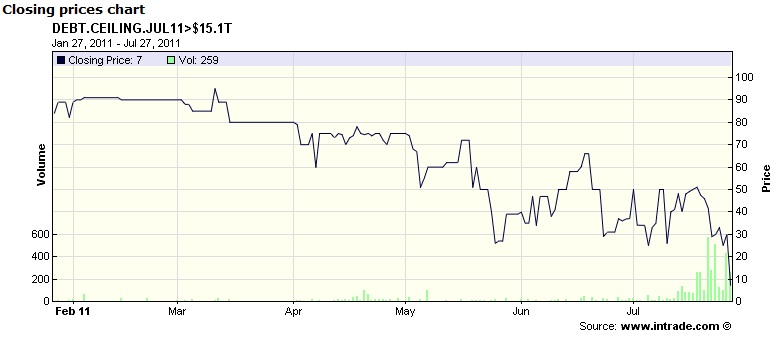 Doesn’t look positive.
On the upside, if you think they pull out of this spiral by July 31st at midnight, there’s money to be had!

Latest InTrade chart on whether or not Washington will raise the debt ceiling by midnight July 31st, 2011.
Doesn’t look positive.
On the upside, if you think they pull out of this spiral by July 31st at midnight, there’s money to be had!
 For a long time I have railed on the current policy of providing long-term unemployment benefits to people out of work. I’ve gone further and documented available jobs in my area. Granted, the jobs are rather unattractive and have, in some cases, offended friends and family who maybe themselves or know someone who has been or is currently, unemployed.
I’ve suspended that series.
However, my point all along is not that people who aren’t taking those jobs but relying on benefits are lazy, it’s that they are rational. The incentives are all wrong.
For example, if I’m unemployed and collecting $350.00 a week what is the marginal value of me taking a job that pays, say $8 an hour for 40 hours? Well, it works out like this:
And THAT is why our unemployment rate is so high.
Anyway, that’s not my point. This is:
Posted in Economics, Economy, Liberty, Politics: National
Tagged Incentives, Unemployment
 So, yesterday I posted about a possible solution to the deficit and the debt. In those plans I accommodated those on the right who insist on a plan that includes no new revenues due to tax increases. Further, I accommodated those on the left who insist on a plan that doesn’t cut; in fact my plan GROWS government each and every single year.
As I ended my analysis I demonstrated a method by which both of those targets were met AND we backed away from the debt limit that we are struggling with today. The solution began to reduce the the deficit in year 1. And it balanced the budget in year 19. It’s the perfect trifecta.
But what if we can do better? What if we can reduce the amount of time in which we are free of the deficit?
I think we can:
Posted in Economy, Government, Politics: National, Rocket Surgery
Tagged Budget, Debt Ceiling, Debt Limit, Politics, Tax Policy Center
NASCAR is big in North Carolina. I used to make fun of it when I lived back in Minnesota. Now, we watch it as a family now.
I’ve embraced the South and am beginning to love it. So, this is me:
Brother Love’s Travellin’ Salvation Show has nothin’ on this man.
 It was back in the 50’s that the family was last defined as “traditional”. The husband went to work. The wife stayed at home. The children behaved.
We haven’t seen that kinda life for 50 years now. The 60’s changed everything and we haven’t looked back since. And ya know what? It’s most certainly a good thing. My wife is better, faster and stronger than I am. Can you imagine the unfulfilled potential that would have been wasted if her only concern was how to better starch my shirts? She drives innovation for a massive company supporting other massive companies. In short, she lets corporations do thing cheaper and more efficiently than they otherwise would have; and she does it better than anyone I know.
So yeah, life is better now.
So why are we trying to go back?
The talk of the town is the debt limit. Raise it or not raise it; and what it would take TO raise it.
Reasonable people can agree on a couple of things:
I honestly feel that if you were to ask this question, hidden in such a way as to bypass the normal political partisanship, every single American would agree. If the checking account is overdrawn, a second job becomes something to consider and a review of the household spending becomes a priority.
But, how do we agree on such a combination when the discussion changes from the household budget to the federal budget? How can we get folks who demand that we raises taxes together with folks who demand we don’t? How do we get people who refuse to cut spending to shake hands with those who feel we HAVE to cut spending?
I propose that we do it by doing neither.
Watch:
Posted in Economy, Government, Politics: National, Rocket Surgery
Tagged Budget, Debt Ceiling, Debt Limit, Deficit, Politics, Tax Policy Center
 I wasn’t paying attention back in 1995-1996. I was managing a jazz club at the time and national politics couldn’t have been further from my mind.
If I could go back in time I might have been able to tell you that the government shut down, but maybe not. It certainly didn’t impact my life one iota.
Come to think of it, that simple fact, that I wasn’t impacted in the least, speaks volumes to the import of most of what the Federal Government has become.
I digress.
As it turns out there are some similar themes between then and now:
The United States federal government shutdown of 1995 and 1996 was the result of a conflict between Democratic President Clinton and the Republican-controlled Congress
…
A majority of Congress members and the House Speaker, Newt Gingrich, had promised to slow the rate of government spending; however, this conflicted with the president’s objectives for education, the environment, Medicare, and public health.
…
Congress had passed a continuing resolution for funding and a bill for debt limit extension, each of which was vetoed by Clinton,who denounced them as “backdoor efforts” to make cuts.
And then this:
The government shutdown took place in two phases. The first lasted five days in November 1995, until the White House agreed to congressional demands to balance the budget within seven years. But talks on implementing that agreement failed, and the second shutdown lasted 21 days, from Dec. 15, 1995 to Jan. 6. 1996. (Then a blizzard struck Washington and local federal workers could not get back to work for days after that.)
The sticking point was the GOP demand that Clinton agree to their version of a balanced budget. In months of negotiations, Clinton had actually given a far amount of ground, infuriating Democrats on the left. He agreed to a balanced budget over seven years, to tax cuts, to changes in mandatory spending programs such as Medicare. But the two sides were remained far apart on the pace of spending cuts — and even further apart on the policies behind those cuts.
Two things seem clear:
We’re seeing the same thing here.
We have a Democrat spender who wants to not only ignore cutting spending but wants to INCREASE spending. Add to that his incessant “Class Warfare” and you have the perfect villain. The set up is pretty close.
Then, as now, it’s the conservative movement that is driving the government to a balanced budget. It’s conservatives who are holding the line on spending and insisting on cuts. It’s the democrats who are refusing to give in.
The difference? Boehner. He was there in ’95. He saw the mistakes Newt made:
The result is that you have a Republican caucus that knows it’s values are supported by America. They know how the Democrats are going to act and they know that a government shutdown will force those Democrats back to the table. And America will support the will of the conservatives.
They did in 1995 and 1996.
They did in Minnesota.
They will again in 2011.
The lesson is this: When the Democrats come back and agree to your deal; TAKE IT!