Category Archives: Liberty

America’s Vision of Prosperity

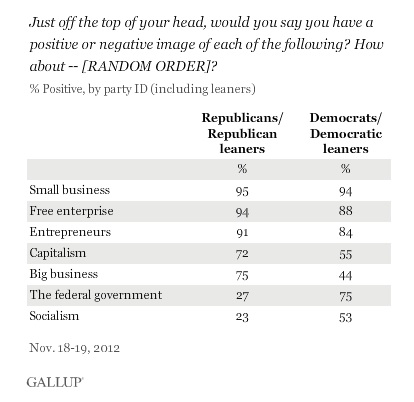
I’m pretty sure this explains a lot.  And why I’m continually surprised by conversations that I have with people out and about.  America is changing how she views the path to prosperity and security.

53% of democrats have a positive image of socialism.  While I’m sure few respondents don’t have an accurate definition of the word socialist or socialism, the idea is the same; “Someone else labors to my benefit.”


A Critique Of Role Of Nation And Role Of Government

All around us, people are willing to stand up and claim countless numbers of rights that ought be bestowed upon people of all kinds.  The right to a fair wage.  The right to food.  To housing.  To clothing and even medical care.  The list is seemingly endless.  There is no satiating the claims upon the grace of the blessed.

Of course, no right exists that compels one man to labor for another; that is tyranny and we’ve rejected that long ago.  Though it rears it’s ugly head again and again, perhaps never to be truly defeated, we must continually be vigilant.

Tonight, while having dinner with my 6 year old son I started a conversation surrounding those less fortunate than ourselves.  I asked him, for example, are we lucky, are we blessed?  He answered that we are blessed and lucky.

Then I asked him what our family, literally, mom and I, should do to help those less fortunate in our community.  His answer was that we should give them what they need because “not everyone can be lucky.”  I smiled and agreed that indeed, we should take great care in making sure our neighbors and friends have what they need.

But then I asked him if he thought it would be okay if that same person came and took what he needed from our house.  It might be money, or food or clothes.  Or maybe that person would make me get up and go to work but would get the money instead of me.

He didn’t think that was okay.  I asked him why:

Because that would be like a robber.

Indeed.

Look, I get it.  I want the world to be a better place too.  I want people to take care of other people and be nice.  To contribute to those who need to be warm, and full and safe and healthy.  But that does NOT mean that I can steal from some in order to meet that want.

And a six year old understands that.


The Concept Of Human Rights

This, this right here, is what is wrong with America today.  When you hear words like this, ideas like this, thoughts like this, run.

Run for your very life.  Because somewhere, someone is wanting to restrict your liberty in the name of charity:

Values

I think two things:

  1. If you have a lot of money and talent and don’t use that wealth and skill in order to make your community a better place you’re an asshole.
  2. If you steal money and property from those that have it in order to make your community a better place you’re an asshole, a thief and a dreamer.

Elections Have Consequences

It’s simple, really.  When there is an incentive to save money, there should be no surprise that incentives will drive behavior.  Consider Community College of Allegheny County:

To Community College of Allegheny County’s president, Alex Johnson, cutting hours for some 400 temporary part-time workers to avoid providing health insurance coverage for them under the impending Affordable Health Care Act is purely a cost-saving measure at a time the college faces a funding reduction.

But to some of the employees affected, including 200 adjunct faculty members, the decision smacks of an attempt to circumvent the national health care legislation that goes into effect in January 2014.

“It’s kind of a double whammy for us because we are facing a legal requirement [under the new law] to get health care and if the college is reducing our hours, we don’t have the money to pay for it,” said Adam Davis, an adjunct professor who has taught biology at CCAC since 2005.

Temporary part-time employees received an email notice from Mr. Johnson on Tuesday informing them that the new health care act defines full-time employees as those working 30 hours or more per week.

As a result, the college as of Dec. 31 will reduce temporary part-time employee hours to 25 per week. For adjuncts, the workload limit will be reduced from 12 to 10 credits per semester.

The decision affects only temporary part-time employees and not permanent part-time employees who already are eligible to participate in the college’s health care plan.

My hope is that the folks impacted voted for Obama; you should reap the rewards of the decisions you make.

But that’s not all:

Darden Restaurants Inc. — parent of the Red Lobster, Olive Garden and Capital Grille eateries in Colorado and elsewhere — is cutting back hours of workers at some of its locations in an apparent effort to reduce insurance costs related to the new health-care reform law.

The Orlando, Fla., Sentinel newspaper reports that the Orlando-based company (NYSE: DRI) “has stopped offering full-time schedules to many hourly workers in at least a few” of its locations.

The Sentinel quotes the company as saying it plans to limit employees at some restaurants in four unidentified markets to 28 hours a week. Darden said the move is intended “to help us address the cost implications health care reform will have on our business.”

Under the federal Affordable Care Act, the health-reform law that some call Obamacare, companies with at least 50 employees must provide health insurance, starting in 2014, to all those who work at least 30 hours a week. Those that don’t will pay a penalty.

I suspect that this will play out across America more and more.  As the ramifications of electing Obama continue to see the light of day, more and more we are going to see this reaction by business.  Fewer people hired, higher ratios hired as part time employees, more efforts to drive productivity by more and more automation.

It really is important to understand that there really aren’t solutions; only tradeoffs.

Want healthcare?  Lose jobs.  Sacrifice growth, accept higher unemployment.

If you voted for Obama, this is on you.  This is what you wanted, this is what you explicitly put into motion.

We warned you.


The Real Story Of Thanksgiving

It’s almost Thanksgiving here in Puerto Rico.  In honor of the holiday, enjoy:

Each year at this time school children all over America are taught the official Thanksgiving story, and newspapers, radio, TV, and magazines devote vast amounts of time and space to it. It is all very colorful and fascinating.

It is also very deceiving. This official story is nothing like what really happened. It is a fairy tale, a whitewashed and sanitized collection of half-truths which divert attention away from Thanksgiving’s real meaning.

The official story has the pilgrims boarding the Mayflower, coming to America and establishing the Plymouth colony in the winter of 1620-21. This first winter is hard, and half the colonists die. But the survivors are hard working and tenacious, and they learn new farming techniques from the Indians. The harvest of 1621 is bountiful. The Pilgrims hold a celebration, and give thanks to God. They are grateful for the wonderful new abundant land He has given them.

The official story then has the Pilgrims living more or less happily ever after, each year repeating the first Thanksgiving. Other early colonies also have hard times at first, but they soon prosper and adopt the annual tradition of giving thanks for this prosperous new land called America.

The problem with this official story is that the harvest of 1621 was not bountiful, nor were the colonists hardworking or tenacious. 1621 was a famine year and many of the colonists were lazy thieves.

In his ‘History of Plymouth Plantation,’ the governor of the colony, William Bradford, reported that the colonists went hungry for years, because they refused to work in the fields. They preferred instead to steal food. He says the colony was riddled with “corruption,” and with “confusion and discontent.” The crops were small because “much was stolen both by night and day, before it became scarce eatable.”

In the harvest feasts of 1621 and 1622, “all had their hungry bellies filled,” but only briefly. The prevailing condition during those years was not the abundance the official story claims, it was famine and death. The first “Thanksgiving” was not so much a celebration as it was the last meal of condemned men.

But in subsequent years something changes. The harvest of 1623 was different. Suddenly, “instead of famine now God gave them plenty,” Bradford wrote, “and the face of things was changed, to the rejoicing of the hearts of many, for which they blessed God.” Thereafter, he wrote, “any general want or famine hath not been amongst them since to this day.” In fact, in 1624, so much food was produced that the colonists were able to begin exporting corn.

What happened?

After the poor harvest of 1622, writes Bradford, “they began to think how they might raise as much corn as they could, and obtain a better crop.” They began to question their form of economic organization.

This had required that “all profits & benefits that are got by trade, working, fishing, or any other means” were to be placed in the common stock of the colony, and that, “all such persons as are of this colony, are to have their meat, drink, apparel, and all provisions out of the common stock.” A person was to put into the common stock all he could, and take out only what he needed.

This “from each according to his ability, to each according to his need” was an early form of socialism, and it is why the Pilgrims were starving. Bradford writes that “young men that are most able and fit for labor and service” complained about being forced to “spend their time and strength to work for other men’s wives and children.” Also, “the strong, or man of parts, had no more in division of victuals and clothes, than he that was weak.” So the young and strong refused to work and the total amount of food produced was never adequate.

To rectify this situation, in 1623 Bradford abolished socialism. He gave each household a parcel of land and told them they could keep what they produced, or trade it away as they saw fit. In other words, he replaced socialism with a free market, and that was the end of famines.

Many early groups of colonists set up socialist states, all with the same terrible results. At Jamestown, established in 1607, out of every shipload of settlers that arrived, less than half would survive their first twelve months in America. Most of the work was being done by only one-fifth of the men, the other four-fifths choosing to be parasites. In the winter of 1609-10, called “The Starving Time,” the population fell from five-hundred to sixty.

Then the Jamestown colony was converted to a free market, and the results were every bit as dramatic as those at Plymouth. In 1614, Colony Secretary Ralph Hamor wrote that after the switch there was “plenty of food, which every man by his own industry may easily and doth procure.” He said that when the socialist system had prevailed, “we reaped not so much corn from the labors of thirty men as three men have done for themselves now.”

Before these free markets were established, the colonists had nothing for which to be thankful. They were in the same situation as Ethiopians are today, and for the same reasons. But after free markets were established, the resulting abundance was so dramatic that the annual Thanksgiving celebrations became common throughout the colonies, and in 1863, Thanksgiving became a national holiday.

Thus the real reason for Thanksgiving, deleted from the official story, is: Socialism does not work; the one and only source of abundance is free markets, and we thank God we live in a country where we can have them.

Go now, earn your wages.  Keep what is yours and sell what you want.

We will all be happier.

Who Is John Galt

Hat Tip: Ryan Grace

Beer And Taxes

A friend of mine posted this on Facebook.  I’ve posted here before but I think every now and then it’s important to take time and understand what taxes are really meant to do:

Raise funds to pay for the proper role of government.

And. because we uses a system of taxation that is progressive, when we reduce taxes, that reduction will also reflect the nature of that progressive tax system.

THE TAX SYSTEM EXPLAINED IN BEER
Suppose that every day, ten men go out for beer and the bill for all ten comes to $100…
If they paid their bill the way we pay our taxes, it would go something like this…
The first four men (the poorest) would pay nothing.
The fifth would pay $1.
The sixth would pay $3.
The seventh would pay $7..
The eighth would pay $12.
The ninth would pay $18.
The tenth man (the richest) would pay $59.
So, that’s what they decided to do..

The ten men drank in the bar every day and seemed quite happy with the arrangement, until one day, the owner threw them a curve ball. “Since you are all such good customers,” he said, “I’m going to reduce the cost of your daily beer by $20”. Drinks for the ten men would now cost just $80.

The group still wanted to pay their bill the way we pay our taxes. So the first four men were unaffected. They would still drink for free. But what about the other six men ? How could they divide the $20 windfall so that everyone would get his fair share?

They realized that $20 divided by six is $3.33. But if they subtracted that from every body’s share, then the fifth man and the sixth man would each end up being paid to drink his beer.

So, the bar owner suggested that it would be fair to reduce each man’s bill by a higher percentage the poorer he was, to follow the principle of the tax system they had been using, and he proceeded to work out the amounts he suggested that each should now pay.

And so the fifth man, like the first four, now paid nothing (100% saving).
The sixth now paid $2 instead of $3 (33% saving).
The seventh now paid $5 instead of $7 (28% saving).
The eighth now paid $9 instead of $12 (25% saving).
The ninth now paid $14 instead of $18 (22% saving).
The tenth now paid $49 instead of $59 (16% saving).

Each of the six was better off than before. And the first four continued to drink for free. But, once outside the bar, the men began to compare their savings.

“I only got a dollar out of the $20 saving,” declared the sixth man. He pointed to the tenth man, “but he got $10!”

“Yeah, that’s right,” exclaimed the fifth man. “I only saved a dollar too. It’s unfair that he got ten times more benefit than me!”

“That’s true!” shouted the seventh man. “Why should he get $10 back, when I got only $2? The wealthy get all the breaks!”

“Wait a minute,” yelled the first four men in unison, “we didn’t get anything at all. This new tax system exploits the poor!”
The nine men surrounded the tenth and beat him up.

The next night the tenth man didn’t show up for drinks, so the nine sat down and had their beers without him. But when it came time to pay the bill, they discovered something important. They didn’t have enough money between all of them for even half of the bill!

And that, boys and girls, journalists and government ministers, is how our tax system works. The people who already pay the highest taxes will naturally get the most benefit from a tax reduction. Tax them too much, attack them for being wealthy, and they just may not show up anymore. In fact, they might start drinking overseas, where the atmosphere is somewhat friendlier.

The “tax cut” above resulted in the rich man saving more dollars.  But he was paying more dollars to begin with.  Remember this when the left screams, “The tax cuts unfairly benefit the rich!”

Spoiled Kids Acting Like 1%’ers

Found this while reading through Say Anything:

Some classics:

  • Hey, dude, that’s not cool!
  • It’s not fun to take people’s candy.
  • This is my candy.  I worked hard for it.
  • He stole my candy already!
  • You can’t split candy ’cause that’s not right.  That’s HIS candy.
  • I’m gonna call the police!

Notice that the kids felt that this was theft.  Taking something from them that they had earned was “not right.”

It’ll be years before these kids learn that when a monkey does it they can call the cops.  But when the government does it, the GOVERNMENT calls the cops.

These kids are learning what legal plunder looks and feels like.

The Power Of A Word

From The Economist - True Progressivism

I was going through my edition of The Economist the other day.  It was a treat really, in the “old days” I used have lunch across from the Barnes and Noble, buy the print edition and read it over Thai food.  I’ve long given that ritual up in favor of a subscription and electronic reading but hey….

So, anyway, there I was with my Phad Thai and the print version of the Economist.  I flipped to the “Leaders” section and just shook my head when I say this title:

True Progressivism

I’ve come to see The Economist as a more moderate magazine than I used to, but every now and then I hit an article that makes me wonder.  I nearly just turned the page and walked away.

But I read on.  And boy am I glad that I did!

To be sure they came out of the gate pretty slowly:

BY THE end of the 19th century, the first age of globalisation and a spate of new inventions had transformed the world economy. But the “Gilded Age” was also a famously unequal one, with America’s robber barons and Europe’s “Downton Abbey” classes amassing huge wealth: the concept of “conspicuous consumption” dates back to 1899. The rising gap between rich and poor (and the fear of socialist revolution) spawned a wave of reforms, from Theodore Roosevelt’s trust-busting to Lloyd George’s People’s Budget. Governments promoted competition, introduced progressive taxation and wove the first threads of a social safety net. The aim of this new “Progressive era”, as it was known in America, was to make society fairer without reducing its entrepreneurial vim.

Ugh.

But the plot improves quickly:

Thus, on America’s campaign trail, the left attacks Mitt Romney as a robber baron and the right derides Barack Obama as a class warrior. In some European countries politicians have simply given in to the mob: witness François Hollande’s proposed 75% income-tax rate.

I’m willing to trade a whole bunch of ideology to someone who’s willing to admit that the left is nothing more than class warriors.  So anyway, the article moves along and then comes some true gems:

In the rich world the cronyism is better-hidden. One reason why Wall Street accounts for a disproportionate share of the wealthy is the implicit subsidy given to too-big-to-fail banks. From doctors to lawyers, many high-paying professions are full of unnecessary restrictive practices. And then there is the most unfair transfer of all—misdirected welfare spending. Social spending is often less about helping the poor than giving goodies to the relatively wealthy. In America the housing subsidy to the richest fifth (through mortgage-interest relief) is four times the amount spent on public housing for the poorest fifth.

WOW!

The Economist is calling out the label, “Too Big To Fail.”  And then the truly Libertarian line of logic that begins to pin back the lawyers and the docs.  Who WOULDN’T love the racket that allows barristers and snake oil salesmen to restrict competition?  And how about that fact regarding the mortgage-interest?

So, ideas?

Compete, target and reform

The priority should be a Rooseveltian attack on monopolies and vested interests, be they state-owned enterprises in China or big banks on Wall Street. The emerging world, in particular, needs to introduce greater transparency in government contracts and effective anti-trust law. It is no coincidence that the world’s richest man, Carlos Slim, made his money in Mexican telecoms, an industry where competitive pressures were low and prices were sky-high. In the rich world there is also plenty of opening up to do. Only a fraction of the European Union’s economy is a genuine single market. School reform and introducing choice is crucial: no Wall Street financier has done as much damage to American social mobility as the teachers’ unions have. Getting rid of distortions, such as labour laws in Europe or the remnants of China’s hukou system of household registration, would also make a huge difference.

Next, target government spending on the poor and the young. In the emerging world too much cash goes to universal fuel subsidies that disproportionately favour the wealthy (in Asia) and unaffordable pensions that favour the relatively affluent (in Latin America). But the biggest target for reform is the welfare states of the rich world. Given their ageing societies, governments cannot hope to spend less on the elderly, but they can reduce the pace of increase—for instance, by raising retirement ages more dramatically and means-testing the goodies on offer. Some of the cash could go into education. The first Progressive era led to the introduction of publicly financed secondary schools; this time round the target should be pre-school education, as well as more retraining for the jobless.

Last, reform taxes: not to punish the rich but to raise money more efficiently and progressively. In poorer economies, where tax avoidance is rife, the focus should be on lower rates and better enforcement. In rich ones the main gains should come from eliminating deductions that particularly benefit the wealthy (such as America’s mortgage-interest deduction); narrowing the gap between tax rates on wages and capital income; and relying more on efficient taxes that are paid disproportionately by the rich, such as some property taxes.

Thoughts on paragraphs 1, 2 and 3:

1- A gigantic FU to the teacher’s unions and labor laws!  What I wouldn’t do to compromise if the deal included teacher’s union destruction and the loosening of labor laws.  I mean, holy shit – “No Wall Street financier has done as much damage to American social mobility as the teacher’s unions!”

2- Welfare reform.  We can only hope to slow the increase, but we should!   Though they do slip on early education; there isn’t any data that suggests the gains last beyond 3rd grade.

3-  This sounds exactly like Romney’s tax plan.

And to think, I almost passed this by because of the word Progressivism.