Category Archives: Government

How Important Is The EPA

EPANot very.

Are fewer than one of every 10 Environmental Protection Agency employees essential to its work?

Only federal employees classified as “essential” can work during a government shutdown. At EPA, that means just 6.6 percent of its workforce, according to Reuters.

Of the agency’s 16,205 employees, a mere 1,069 will work through the shutdown. That means that taxpayers employ 15,136 people at the EPA who are “non-essential.”

This shut down may, or not, make us look a little silly among the world’s nations.  And, indeed, this is all shenanigans.  But there is good news to this:

Because of the shutdown, the EPA will not be able to work on the rules requested by President Obama in his climate plan, but Dina Kruger, a consultant and former climate change director at the EPA, said the agency would be able to complete the rules on time. It might just have to “work a little harder” once the shutdown ends.

The shutdown will also delay the comment period for the EPA’s New Source Performance Standards – the proposal that would make it nearly impossible to open a new coal plant – which started on September 20, 2013.

Good news to be sure.


Brutal Take On Evolution

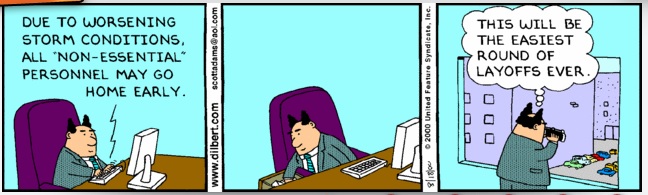
Dilbert.Nonessential

There was a time not so long ago when I was facing potential downsizing.  In my mind, additional work was a commodity.  There were folks in my division who would shy away from taking on the most difficult projects due to fear of failure.  I jumped at everyone of them.  My logic being that in an environment where we are looking to shed dead wood, I wanna be the most living wood that can be found.

Whatever.

The Libertarian in me says that if you are a non-essential government worker you need to be fired and your job eliminated.

Government Employees

One of the fallacies that the main stream leftist has of upper middle class America is that these upper middle class folks they simply have their world given to them.

You know, they’re white and male therefore don’t have to work or achieve.  They just walk in a room and get given the bounty of life.

The truth is far from this perception.

Consider this:

The U.S. Department of Housing and Urban Development said it will close its offices at 1:30 p.m. Other agencies, such as the Labor Department, expect most employees to be gone by mid-day, but haven’t set a specific time.

Once they head home, furloughed employees are under strict orders not to do any work. That means no sneaking glances at Blackberries or smart phones to check emails, no turning on laptop computers, no checking office voicemail, and no use of any other government-issued equipment.

Every single vacation I’ve taken in the last 5-10 years has included my work laptop.  My wife and I got married on the beaches here in North Carolina; we spent 10 glorious days celebrating with friends and family.  We brought work laptops with us.

When I am NOT on vacation, I often times check my email before my feet hit the floor in the morning and one of the last things I  do before going to be is check my work condition.  I often interact with global teams located who knows where, and their needs may not fit a US based schedule.

My point?  Government is without a clue and these people are only making it more painful than they need to be.

Obamacare – Law Of The Land

So, as the country moves into a government shutdown, I’m reflecting on politics.

Consider North Carolina.  We here have elected a republican governor, a republican controlled house and a republican controlled senate.

All legitimate.

Together, these bodies have submitted, debated, passed and vetoed laws; only later to be over ridden.

One of the most controversial laws passed is the Voter ID law; of which the United States has sued to challenge.

Is there a democrat alive that would not support using any means legally necessary to overturn that law?  Shenanigans or not.

Now, consider the opposition.  That is how they feel concerning Obamacare.

And like it or not, it is the House of Representatives that are negotiating and compromising, not the Senate.

Playing With Toy Guns On Private Property – GUILTY!

Nanny State

You have *got* to be kidding me:

Two seventh-grade students in Virginia Beach, Va., were handed long-term suspensions Tuesday that will last until the end of the school year for playing with an airsoft gun in one of their front yards while waiting for the school bus.

We have become France.

Tea Party – Occupy Wall Street

Say what you will about the Tea Party and their tactics in the House over the debate surrounding the Debt Ceiling and raising it.

There is absolutely no doubt that the Tea Party has been wildly more successful in their ambitions to change politics than the Occupy Wall Street hippies ever thought they could hope for.

There hasn’t been a serious OWS story in a year, there are no Occupy candidates running for office and not one that holds office.

Given that success, which movement do you think more accurately represents most American’s desires – the Tea Party or Occupy Wall Street?

Income Disparity

Monopoly Free Market

Interesting move by the Fed this afternoon.  By announcing that they would continue the quantitative easing, the stock market responded with record highs:

NEW YORK — The stock market hit a record high Wednesday after the Federal Reserve’s surprise decision to keep its economic stimulus in place.

Bond yields fell sharply — their biggest move in nearly two years. Meanwhile, the price of gold jumped as some traders anticipated that the Fed’s decision might cause inflation.

In a statement, Fed policymakers voted to maintain the central bank’s $85 billion-a-month bond-buying program, which has been in place in one form or another since late 2008. It is designed to keep interest rates low to spur economic growth.

What this decision does is pump more money into the economy.  And whenever you do that, the cost of stuff goes up.

Consider an “economy” made up of 100 gold pieces and 20 loaves of bread.  In this case, bread costs 5 gold pieces per loaf.  Now, if we double the number of gold pieces floating, does anyone not believe the cost of bread will also not double?

So, when the Fed continues a policy that is pumping money into the market, the price of the “market” doubles.

So the next time a liberal is hollering that the income of the wealthy is rising faster than the income of the poor, you can point to Obama and his Federal Reserve.  After all, the primary source of income of the wealthy is the market and not salary.

Obama is the one responsible for the income disparity that we have recently seen.

Housing Crisis – Data Point

Housing BubbleThere is no doubt that the housing crisis was caused by government policy.  Bad actors everywhere?  Sure.  But at the root of it all the was the government’s desire – by both parties – to increase home ownership in America.  And specifically for the poor and minorities.

With that in mind:

There is no doubt what really happened. Between 1997 and 2007, HUD’s affordable-housing policies under two administrations built an enormous mortgage bubble—nine times as large as any bubble in modern history—and when this bubble collapsed, it caused a 30%-40% decline in housing prices. This left homeowners who had limited financial resources and no equity in their houses unable to refinance or sell, causing an unprecedented number of mortgage defaults. Shocked by these numbers, investors fled mortgage-backed securities, making them useless for short-term financing by financial institutions like Lehman. The result was a panic and a financial crisis.

Indeed.

As I mentioned, there were guilty actors everywhere. Everyone from the appraiser who fudge the home value to the banker who pressured lending agents to companies that engaged in fraud – guilty all.

But it was the government, through the agencies Freddie and Fannie that drove the whole failure.

Consider:

HUD was still at it in 2004, stating that “Millions of Americans with less than perfect credit or who cannot meet some of the tougher underwriting requirements of the prime market . . . rely on subprime lenders for access to mortgage financing. If the GSEs reach deeper into the subprime market, more borrowers will benefit from the advantages that greater stability and standardization create.”

That statement is all you need to understand why, in 2008, 74% of the subprime mortgages outstanding in the U.S. financial system were on the books of government agencies, particularly Fannie and Freddie.


Living On A Budget

Not quite living on $31.50, but this is a neat article describing life on $50 a week:

College, unemployment, or an unexpected change in your life situation can mean that a major cut in spending is required as you plan how to survive from week to week. We found that it’s possible to take care of the essentials, with a dollop of comfort thrown in, for less than $50 a week by shopping at the local dollar store.

Sure, the dollar store is a pit stop for cheap snacks, cooking supplies, toys, and other small items, but it’s also a source for food at one very low price. And yes, there may be a stigma attached to dollar store shopping for all your needs, but can you afford to be snobby at a time like this?

Our suggested menus and shopping list below presume you have some staples on hand, such as mayonnaise and condiments like pickles. Remember, inventory will vary at every dollar store:

Suggest Grocery List:

1 box cereal — $1
1 6-ct pack oatmeal — $1
1 bag coffee — $1
1 loaf bread — $1
1 box pancake mix — $1
1 bottle imitation maple syrup — $1
1 jar jelly — $1
1 jar peanut butter — $1
1 12-ct. carton eggs — $1
1/2 gallon shelf-stable milk/1 gallon fresh milk — $1
1 32-oz. jar apple juice — $1
1 2-ct. pack pre-made pizza crusts — $1
1 jar pizza sauce — $1
1 container grated Parmesan cheese — $1
2 boxes Hamburger Helper — $2
1 bag pasta — $1
2 cans meat sauce — $2
5 5-oz. cans tuna — $5
1 box instant oatmeal — $1
3 1-lb. cans soup — $3
4 10-oz. cans vegetables — $4
1 box crackers — $1
1 pastry crust — $1
1 box New Orleans-style rice — $1
1 can beans — $1
1 box dehydrated mashed potatoes — $1
2 packages frozen chicken — $2
1 pack Country Time Iced Tea Mix — $1
1 bag potato chips — $1
1 6-ct box granola bars — $1
1 bottle barbecue sauce — $1
Total: $43

Not bad.  Combined with my list and I’ll bet it’s even less expensive.

Wage Gap – Employment Gap

Increasing Bar GraphThe argument has long been, “The rich get richer while the poor get poorer.”

There are two problems with the statement:

  1. The people who make up the poor and who make up the rich change over time.  This is especially true when rich and poor are defined by wages only.
  2. This argument never takes into account “externalities”

For example, the argument never admits that we are looking at families and not individuals.  As such, it would be valuable to look at how families are changing over time.  But we never get that.

Additionally, it would be important to look at education and how it  has changed over time.  Again, nothing.

But today we have a new report that provides insight:

WASHINGTON — The gap in employment rates between America’s highest- and lowest-income families has stretched to its widest levels since officials began tracking the data a decade ago, according to an analysis of government data conducted for The Associated Press.

Rates of unemployment for the lowest-income families — those earning less than $20,000 — have topped 21 percent, nearly matching the rate for all workers during the 1930s Great Depression.

U.S. households with income of more than $150,000 a year have an unemployment rate of 3.2 percent, a level traditionally defined as full employment. At the same time, middle-income workers are increasingly pushed into lower-wage jobs. Many of them in turn are displacing lower-skilled, low-income workers, who become unemployed or are forced to work fewer hours, the analysis shows.

Amazing.  And truly heart breaking.  The very folks that need, and I mean NEED, a job are faced with unemployment levels that make it virtually impossible to find work.

A rational policy decision would be to make work as easy as possible to give away.  That is, let these people find and accept a job anywhere they can for whatever wage they can.  Ironically, the administration that most of these folks feel are helping them out are really hurting them the most.

One of the most devastating things that can happen to a worker out of work is to see the wage of the jobs he wants raised above his reasonable level of productivity.  This has the effect of discriminating against him for no reason other than he lacks the skills to obtain better work; skills that are often learned while working.

Don’t forget the history of the minimum wage:

Did you know that there was a time in our country, after the Civil War, when white unemployment was higher than black unemployment? It seems almost unfathomable now, but that was the case in the early decades of the 20th century. This was intentionally changed after Congress enacted the first federal minimum wage law: the Davis-Bacon Act of 1931.

As most of us remember from history class, the 1930s saw a plethora of public works projects introduced to combat the unemployment associated with the Great Depression. (Whether or not this worked is a topic for another day.) But during that time, many impoverished blacks left sharecropping to come north in search of such jobs. The Davis-Bacon Act was created specifically and explicitly to prevent blacks from “taking” these jobs from local white workers.

Congressman Robert Bacon of New York began crafting various pieces of legislation to discriminate against black workers when a black construction crew from Alabama was brought to his state to build a hospital for veterans in 1927. Because most blacks lived in the South, any laws restricting the use of migrant labor discriminated against them. Since blacks were not admitted to trade unions, any law that favored union labor automatically excluded blacks. Bacon submitted 13 such bills over the next four years, culminating in the Davis-Bacon Act.

The act mandated that federal contracts pay their workers the “prevailing wage.” As innocent as this might sound, records of the debate over the bill reveal that everyone understood the “prevailing wage” meant the union wage and that this meant there would be no blacks working on federal projects. In fact, when testifying before the Senate in favor of Davis-Bacon, American Federation of Labor union president William Green complained, “Colored labor is being brought in to demoralize wage rates.”

The federal minimum wage may no longer be racist in intent, but it is still racist in its effects. Labor is affected by supply and demand, just like anything else. If we pass a law that raises the cost of printer paper to $100 a ream, companies will find a way to use less printer paper. In the same way, when the law raises the cost of labor, companies purchase fewer hours of labor.

The history of the minimum wage was SPECIFICALLY meant to discriminate against black workers.  And the effects of that law have created the condition we see today.