Monthly Archives: May 2013

Prom Spending

Money

From all the Facebook posts I’ve been seeing, Prom Season is here.

It’s always fun to read the Visa Prom Report:

FOSTER CITY, Calif., April 24, 2013 /PRNewswire/ — Spending on the annual high school ritual of the prom continues to outpace inflation and grew for the second straight year, hitting an average of $1,139 per family in 2013, results from a new survey released today by Visa Inc. show. That represents an increase of 5% from the $1,078 that American families who have a teenager attending a prom spent on all aspects of the dance in 2012.

Full Disclosure:  I didn’t go to either my Jr. Prom or my Sr. Prom.  I’m a geek and I know it.

That said, $1,139 is an ENORMOUS amount of money to spend on one night.  And that’s only each HAL of the date.  I’m assuming the other half spends the same!  That makes the one night date a $2,278 affair.

Jeepers.

But this is what caught my eye:

One troubling statistic is that parents surveyed who fell in the lower income brackets (less than $50,000 a year) plan to spend more than the national average, $1,245, while parents who make over $50,000 will spend an average of $1,129.

What the what?

But that’s not all:

Additionally, single parents plan to spend $1,563, almost double the amount that married parents plan to spend at $770.

Why would single parents spend more on a Prom than married parents?  And given that single parent households are disproportionately less wealthy, what does that say about the decision making of single parent households?

Housing Bubble – Government Creation Part III

Housing Bubble

Setting the stage.

My argument is that government policies created an environment that encouraged loans to individuals that had an elevated risk of defaulting on those loans.  In many cases the government sponsored enterprise directly encouraged the loans and in others, the actions of those GSEs encouraged others in the market to make riskier and riskier loans themselves.

First, how did Fannie and Freddie define loans:

To better understand how this accumulation of weak mortgages came about, a description of the loan classification system used by Fannie and Freddie (the GSEs) and followed by others is in order. Fannie and Freddie did not classify subprime and Alt-A loans based on objective risk characteristics but on the basis of how the lender or securities issuer classified a loan. Thus a loan was only subprime or Alt-A if a lender or issuer denominated it as such.

Fannie and Freddie didn’t perform any due diligence on their own.  When did Fannie and Freddie acknowledge this?

“We have classified mortgage loans as Alt-A if the lender that delivered the mortgage loans to us had classified the loans as Alt-A based on documentation or other features. We have classified mortgage loans as subprime if the mortgage loan was originated by a lender specializing in the subprime business or by subprime divisions of large lenders. We apply these classification criteria in order to determine our Alt-A and subprime loan exposures; however, we have other loans with some features that are similar to Alt-A and subprime loans that we have not classified as Alt-A or subprime because they do not meet our classification criteria.” P. 182 of Fannie’s Q.3:2008 10-Q

What does this mean?

…one of the key triggers of the Financial Crisis was a policy decision to promote the widespread use of high LTV (highly leveraged) lending in the early 1990s. The risk inherent in high LTV lending was well known.  When Fannie decided to proceed with a 97% LTV program in 1994, objections were made – pointing out the poor experience on 95% LTV lending just a dozen years before…

And that risk?

Pinto.1

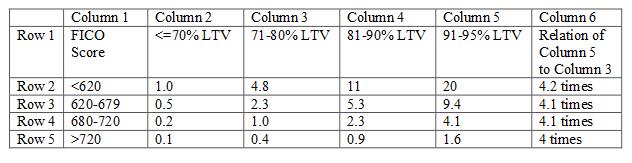
The risk in proceeding with a 95% LTV loan is about 4 times the risk compared to a conventional 20% down loan.  The table above demonstrates.

Consider an individual taking out a loan; credit score between 680 and 720.  Further, they are putting down between 20 and 30%.  Their risk is assigned a value of “1”.  The same individual taking out a loan but only putting down between 5 and 9%?  The risk moves to a rating of 4.1.  Four times the previous rate.

These were the types of loans that Fannie and Freddie, indeed, other government agencies, would be encouraging.

The beginning.

Why It’s Hard Admit To Global Warming

Global Warming.Polar Bear

It’s hard to debate Global Warming.  Or climate change.  Or whatever the word.

It’s hard because you can’t discuss the science any longer without also really find yourself talking about the alarmist’ “cure.”

You wanna talk about the fact that greenhouse gases can increase the temperature?

Wanna discuss the fact that CO2 is a greenhouse gas?  Or that we’ve released more of it than would otherwise have been released?

How about positive feedback and the fact that assumptions regarding them are most likely overstated?

Let’s do that.

But instead we get this:

A Democratic video says 240 House members “voted in 2011 that climate change was a ‘hoax.’ ” Not exactly. The 2011 vote was ultimately a referendum on who should set climate change policy — the Environmental Protection Agency or Congress. It was not a vote on whether climate change is a “hoax.”

Organizing for Action, a nonprofit political group that advocates for President Obama’s policies, unveiled the climate change video on April 25. It is a compilation, for the most part, of Republicans talking dismissively about climate change. One clip shows Rep. John Boehner, who was minority leader at the time, downplaying the environmental harm caused by carbon dioxide — noting that it is emitted by humans exhaling and cows “doing what they do.” We corrected some of the misstatements Boehner made in that 2009 TV interview in a piece titled “Hot Air on ‘This Week.’ ”

But the Democratic video goes too far in its text and images when it says, “Number of House members who voted in 2011 that climate change was a ‘hoax’: 240.” That is immediately followed by a video clip of GOP Rep. Paul Broun calling climate change a “hoax” in a floor speech — which implies that Broun was speaking on the 2011 legislation mentioned in the video.

We asked OFA about that 2011 vote. We were referred to an April 6, 2011, vote on a Democratic amendment to a GOP-backed bill that would have prohibited the EPA from regulating greenhouse gases. The amendment, which was defeated 184-240, did not use the word “hoax.” Broun did not speak on the amendment during the debate, and, in fact, none of the Republicans who spoke against it called climate change a “hoax.”

Also, not all of the 240 who voted against it were Republicans; three were Democrats.

The full text of the amendment, which was sponsored by Rep. Henry Waxman of California, reads: “Congress accepts the scientific findings of the Environmental Protection Agency that climate change is occurring, is caused largely by human activities, and poses significant risks for public health and welfare.”

We’re not going to have a serious debate on this topic anytime soon.  And we certainly aren’t going to see any meaningful legislation as long as this kinda nonsense continues to continue.

Florida: Drug Testing Welfare

Drug Test Welfare

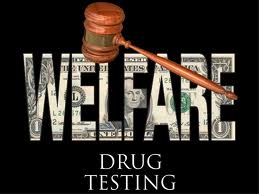
Much ado has been made of Florida’s attempt to drug test welfare applicants.  Florida’s idea is that if an individual has enough discretionary income to afford drugs, that person has enough income to be disqualified from a need based program.

Lately, the left has been trying to make the case that conservatives should be against the initiative based on fiscal calculations:

From July through October in Florida — the four months when testing took place before Judge Scriven’s order — 2.6 percent of the state’s cash assistance applicants failed the drug test, or 108 of 4,086, according to the figures from the state obtained by the group. The most common reason was marijuana use. An additional 40 people canceled the tests without taking them.

Because the Florida law requires that applicants who pass the test be reimbursed for the cost, an average of $30, the cost to the state was $118,140. This is more than would have been paid out in benefits to the people who failed the test, Mr. Newton said.

So, I did my own math.  And what I found was interesting.

The Times article above uses the number of failures at 2.6%, however, other sources I’ve read use a number more like 2%.  Because that number helps the liberal cause, I’ll use 2%.  Because Florida has a 6.7% drug use rate, the 2% failure rate is indicative  of a self-selecting population.  That is, drug users are not applying for benefits knowing they will fail, and have to p ay for, a test.

Further, once an individual fails a test, he is ineligible for benefits for 12 months.  A savings not taken into account.  With all of that said, here is my data:

Drug Test Welfare data

Assuming a constant rate of applications and a conservative 2% failure rate the data shows that 25 people fail each month.  Because Florida hums along at a 6.7% drug use rate, I calculated that a certain number of people would simply not even try to test.  Again, to be conservative, I used a 6% rate and found that 50 people each month did not apply.  Finally, I begin to sum the failure and count the benefits that they WOULD have been given as savings.  I do this on a rolling 12 month period.  Additionally, I assume that this month’s drug users will not be using next month and only count 50 Missing Failure each month; I don’t sum them.

To be fair, the short term cost to the state is negative.  For the first 8 months of this system, the state loses money.  However, by September of the of the first year, or month 9, the state begins to realize savings and finally is in the black12 months after that.

The numbers would be even great if we used a normal 6.7% drug use on the welfare population and didn’t make the assumption that this months drug users will not continue to use next month.

As much as I like it when people use numbers and data to make their point, it’s important that such numbers reflect reality.